

Math vocabulary builds the foundation for every concept you learn in school. If you’re searching for math words that start with F, this guide covers 40+ verified terms from basic arithmetic to advanced calculus.
Each word includes a clear definition, a real example, and why it matters. Whether you’re a student, teacher, or parent, this list is your complete reference.
Quick List: 40+ Math Words That Start With F
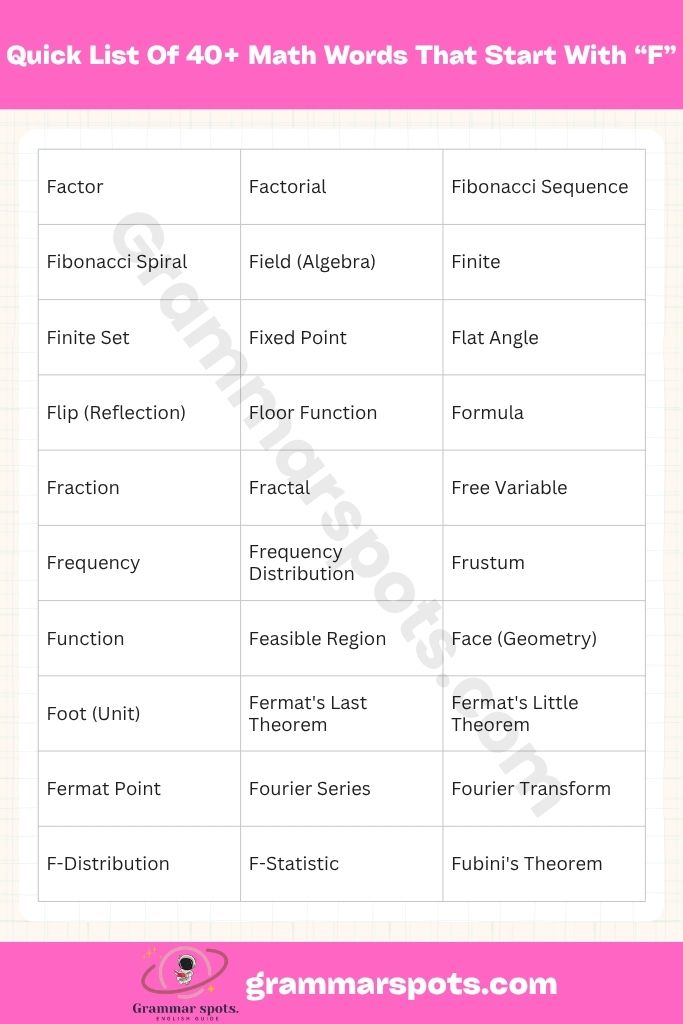
- Factor
- Factorial
- Fibonacci Sequence
- Fibonacci Spiral
- Field (Algebra)
- Finite
- Finite Set
- Fixed Point
- Flat Angle
- Flip (Reflection)
- Floor Function
- Formula
- Fraction
- Fractal
- Free Variable
- Frequency
- Frequency Distribution
- Frustum
- Function
- Feasible Region
- Face (Geometry)
- Foot (Unit)
- Fermat’s Last Theorem
- Fermat’s Little Theorem
- Fermat Point
- Fourier Series
- Fourier Transform
- F-Distribution
- F-Statistic
- Fubini’s Theorem
- Fibonacci Coding
- Fundamental Theorem of Algebra
- Fundamental Theorem of Calculus
- Fuzzy Logic
- Face Diagonal
- Focal Point
- Frequency Polygon
- Full Angle
- False Position Method
- Figurate Number
- Furlong
Common Math Words That Start With F
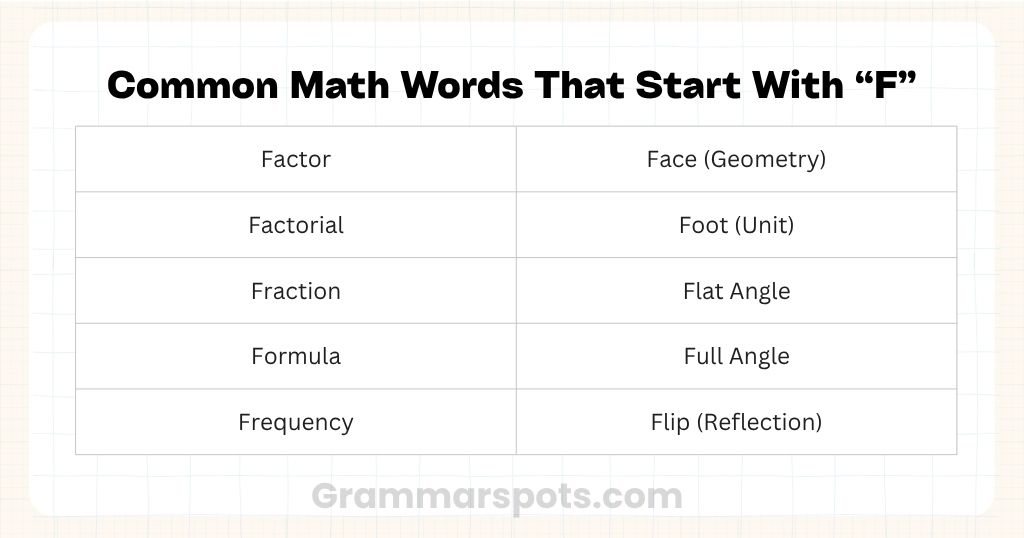
1. Factor
Meaning: A number that divides evenly into another number with no remainder.
Example: The factors of 12 are:
- 1
- 2
- 3
- 4
- 6
- 12
Why It Matters: Factoring is used in simplifying fractions, finding GCF and LCM, and solving algebraic equations.
2. Factorial
Meaning: The product of all positive integers from 1 up to a given number, written with an exclamation mark (!).
Example: 5! = 5 × 4 × 3 × 2 × 1 = 120
Why It Matters: Used in permutations, combinations, probability, and Taylor series in calculus.
3. Fraction
Meaning: A number representing part of a whole, written as numerator over denominator.
Example: ¾ means 3 parts out of 4.
Why It Matters: Fractions lead directly into decimals, ratios, percentages, and rational expressions in algebra.
4. Formula
Meaning: A mathematical rule expressed using symbols and numbers.
Example: Area of a rectangle = l × w
Why It Matters: Formulas allow students to solve geometry, algebra, and science problems without deriving rules from scratch each time.
5. Frequency
Meaning: How many times a value appears in a data set.
Example: In {2, 3, 3, 4, 3, 5}, the frequency of 3 is 3.
Why It Matters: The starting point for data analysis, probability, and statistics.
6. Face (Geometry)
Meaning: A flat surface forming part of a 3D solid.
Example: A cube has:
- 6 faces
- All square-shaped
Why It Matters: Essential for calculating surface area, volume, and applying Euler’s formula (F + V − E = 2).
7. Foot (Unit)
Meaning: A unit of length in the imperial system equal to 12 inches.
Example: A standard door is about 7 feet tall.
Why It Matters: Used in real-world measurement problems involving distance, area, and volume.
8. Flat Angle
Meaning: An angle measuring exactly 180°, forming a straight line.
Example: Two rays pointing in exactly opposite directions form a flat angle.
Why It Matters: Foundation for understanding supplementary angles and linear pairs.
9. Full Angle
Meaning: An angle measuring exactly 360°, completing a full rotation.
Example: A wheel spinning once completes a full angle.
Why It Matters: Used in rotational geometry, circle theorems, and trigonometry.
10. Flip (Reflection)
Meaning: A transformation that mirrors a shape across a line.
Example: Flipping a triangle across the y-axis produces its mirror image.
Why It Matters: One of four core geometric transformations, essential for symmetry and coordinate geometry.
11. Finite
Meaning: Having a countable, limited number of elements.
Example: {2, 4, 6, 8, 10} is a finite set it ends.
Why It Matters: Distinguishing finite from infinite is critical in set theory and calculus (limits and convergence).
12. Finite Set
Meaning: A set containing a specific, countable number of elements.
Example: {a, b, c, d} has exactly 4 elements it is finite.
Why It Matters: Introduces cardinality and subset concepts in set theory and discrete mathematics.
13. Function
Meaning: A relationship where each input has exactly one output.
Example: f(x) = 2x + 3 → f(4) = 11
Why It Matters: The most important concept in algebra and calculus every equation studied at the advanced level describes a function.
14. Fibonacci Sequence
Meaning: A sequence where each term equals the sum of the two terms before it.
Example: 0, 1, 1, 2, 3, 5, 8, 13, 21, 34 …
Why It Matters: Appears in nature (flower petals, shells), art, architecture, and financial modeling. Closely linked to the Golden Ratio.
15. Floor Function
Meaning: Rounds a real number down to the nearest integer.
Example:
- ⌊4.9⌋ = 4
- ⌊−2.3⌋ = −3
Why It Matters: Used in computer science algorithms, number theory, and integer division problems.
16. Frequency Distribution
Meaning: A table or chart showing how often each value occurs in a data set.
Example: Test score ranges and how many students scored in each range.
Why It Matters: The backbone of descriptive statistics used to identify patterns and summarize large data sets.
17. Frequency Polygon
Meaning: A line graph created by connecting the midpoints of each bar in a frequency histogram.
Example: Plot the midpoint of each score range and connect the dots to form the polygon.
Why It Matters: Allows easy visual comparison of two or more frequency distributions on the same graph.
18. Frustum
Meaning: A cone or pyramid with its top cut off by a plane parallel to the base.
Example: A typical bucket or drinking cup shape is a frustum.
Why It Matters: Volume and surface area of frustums appear in solid geometry and real engineering applications.
19. Feasible Region
Meaning: The set of all points satisfying every constraint in a linear programming problem.
Example: On a graph, the shaded area where all inequality constraints overlap is the feasible region.
Why It Matters: Used in operations research and economics to maximize profit or minimize cost within real-world limits.
20. Face Diagonal
Meaning: A line segment connecting two non-adjacent corners of a face on a 3D solid.
Example: On a cube with side 4, the face diagonal = 4√2.
Why It Matters: Used in 3D geometry and the Pythagorean theorem applied to solid figures.
21. Focal Point
Meaning: The point at which parallel rays converge after reflecting off a parabola or passing through a lens.
Example: In the parabola y = x², the focal point lies at (0, ¼).
Why It Matters: Used in conic sections, optics, and the design of telescopes, satellites, and antennas.
22. Furlong
Meaning: A unit of length equal to 1/8 of a mile, or 220 yards.
Example: A standard horse racing track is measured in furlongs.
Why It Matters: Appears in imperial unit conversion problems and real-world measurement contexts.
23. Figurate Number
Meaning: A number that can be arranged into a geometric shape using dots.
Example: Triangular numbers: 1, 3, 6, 10, 15 … (dots arranged as triangles)
Why It Matters: Bridges number theory and geometry; explored in combinatorics and mathematical patterns.
24. Free Variable
Meaning: A variable not constrained by any equation in a system, free to take any value.
Example: In x + y = 5, if y is the free variable, then x = 5 − y for any y.
Why It Matters: Critical in linear algebra when solving systems of equations and analyzing solution spaces.
25. False Position Method
Meaning: A numerical method for finding roots of an equation by using linear interpolation between two points.
Example: If f(1) < 0 and f(3) > 0, the method estimates the root between 1 and 3 using a straight line.
Why It Matters: Used in numerical analysis and computer science to approximate solutions when exact answers are not possible.
Related Post: 55+ Math Words That Start With E (With Meanings and Examples)
Advanced Math Words That Start With F
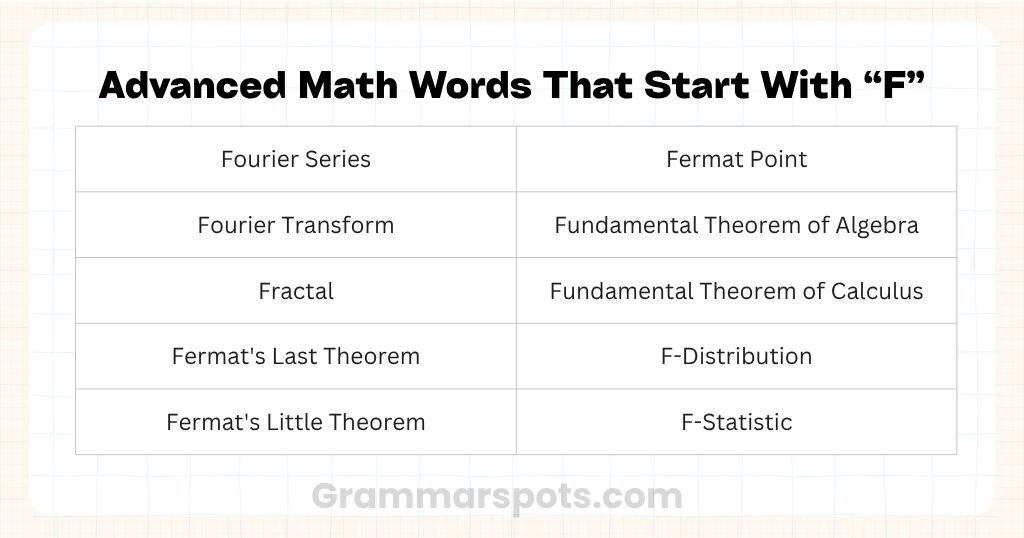
26. Fourier Series
Meaning: Expressing a periodic function as an infinite sum of sine and cosine waves.
Example: A square wave is approximated by adding sine waves of increasing frequency.
Branch: Calculus / Analysis
Real-World Use:
- Signal processing
- Audio engineering
- Image compression (JPEG)
- Solving differential equations
27. Fourier Transform
Meaning: A mathematical operation converting a function of time into its frequency components.
Example: A music equalizer separates bass and treble by applying a Fourier transform.
Branch: Applied Mathematics / Analysis
Real-World Use:
- MRI machines
- Radio transmission
- Data compression
- Quantum mechanics
28. Fractal
Meaning: A shape that repeats its own structure at every scale — self-similar at any zoom level.
Example: The Mandelbrot set and Sierpiński triangle are classic fractals.
Branch: Geometry / Chaos Theory
Real-World Use:
- Computer graphics
- Antenna design
- Financial modeling
- Studying coastlines and cloud formations
29. Fermat’s Last Theorem
Meaning: No positive integers satisfy aⁿ + bⁿ = cⁿ for any integer n greater than 2.
Example: While a² + b² = c² has solutions (3, 4, 5), no such solutions exist for cubes or higher powers.
Branch: Number Theory
Why It Matters: Unsolved for 350+ years. Andrew Wiles proved it in 1995, advancing algebraic geometry significantly.
30. Fermat’s Little Theorem
Meaning: If p is prime and a is not divisible by p, then aᵖ⁻¹ ≡ 1 (mod p).
Example: For p = 5, a = 3: 3⁴ = 81 → 81 mod 5 = 1 ✓
Branch: Number Theory
Real-World Use: Foundation of RSA encryption — securing online banking and digital communication.
31. Fermat Point
Meaning: The interior point of a triangle where the sum of distances to all three vertices is minimized.
Example: Each pair of lines from the Fermat point to the vertices forms a 120° angle.
Branch: Geometry / Optimization
Real-World Use: Network design and logistics finding the best central location to minimize total distance.
32. Fundamental Theorem of Algebra
Meaning: Every non-constant polynomial of degree n has exactly n roots in the complex numbers.
Example: x² + 1 = 0 has no real roots, but has two complex roots: i and −i.
Branch: Algebra / Complex Analysis
Why It Matters: Guarantees polynomial equations always have solutions establishing why complex numbers are necessary.
33. Fundamental Theorem of Calculus
Meaning: Differentiation and integration are inverse operations. A definite integral equals F(b) − F(a), where F is the antiderivative.
Example: ∫₁³ 2x dx = [x²]₁³ = 9 − 1 = 8
Branch: Calculus
Why It Matters: The most important theorem in calculus makes definite integrals practically computable.
34. F-Distribution
Meaning: A right-skewed probability distribution used to compare variances of two populations.
Example: Used in ANOVA to determine if group means differ significantly.
Branch: Statistics
Real-World Use:
- Scientific research
- Clinical trials
- Psychology studies
35. F-Statistic
Meaning: The ratio of variance between groups to variance within groups in hypothesis testing.
Example: A large F-statistic suggests group means are not all equal.
Branch: Statistics / Inferential Analysis
Real-World Use: Regression analysis, ANOVA tests, and model evaluation in research.
36. Field (Abstract Algebra)
Meaning: A set with addition and multiplication operations satisfying axioms including commutativity, associativity, and existence of inverses.
Example: Rational numbers (ℚ) form a field under standard addition and multiplication.
Branch: Abstract Algebra
Why It Matters: Underlies linear algebra, calculus, and cryptography. Real numbers, complex numbers, and rationals are all fields.
37. Fubini’s Theorem
Meaning: A double integral over a region can be computed as two successive single integrals.
Example: ∫∫ f(x, y) dA = ∫[∫ f(x, y) dy] dx (under continuity conditions)
Branch: Multivariable Calculus
Real-World Use: Probability theory (joint distributions) and physics (multi-dimensional integrals).
38. Fibonacci Coding
Meaning: A system representing integers as sums of non-consecutive Fibonacci numbers using binary-style codes.
Example: 10 = 8 + 2, represented as 0010011 in Fibonacci code.
Branch: Discrete Mathematics
Real-World Use: Data compression and error-detection systems.
39. Fibonacci Spiral
Meaning: A spiral formed by drawing arcs through corners of squares with Fibonacci-sequence side lengths.
Example: Starting with 1×1 squares and growing outward creates the recognizable golden spiral.
Branch: Geometry / Number Theory
Real-World Use:
- Nautilus shells
- Galaxy arm structure
- Sunflower seed patterns
- Classical art composition
40. Fixed Point
Meaning: A value unchanged when a function is applied to it where f(x) = x.
Example: For f(x) = x², both 0 and 1 are fixed points.
Branch: Analysis / Dynamical Systems
Real-World Use: Economics (market equilibria), computer science (recursive algorithms), and physics.
41. Fuzzy Logic
Meaning: A logic system where truth values range between 0 and 1, rather than strictly true or false.
Example: A temperature of 28°C might have a truth value of 0.7 for “hot” in a fuzzy system.
Branch: Applied Mathematics / Logic
Real-World Use:
- AI systems
- Washing machine sensors
- Camera autofocus
- Medical diagnostics
Related Post: 35+ Math Words That Start With G (With Meanings and Examples)
Geometry Math Terms That Start With F
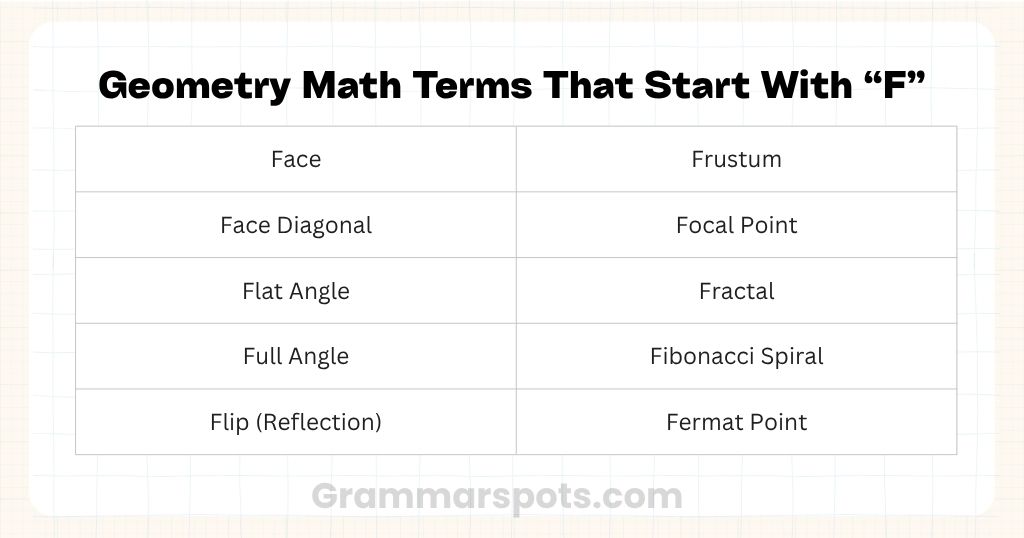
- Face Flat surface of a 3D solid
- Face Diagonal Diagonal across one face of a solid
- Flat Angle 180° angle
- Full Angle 360° angle
- Flip (Reflection) Mirror transformation
- Frustum Cone/pyramid with top removed
- Focal Point Point where rays converge on a parabola
- Fractal Self-similar geometric shape
- Fibonacci Spiral Spiral built from Fibonacci squares
- Fermat Point Point minimizing distance to triangle vertices
Statistics Terms That Start With F
- Frequency Count of a value in data
- Frequency Distribution Table of value counts
- Frequency Polygon Line graph of frequency data
- F-Distribution Variance-comparison distribution
- F-Statistic Ratio of variances in hypothesis tests
Algebra and Arithmetic Terms That Start With F
- Factor Divisor of a number
- Factorial Product of descending integers
- Fraction Part of a whole
- Formula Mathematical rule in symbols
- Function Input-output relationship
- Floor Function Rounds down to nearest integer
- Free Variable Unconstrained variable in a system
- Field Algebraic structure with two operations
Related Post: 50+ Math Words That Start With H (With Meanings and Examples)
Advanced and Applied Terms That Starting With F
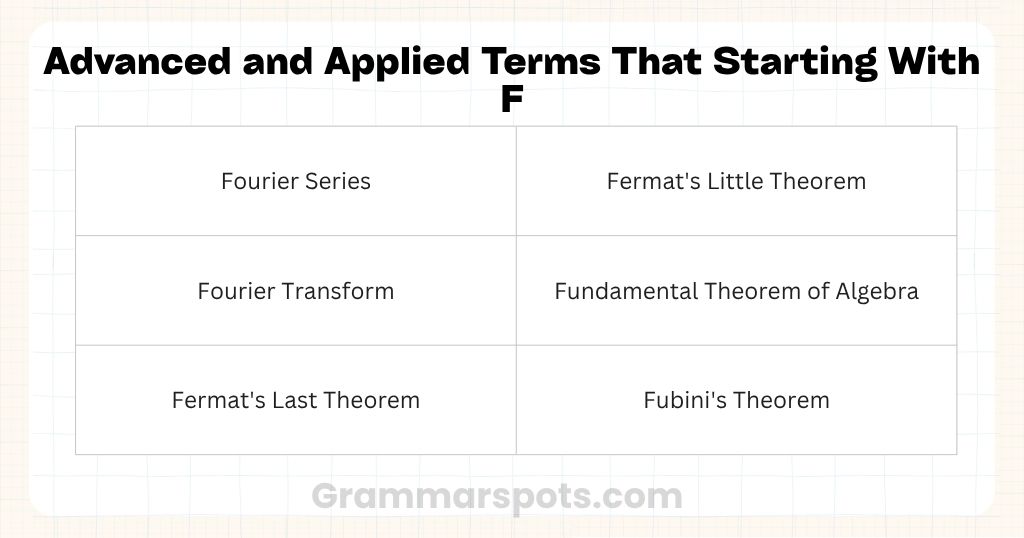
- Fourier Series Periodic function as sine/cosine sum
- Fourier Transform Time-to-frequency conversion
- Fermat’s Last Theorem No integer solution for aⁿ + bⁿ = cⁿ (n > 2)
- Fermat’s Little Theorem aᵖ⁻¹ ≡ 1 (mod p) for prime p
- Fundamental Theorem of Algebra Degree-n polynomial has n complex roots
- Fundamental Theorem of Calculus Links integration and differentiation
- Fubini’s Theorem Double integrals as iterated single integrals
- False Position Method Root approximation via linear interpolation
- Fibonacci Coding Integer encoding using Fibonacci numbers
- Fixed Point f(x) = x value
- Fuzzy Logic Continuous truth values between 0 and 1
Real-World Applications
Measurement and Construction
- Formula, foot, and frustum are used in architecture, carpentry, and engineering for area, volume, and structural design.
Data Science and Research
- Frequency, frequency distribution, F-distribution, and F-statistic are tools for summarizing data, testing hypotheses, and interpreting experimental results.
Technology and Computing
- Fourier transform, fractal, floor function, fuzzy logic, and Fibonacci coding appear in signal processing, AI, image compression, and data storage systems.
Cryptography and Security
- Fermat’s Little Theorem and field algebra are foundational to RSA encryption and elliptic curve cryptography, securing every online transaction.
Nature and Art
- Fibonacci sequence, Fibonacci spiral, and fractals appear in shells, galaxies, plants, and classical artistic compositions.
Related Post: 40+ Math Words That Start With I (With Meanings and Examples)
Tips for Remembering Math Words That Start With F
- Group by branch Study geometry terms together, statistics terms together, and algebra terms together
- Use formula cards Write the symbol on one side, definition on the other
- Visualize Draw a frustum, sketch a Fibonacci spiral, or graph a simple function
- Connect to real life A frustum is a bucket; a Fibonacci spiral is a nautilus shell; a Fourier transform is your music equalizer
- Practice with numbers Compute a factorial, find factors, build a frequency distribution table
Commonly Confused Math F Terms
Factor vs. Multiple
- A factor divides into a number (3 is a factor of 12)
- A multiple is a product of that number (12 is a multiple of 3)
- Factors are smaller or equal; multiples are larger or equal
Fraction vs. Ratio
- A fraction shows part of a whole (¾ of a pizza)
- A ratio compares two separate quantities (3 boys to 4 girls)
- All fractions can be ratios, but not all ratios are fractions
Function vs. Equation
- An equation states that two expressions are equal (2x + 3 = 7)
- A function maps inputs to outputs f(x) = 2x + 3
- Every function generates equations, but not every equation defines a function
Frequency vs. Probability
- Frequency counts how often something happened in observed data
- Probability predicts how often something should happen theoretically
- Relative frequency approaches probability as trials increase but they are not the same
Floor Function vs. Rounding
- Floor function always rounds down: ⌊−1.2⌋ = −2
- Rounding goes to nearest integer: −1.2 rounds to −1
- They differ significantly for negative numbers
Fourier Series vs. Fourier Transform
- Fourier series works on periodic functions expresses them as sine/cosine sums
- Fourier transform extends this to non-periodic functions across continuous frequencies
- Both decompose signals into frequency components, but for different function types
Related Post: 55+ Math Words That Start With J (With Meanings and Examples)
Frequently Asked Questions
Q1: What are the most important math words starting with F for elementary students?
- Fraction
- Factor
- Formula
- Frequency
These four cover arithmetic, basic algebra, and introductory data handling.
Q2: What math words starting with F are used in geometry?
- Face
- Flat angle
- Full angle
- Flip (reflection)
- Frustum
- Focal point
- Fermat point
- Fibonacci spiral
- Fractal
Q3: What is the difference between a factor and a factorial?
- A factor divides a number evenly
- A factorial multiplies all integers from 1 to n (e.g., 4! = 24)
- They both involve multiplication but serve completely different purposes
Q4: What is the Fibonacci sequence and where does it appear in real life?
The sequence 0, 1, 1, 2, 3, 5, 8, 13 … appears in:
- Sunflower seed spirals
- Nautilus shells
- Pine cones
- Galaxy arms
- Classical architecture and art
Q5: What is a fractal?
A shape that repeats its structure at every level of zoom. Famous examples:
- Mandelbrot set
- Sierpiński triangle
- Koch snowflake
Found in coastlines, lightning, and computer-generated graphics.
Q6: Is frequency the same in math and science?
- In statistics, frequency = how often a value appears in data
- In physics, frequency = how many wave cycles per second (Hertz)
- Both uses are precise, but they refer to different things
Q7: What is the Fundamental Theorem of Calculus?
It links differentiation and integration showing they are inverse operations. It makes definite integrals computable using antiderivatives: ∫ₐᵇ f(x) dx = F(b) − F(a).
Q8: What is fuzzy logic used for?
Fuzzy logic handles decisions with degrees of truth rather than strict yes/no:
- AI and robotics
- Washing machine automation
- Camera autofocus systems
- Medical diagnosis tools
Conclusion
This guide covers 41 verified math words that start with F from everyday terms like fraction and factor to advanced concepts like Fourier transform and Fermat’s Last Theorem.
Key takeaways:
- Beginner terms fraction, factor, formula, frequency, function
- Geometry terms face, frustum, flat angle, flip, focal point
- Statistics terms frequency distribution, F-statistic, F-distribution
- Advanced terms Fourier series, Fundamental Theorem of Calculus, fuzzy logic
Bookmark this page as your go-to reference whenever an F math term comes up in class, homework, or research.

I’m Hazel, and I studied BSC English at GCUF. I focus on explaining word meanings in simple, clear language that anyone can understand. My goal is helping readers grasp everyday English, confusing terms, and slang used in real conversations and social media. I believe language learning works best when definitions connect to actual life situations. Through careful research and straightforward explanations, I make vocabulary accessible for students, learners, and anyone curious about how English really works in daily use.