

Math vocabulary is the foundation of every problem you solve. If you’re searching for math words that start with E, this guide covers 55+ verified terms from beginner concepts like equation and even number to advanced topics like eigenvalue and elliptic curve.
Each term includes a clear definition, a simple example, and why it matters in math. Every word here is genuinely mathematical, no filler, no irrelevant entries.
Quick List: 55+ Math Words That Start With E
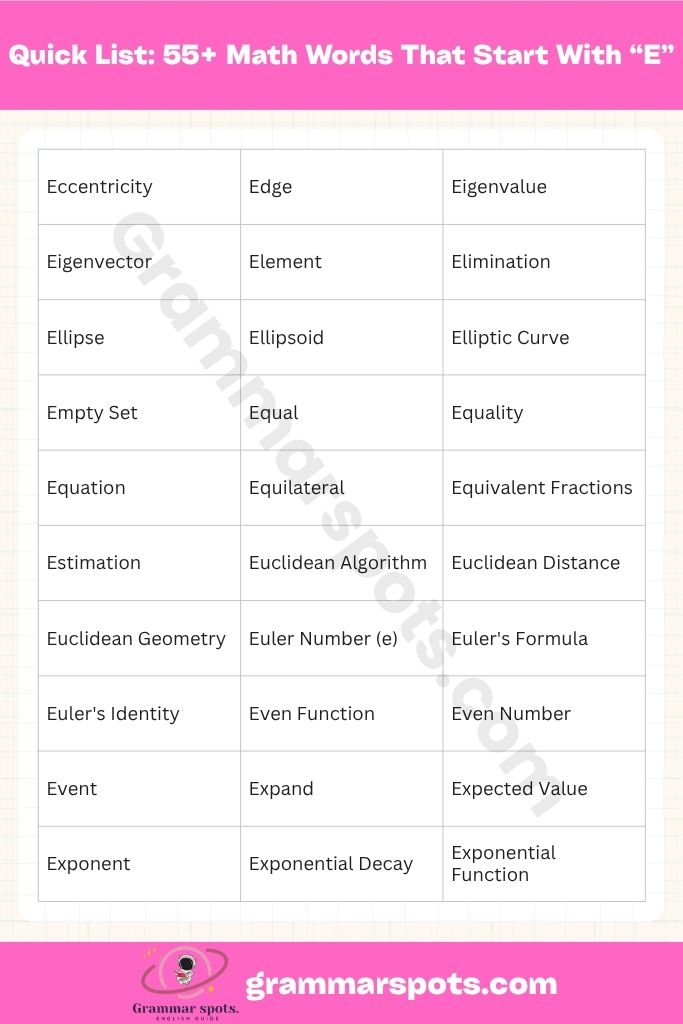
- Eccentricity
- Edge
- Eigenvalue
- Eigenvector
- Element
- Elimination
- Ellipse
- Ellipsoid
- Elliptic Curve
- Empty Set
- Equal
- Equality
- Equation
- Equilateral
- Equivalent Fractions
- Estimation
- Euclidean Algorithm
- Euclidean Distance
- Euclidean Geometry
- Euler Number (e)
- Euler’s Formula
- Euler’s Identity
- Even Function
- Even Number
- Event
- Expand
- Expected Value
- Exponent
- Exponential Decay
- Exponential Function
- Exponential Growth
- Expression
- Exterior Angle
- Extrapolation
- Extremum
- Epsilon (ε)
- Entire Function
- Evolute
- Erdős Number
- Error
- Evaluate
- Exact Value
- Exclusive Event
- Exhaustive Events
- Existential Quantifier (∃)
- Explicit Formula
- Extraneous Solution
- Elliptic Integral
- Empirical Probability
- End Behavior
- Enlargement
- Equidistant
- Equiprobable
- Euler’s Totient Function
- Eulerian Path
- Elimination Matrix
Related Post:
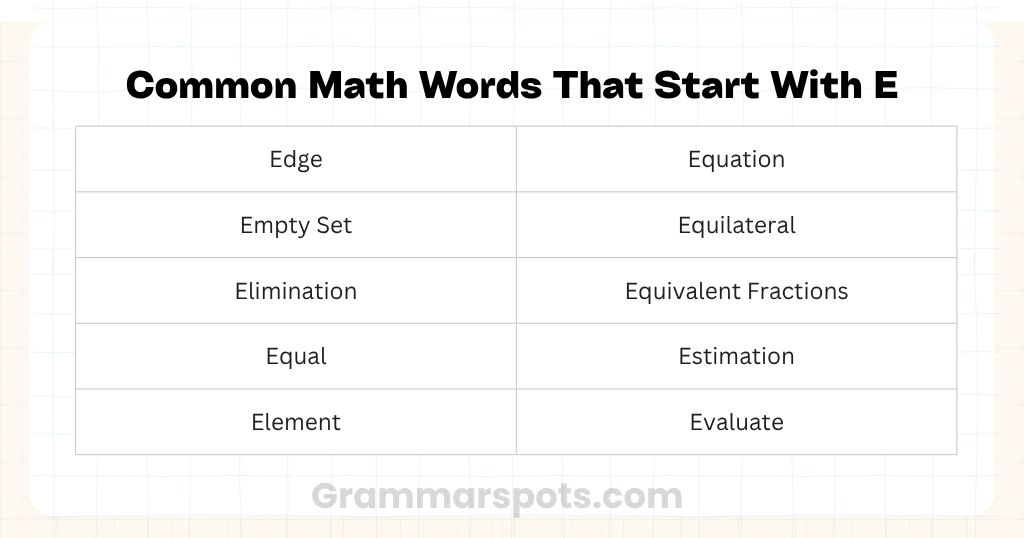
Common Math Words That Start With E
Edge
Meaning: A line segment where two faces of a 3D shape meet, or a side of a 2D polygon.
Example: A cube has 12 edges.
Why It Matters: Essential for counting and classifying 3D shapes using Euler’s polyhedron formula: V − E + F = 2.
Element
Meaning: A member or object that belongs to a set.
Example: In the set {3, 6, 9}, the number 6 is an element.
Why It Matters: The building block of set theory, which underpins all of modern mathematics.
Elimination
Meaning: A method of solving systems of equations by adding or subtracting equations to remove one variable.
Example: x + y = 10 and x − y = 4 → add them → 2x = 14 → x = 7.
Why It Matters: One of the two standard methods for solving simultaneous equations in algebra.
Empty Set
Meaning: A set with no elements, written as {} or ∅.
Example: The set of odd numbers divisible by 2 is the empty set.
Why It Matters: Foundational in logic, set theory, and mathematical proofs.
Equal
Meaning: Having exactly the same value or quantity.
Example: 4 + 6 is equal to 10.
Why It Matters: The concept behind every equation and algebraic balance.
Equality
Meaning: A statement that two expressions have the same value, shown with the = sign.
Example: The equality 3x = 12 tells us x = 4.
Why It Matters: Equality is the engine of algebra every equation rests on it.
Equation
Meaning: A mathematical statement showing two expressions are equal, usually with an unknown.
Example: 2x + 5 = 11 is an equation where x = 3.
Why It Matters: Central to every area of mathematics and applied science.
Equilateral
Meaning: A shape where all sides are equal in length.
Example: An equilateral triangle has three equal sides and three 60° angles.
Why It Matters: Used in symmetry, geometry proofs, and area calculations.
Equivalent Fractions
Meaning: Fractions that represent the same value despite different numerators and denominators.
Example: 1/2 = 2/4 = 4/8 all equivalent fractions.
Why It Matters: Critical for comparing, adding, and subtracting fractions.
Estimation
Meaning: Finding an approximate answer using rounding or reasoning rather than exact calculation.
Example: Estimating 197 × 4 ≈ 200 × 4 = 800.
Why It Matters: A real-life skill used constantly in science, engineering, and everyday decision-making.
Evaluate
Meaning: To calculate the numerical value of an expression by substituting given values.
Example: Evaluate 3x + 2 when x = 4 → 3(4) + 2 = 14.
Why It Matters: A core skill in algebra used every time you substitute values into a formula.
Even Number
Meaning: Any integer divisible by 2 with no remainder.
Example: 2, 4, 6, 8, 10 are even numbers.
Why It Matters: Foundational to number theory, divisibility rules, and parity in proofs.
Event
Meaning: Any outcome or group of outcomes from a probability experiment.
Example: Rolling a 3 on a die is an event.
Why It Matters: The basic unit of probability every probability calculation involves events.
Exact Value
Meaning: A value expressed precisely without rounding or approximating, often using surds, fractions, or π.
Example: The exact value of sin 45° is √2/2, not 0.707.
Why It Matters: Required in formal exams and proofs where decimal approximations are insufficient.
Exclusive Event
Meaning: Two events are mutually exclusive if they cannot happen at the same time.
Example: Rolling an even number and rolling a 3 on the same die throw are mutually exclusive.
Why It Matters: Determines whether probabilities can simply be added together using the addition rule.
Exhaustive Events
Meaning: A set of events is exhaustive if at least one of them must occur together they cover all possibilities.
Example: {Heads, Tails} is an exhaustive set for a coin flip.
Why It Matters: Used in probability to confirm a complete sample space.
Expand
Meaning: To rewrite an expression by removing brackets using multiplication.
Example: Expand 3(x + 4) → 3x + 12.
Why It Matters: Expanding brackets is a foundational algebra skill used before simplifying or solving equations.
Explicit Formula
Meaning: A formula that directly calculates any term in a sequence using its position number (n).
Example: For the sequence 2, 4, 6, 8…, the explicit formula is aₙ = 2n.
Why It Matters: Faster than recursive formulas when you need a distant term without listing every prior term.
Exponent
Meaning: A number showing how many times a base is multiplied by itself.
Example: 3⁴ = 3 × 3 × 3 × 3 = 81. The exponent is 4.
Why It Matters: Used in scientific notation, polynomial expressions, exponential functions, and compound interest.
Expression
Meaning: A mathematical phrase with numbers, variables, and operations but no equals sign.
Example: 5x² − 3x + 7 is an expression.
Why It Matters: Understanding the difference between an expression and an equation prevents critical algebra errors.
Exterior Angle
Meaning: An angle formed between one side of a polygon and the extension of an adjacent side.
Example: An exterior angle of a triangle equals the sum of the two non-adjacent interior angles.
Why It Matters: A key theorem in geometry used in proofs and angle calculations.
Extraneous Solution
Meaning: A solution that appears valid after solving an equation but does not satisfy the original equation.
Example: When solving radical equations, squaring both sides can introduce extraneous solutions that must be checked.
Why It Matters: Students who skip checking answers in radical or rational equations often accept incorrect solutions.
Enlargement
Meaning: A geometric transformation that scales a shape up or down by a scale factor from a centre of enlargement.
Example: Enlarging a triangle by scale factor 2 doubles every side length.
Why It Matters: Core topic in transformation geometry and similarity.
Equidistant
Meaning: At equal distances from one or more reference points.
Example: Every point on a circle is equidistant from the centre.
Why It Matters: Defines circles, perpendicular bisectors, and locus problems in geometry.
Empirical Probability
Meaning: Probability calculated from actual experimental results rather than theory.
Example: If a coin lands heads 47 times out of 100 flips, the empirical probability is 47/100.
Why It Matters: Reflects real-world outcomes and is compared against theoretical probability in statistics.
End Behavior
Meaning: The behavior of a function’s graph as x approaches positive or negative infinity.
Example: For f(x) = x³, as x → +∞, f(x) → +∞; as x → −∞, f(x) → −∞.
Why It Matters: Used to sketch and analyze polynomial and rational function graphs.
Equiprobable
Meaning: Having equal probability of occurring.
Example: Each face of a fair die is equiprobable, with a probability of 1/6.
Why It Matters: A key assumption in classical probability theory.
Error
Meaning: The difference between a measured or calculated value and the true or accepted value.
Example: If the true value is 50 and the measured value is 48, the error is 2.
Why It Matters: Used in statistics, scientific measurement, and data analysis to assess accuracy.
Related Post: 45+ Math Words That Start With D (With Meanings and Examples)
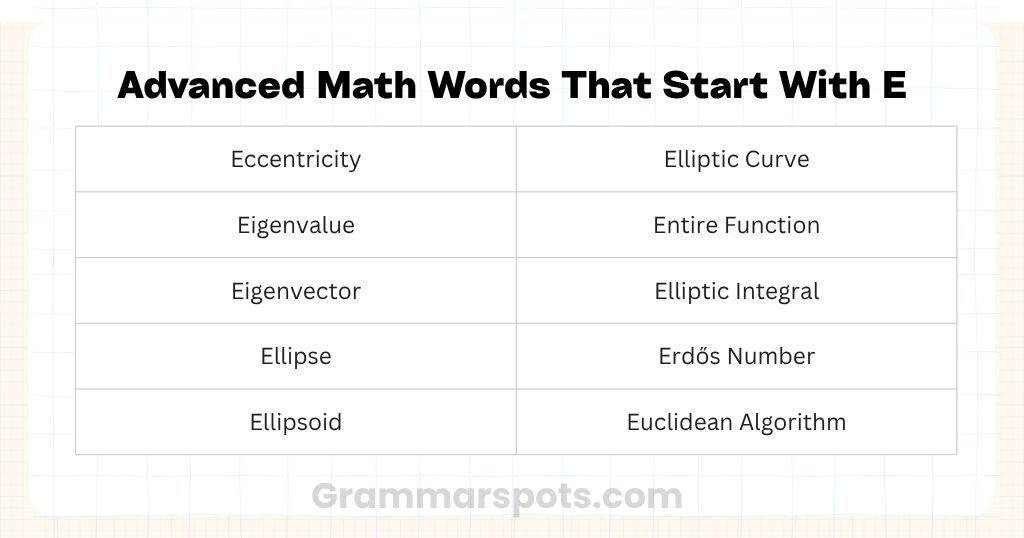
Advanced Math Words That Start With E
Eccentricity
Meaning: A number describing how much a conic section deviates from a perfect circle. Circle = 0; Ellipse = between 0 and 1; Parabola = 1; Hyperbola > 1.
Example: Earth’s orbital eccentricity is approximately 0.017 nearly circular.
Math Branch: Conic Sections, Geometry
Eigenvalue
Meaning: A scalar value associated with a matrix such that multiplying the matrix by a special vector (eigenvector) only stretches or shrinks it never rotates it.
Example: Used in Principal Component Analysis (PCA) in machine learning to reduce data dimensions.
Math Branch: Linear Algebra
Eigenvector
Meaning: A non-zero vector whose direction remains unchanged when a matrix transformation is applied it only scales.
Example: In Google’s PageRank algorithm, the dominant eigenvector determines webpage rankings.
Math Branch: Linear Algebra
Ellipse
Meaning: A closed oval curve where the sum of distances from any point to two fixed points (foci) is constant.
Example: (x²/9) + (y²/4) = 1 is the equation of an ellipse.
Math Branch: Conic Sections, Geometry
Ellipsoid
Meaning: A 3D surface where every cross-section is an ellipse or circle a stretched or flattened sphere.
Example: Earth is technically an oblate ellipsoid slightly flattened at the poles.
Math Branch: 3D Geometry
Elliptic Curve
Meaning: A smooth algebraic curve defined by y² = x³ + ax + b, studied in number theory and cryptography.
Example: Elliptic curve cryptography secures HTTPS connections and digital signatures.
Math Branch: Number Theory, Cryptography
Elliptic Integral
Meaning: A type of integral that cannot be expressed in elementary functions, originally arising when calculating the arc length of an ellipse.
Example: The complete elliptic integral of the first kind K(k) appears in pendulum motion calculations.
Math Branch: Calculus, Mathematical Physics
Entire Function
Meaning: A complex function that is holomorphic (complex-differentiable) at every point in the complex plane.
Example: f(z) = e^z and f(z) = sin(z) are entire functions.
Math Branch: Complex Analysis
Epsilon (ε)
Meaning: A Greek letter used to represent an arbitrarily small positive quantity, especially in the formal epsilon-delta definition of a limit.
Example: “For every ε > 0, there exists δ > 0 such that…” is the standard language of limit proofs.
Math Branch: Real Analysis, Calculus
Erdős Number
Meaning: A measure of a mathematician’s collaborative distance from Paul Erdős in published research papers, modeled as a graph.
Example: A mathematician who co-authored a paper directly with Erdős has an Erdős number of 1.
Math Branch: Graph Theory
Euclidean Algorithm
Meaning: A method for finding the greatest common divisor (GCD) of two integers by repeated application of the remainder operation.
Example: GCD(48, 18): 48 = 2×18 + 12 → 18 = 1×12 + 6 → 12 = 2×6 + 0. GCD = 6.
Math Branch: Number Theory
Euclidean Distance
Meaning: The straight-line distance between two points, calculated using the Pythagorean theorem.
Example: Distance between (1, 2) and (4, 6) = √[(4−1)² + (6−2)²] = √25 = 5.
Math Branch: Geometry, Data Science
Euclidean Geometry
Meaning: The study of geometry based on Euclid’s five postulates, describing flat (plane) space.
Example: The theorem that triangle angles sum to 180° is a result of Euclidean geometry.
Math Branch: Geometry
Euler Number (e)
Meaning: An irrational constant ≈ 2.71828, the base of the natural logarithm, fundamental in calculus and analysis.
Example: Continuous compound interest uses A = Pe^(rt).
Math Branch: Calculus, Analysis
Euler’s Formula
Meaning: The identity e^(iθ) = cos θ + i sin θ, linking complex exponentials to trigonometry.
Example: At θ = π, it produces Euler’s Identity: e^(iπ) + 1 = 0.
Math Branch: Complex Analysis
Euler’s Identity
Meaning: The equation e^(iπ) + 1 = 0, uniting five fundamental mathematical constants: e, i, π, 1, and 0.
Why It Matters: Often called the most beautiful equation in mathematics for its unexpected unification of core concepts.
Math Branch: Complex Analysis
Euler’s Totient Function (φ)
Meaning: A function φ(n) that counts how many integers from 1 to n are coprime to n.
Example: φ(8) = 4, because 1, 3, 5, and 7 are coprime to 8.
Math Branch: Number Theory used in RSA cryptography.
Eulerian Path
Meaning: A path in a graph that visits every edge exactly once. If it starts and ends at the same vertex, it is an Eulerian circuit.
Example: The Königsberg Bridge Problem asked whether an Eulerian path existed Euler proved it did not.
Math Branch: Graph Theory
Even Function
Meaning: A function where f(−x) = f(x) for all x — its graph is symmetric about the y-axis.
Example: f(x) = x² is an even function: f(−3) = 9 = f(3).
Math Branch: Calculus, Functions
Evolute
Meaning: The curve traced by the centers of curvature of another curve.
Example: The evolute of a parabola is another curve called a semi-cubical parabola.
Math Branch: Differential Geometry
Expected Value
Meaning: The probability-weighted average of all possible outcomes of a random variable.
Example: Expected value of a fair die = (1+2+3+4+5+6)/6 = 3.5.
Math Branch: Probability, Statistics
Existential Quantifier (∃)
Meaning: A logical symbol meaning “there exists at least one.” Used in formal mathematical statements.
Example: ∃x ∈ ℝ such that x² = 4 means “there exists a real number whose square is 4.”
Math Branch: Logic, Set Theory
Explicit Formula
(already covered in Common Terms above)
Exponential Function
Meaning: A function of the form f(x) = aˣ where the variable is the exponent.
Example: f(x) = 2ˣ doubles with every unit increase in x.
Math Branch: Algebra, Calculus
Exponential Growth
Meaning: Increase by a consistent percentage over equal time intervals, producing a rapidly accelerating curve.
Example: A bacteria population doubling every hour follows exponential growth.
Real-World Use: Population biology, compound interest, viral spread.
Exponential Decay
Meaning: Decrease by a consistent percentage over equal time intervals.
Example: Carbon-14 decays exponentially with a half-life of ~5,730 years.
Real-World Use: Radioactive dating, drug metabolism, cooling processes.
Extrapolation
Meaning: Estimating values beyond the range of known data by extending an observed trend.
Example: If a plant grows 2 cm/week for 4 weeks, extrapolating predicts 10 cm at week 5.
Math Branch: Statistics, Data Analysis
Extremum
Meaning: A maximum or minimum value of a function. Local extremum = highest/lowest in a region; global extremum = highest/lowest overall.
Example: f(x) = −x² has a global maximum (extremum) at x = 0.
Math Branch: Calculus
Related Post: 60+ Math Words That Start With C (With Meanings and Examples)
Geometry Terms Starting With E
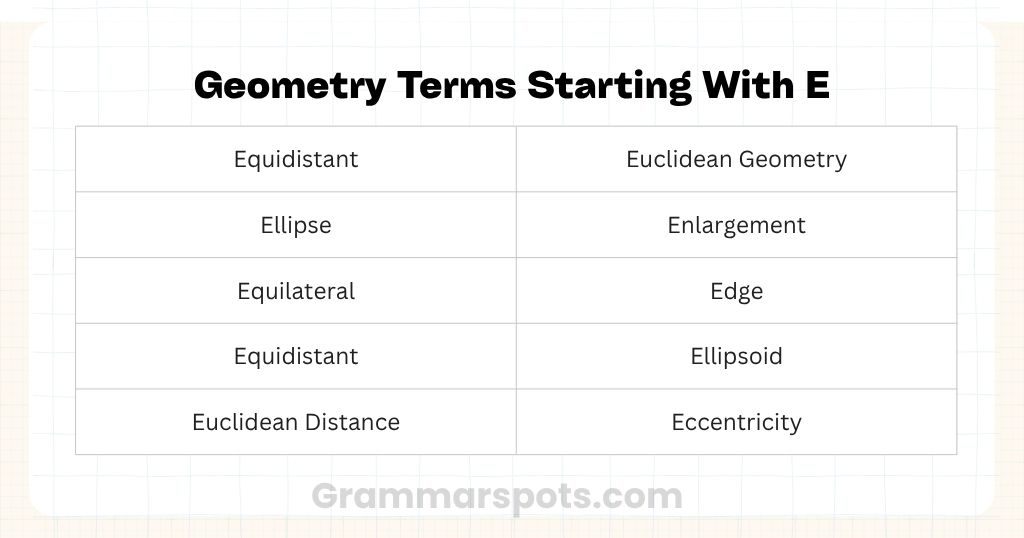
- Edge
- Ellipse
- Ellipsoid
- Equilateral
- Equidistant
- Exterior Angle
- Euclidean Distance
- Euclidean Geometry
- Enlargement
- Eccentricity
Algebra Terms Starting With E
- Equation
- Expression
- Exponent
- Elimination
- Expand
- Equivalent Fractions
- Explicit Formula
- Extraneous Solution
- Evaluate
Probability and Statistics Terms Starting With E
- Event
- Expected Value
- Empirical Probability
- Equiprobable
- Exclusive Event
- Exhaustive Events
- Extrapolation
- Error
Related Post: 50+ Math Words That Start With B (With Meanings and Examples)
Calculus and Analysis Terms Starting With E
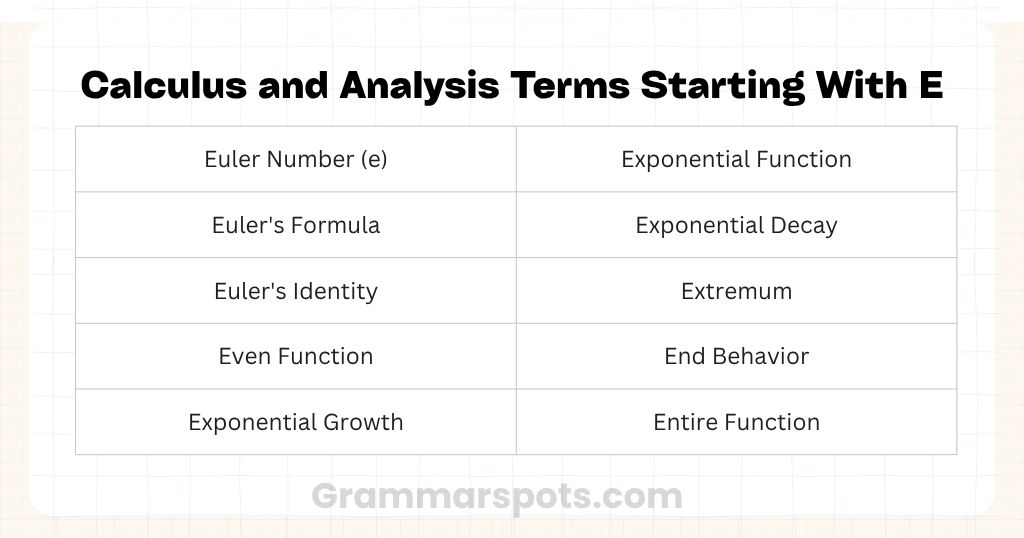
- Euler Number (e)
- Euler’s Formula
- Euler’s Identity
- Even Function
- Exponential Function
- Exponential Growth
- Exponential Decay
- End Behavior
- Extremum
- Epsilon (ε)
- Entire Function
- Elliptic Integral
- Evolute
Number Theory and Logic Terms Starting With E
- Even Number
- Euclidean Algorithm
- Euler’s Totient Function
- Erdős Number
- Eulerian Path
- Existential Quantifier (∃)
Real-Life Applications
Finance
- Euler’s number (e) powers continuous compound interest formulas
- Expected value drives every investment risk model
Cryptography and Technology
- Elliptic curve cryptography secures HTTPS and digital signatures
- The Euclidean Algorithm is the foundation of RSA encryption
- Euler’s Totient Function is embedded in RSA key generation
Science and Biology
- Exponential growth and decay model population dynamics, viral spread, and drug metabolism
- Epsilon and limits underpin the calculus used in physics equations
Engineering
- Eigenvalues determine natural vibration frequencies of bridges and buildings
- Euclidean distance is used in robotics and navigation
Data Science and Machine Learning
- Eigenvalues and eigenvectors power Principal Component Analysis (PCA)
- Expected value and error underpin all predictive models
- Euclidean distance drives k-nearest neighbor algorithms
Astronomy
- Ellipses describe planetary orbits (Kepler’s First Law)
- Eccentricity measures how circular or elongated those orbits are
Tips for Remembering Math Words That Start With E
- Group by theme Sort into sets: geometry, algebra, probability, calculus. Related words reinforce each other naturally.
- Make personal examples Write your own example sentence for each term using something from your daily life.
- Connect to real context Exponential growth explains phone bills and bank interest. Ellipses appear in satellite dishes. Real connections create lasting memory.
- Use flashcards for formulas Put the formula on one side (e.g., E[X] = Σx·P(x)) and the plain-English meaning on the other.
- Draw geometry terms Sketch an ellipse, label an edge, mark an exterior angle. Visual memory strengthens recall far more than re-reading.
- Sort easy vs. advanced Master the Easy column of the table first (equation, expression, exponent, even number) before moving to eigenvalue and epsilon.
Related Post: 60+ Math Words That Start With A (With Meanings and Examples)
Commonly Confused Terms
Expression vs. Equation
An expression has no equals sign (3x + 2). An equation has one (3x + 2 = 11). You simplify an expression; you solve an equation.
Equal vs. Equivalent
Equal means identical in form and value (5 = 5). Equivalent means same value, different appearance (1/2 and 3/6). The distinction matters in formal proofs.
Extrapolation vs. Interpolation
Extrapolation predicts values outside the data range. Interpolation estimates values within the data range. Extrapolation carries more uncertainty.
Exponent vs. Exponential
An exponent is the power in 2³ = 8. An exponential function is a function where the variable is in the exponent: f(x) = 2ˣ. Different concepts, often confused.
Even Function vs. Even Number
An even number is any integer divisible by 2. An even function is a function symmetric about the y-axis. They share a word nothing else.
Estimation vs. Approximation
Estimation is a mental rough calculation using rounding. Approximation is a computed value close to the exact answer, often stated to a given number of decimal places.
Exclusive vs. Exhaustive Events
Exclusive events cannot occur simultaneously. Exhaustive events together cover all possible outcomes. A sample space should ideally be both.
FAQs
Q1: What are the most important math words that start with E?
For school-level math: equation, expression, exponent, even number, estimation, and equilateral. For advanced math: eigenvalue, Euler’s number, extremum, and elliptic curve.
Q2: What does lowercase “e” mean in math?
It refers to Euler’s number, an irrational constant ≈ 2.71828. It is the base of the natural logarithm and appears in exponential growth, decay, and compound interest formulas.
Q3: What geometry words start with E?
Edge, ellipse, ellipsoid, equilateral, equidistant, exterior angle, enlargement, eccentricity, Euclidean distance, and Euclidean geometry.
Q4: What is the difference between an equation and an expression?
An expression is a mathematical phrase without an equals sign (e.g., 4x + 1). An equation states equality between two expressions (e.g., 4x + 1 = 9). Equations are solved; expressions are simplified.
Q5: What probability words start with E?
Event, expected value, empirical probability, equiprobable, exclusive event, and exhaustive events.
Q6: What advanced math words start with E?
Eigenvalue, eigenvector, Euler’s formula, Euler’s identity, elliptic curve, extremum, epsilon, entire function, Euclidean algorithm, Euler’s totient function, and Eulerian path.
Q7: What is extrapolation used for?
Predicting values beyond known data used in weather forecasting, population projections, economic modeling, and scientific research.
Q8: How is Euclidean distance used outside the classroom?
In GPS systems, machine learning (k-nearest neighbors), robotics, computer graphics, and any data system measuring “how far apart” two points are.
Conclusion
Math words that start with E span every level of learning from even number and equation in early school to eigenvalue and elliptic curve in advanced mathematics.
This guide covered:
- 55+ verified, genuinely mathematical terms
- Definitions, examples, and real-world uses for each
- Subject-specific groupings across geometry, algebra, probability, calculus, and number theory
- Tips to study and retain vocabulary effectively
Use the vocabulary table to find terms by difficulty, the subject categories to review by topic, and the definitions to build real understanding not just memorization.

I’m Hazel, and I studied BSC English at GCUF. I focus on explaining word meanings in simple, clear language that anyone can understand. My goal is helping readers grasp everyday English, confusing terms, and slang used in real conversations and social media. I believe language learning works best when definitions connect to actual life situations. Through careful research and straightforward explanations, I make vocabulary accessible for students, learners, and anyone curious about how English really works in daily use.