


Math has its own vocabulary and knowing it makes everything easier. If you’re looking for math words that start with D, this guide covers 45+ verified terms across arithmetic, geometry, algebra, statistics, and calculus.
Every word here is genuinely mathematical. Each includes a clear definition, one example, and why it matters. No filler. No repeated content.
Quick List: 45+ Math Words That Start With D
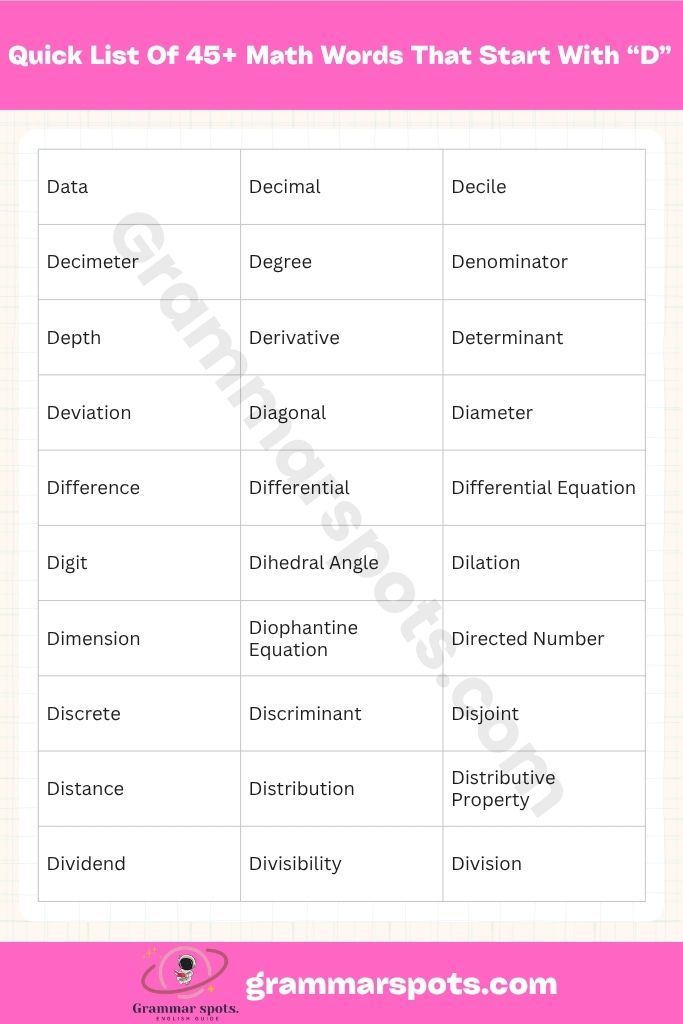
- Data
- Decimal
- Decile
- Decimeter
- Degree
- Denominator
- Depth
- Derivative
- Determinant
- Deviation
- Diagonal
- Diameter
- Difference
- Differential
- Differential Equation
- Digit
- Dihedral Angle
- Dilation
- Dimension
- Diophantine Equation
- Directed Number
- Discrete
- Discriminant
- Disjoint
- Distance
- Distribution
- Distributive Property
- Dividend
- Divisibility
- Division
- Divisor
- Dodecagon
- Dodecahedron
- Domain
- Dot Product
- Double
- Doubling
- De Morgan’s Laws
- Dual
- Data Set
- Degree (Polynomial)
- Degree (Angle)
- Decomposition
- Dense Set
- Divergence
Common Math Words That Start With D
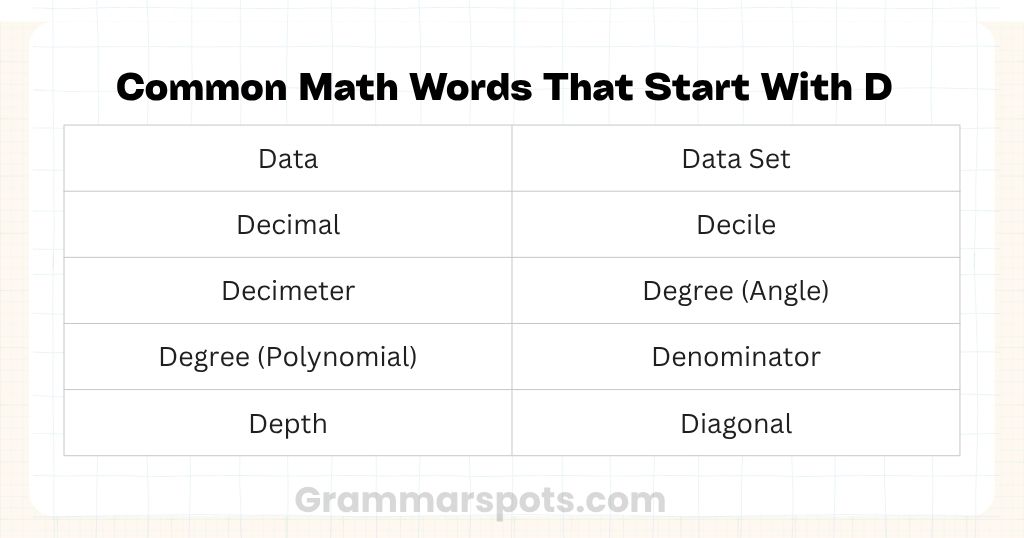
1. Data
Meaning: A collection of numbers, facts, or measurements gathered for analysis.
Example: The teacher recorded students’ test scores as data.
Why It Matters: Every graph, chart, and average starts with data. It is the foundation of all statistics work.
2. Data Set
Meaning: A complete, organized group of related data values.
Example: {4, 7, 9, 12, 15} is a data set of five values.
Why It Matters: Students calculate mean, median, and mode from a data set.
3. Decimal
Meaning: A number written with a decimal point to show values less than one, based on powers of ten.
Example: 3.75 means three and seventy-five hundredths.
Why It Matters: Decimals appear in money, measurements, and percentages at every grade level.
4. Decile
Meaning: One of nine points that divide a ranked data set into ten equal groups.
Example: Scoring in the 9th decile means performing better than 90% of all test takers.
Why It Matters: Deciles are used in education, economics, and medical research to compare positions within large data sets.
5. Decimeter
Meaning: A unit of length equal to one-tenth of a meter (10 cm).
Example: A standard ruler is about 3 decimeters long.
Why It Matters: Students use decimeters when converting between metric units.
6. Degree (Angle)
Meaning: A unit for measuring the size of an angle. A full rotation equals 360 degrees.
Example: A right angle measures exactly 90 degrees.
Why It Matters: Angle measurement is essential in geometry, trigonometry, and construction.
7. Degree (Polynomial)
Meaning: The highest exponent of the variable in a polynomial expression.
Example: In 4x³ + 2x − 1, the degree is 3.
Why It Matters: The degree tells students how many roots a polynomial can have and how to classify it.
8. Denominator
Meaning: The bottom number in a fraction, showing how many equal parts make the whole.
Example: In 5/8, the denominator is 8.
Why It Matters: Adding, subtracting, and comparing fractions requires understanding the denominator.
9. Depth
Meaning: The measurement of how far back or how deep an object extends the third dimension.
Example: A box measuring 10 cm × 6 cm × 4 cm has a depth of 4 cm.
Why It Matters: Depth is needed to calculate the volume of 3D shapes.
10. Diagonal
Meaning: A line segment connecting two non-adjacent vertices of a polygon.
Example: Drawing a diagonal across a rectangle creates two equal triangles.
Why It Matters: Diagonals help identify symmetry, calculate areas, and understand polygon properties.
11. Diameter
Meaning: A straight line through the center of a circle connecting two points on its edge. It equals twice the radius.
Example: A circle with radius 5 cm has a diameter of 10 cm.
Why It Matters: Diameter is used in the circumference formula C = πd and in area calculations.
12. Difference
Meaning: The result of subtracting one number from another.
Example: The difference between 20 and 8 is 12.
Why It Matters: “Find the difference” is one of the most common instructions in word problems, signaling subtraction.
13. Digit
Meaning: Any one of the ten symbols used to write numbers: 0, 1, 2, 3, 4, 5, 6, 7, 8, 9.
Example: The number 472 contains three digits: 4, 7, and 2.
Why It Matters: Place value the entire number system is built on the position of each digit.
14. Dilation
Meaning: A geometric transformation that enlarges or shrinks a shape proportionally from a fixed center point.
Example: Dilating a triangle by a factor of 2 doubles every side length.
Why It Matters: Dilation is central to understanding similarity, scale drawings, and map reading.
15. Dimension
Meaning: A direction in which measurement can be made. Length is 1D, area is 2D, volume is 3D.
Example: A cube exists in three dimensions: length, width, and height.
Why It Matters: Dimension determines whether students calculate perimeter, area, or volume.
16. Directed Number
Meaning: A number with both a size and a direction either positive (+) or negative (−).
Example: −7 is a directed number showing 7 units below zero.
Why It Matters: Directed numbers are the foundation for working with integers, debt, temperature, and coordinate geometry.
17. Discrete
Meaning: Data or values that are countable and take only specific separate values no values in between.
Example: The number of students in a class (25, 26, 27) is discrete data.
Why It Matters: Knowing data is discrete versus continuous determines which statistical tools are appropriate.
18. Distance
Meaning: The total length between two points, always a positive value.
Example: Using the formula d = √[(x₂−x₁)² + (y₂−y₁)²], the distance between (0,0) and (3,4) is 5.
Why It Matters: Distance appears in coordinate geometry, speed/time problems, and real-world measurement.
19. Distribution
Meaning: The way values in a data set are spread or arranged across a range.
Example: A bell-shaped distribution shows most values clustered near the mean.
Why It Matters: Understanding distribution is essential for interpreting graphs, histograms, and probability.
20. Distributive Property
Meaning: A rule stating that a(b + c) = ab + ac multiplying a number by a sum equals the sum of individual products.
Example: 3(4 + 5) = 3×4 + 3×5 = 12 + 15 = 27.
Why It Matters: The distributive property is used in expanding brackets, simplifying expressions, and mental arithmetic.
21. Dividend
Meaning: The number being divided in a division problem.
Example: In 24 ÷ 6 = 4, the dividend is 24.
Why It Matters: Correctly identifying the dividend helps students set up division problems especially long division.
22. Divisibility
Meaning: Whether one number can be divided by another with no remainder.
Example: 36 is divisible by 4 because 36 ÷ 4 = 9 with no remainder.
Why It Matters: Divisibility rules (for 2, 3, 5, 9, 10) help students simplify fractions and find factors quickly.
23. Division
Meaning: The arithmetic operation of splitting a quantity into equal groups.
Example: 30 ÷ 5 = 6 means 30 split into 5 equal groups gives 6 per group.
Why It Matters: Division underpins fractions, ratios, percentages, and algebraic equations.
24. Divisor
Meaning: The number by which the dividend is divided.
Example: In 18 ÷ 3 = 6, the divisor is 3.
Why It Matters: Students must distinguish divisor from dividend to correctly interpret and solve division problems.
25. Dodecagon
Meaning: A polygon with exactly 12 sides and 12 angles.
Example: A regular dodecagon has interior angles of 150° each.
Why It Matters: Dodecagons appear in geometry problems involving polygons, interior angles, and tessellation.
26. Dodecahedron
Meaning: A three-dimensional solid with 12 pentagonal faces, 30 edges, and 20 vertices.
Example: One of the five Platonic solids is the dodecahedron.
Why It Matters: Studied in 3D geometry and used in crystallography and game design (12-sided dice).
27. Domain
Meaning: The complete set of all valid input values (x-values) for a function.
Example: For f(x) = 1/x, the domain is all real numbers except 0.
Why It Matters: Identifying the domain prevents undefined calculations and is a key skill in functions and graphing.
28. Double
Meaning: To multiply a value by 2.
Example: Double of 17 is 34.
Why It Matters: Doubling is a core mental math strategy used in multiplication tables and pattern recognition.
29. Doubling
Meaning: The process of repeatedly multiplying by 2 to create a sequence.
Example: Starting from 1: 1, 2, 4, 8, 16, 32 each term is a doubling of the previous.
Why It Matters: Doubling sequences introduce students to exponential growth concepts.
30. Decomposition
Meaning: Breaking a number or expression into simpler parts for easier calculation.
Example: 47 + 36 can be decomposed as (40 + 7) + (30 + 6) = 83.
Why It Matters: Decomposition is a foundational mental math and algebra strategy used to simplify complex problems.
31. Deviation
Meaning: The difference between a single data value and the mean of the data set.
Example: If the mean is 50 and a value is 63, the deviation is 13.
Why It Matters: Deviation is the starting point for calculating variance and standard deviation two key statistical measures.
Related Post: 55+ Math Words That Start With E (With Meanings and Examples)
Advanced Math Words That Start With D
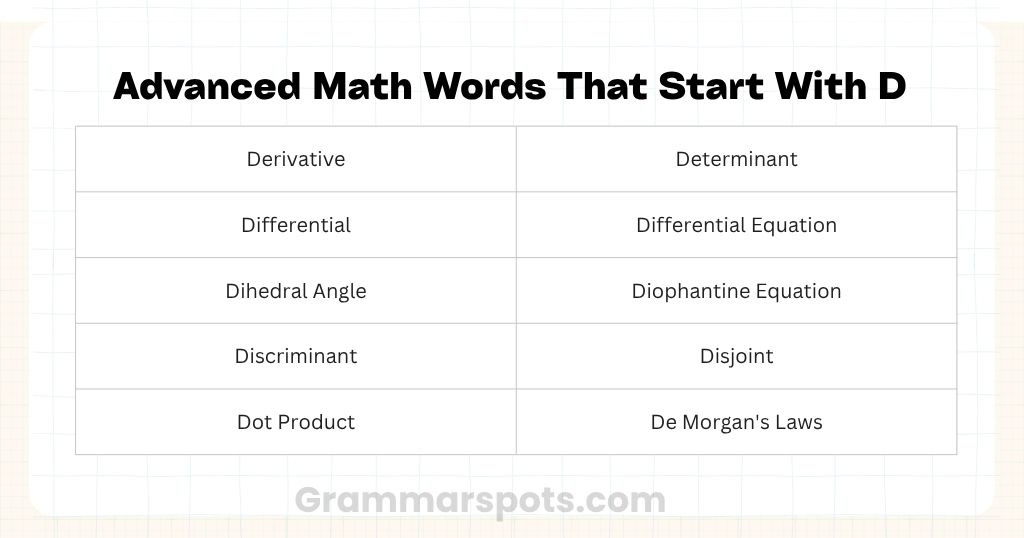
32. Derivative
Meaning: The instantaneous rate of change of a function at any given point.
Math Branch: Calculus
Example: If f(x) = x², then f′(x) = 2x. At x = 3, the rate of change is 6.
Why It Matters: Derivatives are used to find speed from position, optimize functions, and model change in science and economics.
33. Determinant
Meaning: A scalar value calculated from a square matrix that indicates whether the matrix is invertible.
Math Branch: Linear Algebra
Example: For matrix [[3, 1], [2, 4]], the determinant is (3×4) − (1×2) = 10.
Why It Matters: Determinants solve systems of equations, transform coordinates, and power computer graphics.
34. Differential
Meaning: An infinitely small change in a variable, written as dx or dy, used in calculus notation.
Math Branch: Calculus
Example: In dy/dx, both dy and dx represent differentials tiny changes in y and x respectively.
Why It Matters: Differentials form the language of calculus and appear in physics, engineering, and economics equations.
35. Differential Equation
Meaning: An equation that relates a function to its own derivatives.
Math Branch: Calculus
Example: dy/dx = 3y is a differential equation modeling exponential growth.
Why It Matters: Differential equations describe everything from population growth to heat transfer to electrical circuits.
36. Dihedral Angle
Meaning: The angle between two intersecting flat surfaces (planes), measured along their shared edge.
Math Branch: 3D Geometry
Example: Two adjacent faces of a cube meet at a dihedral angle of 90°.
Why It Matters: Dihedral angles appear in crystallography, architecture, and the study of polyhedra.
37. Diophantine Equation
Meaning: A polynomial equation in which only integer solutions are sought.
Math Branch: Number Theory
Example: x² + y² = z² is a Diophantine equation. The integers (3, 4, 5) are one solution.
Why It Matters: Diophantine equations are central to number theory and include some of mathematics’ most famous unsolved problems.
38. Discriminant
Meaning: The expression b² − 4ac from the quadratic formula, which determines the number of real solutions.
Math Branch: Algebra
Example: For x² + 4x + 4 = 0: discriminant = 16 − 16 = 0, giving exactly one real solution.
Why It Matters:
- Discriminant > 0 → two real solutions
- Discriminant = 0 → one real solution
- Discriminant < 0 → no real solutions
39. Disjoint
Meaning: Two sets that share no common elements their intersection is empty.
Math Branch: Set Theory
Example: Set A = {1, 2, 3} and Set B = {7, 8, 9} are disjoint.
Why It Matters: Disjoint sets are used in probability (mutually exclusive events) and Venn diagram problems.
40. Dot Product
Meaning: An operation on two vectors that multiplies corresponding components and adds the results to give a single scalar.
Math Branch: Vector Mathematics
Example: For vectors (3, 4) and (2, 1): dot product = (3×2) + (4×1) = 10.
Why It Matters: Dot products calculate work in physics and determine angles between vectors in computer graphics.
41. De Morgan’s Laws
Meaning: Two logical rules stating:
- NOT (A OR B) = (NOT A) AND (NOT B)
- NOT (A AND B) = (NOT A) OR (NOT B)
Math Branch: Logic / Set Theory
Example: The complement of (A ∪ B) equals (A’ ∩ B’).
Why It Matters: De Morgan’s Laws are used in Boolean algebra, computer programming, and set theory proofs.
42. Dual
Meaning: A related mathematical structure formed by interchanging elements such as swapping points and lines.
Math Branch: Abstract Algebra / Geometry
Example: The dual of a cube is an octahedron.
Why It Matters: Duality principles apply in optimization theory, network analysis, and projective geometry.
43. Dense Set
Meaning: A set where every point in a space is either in the set or arbitrarily close to a point in the set.
Math Branch: Real Analysis
Example: The rational numbers are dense in the real numbers between any two reals, there is always a rational.
Why It Matters: Dense sets are fundamental in real analysis and help define limits and continuity rigorously.
44. Divergence
Meaning: In calculus, a sequence or series diverges if it does not approach a finite limit.
Math Branch: Calculus / Analysis
Example: The series 1 + 2 + 3 + 4 + … diverges because its sum grows without bound.
Why It Matters: Understanding divergence versus convergence is essential in infinite series, calculus, and mathematical analysis.
45. Distribution (Probability)
Meaning: A function describing how probabilities are assigned to each possible outcome of a random variable.
Math Branch: Probability / Statistics
Example: In a normal distribution, data clusters symmetrically around the mean in a bell curve shape.
Why It Matters: Probability distributions are used in statistics, data science, finance, and scientific research.
Related Post: 60+ Math Words That Start With A (With Meanings and Examples)
Geometry Terms Starting With D
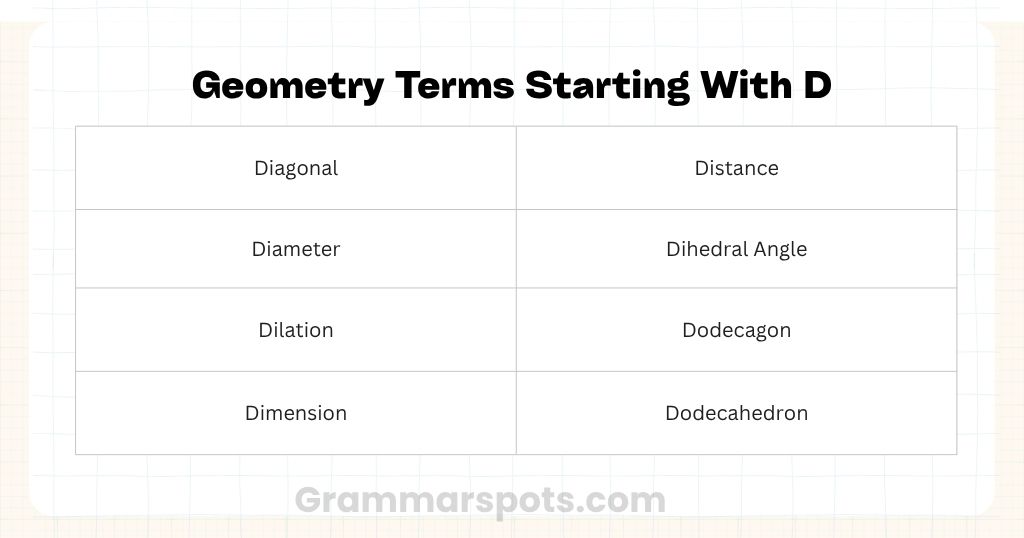
- Diagonal
- Diameter
- Dilation
- Dimension
- Distance
- Dihedral Angle
- Dodecagon
- Dodecahedron
- Degree (Angle)
Statistics Terms Starting With D
- Data
- Data Set
- Decile
- Deviation
- Discrete
- Distribution
Algebra & Functions Terms Starting With D
- Degree (Polynomial)
- Discriminant
- Domain
- Distributive Property
- Decomposition
Calculus Terms Starting With D
- Derivative
- Differential
- Differential Equation
- Divergence
Related Post: 60+ Math Words That Start With C (With Meanings and Examples)
Number Theory & Logic Terms Starting With D
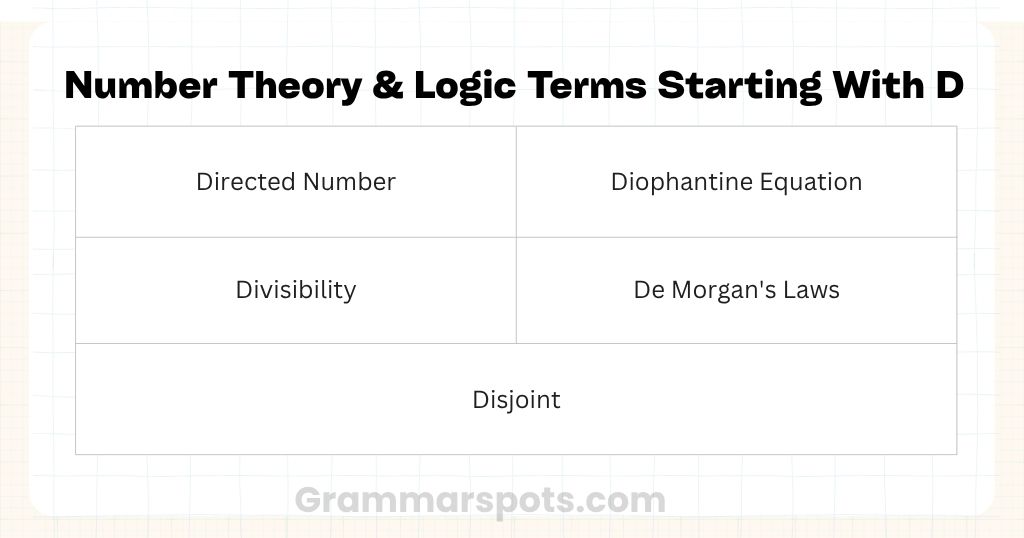
- Directed Number
- Divisibility
- Diophantine Equation
- De Morgan’s Laws
- Disjoint
Real-World Applications
Engineering & Architecture:
- Diameter, depth, dimension, and dihedral angle are used to design structures and machines.
Finance & Economics:
- Decimals, distribution, and derivatives (financial derivatives, not calculus) model prices and risk.
Computer Science:
- Dot product, De Morgan’s Laws, determinant, and discrete math power graphics engines and software logic.
Medicine & Research:
- Decile, deviation, and distribution are used to analyze clinical trial results and population data.
Everyday Life:
- Division, digit, decimal, difference, and distance appear in shopping, cooking, travel, and budgeting.
Tips for Remembering Math Words That Start With D
- Group by subject geometry words together, algebra words together. Context strengthens memory.
- Write one sentence per word active recall beats passive reading every time.
- Use flashcards word on one side, definition and example on the other.
- Connect to real life diameter = tire width, data = sports stats, decimal = price tags.
- Teach someone else explaining a concept forces full understanding.
- Keep a vocabulary journal write each new word with its meaning and a hand-drawn sketch where possible.
Related Post: 50+ Math Words That Start With B (With Meanings and Examples)
Commonly Confused Terms
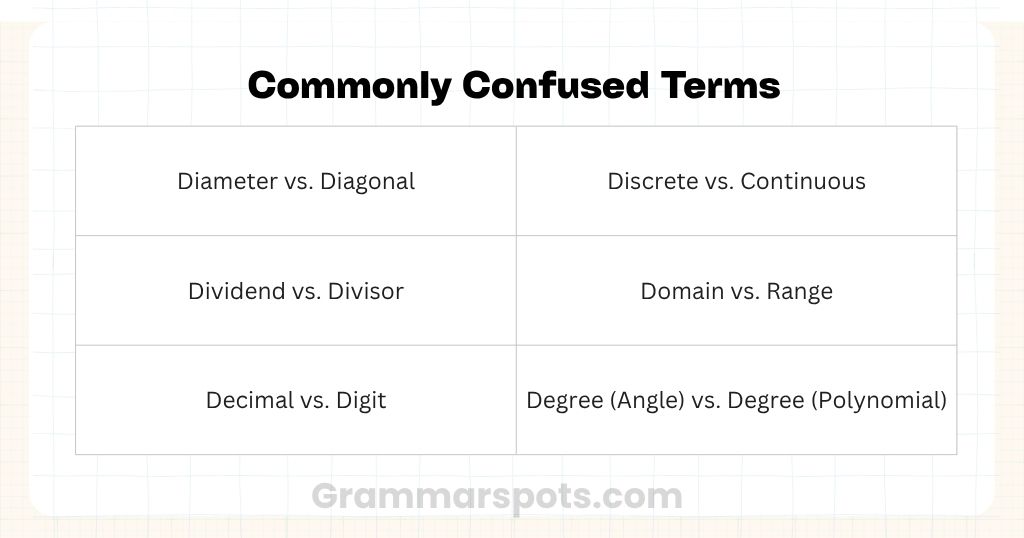
Diameter vs. Diagonal
- Diameter is specific to circles through the center, edge to edge.
- Diagonal applies to polygons corner to non-adjacent corner.
- A rectangle has diagonals. A circle has a diameter. They are not interchangeable.
Dividend vs. Divisor
- Dividend = the number being divided (24 in 24 ÷ 6).
- Divisor = the number you divide by (6 in 24 ÷ 6).
- Memory tip: the Dividend is the bigger number that gets Divided up.
Decimal vs. Digit
- A digit is one symbol (0–9).
- A decimal is a complete number with a decimal point.
- In 5.3, there are two digits (5 and 3), and the whole thing is a decimal.
Degree (Angle) vs. Degree (Polynomial)
- In geometry, degree measures how wide an angle opens (90°, 180°).
- In algebra, degree is the highest exponent in a polynomial (x⁴ has degree 4).
- Same word. Two meanings. Context always tells you which applies.
Discrete vs. Continuous
- Discrete data has gaps only certain values are possible (number of cars: 1, 2, 3).
- Continuous data flows any value in a range is possible (temperature: 36.1°, 36.15°).
- This distinction changes which graphs and formulas you use.
Domain vs. Range
- Domain = valid inputs (x-values) going into a function.
- Range = outputs (y-values) coming out of a function.
- Think of domain as the question and range as the answer.
Frequently Asked Questions
Q1: How many math words start with D?
There are dozens of verified mathematical terms starting with D this guide covers 45+ across arithmetic, geometry, algebra, statistics, calculus, and number theory.
Q2: What are the most important D words in math?
For school: decimal, denominator, diameter, difference, digit, division, domain, and distributive property. These appear across every grade level.
Q3: What does domain mean in math?
Domain is the full set of valid input values for a function. For f(x) = √x, the domain is x ≥ 0, because you cannot take the square root of a negative number in real numbers.
Q4: What is the discriminant used for?
The discriminant (b² − 4ac) tells you how many real solutions a quadratic equation has before you solve it. It is taught in Algebra 2 or around grades 9–10.
Q5: What is the difference between discrete and continuous data?
Discrete data is countable with gaps between values. Continuous data can take any value in a range. Number of siblings is discrete. Your exact height is continuous.
Q6: What is dilation in geometry?
Dilation resizes a shape by a scale factor from a fixed center point. A scale factor greater than 1 enlarges. A scale factor between 0 and 1 shrinks. The shape’s angles stay the same.
Q7: What is a derivative in simple terms?
A derivative measures how fast something is changing at a specific moment. If a car’s position is described by a function, the derivative gives its speed at any instant.
Q8: What is the distributive property?
It states that a(b + c) = ab + ac. Multiplying a number by a sum is the same as multiplying by each part separately. It is one of the most used rules in algebra.
Conclusion
This guide covers 45+ math words that start with D from basic terms like digit, decimal, and division to advanced concepts like derivative, determinant, and Diophantine equation.
Start with the common terms. Build toward the advanced ones. Use the subject categories to study within context, and return to the confused-terms section whenever two words feel too similar.
Strong math vocabulary leads to stronger problem-solving and D is a great letter to master.

I’m Hazel, and I studied BSC English at GCUF. I focus on explaining word meanings in simple, clear language that anyone can understand. My goal is helping readers grasp everyday English, confusing terms, and slang used in real conversations and social media. I believe language learning works best when definitions connect to actual life situations. Through careful research and straightforward explanations, I make vocabulary accessible for students, learners, and anyone curious about how English really works in daily use.