

Math vocabulary starting with B covers nearly every branch of the subject from basic arithmetic and geometry to advanced statistics and calculus. Whether you’re a student building subject knowledge, a teacher preparing a word list, or a parent helping with homework, this guide gives you 50+ verified math terms with clear definitions, examples, and real uses. No filler, no irrelevant words just genuine math vocabulary.
Quick List: 50+ Math Words That Start With B
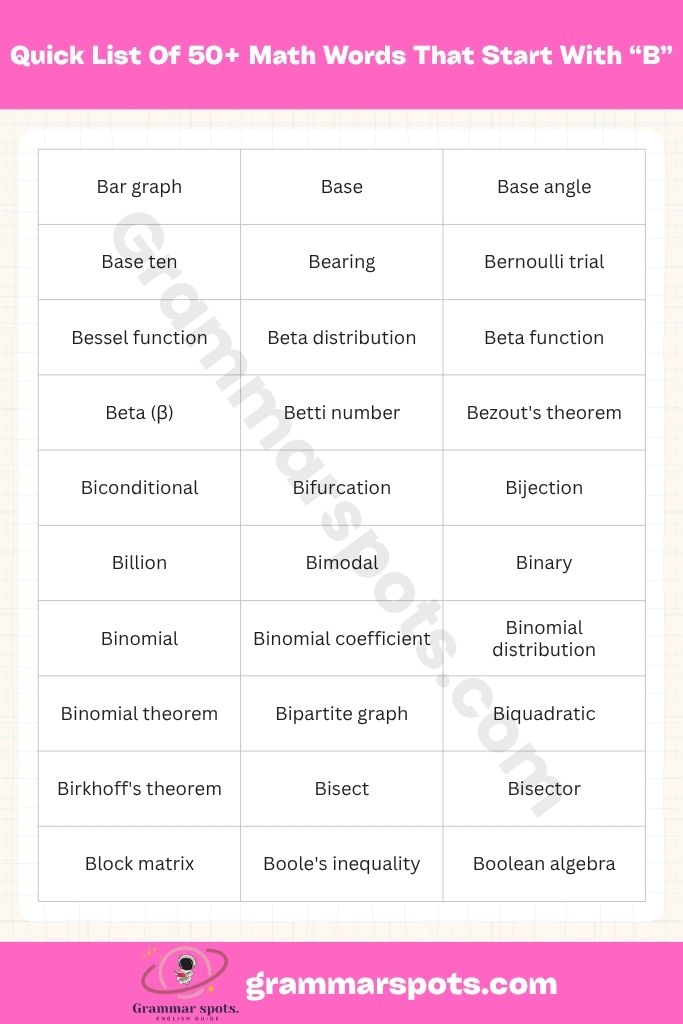
- Bar graph
- Base
- Base angle
- Base ten
- Bearing
- Bernoulli trial
- Bessel function
- Beta distribution
- Beta function
- Beta (β)
- Betti number
- Bezout’s theorem
- Biconditional
- Bifurcation
- Bijection
- Billion
- Bimodal
- Binary
- Binomial
- Binomial coefficient
- Binomial distribution
- Binomial theorem
- Bipartite graph
- Biquadratic
- Birkhoff’s theorem
- Bisect
- Bisector
- Block matrix
- Boole’s inequality
- Boolean algebra
- Boolean expression
- Borel set
- Bound
- Boundary
- Bounded sequence
- Bounded set
- Box plot
- Brace
- Bracket
- Breadth
- Broken line graph
- B-spline
- B-tree
- Branch (of a curve)
- Base vector
- Bijective function
- Binomial series
- Bivariate data
- Bivariate distribution
- Borel measure
- Byte (binary unit)
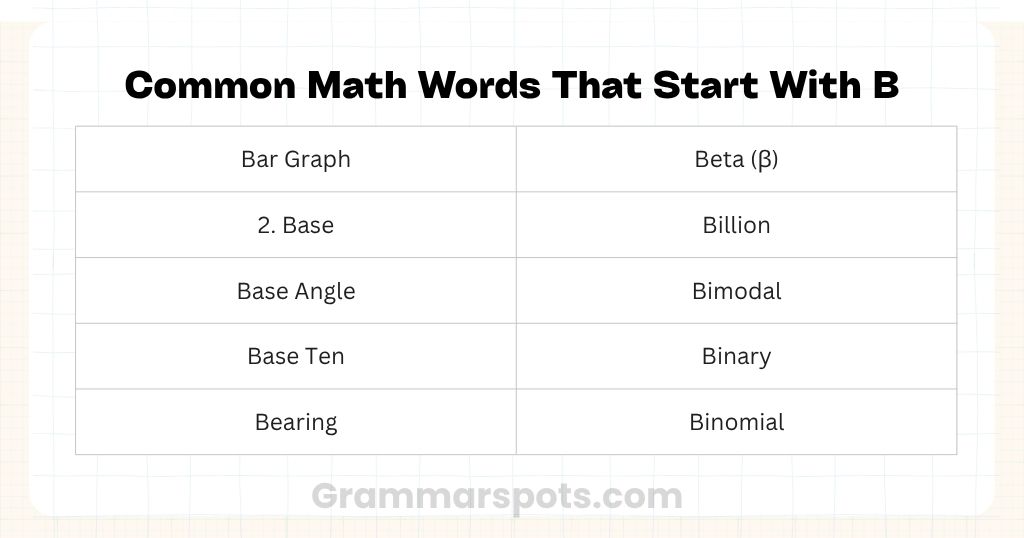
Common Math Words That Start With B
1. Bar Graph
Meaning: A chart using rectangular bars to compare data across categories.
Example: A bar graph showing how many students chose each favorite subject.
Why it matters: One of the first data tools students learn; builds statistical literacy.
2. Base
Meaning: In exponents, the number being raised to a power. In geometry, the bottom reference side of a shape.
Example:
- Exponents: In 5³, the base is 5.
- Geometry: Area of triangle = ½ × base × height.
Why it matters: Appears across exponents, logarithms, number systems, and geometry.
3. Base Angle
Meaning: Either of the two equal angles at the base of an isosceles triangle.
Example: An isosceles triangle with a top angle of 40° has two base angles of 70° each.
Why it matters: Essential for triangle proofs and angle calculations.
4. Base Ten
Meaning: The standard number system built on powers of 10.
Example: 347 = 3 hundreds + 4 tens + 7 ones.
Why it matters: Foundation of all everyday arithmetic and decimal notation.
5. Bearing
Meaning: A direction measured clockwise from north, always written as three digits.
Example: A ship heading due east travels at a bearing of 090°.
Why it matters: Connects geometry to real-world navigation problems.
6. Beta (β)
Meaning: A Greek letter used as a variable or parameter in statistics, algebra, and calculus.
Example: In regression, β represents a slope coefficient.
Why it matters: Used across multiple branches as a standard symbol.
7. Billion
Meaning: The number 1,000,000,000 — one thousand million.
Example: Earth’s population exceeds 8 billion.
Why it matters: Needed for working with large numbers in data, science, and finance.
8. Bimodal
Meaning: A data set with two modes — two values that each appear most frequently.
Example: In {3, 5, 5, 7, 9, 9}, both 5 and 9 are modes — the data is bimodal
Why it matters: Signals two subgroups in a dataset; misleads if treated as unimodal.
9. Binary
Meaning: A base-2 number system using only 0 and 1.
Example: The decimal number 6 = 110 in binary.
Why it matters: The language of all digital computers and electronics.
10. Binomial
Meaning: An algebraic expression with exactly two terms.
Example: 3x + 5 and a² − b are both binomials.
Why it matters: Core building block in algebra, factoring, and the binomial theorem.
11. Bisect
Meaning: To cut something into exactly two equal parts.
Example: Bisecting a 90° angle produces two 45° angles.
Why it matters: Foundational geometric construction used in proofs and design.
12. Bisector
Meaning: A line or ray that divides an angle or segment into two equal parts.
Example: The perpendicular bisector of a 10 cm segment passes through the 5 cm midpoint at 90°.
Why it matters: Appears in triangle theorems, constructions, and coordinate geometry.
13. Box Plot
Meaning: A diagram summarizing data using five values: minimum, Q1, median, Q3, and maximum.
Example: A box plot of exam scores shows the middle 50% of students scored between 60 and 80.
Why it matters: Efficiently shows spread, skew, and outliers in a dataset.
14. Brace { }
Meaning: Curly brackets used in set notation or to group expressions.
Example: The set of even numbers: {2, 4, 6, 8}.
Why it matters: Standard notation in set theory, algebra, and programming.
15. Bracket [ ]
Meaning: Square brackets used to group expressions, often as the outer layer in nested grouping.
Example: 3 × [(4 + 2) − 1] = 3 × 5 = 15.
Why it matters: Critical for correct order of operations.
16. Breadth
Meaning: The side-to-side measurement of a shape; width.
Example: A rectangle of length 12 cm and breadth 5 cm has area 60 cm².
Why it matters: Standard measurement vocabulary, especially in UK curricula.
17. Broken Line Graph
Meaning: A graph connecting plotted data points with straight line segments to show change over time.
Example: Monthly rainfall plotted over 12 months, connected by lines.
Why it matters: Helps students read trends and make predictions from data.
18. Bivariate Data
Meaning: Data that records two variables for each individual or observation.
Example: Recording both height and weight for each student in a class.
Why it matters: Foundation for scatter graphs, correlation, and regression analysis.
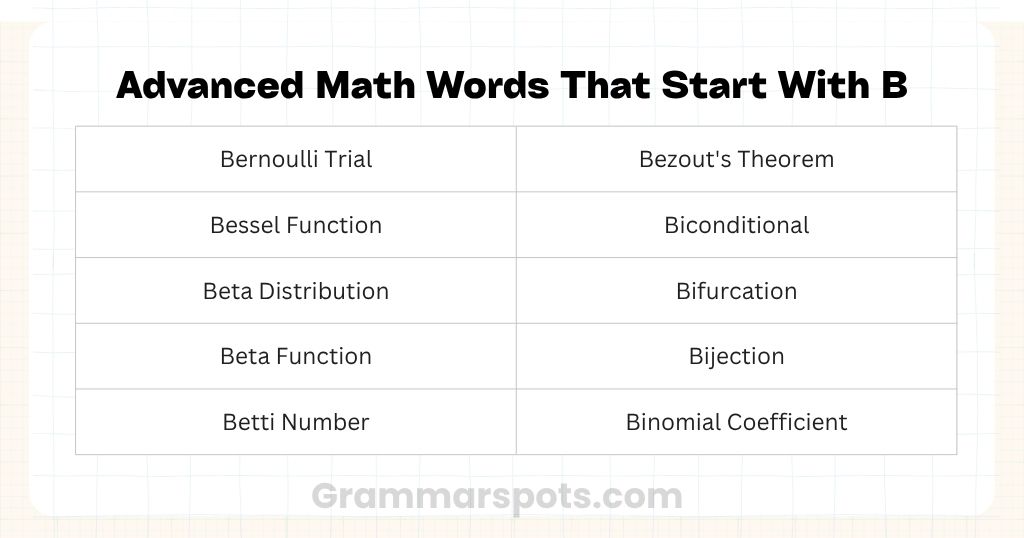
Advanced Math Words That Start With B
19. Bernoulli Trial
Meaning: A random experiment with exactly two outcomes (success/failure) and a constant probability.
Example: Flipping a coin heads = success, tails = failure, p = 0.5 every flip.
Branch: Probability
Application: Clinical trials, quality control, survey sampling.
20. Bessel Function
Meaning: A family of solutions to Bessel’s differential equation, arising in problems with cylindrical symmetry.
Example: Describes vibration patterns of a circular drum.
Branch: Advanced differential equations
Application: Physics, signal processing, engineering.
21. Beta Distribution
Meaning: A continuous probability distribution defined on [0, 1], shaped by two parameters α and β.
Example: Used to model conversion rates based on observed successes and failures.
Branch: Statistics / Probability
Application: Bayesian statistics, A/B testing, machine learning.
22. Beta Function
Meaning: A special function B(x, y) = Γ(x)Γ(y) / Γ(x+y), linked to the gamma function.
Example: B(2, 3) = 1/12.
Branch: Calculus / Analysis
Application: Probability theory, combinatorics, physics integrals.
23. Betti Number
Meaning: A topological invariant counting independent cycles in a shape.
Example: A torus (donut) has a first Betti number of 2.
Branch: Algebraic topology
Application: Classifying surfaces; data shape analysis.
24. Bezout’s Theorem
Meaning: Two polynomial curves of degrees m and n intersect in exactly m × n points (in the complex projective plane, counting multiplicity).
Example: A line (degree 1) and a circle (degree 2) intersect in 2 points.
Branch: Algebraic geometry
Application: Solving polynomial systems, robotics path planning.
25. Biconditional
Meaning: A logical statement meaning “P if and only if Q” — true when both sides share the same truth value.
Example: “A triangle is equilateral if and only if all its angles are 60°.”
Branch: Logic
Application: Mathematical proofs, circuit design.
26. Bifurcation
Meaning: A point where a small change in a system’s parameter causes a sudden qualitative shift in behavior.
Example: In population models, increasing the growth rate past a threshold causes oscillation instead of steady equilibrium.
Branch: Dynamical systems / Chaos theory
Application: Climate modeling, structural engineering, ecology.
27. Bijection
Meaning: A function that is both injective (one-to-one) and surjective (onto) — every element pairs perfectly with exactly one other.
Example: f(x) = 2x from ℝ to ℝ is bijective.
Branch: Set theory
Application: Cryptography, proving two infinite sets have equal size.
28. Binomial Coefficient
Meaning: The number of ways to choose k items from n without regard to order: C(n, k) = n! / (k!(n−k)!)
Example: C(5, 2) = 10.
Branch: Combinatorics
Application: Pascal’s triangle, probability, genetics.
29. Binomial Distribution
Meaning: A probability distribution for the number of successes in n independent Bernoulli trials with probability p.
Example: Flipping a fair coin 10 times — number of heads follows Binomial(n=10, p=0.5).
Branch: Probability / Statistics
Application: Quality control, clinical testing, survey analysis.
30. Binomial Theorem
Meaning: A formula for expanding (a + b)ⁿ as a sum using binomial coefficients.
Example: (x + 1)³ = x³ + 3x² + 3x + 1.
Branch: Algebra / Combinatorics
Application: Polynomial expansion, approximation methods.
31. Binomial Series
Meaning: The infinite series expansion of (1 + x)ⁿ for any real n, valid when |x| < 1.
Example: (1 + x)^(1/2) ≈ 1 + x/2 − x²/8 + … for small x.
Branch: Calculus
Application: Approximation in physics and engineering.
32. Bipartite Graph
Meaning: A graph whose vertices split into two groups where edges only connect across groups, never within.
Example: Workers on one side, tasks on the other — edges show who can do what.
Branch: Graph theory
Application: Scheduling, matching problems, network flow.
33. Biquadratic
Meaning: A degree-4 polynomial with only even-power terms: ax⁴ + bx² + c = 0.
Example: x⁴ − 5x² + 4 = 0 is solved by substituting u = x².
Branch: Algebra
Application: Symmetric engineering and physics problems.
34. Birkhoff’s Theorem
Meaning: In ergodic theory, describes the long-run time average of a dynamical system. In relativity, states any spherically symmetric vacuum solution equals the Schwarzschild metric.
Example: Time averages equal space averages for ergodic systems.
Branch: Ergodic theory / Mathematical physics
Application: Statistical mechanics, general relativity.
35. Bivariate Distribution
Meaning: A probability distribution over two random variables simultaneously.
Example: Modeling the joint distribution of height and weight.
Branch: Statistics
Application: Multivariate analysis, risk modeling.
36. Block Matrix
Meaning: A matrix divided into smaller submatrices (blocks) that can be manipulated as single units.
Example: A 4×4 matrix partitioned into four 2×2 blocks.
Branch: Linear algebra
Application: Computer graphics, numerical methods, machine learning.
37. Boole’s Inequality
Meaning: The probability of a union of events is at most the sum of individual probabilities:
P(A₁ ∪ … ∪ Aₙ) ≤ P(A₁) + … + P(Aₙ)
Example: P(A) = 0.3, P(B) = 0.4 → P(A ∪ B) ≤ 0.7.
Branch: Probability theory
Application: Risk bounding, algorithm error analysis.
38. Boolean Algebra
Meaning: An algebraic system with variables taking only two values (true/false or 1/0), using AND, OR, NOT.
Example: (1 AND 0) = 0; (1 OR 0) = 1; NOT 1 = 0.
Branch: Logic / Discrete mathematics
Application: Digital circuits, computer architecture, programming.
39. Boolean Expression
Meaning: A logical formula that evaluates to either true or false.
Example: (x > 3) AND (x < 10) is true when x = 5.
Branch: Logic
Application: Programming conditionals, search filters, circuit design.
40. Borel Set
Meaning: Any set formed from open sets through countable unions, intersections, and complements.
Example: All open and closed intervals on the real line are Borel sets.
Branch: Measure theory
Application: Rigorous probability, real analysis.
41. Borel Measure
Meaning: A measure defined on all Borel sets of a topological space that assigns sizes to sets consistently.
Example: Lebesgue measure on ℝ is a Borel measure.
Branch: Measure theory
Application: Integration theory, probability foundations.
42. Bound
Meaning: A value that limits a function or set from above (upper bound) or below (lower bound).
Example: The sequence 1, 1/2, 1/4, … has upper bound 1 and lower bound 0.
Branch: Analysis
Application: Convergence proofs, optimization, numerical analysis.
43. Boundary
Meaning: The set of points at the edge of a region where every neighborhood contains both interior and exterior points.
Example: The boundary of a disk is its enclosing circle.
Branch: Topology / Analysis
Application: Differential equations, physics, fluid dynamics.
44. Bounded Sequence
Meaning: A sequence where all terms lie within a fixed finite range.
Example: 1, 1/2, 1/4, 1/8, … is bounded between 0 and 1.
Branch: Real analysis
Application: Convergence theorems, numerical methods.
45. Bounded Set
Meaning: A set where all elements lie within a finite distance from a fixed point.
Example: The interval [−5, 5] is bounded; the set of all integers is not.
Branch: Real analysis
Application: Compactness, optimization, functional analysis.
46. Base Vector
Meaning: One of the vectors in a basis that spans a vector space — all other vectors can be expressed as combinations of base vectors.
Example: In 2D space, the standard base vectors are i = (1, 0) and j = (0, 1).
Branch: Linear algebra
Application: Physics, engineering, computer graphics.
47. Branch (of a Curve)
Meaning: One continuous, disconnected portion of a curve.
Example: The hyperbola y = 1/x has two branches — one in the first quadrant, one in the third.
Branch: Calculus / Analytic geometry
Application: Optics, orbital mechanics, function analysis.
48. B-spline
Meaning: A smooth piecewise polynomial curve defined over a set of control points and knots.
Example: Used to model the smooth contour of a car body in design software.
Branch: Numerical analysis / Applied mathematics
Application: Computer graphics, animation, industrial design.
49. B-tree
Meaning: A self-balancing tree data structure where each node holds multiple keys and children, keeping operations efficient.
Example: A B-tree of order 3 allows each node up to 3 children.
Branch: Discrete mathematics / Computer science
Application: Database indexing, file systems, search algorithms.
50. Byte
Meaning: A unit of digital information equal to 8 bits, where each bit is a binary digit (0 or 1).
Example: A single character in ASCII encoding takes 1 byte = 8 bits.
Branch: Computer mathematics / Binary systems
Application: Memory measurement, data storage, digital communication.
Geometry Terms
- Base
- Base angle
- Bearing
- Bisect
- Bisector
- Boundary
- Branch (of a curve)
- Breadth
Related Post: 60+ Math Words That Start With C (With Meanings and Examples)
Statistics and Probability Terms
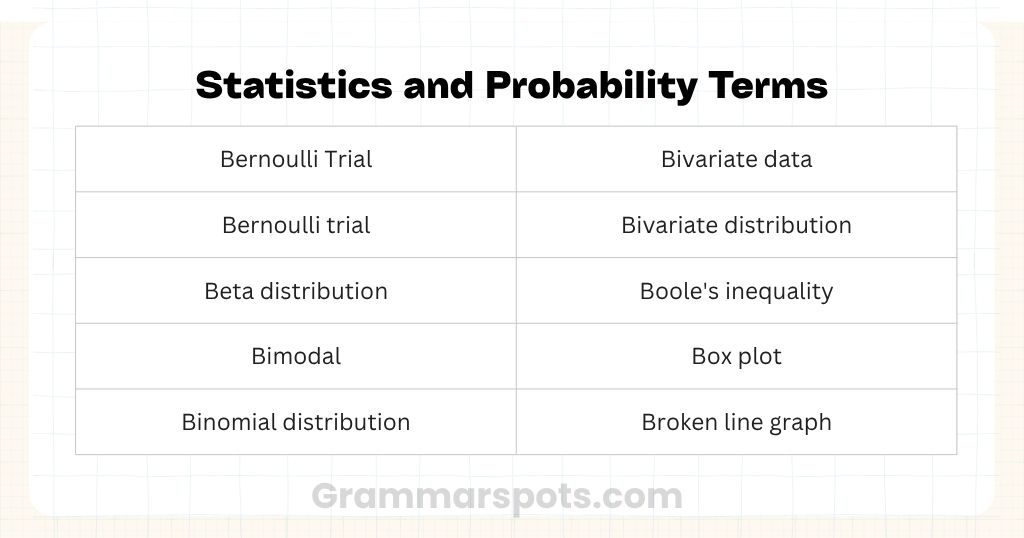
- Bar graph
- Bernoulli trial
- Beta distribution
- Bimodal
- Binomial distribution
- Bivariate data
- Bivariate distribution
- Boole’s inequality
- Box plot
- Broken line graph
Algebra Terms
- Base
- Beta (β)
- Binomial
- Binomial coefficient
- Binomial theorem
- Binomial series
- Biquadratic
- Boolean expression
- Bracket
- Brace
Number Systems and Arithmetic
- Base ten
- Binary
- Billion
- Byte
Logic and Discrete Mathematics
- Biconditional
- Bipartite graph
- Boolean algebra
- Boolean expression
- Boole’s inequality
- B-tree
Related Post: 45+ Math Words That Start With D (With Meanings and Examples)
Advanced Analysis and Applied Mathematics
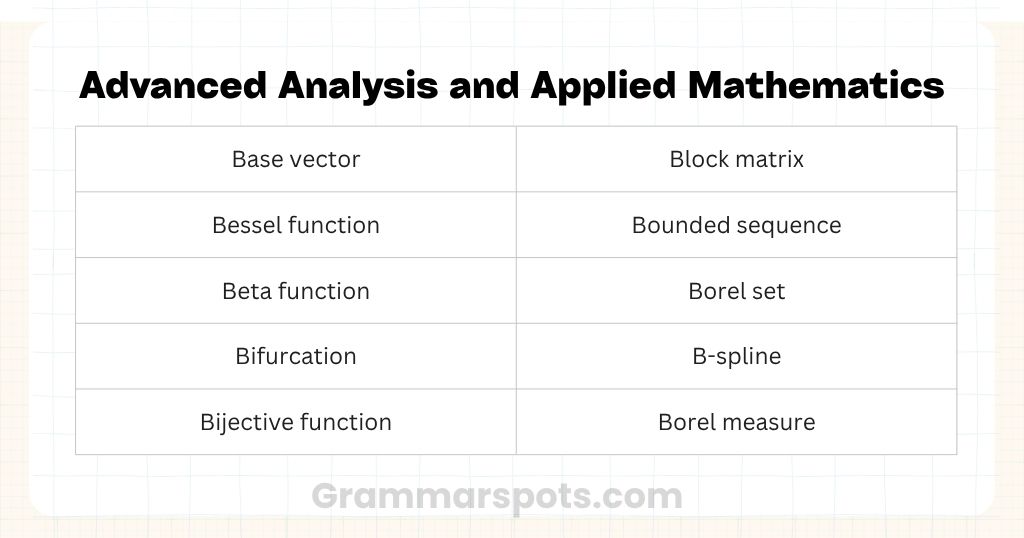
- Base vector
- Bessel function
- Beta function
- Betti number
- Bifurcation
- Bijection
- Bijective function
- Birkhoff’s theorem
- Block matrix
- Bound
- Bounded sequence
- Bounded set
- Borel set
- Borel measure
- B-spline
Commonly Confused Terms
Base vs. Basis
- Base is a specific number or geometric side.
- Basis (linear algebra) is a full set of vectors spanning a vector space.
- Related in concept, but not interchangeable.
Bisector vs. Median
- Bisector divides an angle or segment in half.
- Median connects a vertex to the midpoint of the opposite side.
- Both pass through triangles — but for different purposes.
Binary vs. Boolean
- Binary is a number system (base-2 digits: 0 and 1).
- Boolean is a logical system (values: true and false).
- Computers use both, but they answer different questions.
Binomial vs. Polynomial
- A binomial has exactly two terms.
- A polynomial has any number of terms.
- All binomials are polynomials; not all polynomials are binomials.
Bound vs. Boundary
- Bound is a numerical limit a set or function stays within.
- Boundary is the geometric/topological edge of a region.
- Different branches, different precise meanings.
Bar Graph vs. Histogram
- Bar graph: categorical data, bars have gaps.
- Histogram: continuous numerical data, bars touch.
- Visually similar, mathematically distinct.
Bounded Set vs. Bounded Sequence
- A bounded set is a collection of values within a finite range.
- A bounded sequence is an ordered list where all terms stay within a range.
- A bounded sequence forms a bounded set, but sets aren’t always sequences.
Related Post: 55+ Math Words That Start With E (With Meanings and Examples)
Real-World Applications
Measurement and Construction
- Breadth, base, and bisectors are used in architecture, carpentry, and engineering to calculate dimensions and divide materials.
Data and Reporting
- Bar graphs, box plots, and broken line graphs appear in news, research reports, and business dashboards to communicate data clearly.
Computer Science
- Binary, Boolean algebra, and B-trees are foundational to how computers process data, make decisions, and retrieve stored information.
Navigation
- Bearings connect trigonometry to real-world direction-finding for pilots, sailors, and hikers.
Probability and Risk
- Bernoulli trials and the binomial distribution model test accuracy, product reliability, and clinical outcomes.
Physics and Engineering
- Bessel functions describe heat conduction and wave propagation in cylindrical objects.
- Bifurcation theory models how systems bridges, fluids, populations suddenly shift behavior.
Learning Tips
- Group by prefix. Bi- means two — binary, bisect, binomial, bimodal, bipartite, biconditional, bijection all share it. Learn the prefix, decode multiple words.
- Study by branch. Focus on geometry B-words during geometry unit, statistics B-words during data unit. Context makes meaning stick.
- Write your own examples. Don’t copy create a sentence using the term in your own words.
- Use flashcards. Write the term on one side, definition + example on the other.
- Spot the term in problems. When you see a B-word in a textbook question, pause and define it before solving.
FAQs
Q: What are the most common B math words for beginners?
Base, bar graph, bisect, binary, binomial, breadth, and box plot cover most beginner and middle school needs.
Q: What does the prefix “bi-” mean in math?
It means two appearing in binary, bisect, binomial, bimodal, bipartite, bijection, biconditional, and more.
Q: Is “base” always the same thing?
No. In exponents it’s the number being multiplied by itself. In geometry it’s the reference side. In number systems it defines the counting structure. Context always determines meaning.
Q: When do students learn the binomial theorem?
Typically in grades 10–12 (Algebra 2, Pre-Calculus, or A-level), then revisited in university algebra and calculus.
Q: What is Boolean algebra used for?
Designing logic gates in digital circuits, writing programming conditionals, and solving problems in discrete mathematics.
Q: What is the difference between a bar graph and a box plot?
A bar graph compares categories. A box plot summarizes the spread and center of one numerical dataset using five values.
Q: Is binary the same as Boolean?
No. Binary is a number system (base-2). Boolean is a logic system (true/false). They use the same symbols (0 and 1) but serve different mathematical purposes.
Q: What is a Bernoulli trial in simple terms?
Any experiment with exactly two outcomes where the probability doesn’t change between repetitions like flipping a coin or testing a component pass/fail.
Conclusion
This guide covers 50+ genuine math words starting with B from beginner terms like base and bar graph to advanced concepts like bifurcation, bijection, and Bessel functions. Each term belongs to a specific branch of mathematics, has a precise meaning, and shows up in real learning contexts. Use this as a reference during study, a vocabulary builder for exams, or a teaching resource for building mathematical fluency.

I’m Hazel, and I studied BSC English at GCUF. I focus on explaining word meanings in simple, clear language that anyone can understand. My goal is helping readers grasp everyday English, confusing terms, and slang used in real conversations and social media. I believe language learning works best when definitions connect to actual life situations. Through careful research and straightforward explanations, I make vocabulary accessible for students, learners, and anyone curious about how English really works in daily use.