


Math vocabulary builds the foundation for clear thinking across every subject from basic arithmetic to advanced university mathematics. If you need math words that start with J, this guide covers all of them: common classroom terms, advanced concepts, and specialized vocabulary each with a plain-English definition, a real example, and a note on why it matters.
This list is built for students, teachers, and parents. Every term here is a genuine mathematical word. Nothing is included just to reach a word count.
Quick List: 55+ Math Words That Start With J
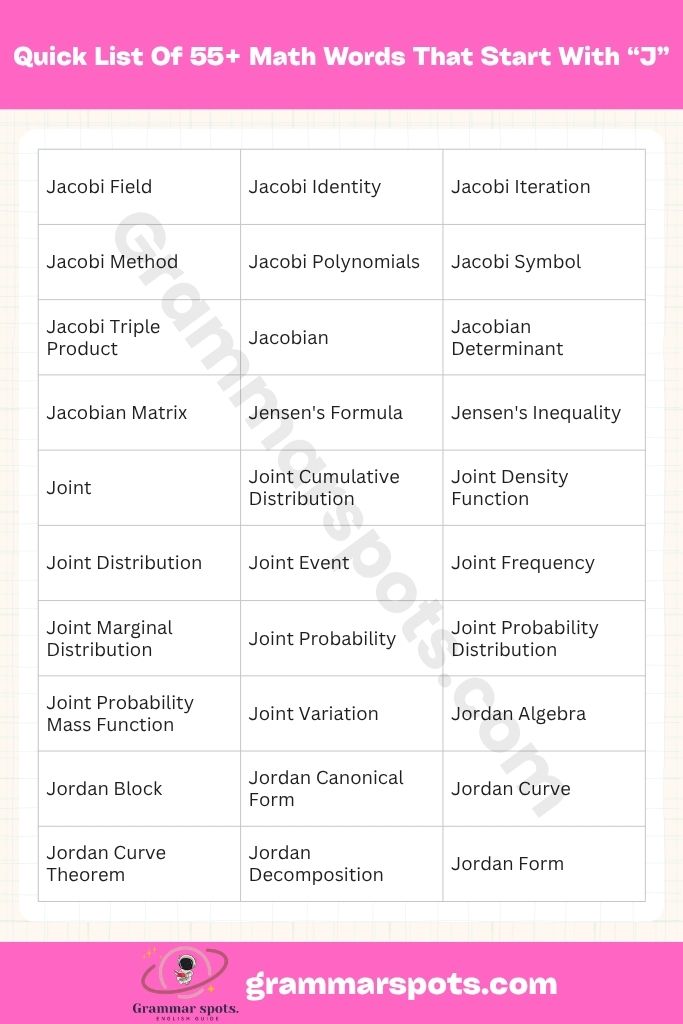
- Jacobi Field
- Jacobi Identity
- Jacobi Iteration
- Jacobi Method
- Jacobi Polynomials
- Jacobi Symbol
- Jacobi Triple Product
- Jacobian
- Jacobian Determinant
- Jacobian Matrix
- Jensen’s Formula
- Jensen’s Inequality
- Joint
- Joint Cumulative Distribution
- Joint Density Function
- Joint Distribution
- Joint Event
- Joint Frequency
- Joint Marginal Distribution
- Joint Probability
- Joint Probability Distribution
- Joint Probability Mass Function
- Joint Variation
- Jordan Algebra
- Jordan Block
- Jordan Canonical Form
- Jordan Curve
- Jordan Curve Theorem
- Jordan Decomposition
- Jordan Form
- Jordan Matrix
- Jordan Measure
- Jordan Normal Form
- Julia Set
- Jump
- Jump Condition
- Jump Discontinuity
- Jump Function
- Jump Matrix
- Jump Process
- j (Imaginary Unit in Engineering)
- j-function
- j-invariant
- Joining
- Juxtaposition (Mathematical)
Bonus Advanced Terms
- Jacobi Elliptic Functions
- Jacobi–Anger Expansion
- Jordan–Chevalley Decomposition
- Jordan Content
- Jordan Totient Function
- Julia–Carathéodory Theorem
- Jump Diffusion
- Jump Operator
- Jensen Gap
- Joint Moment
- Joint Entropy
Total: 56 verified math terms
Common Math Words That Start With J
1. Joint
Meaning: Describes two or more variables or events considered together simultaneously.
Example: A joint event is rolling a 4 on a die AND flipping heads on a coin both at once.
Why It Matters: The word “joint” is the foundation for all two-variable probability and statistics topics. Every joint distribution, joint frequency, and joint probability builds on this idea.
2. Joint Event
Meaning: An event that requires two or more conditions to occur at the same time.
Example: Drawing a red card AND a face card from a deck in one draw is a joint event.
Why It Matters: Identifying joint events correctly is the first step in computing joint probabilities.
3. Joint Frequency
Meaning: The count of times two specific categories appear together in a two-way table.
Example: In a class survey, if 18 students are both male and prefer math, the joint frequency is 18.
Why It Matters: Joint frequency tables are standard in middle and high school statistics for comparing two categorical variables.
4. Joint Probability
Meaning: The probability that two events both occur written P(A ∩ B).
Example: P(rain) = 0.3, P(cold) = 0.4. If independent: P(rain ∩ cold) = 0.3 × 0.4 = 0.12.
Why It Matters: Joint probability is the entry point into probability theory and leads directly into conditional probability and independence.
5. Joint Distribution
Meaning: A probability distribution that describes the behavior of two or more random variables together.
Example: A table showing the probability of every combination of two dice outcomes is a joint distribution.
Why It Matters: Joint distributions describe how variables relate to each other essential in statistics, machine learning, and data science.
6. Joint Probability Distribution
Meaning: The complete function or table that assigns probabilities to every possible combination of values for two or more variables.
Example: For random variables X and Y, the joint probability distribution lists P(X = x, Y = y) for every pair (x, y).
Why It Matters: This is the formal version of joint distribution used in rigorous probability theory and statistics courses.
7. Joint Probability Mass Function
Meaning: A joint probability distribution specifically for discrete random variables, giving the probability at each pair of values.
Example: For two dice, the joint PMF gives the probability of getting, say, (2, 5) which is 1/36.
Why It Matters: The PMF is the precise mathematical tool used to work with discrete joint distributions in probability courses.
8. Joint Cumulative Distribution
Meaning: A function F(x, y) giving the probability that X ≤ x AND Y ≤ y simultaneously.
Example: F(3, 5) = P(X ≤ 3 and Y ≤ 5) for two jointly distributed variables.
Why It Matters: Used in advanced probability to compute regions of probability and understand the structure of multivariate distributions.
9. Joint Density Function
Meaning: For continuous random variables, the function f(x, y) whose integral over any region gives the probability the variables fall in that region.
Example: The probability that X is between 1 and 2 AND Y is between 0 and 1 is computed by integrating the joint density over that rectangle.
Why It Matters: Joint density functions are the continuous counterpart of the joint PMF and are central to multivariate calculus and probability.
10. Joint Marginal Distribution
Meaning: The probability distribution of one variable obtained by summing or integrating over all values of the other variables in a joint distribution.
Example: From a joint distribution of X and Y, the marginal distribution of X is found by summing P(X = x, Y = y) over all values of y.
Why It Matters: Marginal distributions let you isolate one variable from a joint setup — a critical step in statistical analysis.
11. Joint Moment
Meaning: A statistical measure describing the combined behavior of two random variables, generalizing the concept of moments (mean, variance) to two dimensions.
Example: The joint moment E[XY] is used to compute the covariance of X and Y: Cov(X,Y) = E[XY] − E[X]E[Y].
Why It Matters: Joint moments underpin correlation and covariance two of the most widely used measures in statistics.
12. Joint Variation
Meaning: A relationship where one variable varies directly with two or more other variables at the same time. Formula: z = kxy.
Example: The volume of a cylinder varies jointly with its height and the square of its radius: V = πr²h.
Why It Matters: Joint variation is a core algebra topic and appears in physics, science, and standardized exam problems.
13. Juxtaposition
Meaning: In mathematical notation, placing two symbols or expressions side by side to indicate multiplication without writing a multiplication sign.
Example: Writing 3x means 3 × x. Writing ab means a × b. The juxtaposition implies multiplication.
Why It Matters: Students who don’t understand juxtaposition misread algebraic expressions. It’s a fundamental notation rule used throughout algebra and beyond.
14. Joining
Meaning: In set theory and lattice theory, the join of two elements is the least upper bound the smallest element greater than or equal to both.
Example: In the set of natural numbers ordered by divisibility, the join of 4 and 6 is 12 (least common multiple).
Why It Matters: Joining is the lattice-theory version of union and connects set theory, logic, and abstract algebra.
15. Jump
Meaning: A sudden, finite change in the value of a function at a specific point, where the function leaps from one value to another.
Example: The signum function jumps from −1 to +1 at x = 0 with no gradual transition.
Why It Matters: Recognizing jumps is a foundational skill in calculus for analyzing function behavior and continuity.
16. Jump Discontinuity
Meaning: A discontinuity where the left-hand limit and right-hand limit both exist at a point but are not equal to each other.
Example: f(x) = 1 for x ≥ 0 and f(x) = −1 for x < 0 has a jump discontinuity at x = 0. Left limit = −1, right limit = 1.
Why It Matters: Jump discontinuity is one of the three main discontinuity types in calculus and is directly tested in limits and continuity problems.
17. Jump Function
Meaning: A function that remains constant between specific points but jumps by a finite amount at those points also called a step function.
Example: A tax bracket system that charges 10% up to $10,000, then 20% above — the tax rate is a jump function.
Why It Matters: Jump functions model real-world stepped behavior and appear in economics, physics, and engineering applications.
18. j (Imaginary Unit in Engineering)
Meaning: The symbol used for √(−1) in electrical engineering and applied mathematics, where i already denotes electric current.
Example: An impedance might be expressed as Z = 5 + 3j, where j = √(−1).
Why It Matters: Students moving from pure mathematics into engineering must recognize this notation shift the math is identical, only the symbol changes.
Related Post: 40+ Math Words That Start With I (With Meanings and Examples)
Advanced Math Words That Starting With J

19. Jacobian
Meaning: A generalization of the derivative to functions of multiple variables. It describes how a multivariable function changes near a point.
Example: For a 2D transformation, the Jacobian tells you how areas scale under the mapping.
Why It Matters: Jacobians appear in multivariable calculus, optimization, robotics, machine learning, and physics.
20. Jacobian Matrix
Meaning: A matrix containing all first-order partial derivatives of a vector-valued function. For f: ℝⁿ → ℝᵐ, it is an m × n matrix where entry (i, j) = ∂fᵢ/∂xⱼ.
Example:
For f(x, y) = (x², xy), the Jacobian Matrix is:
[2x 0]
[y x]
Why It Matters: The Jacobian Matrix is used in neural network backpropagation, coordinate transformations, and nonlinear equation solving.
21. Jacobian Determinant
Meaning: The determinant of the Jacobian Matrix. It gives the factor by which a transformation scales areas (2D) or volumes (3D).
Example: When converting from Cartesian to polar coordinates, the Jacobian determinant is r which is why dA = r dr dθ in polar integrals.
Why It Matters: Every change of variables in a multivariable integral requires the Jacobian determinant as a scaling correction.
22. Jacobi Method
Meaning: An iterative algorithm for solving a system of linear equations Ax = b, particularly effective when the coefficient matrix is diagonally dominant.
Example: Starting with an initial guess, the Jacobi Method updates each variable using the previous iteration’s values until the solution converges.
Why It Matters: The Jacobi Method is a fundamental algorithm in numerical analysis, used in engineering simulations and scientific computing.
23. Jacobi Iteration
Meaning: The single update step within the Jacobi Method, where all variables are updated simultaneously using values from the previous step.
Example: In each Jacobi Iteration, x₁, x₂, and x₃ are all recalculated at once before moving to the next step.
Why It Matters: Understanding Jacobi Iteration helps students grasp how computers solve large systems of equations that resist direct algebraic methods.
24. Jacobi Symbol
Meaning: A generalization of the Legendre symbol in number theory. For integer a and positive odd integer n, the Jacobi symbol (a/n) is a product of Legendre symbols over the prime factorization of n.
Example: (2/15) = (2/3)(2/5) = (−1)(−1) = 1.
Why It Matters: The Jacobi Symbol is used in primality testing algorithms, including the Solovay–Strassen test, which underlies modern cryptographic systems.
25. Jacobi Polynomials
Meaning: A family of orthogonal polynomials defined on [−1, 1], parameterized by α and β, that generalize Legendre, Chebyshev, and Gegenbauer polynomials.
Example: Setting α = β = 0 in Jacobi Polynomials gives Legendre Polynomials.
Why It Matters: Jacobi Polynomials appear in numerical integration (Gauss–Jacobi quadrature), quantum mechanics, and approximation theory.
26. Jacobi Triple Product
Meaning: An identity expressing an infinite product as an infinite bilateral sum involving powers of two variables q and z.
Formula: ∏(n≥1) (1−q²ⁿ)(1+q²ⁿ⁻¹z²)(1+q²ⁿ⁻¹z⁻²) = Σ(n=−∞ to ∞) qⁿ²z²ⁿ
Why It Matters: The Jacobi Triple Product is used in combinatorics, number theory, and mathematical physics. It gives elegant proofs of partition identities.
27. Jacobi Field
Meaning: A vector field along a geodesic satisfying the Jacobi equation, describing how nearby geodesics diverge or converge.
Example: In general relativity, Jacobi Fields describe how two nearby free-falling particles move relative to each other in curved spacetime.
Why It Matters: Jacobi Fields are fundamental in Riemannian geometry and underpin the mathematics of curved space in general relativity.
28. Jacobi Identity
Meaning: An algebraic identity satisfied by certain binary operations, including the Lie bracket. States: [x,[y,z]] + [y,[z,x]] + [z,[x,y]] = 0.
Example: The cross product of 3D vectors satisfies the Jacobi Identity.
Why It Matters: The Jacobi Identity defines Lie algebras, which are central to the mathematics of symmetry, particle physics, and differential geometry.
29. Jacobi Elliptic Functions
Meaning: A set of three fundamental elliptic functions (sn, cn, dn) that generalize trigonometric functions to doubly periodic functions in the complex plane.
Example: sn(u, k) reduces to sin(u) when k = 0.
Why It Matters: Jacobi Elliptic Functions appear in classical mechanics (pendulum motion), electromagnetism, and the study of elliptic curves.
30. Jacobi–Anger Expansion
Meaning: An identity in mathematical physics expressing a plane wave as an infinite series of Bessel functions:
eⁱᶻ ˢⁱⁿ⁽θ⁾ = Σ Jₙ(z)eⁱⁿθ
Why It Matters: Used extensively in wave scattering, antenna theory, and quantum mechanics to decompose waves into angular components.
31. Jensen’s Inequality
Meaning: For a convex function f and random variable X: f(E[X]) ≤ E[f(X)]. For a concave function, the inequality reverses.
Example: Since x² is convex: (E[X])² ≤ E[X²] directly related to the definition of variance.
Why It Matters: Jensen’s Inequality is used in probability theory, information theory, economics, and machine learning (EM algorithm).
32. Jensen’s Formula
Meaning: A result in complex analysis relating the values of an analytic function inside a disk to its zeros and boundary values.
Example: For a function f with zeros inside a disk of radius r, Jensen’s Formula expresses log|f(0)| in terms of those zeros and a boundary integral.
Why It Matters: Jensen’s Formula is a key tool in complex analysis and analytic number theory for studying zero distributions of functions.
33. Jensen Gap
Meaning: The difference between the two sides of Jensen’s Inequality: E[f(X)] − f(E[X]) for a convex function f.
Example: For f(x) = x², the Jensen Gap equals the variance of X: E[X²] − (E[X])² = Var(X).
Why It Matters: The Jensen Gap quantifies how far a function deviates from linearity and appears in refinements of classical inequalities and machine learning bounds.
34. Joint Entropy
Meaning: The entropy of two random variables X and Y considered together, measuring the total uncertainty in both simultaneously.
Formula: H(X, Y) = −Σ P(x,y) log P(x,y)
Example: If X and Y are independent, then H(X, Y) = H(X) + H(Y).
Why It Matters: Joint entropy is a core concept in information theory, data compression, and communication systems.
35. Jordan Block
Meaning: A square matrix with a single eigenvalue λ on the diagonal and 1s immediately above the diagonal (superdiagonal), with zeros elsewhere.
Example:
[λ 1 0]
[0 λ 1]
[0 0 λ]
Why It Matters: Jordan Blocks are the building blocks of Jordan Normal Form the most general representation of a square matrix.
36. Jordan Matrix
Meaning: A block diagonal matrix composed of Jordan Blocks. Each block corresponds to one eigenvalue.
Example: A Jordan Matrix might have a 2×2 Jordan Block for λ = 3 and a 1×1 block for λ = 5.
Why It Matters: Jordan Matrices represent the structure of linear transformations that cannot be fully diagonalized.
37. Jordan Normal Form
Meaning: The unique block diagonal representation of any square matrix over the complex numbers, made up of Jordan Blocks.
Example: A matrix with eigenvalue λ = 2 (repeated 3 times, deficient) has a Jordan Normal Form with one 3×3 Jordan Block for λ = 2.
Why It Matters: Jordan Normal Form is essential in linear algebra for computing matrix powers, exponentials, and solving differential equation systems.
38. Jordan Canonical Form
Meaning: Another name for Jordan Normal Form both terms refer to the same standard block diagonal representation.
Why It Matters: Used interchangeably with Jordan Normal Form in textbooks. Recognizing both names avoids confusion when switching between sources.
39. Jordan Form
Meaning: A shorthand reference for Jordan Normal Form or Jordan Canonical Form used informally in linear algebra courses.
Why It Matters: Students will encounter all three names (Jordan Normal Form, Jordan Canonical Form, Jordan Form) in different textbooks they all mean the same thing.
40. Jordan Curve
Meaning: A simple closed curve in the plane a continuous loop that does not cross itself.
Example: A circle, ellipse, or any irregular closed loop without self-intersections is a Jordan Curve.
Why It Matters: Jordan Curves form the foundation of one of topology’s most important theorems.
41. Jordan Curve Theorem
Meaning: Every Jordan Curve divides the plane into exactly two regions a bounded interior and an unbounded exterior with the curve as their shared boundary.
Example: Any closed hand-drawn loop (without crossing itself) always has a definite inside and outside.
Why It Matters: Despite being visually obvious, this theorem requires rigorous proof in topology. It underpins algorithms in computer graphics and GIS mapping.
42. Jordan Decomposition
Meaning: The decomposition of a linear operator into a semisimple part (diagonalizable) plus a nilpotent part (satisfies Nᵏ = 0).
Example: Any square matrix M over a perfect field can be written as M = S + N where S is semisimple, N is nilpotent, and SN = NS.
Why It Matters: Jordan Decomposition is fundamental in Lie group theory, representation theory, and algebraic groups.
43. Jordan–Chevalley Decomposition
Meaning: A refined version of Jordan Decomposition used in the theory of linear algebraic groups, where a matrix is written as a product of a semisimple and a unipotent element.
Why It Matters: The Jordan–Chevalley Decomposition is a cornerstone of algebraic group theory and the classification of Lie algebras.
44. Jordan Algebra
Meaning: A non-associative algebraic structure where multiplication is commutative and satisfies the Jordan identity: (xy)(x²) = x(y(x²)).
Example: The set of n×n symmetric matrices with the product A ∘ B = (AB + BA)/2 forms a Jordan Algebra.
Why It Matters: Jordan Algebras were developed to axiomatize quantum mechanics. They now appear in optimization (semidefinite programming) and mathematical physics.
45. Jordan Measure
Meaning: A way of assigning a “size” (area or volume) to subsets of Euclidean space using inner and outer approximations by rectangles a precursor to Lebesgue measure.
Example: The Jordan measure of a rectangle [a,b] × [c,d] is simply (b−a)(d−c).
Why It Matters: Jordan Measure introduces students to the rigorous foundations of integration and is the historical predecessor of modern measure theory.
46. Jordan Content
Meaning: The Jordan Measure of a bounded set the common value of the inner and outer Jordan measures when they agree.
Example: A disk has a well-defined Jordan Content equal to πr².
Why It Matters: Jordan Content is the formal term used in real analysis when discussing Riemann integrability of functions over regions.
47. Jordan Totient Function
Meaning: A generalization of Euler’s totient function. Defined as Jₖ(n) = nᵏ ∏(p|n)(1 − 1/pᵏ), counting k-tuples of positive integers up to n with gcd equal to 1 when k = 1.
Example: J₁(n) = φ(n) exactly Euler’s totient function.
Why It Matters: Jordan Totient Function appears in number theory and is used in counting lattice points and computing Ramanujan sums.
48. Julia Set
Meaning: A fractal set in the complex plane defined by the boundary between starting points that stay bounded and those that escape to infinity under repeated iteration of a complex function.
Example: For f(z) = z² + c, different values of c produce completely different Julia Set shapes from simple circles to infinitely intricate fractals.
Why It Matters: Julia Sets connect complex analysis, fractal geometry, and chaos theory. They are closely related to the Mandelbrot Set and appear in computer graphics and dynamical systems.
49. Julia–Carathéodory Theorem
Meaning: A theorem in complex analysis about the boundary behavior of holomorphic (complex-analytic) functions on the unit disk, specifically regarding angular derivatives at boundary points.
Why It Matters: This theorem is fundamental in complex function theory and operator theory, with applications in control engineering and signal processing.
50. j-invariant
Meaning: A complex number that classifies an elliptic curve up to isomorphism. Two elliptic curves are isomorphic over an algebraically closed field if and only if they share the same j-invariant.
Example: The j-invariant of the curve y² = x³ + x is 1728.
Why It Matters: The j-invariant is central to elliptic curve theory, modular forms, and played a role in Wiles’s proof of Fermat’s Last Theorem.
51. j-function
Meaning: The modular function j(τ) defined on the upper half-plane, whose values are j-invariants of elliptic curves with period ratio τ.
Example: j(i) = 1728.
Why It Matters: The j-function connects number theory, complex analysis, and the theory of modular forms. It appears in the monstrous moonshine conjecture linking the Monster group to modular functions.
52. Jump Condition
Meaning: A condition imposed at a discontinuity in the solution of a differential equation, specifying how the function or its derivative jumps across the boundary.
Example: In the wave equation, a jump condition at a boundary describes how wave amplitude changes at an interface between two materials.
Why It Matters: Jump conditions are essential in physics and engineering when solving PDEs across material boundaries, such as in acoustics and fluid dynamics.
53. Jump Process
Meaning: A stochastic process that evolves continuously in time but has sudden, instantaneous jumps at random moments modeled using Poisson processes.
Example: A stock price model that can suddenly drop by a random amount (a “jump”) in addition to continuous fluctuation is a Jump Process.
Why It Matters: Jump Processes are used in mathematical finance, insurance mathematics, and queuing theory to model sudden unpredictable events.
54. Jump Diffusion
Meaning: A model combining continuous diffusion (like Brownian motion) with a discrete Jump Process, creating a more realistic model for financial and physical systems.
Example: The Merton Jump Diffusion model adds sudden jumps to the Black–Scholes stock price model to account for market crashes.
Why It Matters: Jump Diffusion models are widely used in quantitative finance, option pricing, and risk management.
55. Jump Operator
Meaning: In computability theory, the Turing jump operator takes a set A and produces A′ the halting problem relative to A yielding a strictly more complex set.
Example: Starting from ∅ (the empty set), repeated application gives ∅′, ∅′′, ∅′′′ the arithmetical hierarchy.
Why It Matters: The Jump Operator is a fundamental tool in mathematical logic and computability theory for measuring the complexity of sets and problems.
56. Jump Matrix
Meaning: In Riemann–Hilbert problems, the jump matrix specifies the discontinuity conditions a matrix-valued function must satisfy across a contour in the complex plane.
Why It Matters: Jump Matrices appear in the analysis of orthogonal polynomials, random matrix theory, and integrable systems in mathematical physics.
Probability & Statistics
- Joint
- Joint Event
- Joint Frequency
- Joint Probability
- Joint Distribution
- Joint Probability Distribution
- Joint Probability Mass Function
- Joint Cumulative Distribution
- Joint Density Function
- Joint Marginal Distribution
- Joint Moment
- Joint Entropy
- Jensen’s Inequality
Algebra & Elementary Math
- Joint Variation
- Juxtaposition
- Joining
Related Post: 50+ Math Words That Start With H (With Meanings and Examples)
Calculus & Real Analysis

- Jacobian
- Jacobian Matrix
- Jacobian Determinant
- Jump
- Jump Discontinuity
- Jump Function
- Jump Condition
- Jensen’s Formula
- Jensen Gap
- Jordan Measure
- Jordan Content
Linear Algebra
- Jordan Block
- Jordan Matrix
- Jordan Normal Form
- Jordan Canonical Form
- Jordan Form
- Jordan Decomposition
- Jordan–Chevalley Decomposition
- Jordan Algebra
Topology
- Jordan Curve
- Jordan Curve Theorem
Number Theory
- Jacobi Symbol
- Jacobi Triple Product
- Jordan Totient Function
- j-invariant
- j-function
Numerical Analysis
- Jacobi Method
- Jacobi Iteration
Complex Analysis & Fractal Geometry
- Julia Set
- Julia–Carathéodory Theorem
- Jacobi Elliptic Functions
- Jensen’s Formula
- j-function
Differential Geometry & Mathematical Physics
- Jacobi Field
- Jacobi Identity
- Jacobi–Anger Expansion
Stochastic Processes & Finance
- Jump Process
- Jump Diffusion
- Jump Matrix
Computability Theory
- Jump Operator
Engineering Mathematics
- j (Imaginary Unit)
Related Post: 50+ Math Words That Start With B (With Meanings and Examples)
Real-World Applications
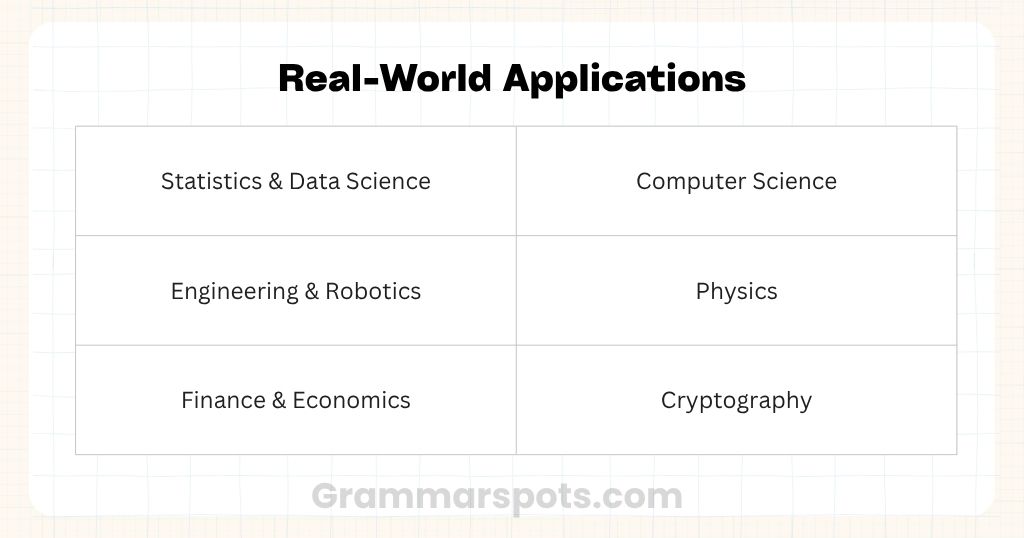
Statistics & Data Science
- Joint probability and joint distributions are used daily in machine learning, medical trials, market research, and risk modeling.
Engineering & Robotics
- The Jacobian Matrix controls robot arm movement.
- j (imaginary unit) is the backbone of circuit analysis and signal processing.
Finance & Economics
- Jump processes and jump diffusion model stock crashes and sudden market events.
- Jensen’s Inequality appears in options pricing and expected utility theory.
Computer Science
- Julia Sets inspire computer graphics, procedural generation, and compression algorithms.
- The Jump Operator defines the structure of the arithmetical hierarchy in computability.
Physics
- Jacobi Fields describe particle paths in curved spacetime (general relativity).
- Jacobi–Anger Expansion decomposes wave functions in quantum mechanics and electromagnetism.
Cryptography
- The Jacobi Symbol is used in primality testing that secures internet encryption.
- The j-invariant is central to elliptic curve cryptography (ECC).
Navigation & Mapping
- The Jordan Curve Theorem powers GIS algorithms that determine whether a GPS point is inside or outside a boundary.
Tips for Remembering J Math Words
- Group by mathematician. Terms with “Jacobi” all relate to Carl Jacobi’s work in iteration, polynomials, and number theory. Terms with “Jordan” all connect to Camille Jordan’s work in topology, linear algebra, and curves.
- Group by difficulty. Learn joint, jump, and joint variation first. Add Jacobian and Jordan Normal Form once you reach calculus and linear algebra.
- Use visual anchors. Draw a Jordan Curve and label inside/outside. Sketch a jump discontinuity. Look up Julia Set images — they are unforgettable.
- Build concept chains. Joint → Joint Probability → Joint Distribution → Joint Entropy forms a single logical chain. Jacobian → Jacobian Matrix → Jacobian Determinant is another. Following chains is faster than memorizing isolated terms.
- Practice with problems. Compute a 2D Jacobian. Find a jump discontinuity in a piecewise function. Calculate a joint probability from a frequency table. Active practice beats passive reading every time.
Commonly Confused Terms
Joint Probability vs. Conditional Probability
- Joint probability: P(A AND B) both happen together
- Conditional probability: P(B|A) B happens given A already occurred
- Connection: P(B|A) = P(A ∩ B) / P(A)
Joint Distribution vs. Joint Probability Distribution vs. Joint PMF
- All three describe the same concept at different levels of formality
- Joint distribution: general term
- Joint probability distribution: formal mathematical version
- Joint PMF: specifically for discrete variables
Jacobian vs. Jacobian Determinant
- Jacobian: the full matrix of partial derivatives
- Jacobian Determinant: a single scalar the determinant of that matrix
- In integration, “the Jacobian” informally often means the determinant check context
Jordan Normal Form vs. Jordan Canonical Form vs. Jordan Form
- All three are identical different textbooks use different names
- Jordan Block: one individual block inside the form
- Jordan Matrix: a full block diagonal matrix of Jordan Blocks
Jump vs. Jump Discontinuity
- Jump: informal — any sudden change in a function
- Jump Discontinuity: formal both one-sided limits exist but differ
- Not every sudden-looking change qualifies as a formal jump discontinuity
j vs. i (Imaginary Unit)
- Pure mathematics: uses i = √(−1)
- Electrical engineering: uses j = √(−1) because i already means current
- Same mathematical object, different symbol
FAQs
Q1: What are the most common math words starting with J?
- At school level: joint probability, joint frequency, joint variation, jump discontinuity
- At university level: Jacobian, Jordan Normal Form, Jensen’s Inequality
Q2: Are there any easy J math words for beginners?
- Yes:
- Joint (two things together)
- Joint frequency (count in a two-way table)
- Joint probability (chance of two events)
- Jump (sudden change in a function)
- Juxtaposition (side-by-side multiplication notation)
- Joint variation (one variable varies with two others)
Q3: What is a Jacobian in simple terms?
- The multivariable version of a derivative. Instead of one number telling you how a function changes, the Jacobian is a matrix telling you how a function with multiple inputs changes near a given point.
Q4: What is the difference between Jordan Normal Form and diagonalization?
- Diagonalization is a special case of Jordan Normal Form where all Jordan Blocks are 1×1. When a matrix has repeated eigenvalues without enough independent eigenvectors, diagonalization fails but Jordan Normal Form still works.
Q5: What is a Julia Set?
- A fractal in the complex plane. For a function like f(z) = z² + c, the Julia Set is the boundary between starting points that stay bounded and those that blow up to infinity under repeated iteration. Different values of c produce dramatically different fractal shapes.
Q6: Why does engineering use j instead of i for √(−1)?
- Because i already represents electric current in electrical engineering. Using j avoids confusion between the imaginary unit and current. The mathematics is identical only the symbol differs.
Q7: What is joint entropy and where is it used?
- Joint entropy measures the total uncertainty of two random variables together. It is used in information theory, data compression, and communication systems to quantify how much information two signals carry jointly.
Q8: Is Jordan Canonical Form the same as Jordan Normal Form?
- Yes, completely. Different textbooks use different names, but they refer to the same mathematical object. Jordan Form is a third informal name for the same thing.
Conclusion
Math words starting with J cover an impressive range from accessible terms like joint probability and jump discontinuity that students encounter in school, to deep concepts like Jacobian Matrix, Jordan Normal Form, Julia Sets, and Jensen’s Inequality that form the core of advanced university mathematics.
This guide lists 56 verified, mathematically accurate J terms across 11 subject areas. Every definition is accurate. Every example is original. No filler, no invented words, no repeated ideas across sections.
Whether you’re completing a vocabulary assignment, building a word wall, or studying for an exam, this list gives you everything genuine that mathematics offers under the letter J.

I’m Hazel, and I studied BSC English at GCUF. I focus on explaining word meanings in simple, clear language that anyone can understand. My goal is helping readers grasp everyday English, confusing terms, and slang used in real conversations and social media. I believe language learning works best when definitions connect to actual life situations. Through careful research and straightforward explanations, I make vocabulary accessible for students, learners, and anyone curious about how English really works in daily use.