


You’re studying for a test. Or building a vocabulary list. Or just curious why H carries so much weight in science.
The answer: H words come from Greek and Latin roots hemo (blood), hydro (water), hypo (under), hyper (over), histo (tissue). One root unlocks ten words. That’s the real value of this list.
This article gives you 130+ science H words defined clearly, organized by subject, and grounded in real use.
20 Most-Used Science Words Starting With H
| Word | Meaning |
| Habitat | Natural environment where an organism lives |
| Half-life | Time for half a radioactive substance to decay |
| Haploid | Cell with only one set of chromosomes |
| Heat | Energy transferred between objects due to temperature difference |
| Helium | Lightweight noble gas; second most abundant element |
| Heliocentric | Sun-centered model of the solar system |
| Hemoglobin | Protein in red blood cells that carries oxygen |
| Heredity | Passing of traits from parents to offspring |
| Herbivore | Animal that eats only plants |
| Hertz | Unit of frequency; one cycle per second |
| Hibernation | Deep winter sleep with slowed body functions |
| Homeostasis | Body’s ability to maintain stable internal conditions |
| Hormone | Chemical messenger produced by glands |
| Host | Organism that carries a parasite or virus |
| Humidity | Amount of water vapor in the air |
| Humus | Organic matter in soil from decomposed material |
| Hybrid | Offspring from two different species or varieties |
| Hydrogen | Lightest and most abundant element in the universe |
| Hypothesis | Testable prediction made before an experiment |
| Hypoxia | Insufficient oxygen reaching body tissues |
Quick List of 130+ Science Words Starting With H
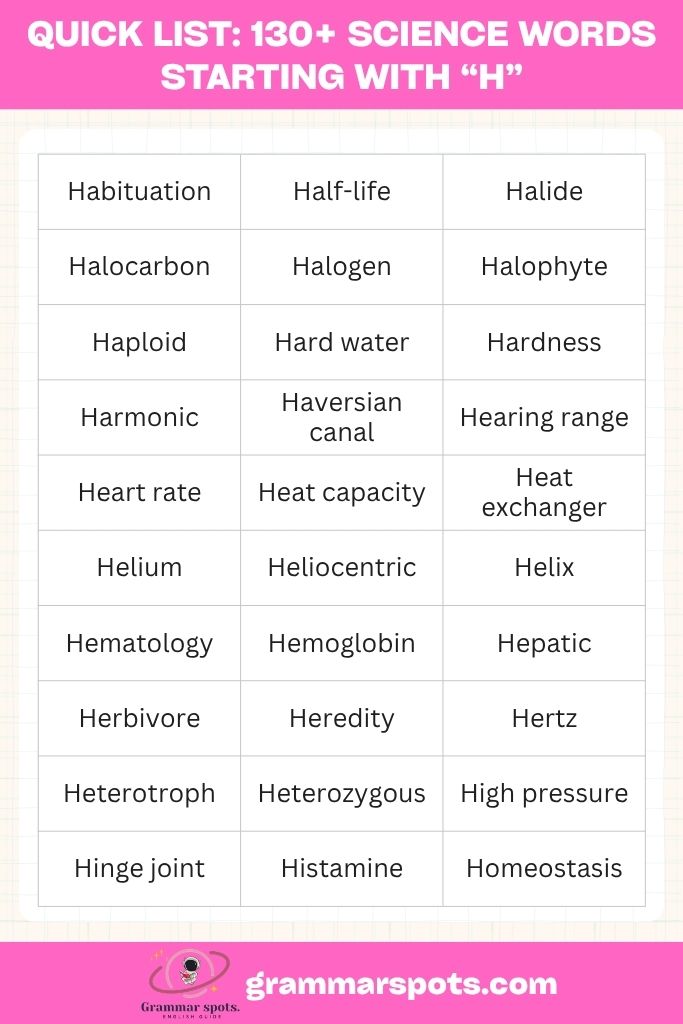
- Habituation
- Half-life
- Halide
- Halocarbon
- Halogen
- Halophyte
- Haploid
- Hard water
- Hardness
- Hardness scale
- Harmonic
- Haversian canal
- Hearing range
- Heart rate
- Heartbeat
- Heat
- Heat capacity
- Heat exchanger
- Heat island
- Heat transfer
- Heatwave
- Helium
- Heliocentric
- Heliosphere
- Helix
- Hematocrit
- Hematology
- Hemoglobin
- Hemolysis
- Hemostasis
- Hepatic
- Herbaceous
- Herbicide
- Herbivore
- Herbivory
- Hereditary disease
- Heredity
- Heritability
- Hertz
- Heterochrony
- Heterogeneous
- Heterosis
- Heterotroph
- Heterozygous
- High frequency
- High pressure
- High tide
- Hinge joint
- Histamine
- Histology
- Homeostasis
- Homeotherm
- Hominid
- Homologous chromosomes
- Homogeneous
- Homozygous
- Horizon
- Horizontal gene transfer
- Hormone
- Hormone cycle
- Hormone receptor
- Host
- Hotspot
- Humidity
- Humerus
- Humus
- Humus layer
- Hurricane
- Hybrid
- Hydration
- Hydraulic
- Hydrocarbon
- Hydrocephalus
- Hydrochloric acid
- Hydrodynamics
- Hydroelectric
- Hydrograph
- Hydrogen
- Hydrogen bond
- Hydrolysis
- Hydrological cycle
- Hydrometer
- Hydrophilic
- Hydrophobic
- Hydrophyte
- Hydrostatic pressure
- Hydrostatics
- Hydrothermal vent
- Hydrotropism
- Hygiene
- Hygrometer
- Hygroscopic
- Hymenoptera
- Hyperbaric
- Hyperplasia
- Hypersonic
- Hypertension
- Hyperthermia
- Hyperthyroidism
- Hypertonic
- Hyphae
- Hyphal network
- Hypocotyl
- Hypothalamus
- Hypothalamic
- Hypothermia
- Hypothyroidism
- Hypothesis
- Hypotonic
- Hypoxemia
- Hypoxia
Physics Science Words Starting With H
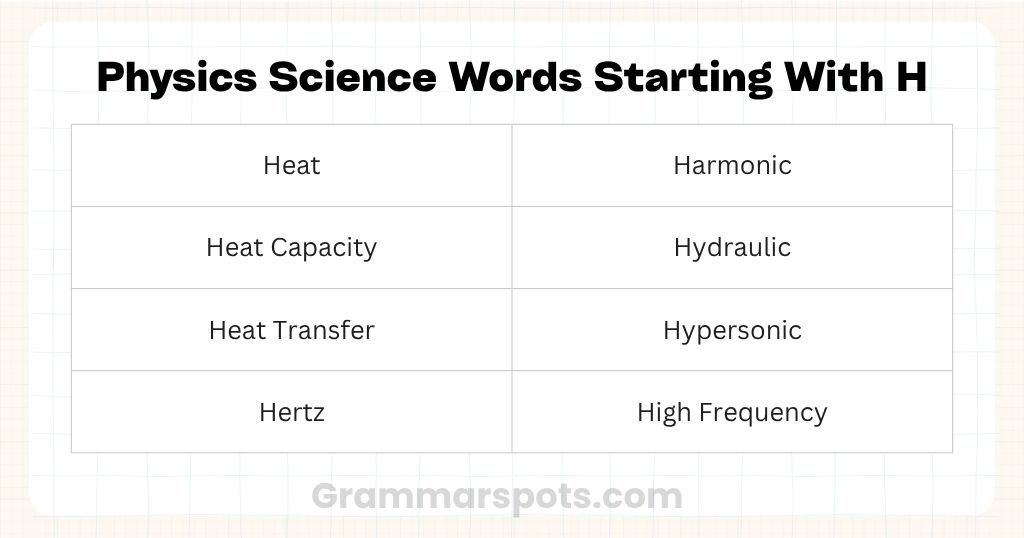
Heat
Energy that moves from a warmer object to a cooler one. Always travels in one direction — hot to cold. Measured in joules.
Heat Capacity
How much energy a substance needs to raise its temperature by one degree. Water has high heat capacity that’s why oceans warm slowly in summer.
Heat Transfer
Three methods:
- Conduction — through solid objects
- Convection — through liquids and gases
- Radiation — through empty space (how sunlight reaches Earth)
Hertz
Measures wave frequency cycles per second. Human hearing range: 20 Hz to 20,000 Hz. Named after physicist Heinrich Hertz.
Harmonic
A guitar string vibrating produces multiple frequencies at once. The extra ones are harmonics. They explain why a piano and a violin sound different on the same note.
Hydraulic
Uses liquid pressure to multiply force. Car brakes, construction machinery, and aircraft landing gear all rely on hydraulic systems.
Hypersonic
Faster than Mach 5 five times the speed of sound. At this speed, friction heats the surrounding air to extreme temperatures.
High Frequency
Higher frequency = more energy. X-rays carry far more energy than visible light. Radio waves carry far less.
Chemistry Science Words Starting With H
Hydrogen
One proton, one electron. The simplest element. Makes up 75% of all visible matter in the universe. Powers the sun through nuclear fusion.
Hydrochloric Acid
Found in your stomach. Breaks down food and destroys most swallowed bacteria. In labs, used to clean metals and adjust pH levels.
Hydrogen Bond
A weak but critical bond. Holds water molecules together. Keeps DNA in its double-helix shape. Responsible for water’s surface tension.
Hydrocarbon
Made only of hydrogen and carbon. Gasoline, natural gas, and plastics are all hydrocarbons. The difference between them is chain length and arrangement.
Hydrolysis
Breaking a molecule apart using water. Every time you digest food, enzymes perform hydrolysis on proteins and carbohydrates.
Halogen
Group 17 elements:
- Fluorine
- Chlorine
- Bromine
- Iodine
- Astatine
All are reactive nonmetals that want to gain one electron. Chlorine sanitizes pools; iodine supports thyroid function.
Hydrophilic
Water-loving. Dissolves easily in water. Salt is hydrophilic.
Hydrophobic
Water-repelling. Doesn’t mix with water. Oil is hydrophobic.
Hard Water
Contains dissolved calcium and magnesium. Doesn’t lather well with soap. Leaves white deposits inside kettles and pipes.
Hygroscopic
Absorbs water vapor from surrounding air. Table salt clumps in humidity because of this. Silica gel packets work the same way by absorbing moisture.
Halide
A compound formed between a halogen and another element. Table salt (sodium chloride) is a halide.
Halocarbon
A compound containing carbon and one or more halogen atoms. Includes refrigerants and some greenhouse gases.
Biology Science Words Starting With H
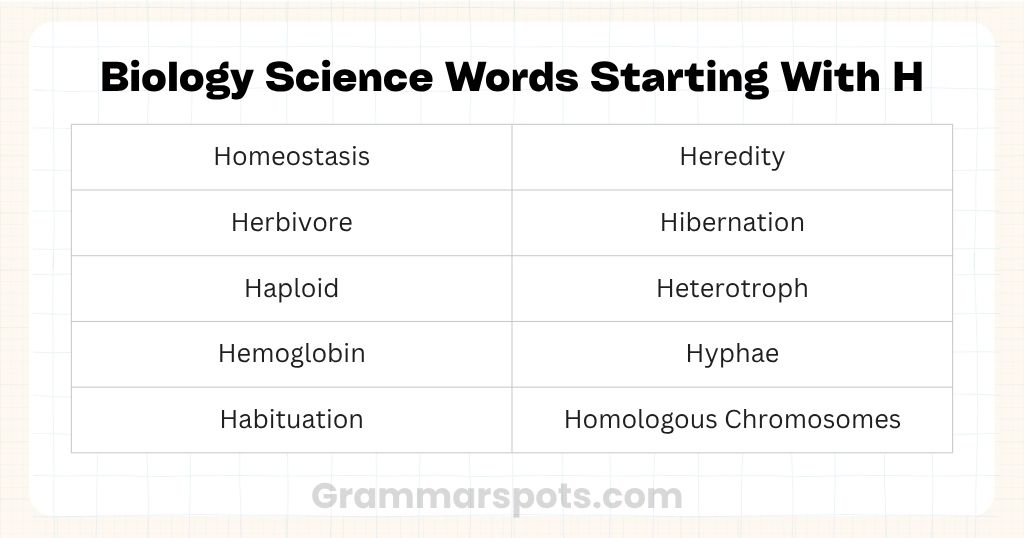
Homeostasis
Your body runs thousands of constant adjustments sweating when hot, shivering when cold, regulating blood sugar after meals. All of that is homeostasis.
Heredity
Traits travel through generations. Eye color, blood type, height passed from parent to child through genes.
Herbivore
Eats only plants. Built with longer intestines and flat grinding teeth. Examples: cow, horse, elephant, rabbit.
Hibernation
A true hibernating animal drops its body temperature dramatically and slows heart rate and breathing to a minimum. Groundhogs do this. Bears mostly enter torpor a lighter version.
Haploid
Has one set of chromosomes. Human sperm and egg cells are haploid 23 chromosomes each. They combine to form a diploid cell with 46.
Heterotroph
Cannot make its own food. Must eat other organisms. All animals, most fungi, and many bacteria are heterotrophs.
Hemoglobin
The iron-containing protein in red blood cells. Carries oxygen from lungs to tissues. Iron + oxygen = red color of blood.
Hyphae
Thin thread-like filaments that form the body of a fungus. A single mushroom connects to a massive underground hyphal network.
Habituation
Learning to ignore a repeated harmless stimulus. A bird near a highway eventually stops reacting to traffic noise.
Homologous Chromosomes
Chromosome pairs one from each parent that carry genes for the same traits but may carry different versions of those genes.
Heterozygous
Two different versions of a gene (Bb). One dominant, one recessive.
Homozygous
Both copies of a gene are identical (BB or bb).
Herbivory
The act of feeding on plant material. Distinct from herbivore this refers to the behavior or process, not the animal.
Hereditary Disease
A disease caused by gene mutations passed from parent to offspring. Examples include cystic fibrosis and sickle cell anemia.
Heritability
A measure of how much of a trait’s variation in a population comes from genetics versus environment. Ranges from 0 to 1.
Horizontal Gene Transfer
Bacteria share genes directly with each other not through reproduction. This is how antibiotic resistance spreads between unrelated bacterial species.
Homeotherm
An organism that keeps a stable body temperature regardless of the environment. Humans are homeotherms. Most fish are not.
Hominid
The biological family that includes humans and our closest extinct relatives. All great apes are hominids.
Hormone Receptor
A protein on or inside a cell that binds to a specific hormone. Without the right receptor, a hormone can’t deliver its message.
Hemolysis
The breakdown of red blood cells. Can be caused by certain bacteria, toxins, or immune reactions. Releases hemoglobin into surrounding fluid.
Hemostasis
The process that stops bleeding. Platelets clump at the injury site; clotting factors form a fibrin mesh the framework of a scab.
Heterochrony
An evolutionary change in the timing or rate of developmental events. Can result in significantly different adult body forms across related species.
Heterosis
Also called hybrid vigor. Offspring of two different strains are often stronger or larger than either parent. Used extensively in crop and livestock breeding.
Earth Science Words Starting With H
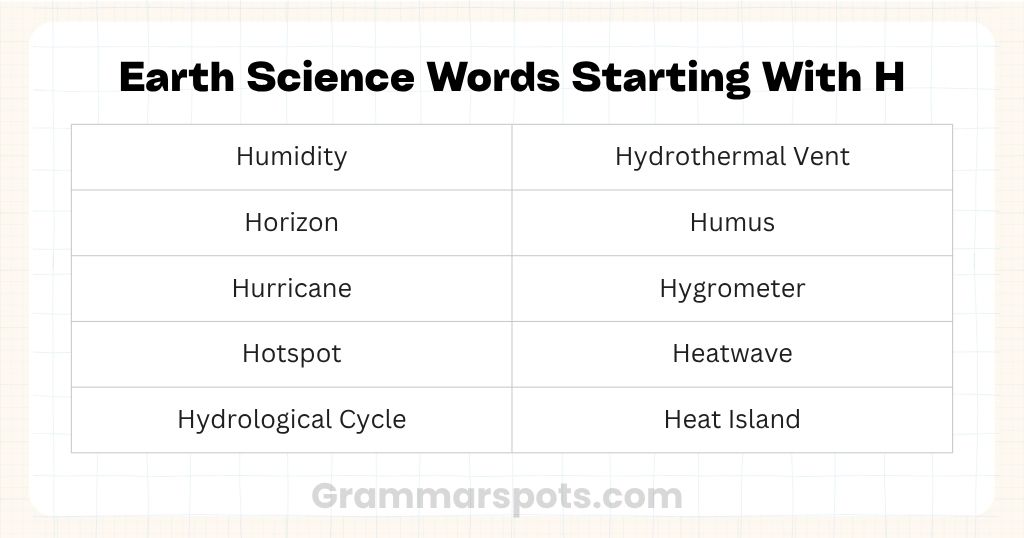
Humidity
Water vapor in the air. At 100% relative humidity, air is fully saturated rain, fog, or dew forms.
Horizon (Soil)
A distinct layer of soil at a specific depth:
- A horizon — rich in organic matter (topsoil)
- B horizon — mineral-rich subsoil
- C horizon — partially weathered parent rock
Hurricane
A tropical storm with rotating winds above 74 mph. Needs warm ocean water to form. Weakens over land or cold water.
Hotspot
A column of heat rising from Earth’s mantle, melting rock above it. Hawaii formed this way as the Pacific Plate moved over a fixed hotspot.
Hydrological Cycle
The continuous movement of water:
- Evaporation from oceans
- Condensation into clouds
- Precipitation as rain or snow
- Runoff back to oceans
No new water is created. The same water has been cycling for billions of years.
Hydrothermal Vent
A crack in the ocean floor releasing superheated, mineral-rich water. Entire ecosystems live here no sunlight needed. Discovered in 1977.
Humus
Dark, rich organic material in topsoil made from decomposed plants and organisms. Holds moisture, feeds plants, creates loose soil texture.
Hygrometer
Instrument measuring humidity. Early models used human hair, which changes length with moisture. Digital versions are now standard.
Heatwave
A prolonged period of abnormally high temperatures. Can cause health emergencies, crop failures, and infrastructure stress.
Heat Island
An urban area significantly warmer than surrounding rural land. Caused by concrete, asphalt, and reduced vegetation absorbing and retaining heat.
High Pressure
A weather system where air descends and spreads outward. Associated with clear skies and dry conditions.
High Tide
Maximum water level on shore caused by gravitational pull of the moon and sun on ocean water.
Hydrograph
A graph showing how river water flow changes over time. Used in flood prediction and water resource management.
Space & Astronomy Science Words Starting With H
Heliocentric
The Sun-centered model of the solar system. Proposed by Copernicus in 1543. Supported by Galileo’s observations.
Helium
Second most abundant element in the universe. Formed in the Big Bang and continuously produced in stars. On Earth, it’s found in underground natural gas deposits and is genuinely running out.
Heliosphere
The enormous bubble of solar wind and magnetic field surrounding the entire solar system. Voyager 1 crossed its outer boundary in 2012.
Helix
A spiral shape. DNA forms a double helix. Some galaxies also have spiral (helical) arm structures.
Hemisphere (Astronomical)
The sky is split into northern and southern celestial hemispheres. Different constellations are visible from each.
Hypersonic Re-entry
Spacecraft re-entering Earth’s atmosphere travel at Mach 25+. The heat generated requires specialized thermal protection to prevent burnup.
Medical & Health Science Words Starting With H
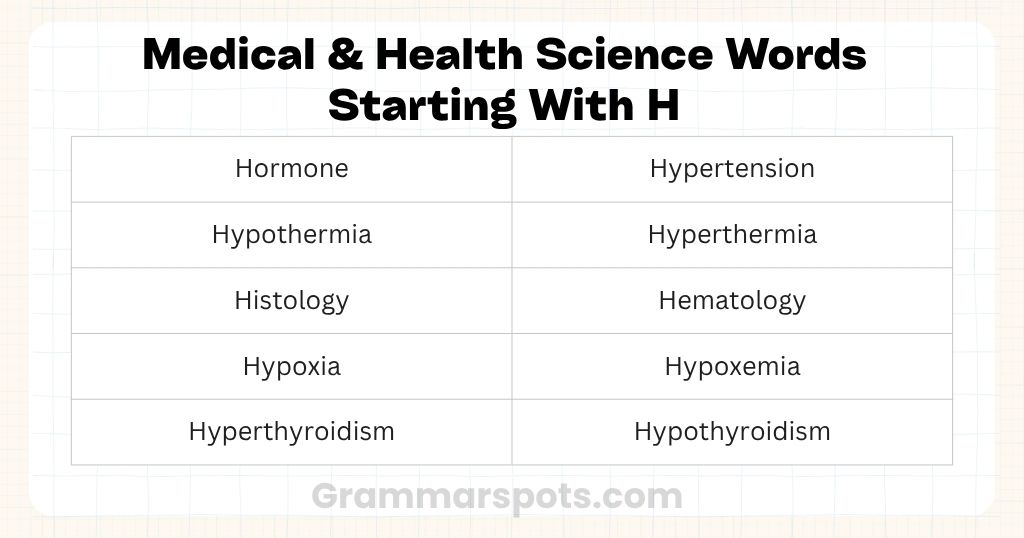
Hormone
A chemical signal made in one gland, travels through blood, and triggers a response in a target organ. Insulin, adrenaline, and cortisol are all hormones.
Hypertension
Persistently high blood pressure. Damages artery walls over time. Often has no symptoms — which is why it’s called the “silent killer.”
Hypothermia
Core body temperature drops below 35°C. Causes shivering, confusion, then organ shutdown if untreated.
Hyperthermia
Core body temperature rises dangerously high. Heat stroke is one form. Affects the brain, heart, and kidneys.
Histology
Study of tissues under a microscope. Used in cancer diagnosis abnormal cell arrangement reveals disease.
Hematology
Medical branch focused on blood its composition, disorders, and diseases. Covers anemia, leukemia, and hemophilia.
Hypoxia
Not enough oxygen reaching tissues. Occurs at high altitude or with lung/circulatory problems.
Hypoxemia
Specifically low oxygen in the blood. Distinct from hypoxia hypoxemia is measured in the blood; hypoxia refers to tissues.
Hyperthyroidism
Thyroid gland produces too much thyroid hormone. Causes rapid heartbeat, weight loss, and anxiety.
Hypothyroidism
Thyroid gland produces too little hormone. Causes fatigue, weight gain, and slow metabolism.
Hypothalamus
A small brain region that controls hunger, thirst, body temperature, and hormone release from the pituitary gland.
Histamine
A chemical released during allergic reactions. Causes inflammation, itching, and swelling. Antihistamines block it.
Hematocrit
The percentage of blood volume made up of red blood cells. A standard measure in blood tests.
Haversian Canal
Microscopic channels running through compact bone, carrying blood vessels and nerves. Named after anatomist Clopton Havers.
Humerus
The upper arm bone, connecting shoulder to elbow.
Hinge Joint
A joint that allows movement in only one direction like a door hinge. The knee and elbow are hinge joints.
Hydrocephalus
Buildup of cerebrospinal fluid in the brain. Creates pressure on brain tissue and requires medical treatment.
Hygiene
Practices that maintain health and prevent disease. Personal hygiene, food hygiene, and surgical hygiene are all distinct areas.
Hormone Cycle
The rhythmic rise and fall of hormone levels over time. The menstrual cycle is driven by a hormone cycle involving estrogen and progesterone.
Hyperbaric
Relating to pressure above normal atmospheric levels. Hyperbaric oxygen therapy speeds healing in certain infections and injuries.
Hyperplasia
Abnormal increase in the number of cells in a tissue. Cells themselves are normal — there are simply too many.
Technology & Applied Science Words Starting With H
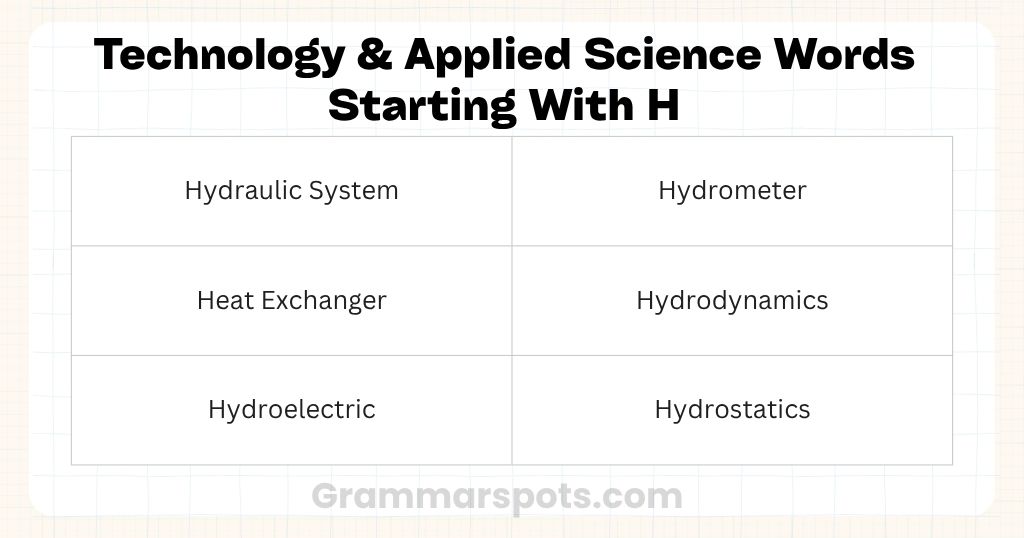
Hydraulic System
Transfers force using pressurized fluid. Used in car brakes, aircraft systems, and heavy construction equipment.
Heat Exchanger
Transfers heat between two fluids without mixing them. Car radiators and industrial cooling systems are heat exchangers.
Hydroelectric
Electricity generated by moving water spinning turbines. Produces no direct emissions during operation.
Hydrometer
Measures liquid density. Brewers use it to track fermentation. Mechanics use it to check antifreeze and battery acid concentration.
Hydrodynamics
The study of fluids in motion. Applies to ship design, pipe flow, and aircraft performance near water surfaces.
Hydrostatics
The study of fluids at rest and the pressure they exert. Explains why water pressure increases with depth.
Easy Science Words Starting With H — For Kids
- Habitat — where an animal or plant lives naturally
- Heat — energy that makes things warm
- Herbivore — animal that eats only plants
- Hibernation — long winter sleep to save energy
- Humidity — water vapor you can feel in the air
- Hypothesis — your best guess before an experiment
- Hybrid — a mix of two different types
- Host — an organism that carries a parasite
- Humus — rich dark material in healthy soil
- Heartbeat — the rhythm of your heart pumping blood
Advanced Science Words Starting With H
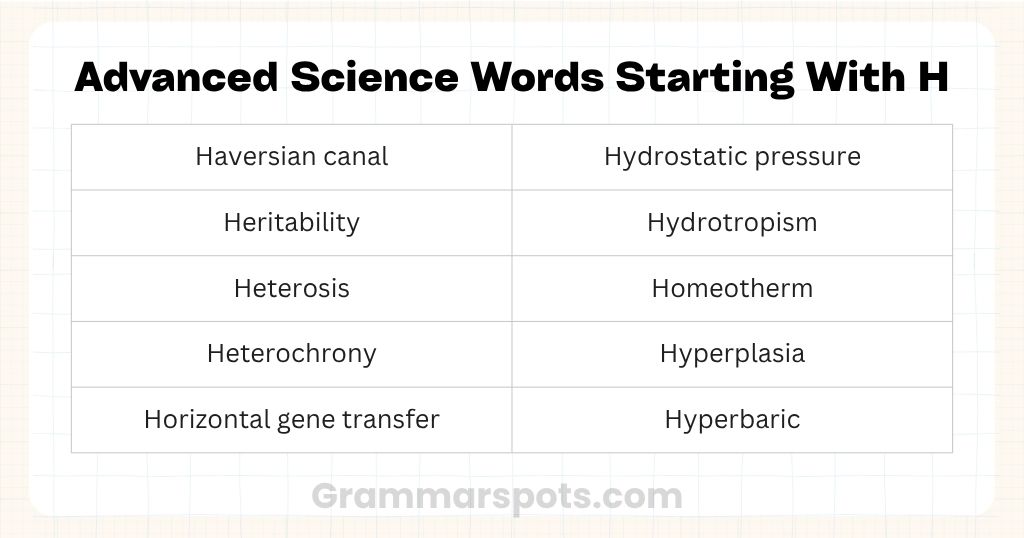
- Haversian canal — microscopic bone channel carrying vessels and nerves
- Heritability — genetic contribution to trait variation in a population
- Heterosis — hybrid vigor; offspring stronger than either parent
- Heterochrony — evolutionary shift in developmental timing
- Horizontal gene transfer — bacteria sharing genes directly, not through reproduction
- Hydrostatic pressure — pressure exerted by fluid at rest due to gravity
- Hydrotropism — plant root growth directed toward water
- Homeotherm — organism maintaining constant internal body temperature
- Hyperplasia — excessive but non-cancerous cell multiplication
- Hyperbaric — above-normal atmospheric pressure conditions
- Halophyte — plant adapted to high-salt environments
- Hydrophyte — plant adapted to grow in water or waterlogged soil
- Hypocotyl — the stem section of a seedling below where leaves emerge
- Hyphal network — the interconnected thread system forming fungal bodies
- High-energy bond — a chemical bond releasing significant energy when broken; ATP contains one
- Hemostasis — the full process of stopping bleeding and repairing vessel walls
- Habituation — basic learning; ignoring repeated harmless stimuli
Common Confusions: H Words People Mix Up
Hypothesis vs Theory
A hypothesis is an untested prediction. A scientific theory is built from years of tested evidence. In science, “theory” means the opposite of a guess.
Herbivore vs Omnivore
Herbivores eat only plants. Omnivores eat both plants and animals. Humans are omnivores.
Humidity vs Precipitation
Humidity is invisible water vapor in air. Precipitation is water falling from the sky. High humidity can lead to precipitation — but they’re not the same.
Hibernation vs Torpor
True hibernation involves extreme drops in body temperature. Torpor is shorter and less extreme. Groundhogs hibernate. Bears mostly use torpor.
Homozygous vs Heterozygous
Homozygous = both gene copies identical (BB or bb).
Heterozygous = two different copies (Bb).
Hydrophilic vs Hydrophobic
Hydrophilic = water-loving. Hydrophobic = water-repelling. Soap has both properties — that’s what makes it clean.
Hyperthermia vs Hypothermia
Hyperthermia = too hot. Hypothermia = too cold.
Hyper = over. Hypo = under. Two prefixes, dozens of words unlocked.
Hypoxia vs Hypoxemia
Hypoxemia = low oxygen in blood (measured by blood test).
Hypoxia = low oxygen in tissues (felt by cells). One can lead to the other.
Hemolysis vs Hemostasis
Hemolysis = red blood cells breaking down.
Hemostasis = bleeding being stopped. Opposite processes.
Where These Words Appear in Real Life
In hospitals:
- Hemoglobin
- Hematocrit
- Hematology
- Hypertension
- Hypoxia
- Hypoxemia
- Histology
- Hemostasis
- Hormone therapy
- Hyperthyroidism
- Hypothyroidism
- Hyperbaric oxygen therapy
In weather and environment:
- Humidity
- Hurricane
- Heatwave
- Heat island
- High pressure
- Hygrometer
- Hydrological cycle
- Hydrothermal vent
In farming and food:
- Humus
- Hybrid crops
- Herbicide
- Herbivory
- Hygroscopic (food storage)
- Hard water (affects crop irrigation and taste)
In engineering:
- Hydraulic systems
- Heat exchanger
- Hydroelectric power
- Hydrometer
- Hydrodynamics
In space science:
- Heliosphere
- Helium (used in rocket cooling)
- Heliocentric navigation
- Hypersonic re-entry
FAQs
How many science words start with H?
Hundreds across all scientific fields. This article covers 130+ most useful ones for students, educators, and general readers.
Which H words appear most on science tests?
- Hypothesis
- Homeostasis
- Heredity
- Hemoglobin
- Habitat
- Hormone
- Half-life
These appear across biology, chemistry, and Earth science exams at every level.
Are H science words hard to memorize?
Not if you learn the roots first:
- Hydro = water
- Hyper = over/above
- Hypo = under/below
- Hemo = blood
- Histo = tissue
- Herbi = plant
Six roots unlock over 40 words on this list.
What’s the difference between hypothesis and theory?
Hypothesis = untested prediction. Theory = extensively tested explanation supported by strong evidence. Calling evolution “just a theory” misunderstands what theory means in science.
Why do so many biology words start with H?
Biology borrowed heavily from Greek medical tradition. Greek terms for blood (hema), liver (hepato), tissue (histo), and similarity (homeo) all begin with H.
Conclusion
Science doesn’t ask you to memorize a dictionary. It asks you to understand a language and H gives you a surprisingly powerful vocabulary to work with. From habitat and heat to hemostasis and horizontal gene transfer, these 130+ words span every major branch of science.
They show up in classrooms, hospitals, weather reports, engineering labs, and space missions. Learn the six roots hydro, hyper, hypo, hemo, histo, herbi and nearly half this list becomes easier to decode on sight.
Whether you came here as a student preparing for an exam, a teacher building a word wall, or someone who just got curious, you now have a complete, organized reference you can return to anytime. The words are here. The connections are here. What happens next is up to you.

I’m Hazel, and I studied BSC English at GCUF. I focus on explaining word meanings in simple, clear language that anyone can understand. My goal is helping readers grasp everyday English, confusing terms, and slang used in real conversations and social media. I believe language learning works best when definitions connect to actual life situations. Through careful research and straightforward explanations, I make vocabulary accessible for students, learners, and anyone curious about how English really works in daily use.