


You hit a science word starting with M and it didn’t click. Or you’re building vocabulary for a test, a project, or just curiosity.
M is one of science’s busiest letters. It covers cell biology, space, chemistry, weather, medicine, and more. This article gives you every major M science word sorted, defined, and organized so you can find exactly what you need fast.
Quick Answer: 20 Most Common Science Words Starting With M
| Word | Meaning |
| Mass | Amount of matter in an object |
| Molecule | Two or more atoms bonded as one unit |
| Membrane | Thin layer that covers or separates structures |
| Metabolism | All chemical reactions keeping a living body working |
| Mitosis | Cell division producing two identical cells |
| Meiosis | Cell division producing four genetically unique cells |
| Mitochondria | Cell organelle that produces energy |
| Mutation | Permanent change in an organism’s DNA |
| Magnet | Object that attracts iron through magnetic force |
| Momentum | Mass multiplied by velocity of a moving object |
| Melting point | Temperature at which a solid becomes liquid |
| Mineral | Naturally occurring solid inorganic substance |
| Microscope | Instrument that magnifies objects too small to see |
| Motion | Change in an object’s position over time |
| Microorganism | Living thing invisible without magnification |
| Mixture | Two substances combined but not chemically joined |
| Metal | Element that conducts heat and electricity well |
| Moon | Natural satellite orbiting a planet |
| Meteorology | Scientific study of weather and atmosphere |
| Marine | Related to the ocean or sea environment |
Quick List of 170+ Science Words Starting With M
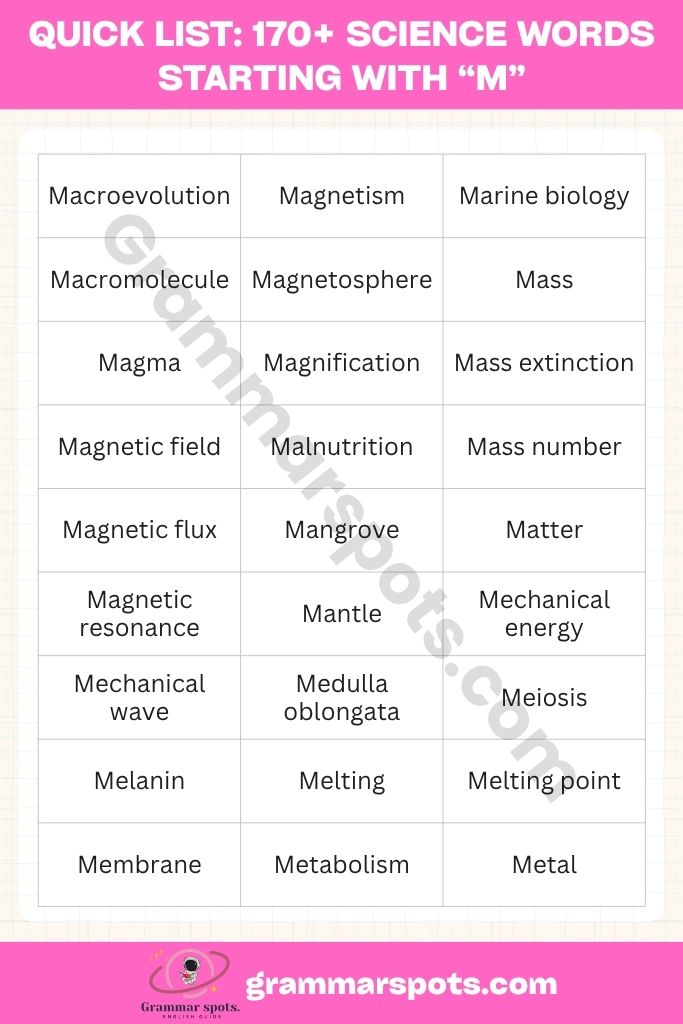
- Macroevolution
- Macromolecule
- Magma
- Magnetic field
- Magnetic flux
- Magnetic resonance
- Magnetism
- Magnetosphere
- Magnification
- Malnutrition
- Mangrove
- Mantle
- Marine biology
- Mass
- Mass extinction
- Mass number
- Matter
- Mechanical energy
- Mechanical wave
- Medulla oblongata
- Meiosis
- Melanin
- Melting
- Melting point
- Membrane
- Metabolism
- Metal
- Metamorphic rock
- Metamorphosis
- Meteor
- Meteorite
- Meteoroid
- Meteorology
- Microbe
- Microbiology
- Microbiome
- Microchip
- Microclimate
- Microgravity
- Micronutrient
- Microorganism
- Microscope
- Microscopy
- Migration
- Migratory pattern
Physics Science Words Starting With M
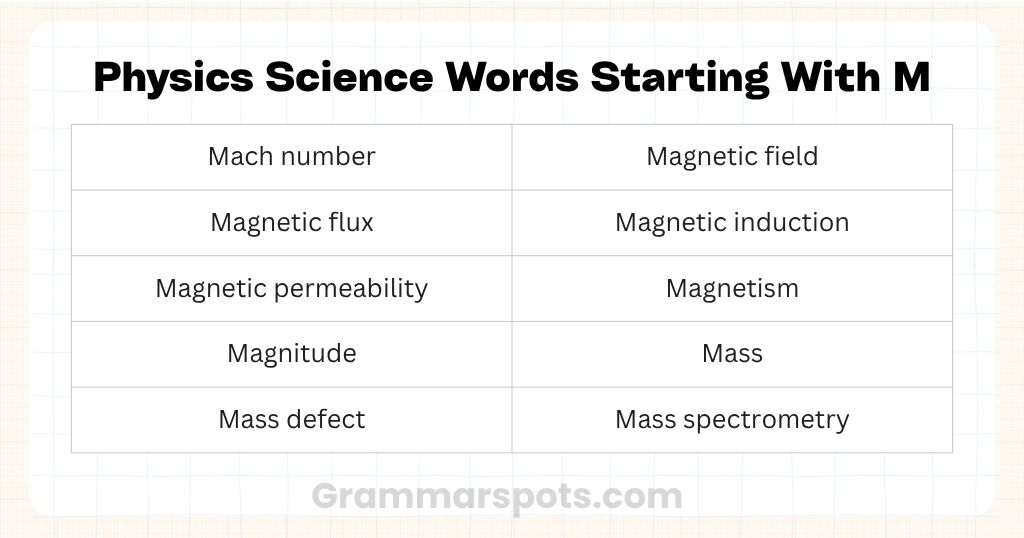
- Mach number — ratio of an object’s speed to the speed of sound; above Mach 1 is supersonic
- Magnetic field — invisible region of force around a magnet or moving charge
- Magnetic flux — total magnetic field passing through a given surface area
- Magnetic induction — creation of electric current in a conductor by a changing magnetic field
- Magnetic permeability — measure of how easily a material supports a magnetic field inside it
- Magnetism — force produced by moving electric charges that attracts or repels certain materials
- Magnitude — numerical size or strength of a physical quantity such as force or earthquake intensity
- Mass — total amount of matter in an object, unchanged by gravity or location
- Mass defect — difference between a nucleus’s mass and the sum of its individual particles; linked to nuclear energy
- Mass spectrometry — technique that separates particles by their mass-to-charge ratio to identify substances
- Mean free path — average distance a particle travels between collisions with other particles
- Mechanical advantage — ratio showing how much a machine multiplies input force
- Mechanical energy — sum of kinetic energy and potential energy in a physical system
- Mechanical resonance — amplification of vibration when a system is driven at its natural frequency
- Mechanical wave — wave that requires a physical medium to travel through, such as sound in air
- Melting curve — graph showing the relationship between pressure and melting point of a substance
- Metric system — decimal-based measurement system used globally in science
- Momentum — product of an object’s mass and velocity; the quantity that resists changes in motion
- Motion — change in position of an object relative to a reference point over time
Chemistry Science Words Starting With M
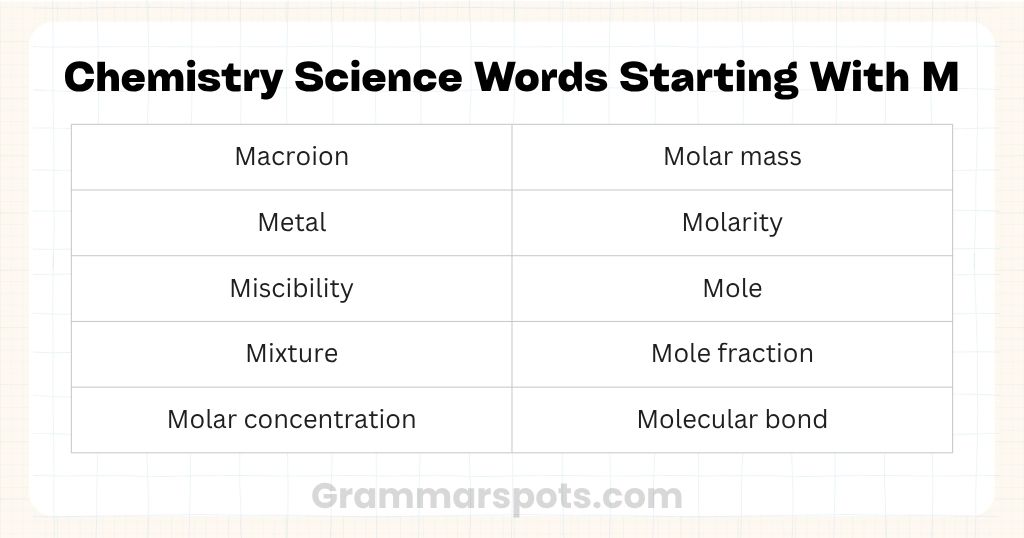
- Macroion — large ion formed in solution, often from proteins or synthetic polymers
- Metal — element that readily loses electrons and conducts heat and electricity
- Miscibility — ability of two liquids to mix together in all proportions without separating
- Mixture — two or more substances physically combined but not chemically bonded
- Molar concentration — number of moles of solute dissolved per litre of solution
- Molar mass — mass of one mole of a substance, measured in grams per mole
- Molarity — another term for molar concentration, widely used in lab settings
- Mole — unit equal to 6.022 × 10²³ particles; allows chemists to count atoms in workable quantities
- Mole fraction — ratio of moles of one component to total moles in a mixture
- Molecular bond — force holding two or more atoms together in a molecule
- Molecular formula — notation showing the exact number of each type of atom in a molecule
- Molecular geometry — three-dimensional shape formed by atoms in a molecule
- Molecular orbital — region in a molecule where electrons are likely to be found
- Molecular polarity — unequal distribution of charge across a molecule due to electronegativity differences
- Molecular weight — total mass of all atoms in a molecule added together
- Molecule — smallest unit of a compound that retains all the chemical properties of that compound
- Monatomic — consisting of single atoms; noble gases like helium and argon are monatomic
- Monohydrate — compound containing one water molecule chemically bonded per formula unit
- Monosaccharide — simplest form of sugar; glucose and fructose are examples
- Monomer — small repeating unit that links with others to form a polymer chain
- Melting point — specific temperature at which a solid substance transitions into liquid
Biology Science Words Starting With M
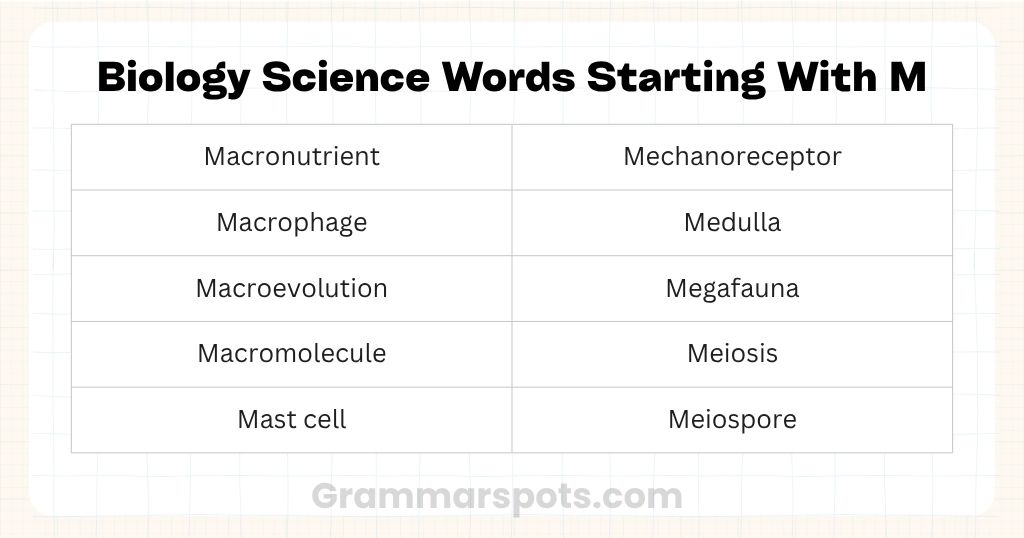
- Macronutrient — nutrient needed in large amounts for growth; includes protein, carbohydrates, and fat
- Macrophage — immune cell that engulfs and destroys bacteria, dead cells, and foreign particles
- Macroevolution — large-scale evolutionary change resulting in new species or higher-level groups over millions of years
- Macromolecule — large complex molecule such as DNA, protein, or starch
- Mast cell — immune cell that releases histamine and other chemicals during allergic responses
- Mechanoreceptor — sensory cell or structure that responds to physical pressure or distortion
- Medulla — innermost region of an organ, such as the inner part of the kidney or adrenal gland
- Megafauna — collective term for large animals, often used when discussing extinction events
- Meiosis — cell division process that produces four genetically distinct reproductive cells
- Meiospore — spore formed through meiosis, capable of developing without fertilization
- Melanin — pigment responsible for color in skin, hair, and eyes; also absorbs ultraviolet radiation
- Membrane — thin, flexible layer controlling what enters and exits a cell or organ
- Meninges — three protective membranes surrounding the brain and spinal cord
- Meristem — plant tissue where active cell division occurs, driving growth at roots and shoot tips
- Mesoderm — middle tissue layer in an embryo; develops into muscle, bone, and the circulatory system
- Mesophyte — plant adapted to moderate water availability, neither too wet nor too dry
- Metabolism — all chemical reactions in a living organism that sustain life and produce energy
- Microbiome — full community of microorganisms living in a particular environment, such as the human gut
- Microevolution — small-scale genetic changes within a population over shorter time periods
- Microhabitat — small, specific environment within a larger ecosystem where an organism lives
- Microorganism — living organism too small to see without a microscope
- Microvilli — tiny finger-like projections on intestinal cells that increase surface area for nutrient absorption
- Mid-ocean ridge — underwater mountain range formed where tectonic plates separate and magma rises
- Migration — seasonal movement of animals from one region to another for feeding or reproduction
- Mitochondria — organelle inside cells that converts glucose and oxygen into ATP energy
- Mitochondrial DNA — genetic material found only in mitochondria, inherited through the maternal line
- Mitosis — cell division that produces two genetically identical daughter cells; used for growth and repair
- Monocot — flowering plant with one seed leaf; includes grasses, lilies, and palms
- Monoculture — farming practice of growing a single crop species across a large area
- Morphology — scientific study of the form, shape, and structure of organisms
- Multicellular — organism composed of more than one cell, with specialized cells doing different jobs
- Muscular system — body system made up of muscles that enable movement and maintain posture
- Mutation — permanent alteration in the DNA sequence of an organism’s genome
- Mutualism — relationship between two species where both organisms benefit from the interaction
- Mycelium — network of thread-like filaments forming the main body of a fungus underground
- Mycology — branch of biology dedicated to the scientific study of fungi
- Myelin sheath — fatty insulating layer wrapped around nerve fibers that speeds up signal transmission
Earth Science Words Starting With M
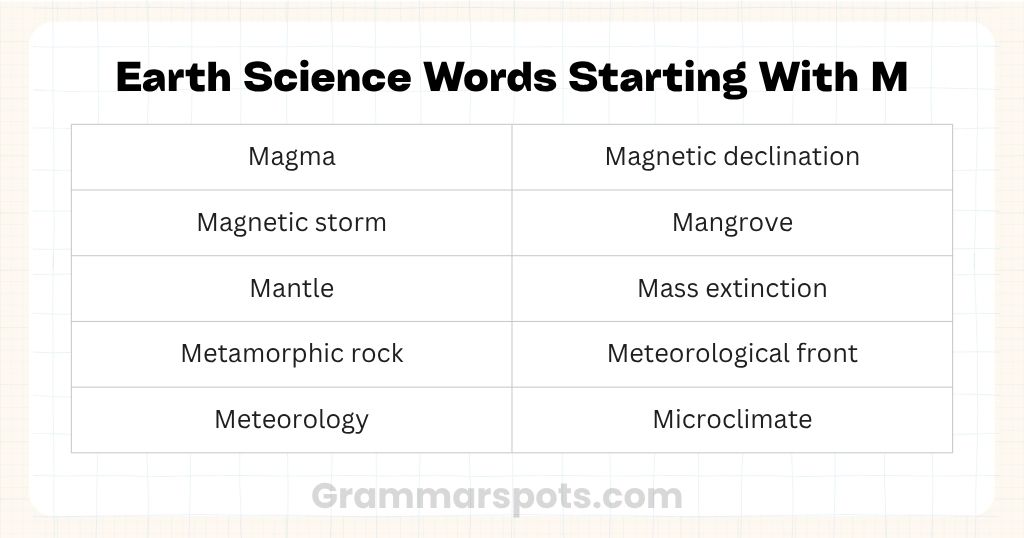
- Magma — molten rock found beneath Earth’s surface; becomes lava once it erupts
- Magnetic declination — angle between geographic north and magnetic north at any given location
- Magnetic storm — major disturbance in Earth’s magnetic field caused by solar activity
- Mangrove — salt-tolerant coastal tree with tangled roots that protect shorelines from erosion
- Mantle — thick layer of hot, slowly moving rock between Earth’s crust and its core
- Mass extinction — geological event where a large percentage of species disappear in a short time period
- Metamorphic rock — rock transformed by extreme heat and pressure without melting
- Meteorological front — boundary between two air masses of different temperatures and humidity
- Meteorology — scientific study of weather patterns, atmosphere, and climate systems
- Microclimate — local climate conditions that differ from the surrounding larger area
- Mineral — naturally occurring, solid inorganic substance with a defined crystal structure
- Mineral density — mass of a mineral per unit of volume; used in geology and materials science
- Minor planet — small solar system body orbiting the Sun; includes asteroids and dwarf planets
- Moraine — accumulation of rock and sediment deposited by a glacier
- Mouth — point where a river empties into a larger body of water such as a sea or lake
Space & Astronomy Science Words Starting With M
- Magnetic storm — disruption of Earth’s magnetosphere caused by powerful solar wind bursts
- Magnetosphere — region of space controlled by a planet’s magnetic field, deflecting solar radiation
- Main sequence star — star in the stable phase of its life, fusing hydrogen into helium; the Sun is one
- Mare — large, dark, flat plain on the Moon’s surface formed by ancient volcanic eruptions
- Mass ejection — large burst of plasma and magnetic field expelled from the Sun’s corona
- Mesosphere — atmospheric layer between 50 and 80 km above Earth; where most meteors burn up
- Meteor — streak of light caused by a space rock burning through Earth’s atmosphere
- Meteorite — space rock that survives the atmosphere and lands on Earth’s surface
- Meteoroid — small rocky or metallic body moving through space before it enters an atmosphere
- Microgravity — near-weightless environment experienced aboard orbiting spacecraft
- Milky Way — galaxy containing Earth’s solar system, appearing as a band of stars in the night sky
- Molecular cloud — dense region of gas and dust in space where new stars form
- Moon — natural satellite gravitationally bound to a planet; Earth’s Moon drives ocean tides
Medical & Health Science Words Starting With M
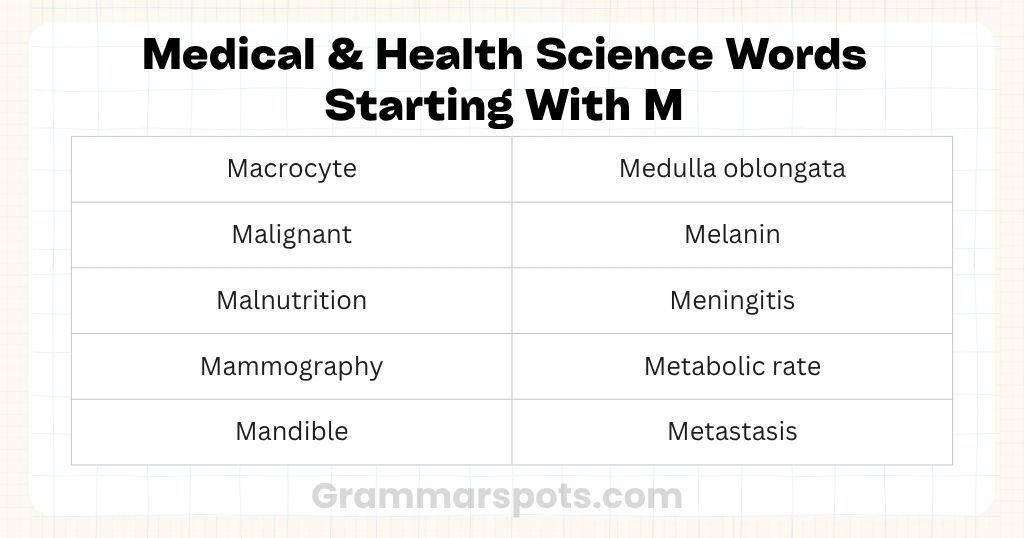
- Macrocyte — abnormally large red blood cell, often a sign of certain nutritional deficiencies
- Malignant — describes a tumor or condition that grows uncontrollably and can spread to other tissues
- Malnutrition — state where the body lacks essential nutrients needed for normal function
- Mammography — low-dose X-ray imaging technique used to detect breast tissue abnormalities
- Mandible — lower jawbone; the only movable bone in the human skull
- Medulla oblongata — brain region controlling involuntary functions including breathing and heart rate
- Melanin — protective pigment in skin absorbing UV radiation and preventing cellular damage
- Meningitis — inflammation of the meninges surrounding the brain, typically caused by infection
- Metabolic rate — speed at which the body converts food and oxygen into energy
- Metastasis — spread of cancer cells from a primary tumor to other parts of the body
- Microdosing — practice of taking very small, sub-therapeutic amounts of a substance for research or treatment
- Microfluidics — science of controlling tiny fluid amounts through miniaturized laboratory systems
- Microsurgery — surgical technique performed under a microscope for delicate procedures on small structures
- Mitral valve — heart valve between the left atrium and left ventricle that prevents blood from flowing backward
- Motor neuron — nerve cell that carries movement signals from the brain or spinal cord to muscles
- Motor pathway — neural route along which signals travel from the brain to control voluntary movement
- MRI — imaging technique using magnetic fields and radio waves to produce detailed internal body images
- Mucosa — moist tissue lining body cavities and internal organs exposed to external substances
- Mucous membrane — protective lining inside the nose, mouth, lungs, and digestive tract
- Muscular dystrophy — genetic condition causing progressive weakening and loss of muscle tissue
- Myocardium — muscular wall of the heart responsible for the pumping contractions
- Myopia — vision condition where nearby objects appear clear but distant objects appear blurry
Technology & Applied Science Words Starting With M
- Magnetic resonance — property of atomic nuclei responding to magnetic fields; the basis of MRI scanning
- Magneto-hydrodynamics — study of how electrically conducting fluids behave in magnetic fields
- Microchip — tiny silicon device holding billions of transistors; the core processor in all digital technology
- Microfluidics — engineering field designing systems that handle very small fluid volumes for analysis or medicine
- Microscopy — science of using microscopes to study objects at scales invisible to the naked eye
Easy Science Words Starting With M (Beginner Level)
These are the words most likely to appear in elementary and early middle school science:
- Magnet — object that pulls iron and steel toward it
- Mass — how much matter is packed into something
- Metal — shiny material that carries heat and electricity
- Microscope — tool used to see very tiny things
- Migration — seasonal movement of animals to different places
- Mineral — natural solid found in rocks and soil
- Mixture — two things combined but not chemically changed
- Moon — large natural object orbiting a planet
- Moss — small flowerless plant that grows in damp, shaded places
- Motion — any change in position from one place to another
- Muscle — body tissue that pulls on bones to create movement
Advanced Science Words Starting With M (Higher Level)
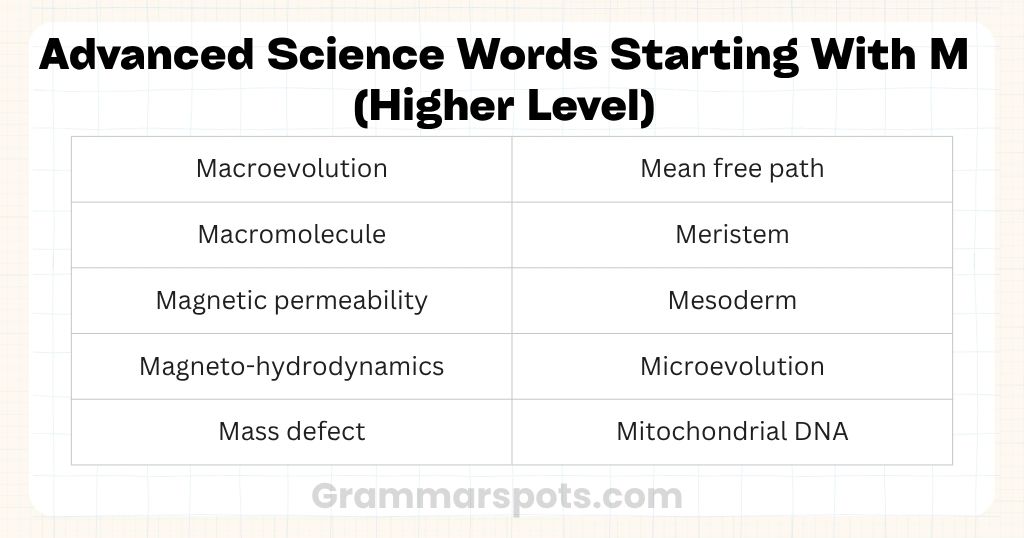
- Macroevolution — evolution at or above the species level, visible across geological time scales
- Macromolecule — extremely large molecule like DNA, proteins, or cellulose built from repeating units
- Magnetic permeability — measure of a material’s ability to support a magnetic field within it
- Magneto-hydrodynamics — branch of physics studying electrically conducting fluids in magnetic fields
- Mass defect — mass difference between a nucleus and its constituent particles, converted into binding energy
- Mass spectrometry — analytical technique separating atoms and molecules by mass for precise identification
- Mean free path — average distance a particle travels between successive collisions in a gas
- Meristem — undifferentiated plant tissue where all cell division and growth originates
- Mesoderm — embryonic tissue layer giving rise to the skeleton, muscles, and circulatory system
- Microevolution — generation-to-generation genetic changes within a single population
- Mitochondrial DNA — circular genome inherited maternally; used in ancestry research and evolutionary biology
- Molecular orbital — quantum mechanical region in a molecule where electrons are statistically likely to exist
- Molecular polarity — charge imbalance across a molecule caused by electronegativity differences between atoms
- Monocot — plant class with one embryonic leaf, parallel leaf veins, and flower parts in multiples of three
- Myelin sheath — fatty insulating layer around nerve axons that dramatically increases signal conduction speed
Science Words Starting With M for Kids
- Metamorphosis — process a caterpillar uses to transform into a butterfly
- Microorganism — bacteria and other tiny life forms that cause illness or make yogurt
- Migration — geese flying south when winter arrives
- Magma — hot liquid rock inside a volcano before it erupts
- Mineral — salt, quartz, and iron are all minerals found in rocks
- Moon — the object you see in the night sky that causes ocean tides
- Moss — the soft green plant growing on wet forest rocks and tree trunks
- Mixture — stirring salt into water — both are still there, just mixed
Science Words Starting With M for 7th Grade
- Mitosis — cell division unit; produces identical cells for growth and repair
- Meiosis — reproduction unit; produces unique sperm and egg cells
- Metabolism — connects to digestion, respiration, and energy lessons
- Momentum — physics unit on force, mass, and motion
- Metamorphic rock — part of the rock cycle alongside igneous and sedimentary
- Magnetic field — electricity and magnetism unit, often involving lab work
- Mineral — Earth science and geology unit on rocks and soil
- Mutation — genetics unit connecting DNA, heredity, and natural selection
Common Confusions With M Science Words
Mitosis vs. Meiosis
- Mitosis → 2 identical cells → used for growth and repair
- Meiosis → 4 unique cells → used to make reproductive cells
Mass vs. Weight
- Mass → amount of matter → never changes
- Weight → gravity’s pull on that mass → changes on the Moon
Meteoroid vs. Meteor vs. Meteorite
- Meteoroid → rock floating in space
- Meteor → that rock burning through the atmosphere (the streak of light)
- Meteorite → what lands on the ground after surviving the fall
Magma vs. Lava
- Magma → underground molten rock
- Lava → same rock, above ground after erupting
Mixture vs. Compound
- Mixture → substances physically combined, still separable
- Compound → atoms chemically bonded, need a chemical reaction to separate
Microbe vs. Microorganism
- Same meaning — microbe is simply the shorter everyday version
Myelin sheath vs. Motor neuron
- Motor neuron → the nerve cell carrying the signal
- Myelin sheath → the fatty coating around that nerve cell speeding up the signal
Where These Words Actually Show Up
In your body right now:
- Mitochondria producing ATP so your cells can function
- Metabolism processing everything you ate today
- Myelin sheath making nerve signals fast enough to feel instant
- Motor neurons letting you move your fingers while reading this
In weather and the environment:
- Meteorologists tracking moisture, fronts, and air pressure to forecast rain
- Microbiomes in soil deciding how healthy farmland is
- Microclimate differences shaping which plants survive in a garden corner
In technology:
- Microchips running every smartphone, computer, and appliance
- MRI machines using magnetic resonance to image soft tissue without surgery
- Microscopy revealing the structure of viruses and nanomaterials
In space:
- Earth’s magnetosphere blocking solar radiation from stripping the atmosphere
- Meteors burning up millions of times daily in the upper atmosphere
- Microgravity research on the ISS producing drugs and materials impossible to test on Earth
Why These Words Matter
For students:
M-words appear constantly across biology, chemistry, physics, and earth science. Recognizing them stops you from losing marks over vocabulary rather than understanding.
For curious learners:
Each word is a door. Once you know what a mole actually is in chemistry, equations stop being random. Once you understand mitochondria, cellular respiration clicks completely.
In everyday life:
You’ll hear magnetosphere in news about solar storms. Doctors mention myocardium after cardiac events. Nutrition labels use metabolism. These words find you whether you study them or not so knowing them in advance is worth something real.
FAQs About Science Words That Start With M
How many science words start with M?
Across all scientific fields, well over 300 technical terms begin with M. This article covers the 170+ most relevant across school-level and professional science.
Which science field uses the most M-words?
Biology and chemistry lead mitosis, meiosis, membrane, molecule, monomer, metabolism, and more. Physics follows with mass, motion, momentum, and magnetic terms.
Why do so many M science words sound similar?
Many come from the same Latin or Greek roots. Micro means small. Mito refers to thread-like structures. Macro means large. Knowing the roots makes unfamiliar words easier to guess.
What’s the single most important M science word?
Molecule. It connects chemistry, biology, and physics. Every material thing food, air, your body is made of molecules. That one word unlocks a large portion of science thinking.
Do these words come up in exams?
Yes frequently. Mitosis, metabolism, momentum, mineral, and mutation appear in standardized science tests, school exams, and competitive entrance assessments.
Are M science words hard to learn?
Words that feel hard usually feel that way because of unfamiliar origin not actual difficulty. Learn a few roots and the words stop looking random.
Conclusion
This article walked you through 170+ science words starting with M from the quick-reference table of the 20 most common terms to a full alphabetical list covering physics, chemistry, biology, earth science, space, medicine, and technology. Each section gave real definitions with real context, not just a wall of terms.
You also got beginner and advanced breakdowns, common confusions cleared up side by side, and answers to the questions people actually search for. M covers how your cells work, why weather happens, what lives inside Earth, and what keeps astronauts safe in space. That’s not just vocabulary that’s the language science actually speaks.

I’m Hazel, and I studied BSC English at GCUF. I focus on explaining word meanings in simple, clear language that anyone can understand. My goal is helping readers grasp everyday English, confusing terms, and slang used in real conversations and social media. I believe language learning works best when definitions connect to actual life situations. Through careful research and straightforward explanations, I make vocabulary accessible for students, learners, and anyone curious about how English really works in daily use.