

You’re staring at a science textbook and every other word starts with P. Photosynthesis. Proton. Pressure. Plasma. It feels like a lot because it genuinely is.
P is one of the most loaded letters in science vocabulary. It covers everything from plant biology to space physics to human health. This guide organizes all of it clearly, so you can find what you need fast.
20 Most-Used Science Words That Start With P
| Word | Meaning |
| Photosynthesis | Plants making food using sunlight |
| Proton | Positive particle in an atom’s nucleus |
| Plasma | Fourth state of matter; also liquid part of blood |
| Protein | Molecule that builds and repairs body tissue |
| Pressure | Force applied over a surface area |
| Parasite | Organism that harms its host while living on it |
| Photon | Tiny packet of light energy |
| pH | Scale measuring acidity or alkalinity |
| Pollination | Transfer of pollen between flowers |
| Predator | Animal that hunts other animals for food |
| Polymer | Large molecule made of repeating smaller units |
| Precipitation | Water falling from clouds as rain, snow, or hail |
| Pulse | Rhythmic beat felt as heart pumps blood |
| Pathogen | Microorganism that causes disease |
| Phloem | Plant tissue carrying sugars downward |
| Permafrost | Ground that stays frozen year-round |
| Parallax | Apparent position shift based on viewing angle |
| Pulsar | Fast-spinning neutron star emitting radiation beams |
| Peptide | Short chain of amino acids |
| Piezoelectric | Material generating electricity when compressed |
Quick List of 140+ Science Words Starting With P
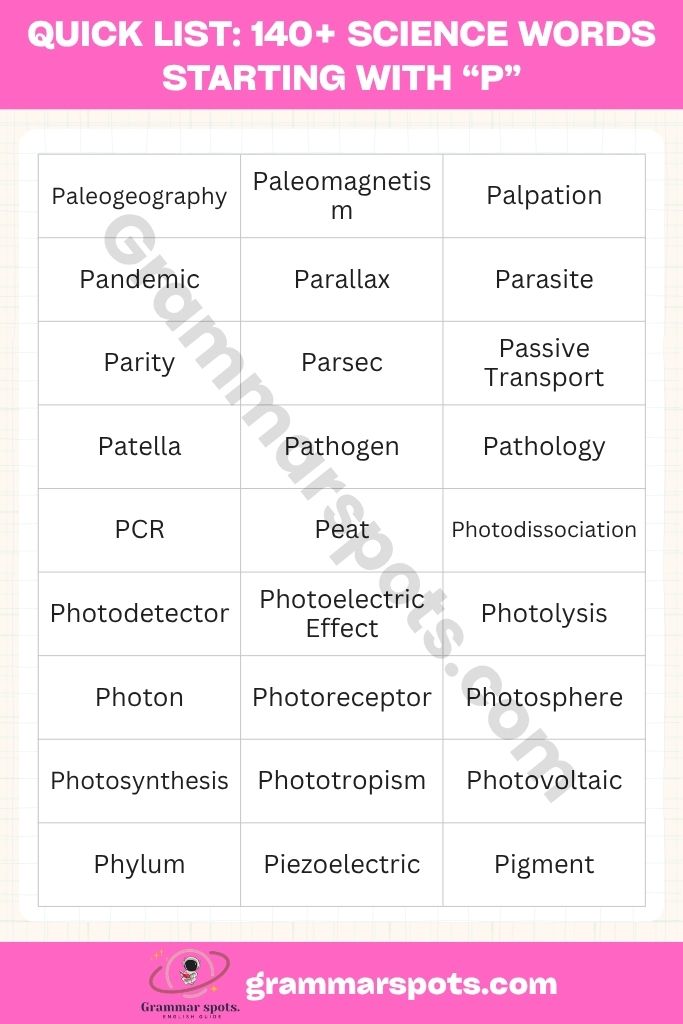
- Parabola
- Paleogeography
- Paleomagnetism
- Palpation
- Pandemic
- Parallax
- Parasite
- Parity
- Parsec
- Passive Transport
- Patella
- Pathogen
- Pathology
- PCR
- Peat
- Photodissociation
- Photodetector
- Photoelectric Effect
- Photolysis
- Photon
- Photoreceptor
- Photosphere
- Photosynthesis
- Phototropism
- Photovoltaic
- Phylum
- Piezoelectric
- Pigment
- Pioneer Species
- Pitch
- Pituitary Gland
- Pixel
- Placebo
- Placenta
- Planck’s Constant
- Planet
- Planetesimal
- Plasma
- Plasmid
- Plate Boundary
- Plate Tectonics
- Pneumatics
- Pod
- Point Source Pollution
- Polar Molecule
- Polar Zone
Physics Science Words That Start With P
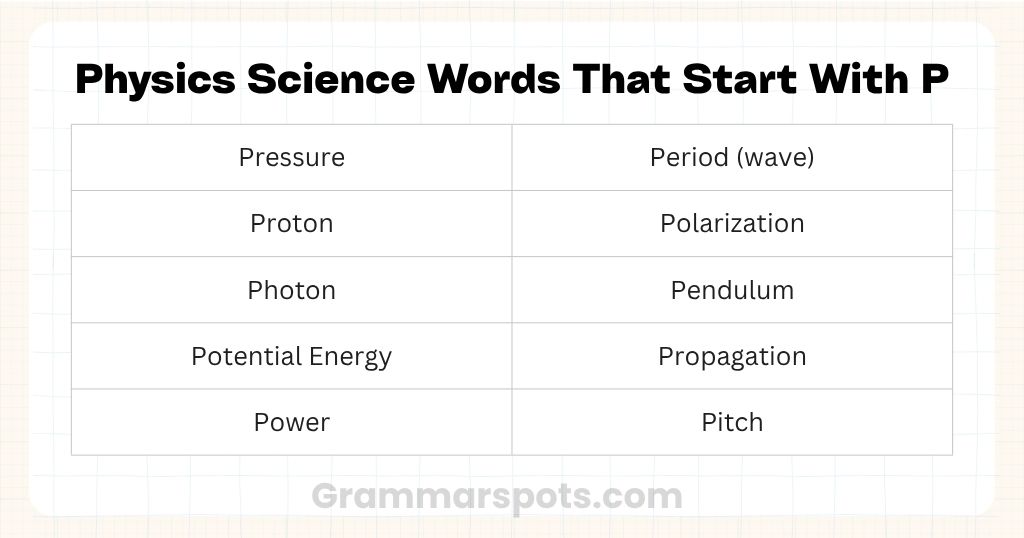
Pressure — Force spread over an area. A sharp knife cuts because all force concentrates on a tiny edge. Formula: Pressure = Force ÷ Area.
Proton — Positively charged particle inside every atom’s nucleus. The number of protons defines which element something is. Carbon always has 6. Gold always has 79.
Photon — A particle of light with no mass but real energy. When sunlight warms your skin, photons are responsible.
Potential Energy — Stored energy waiting to be released. A rock on a cliff has it. The moment it falls, that energy becomes motion.
Power — How fast work gets done. Two people can lift the same box, but the faster one uses more power.
Period (wave) — Time for one complete wave cycle. Applies to sound waves, light waves, and ocean waves equally.
Polarization — Light waves aligning in one direction. Polarized sunglasses use this to cut glare from roads and water.
Pendulum — A hanging weight that swings back and forth. Old mechanical clocks used pendulums to keep accurate time.
Propagation — How waves travel through a medium. Sound propagates through air. Earthquake waves propagate through rock.
Pitch — How high or low a sound is. Violin strings produce high pitch. Bass drums produce low pitch.
Photoelectric Effect — Light hitting certain metals knocks electrons loose, producing electricity. Einstein won his Nobel Prize for explaining this — not for relativity.
Phonon — A quantum of vibrational energy in solid materials. Sound travels through solids as phonons.
Parity — Whether a physical system behaves identically when its spatial coordinates are flipped. Weak nuclear forces actually violate parity — a major discovery in 1956.
Perturbation — A small disturbance added to a system to study how it responds. Used in orbital mechanics and quantum physics calculations.
Chemistry Science Words That Start With P
pH — Scale from 0–14 measuring acidity. Lemon juice sits around 2. Bleach around 13. Pure water is 7. Matters in medicine, cooking, swimming pools, and farming.
Polymer — Giant molecule built from thousands of repeating smaller units. Plastic is a polymer. DNA is a polymer. So is the protein in your hair.
Peptide — Short amino acid chain. Longer chains become proteins. Found in medications, skincare products, and your digestive system.
Precipitate — A solid that forms and drops out of a liquid during a chemical reaction. Mix certain solutions and a cloudy solid appears at the bottom — that’s a precipitate.
Periodic Table — Organized chart of every known element. Over 100 years old. Still the most useful tool in any chemistry class.
Product — What gets made in a chemical reaction. Reactants go in. Products come out. Water is the product when hydrogen burns in oxygen.
Polar Molecule — A molecule with uneven electron sharing, giving it a positive end and a negative end. Water is polar — that’s why it dissolves so many things.
Polymerization — The process of joining monomers into a polymer chain. How plastic is made. How rubber is produced. How your body assembles proteins.
Phenol — A chemical compound used in antiseptics, plastics, and medicines. Responsible for that sharp hospital smell in older disinfectants.
Phosphorus — Element symbol P. Found in DNA, bones, and cell membranes. Also used in fertilizers and matchstick heads.
Photolysis — Breaking a chemical bond using light energy. Happens during photosynthesis when sunlight splits water molecules.
Partial Pressure — The pressure one gas exerts in a mixture of gases. Relevant in scuba diving, respiratory medicine, and industrial chemistry.
Precipitation Reaction — A chemical reaction where two liquids mix and produce an insoluble solid. A standard experiment in school chemistry labs.
Phospholipid — A fat molecule that forms the outer layer of every cell. Two layers of phospholipids make up the cell membrane.
Biology Science Words That Start With P
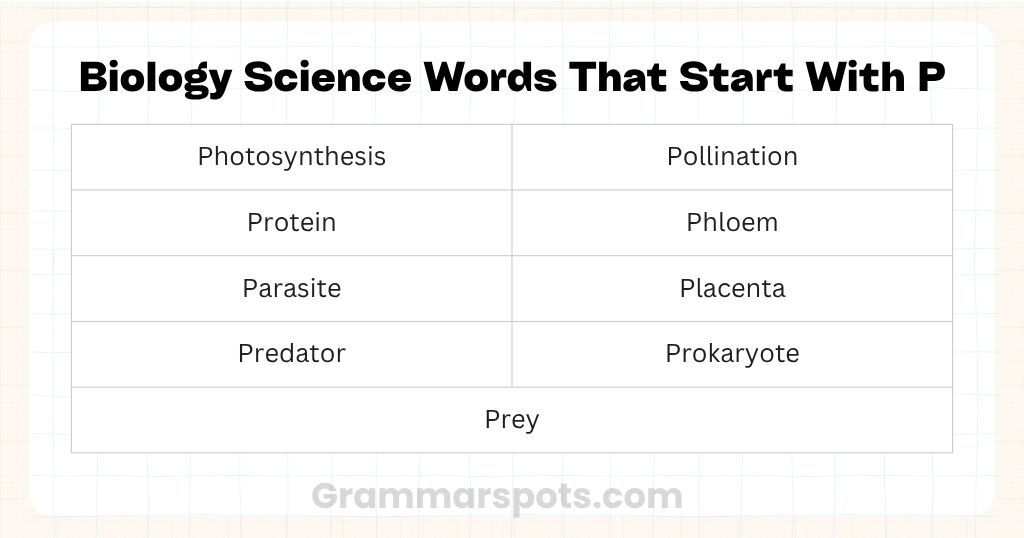
Photosynthesis — Plants capture sunlight and convert carbon dioxide plus water into sugar and oxygen. No photosynthesis means no atmospheric oxygen means no life as we know it.
Protein — Molecules that do nearly everything in your body — build muscle, carry oxygen, fight infections, and speed up chemical reactions.
Parasite — Lives on or inside a host organism and benefits at the host’s expense. Tapeworms, ticks, and certain fungi all qualify.
Predator — Hunts and eats other animals. Keeps ecosystems balanced by controlling prey populations.
Prey — The animal being hunted. Prey species have evolved speed, camouflage, and sharp senses over millions of years.
Pollination — Pollen moving from a flower’s male part to its female part. Done by bees, birds, wind, or other insects. No pollination means no seeds and no fruit.
Phloem — Plant tubes that carry sugars made during photosynthesis downward from leaves to roots and stems.
Placenta — Organ that connects a developing mammal baby to its mother’s blood supply, delivering nutrients and oxygen throughout pregnancy.
Prokaryote — Single-celled organism with no nucleus. Bacteria are prokaryotes. They’re Earth’s oldest living organisms.
Phenotype — The visible physical traits of an organism — eye color, height, leaf shape. The result of genes interacting with environment.
Phototropism — Plant growth directed toward a light source. Sunflowers tracking the sun across the sky is the classic example.
Pathogen — Any microorganism that causes disease. Includes viruses, bacteria, fungi, and parasites. Your immune system exists mainly to stop these.
Pulse — Rhythmic pressure in arteries from heartbeats. Felt at the wrist or neck. Used by doctors to assess heart rate and circulation.
Pheromone — Chemical signals released by animals to communicate with their own species. Ants use them to mark trails. Moths use them to find mates from miles away.
Puberty — The biological stage when a young body develops into an adult body. Driven by hormones affecting growth, reproduction, and organ function.
Pupa — The resting transformation stage of certain insects. Inside a cocoon or chrysalis, a caterpillar reorganizes into a butterfly or moth.
Phagocytosis — A cell engulfing and destroying a foreign particle or pathogen. White blood cells use this to eat bacteria.
Plasmid — A small, circular piece of DNA found in bacteria, separate from the main chromosome. Used widely in genetic engineering experiments.
Pioneer Species — The first organisms to colonize a barren or disturbed environment. Lichens on bare rock are a classic pioneer species.
Peristalsis — Wave-like muscle contractions that push food through your digestive system. Happens automatically — you don’t control it consciously.
Phylum — A major classification level in biology. Sits below Kingdom and above Class. All vertebrates belong to Phylum Chordata.
Pituitary Gland — A small gland at the base of the brain that controls growth, metabolism, and many other hormones. Often called the master gland.
Passive Transport — Movement of substances across a cell membrane without using energy. Oxygen entering cells happens this way.
Positive Feedback — A biological process where the output amplifies the original signal. Childbirth contractions increasing in intensity is one example.
Population Genetics — The study of how gene frequencies change in a population over time. The backbone of understanding evolution.
Pectin — A natural carbohydrate found in fruit cell walls. Gives jam its gel-like texture. Also studied for medical drug delivery uses.
Pigment — A molecule that absorbs certain wavelengths of light and reflects others. Chlorophyll is green because it reflects green light. Melanin gives skin and hair their color.
Polyploidy — Having more than two full sets of chromosomes. Common in plants — wheat, cotton, and strawberries are all polyploid.
Earth Science Words That Start With P
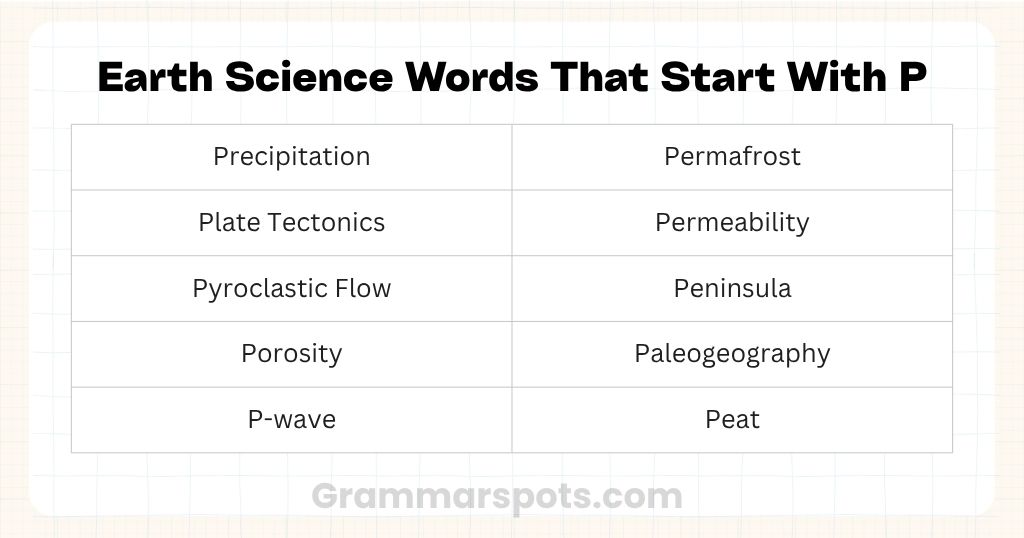
Precipitation — Any water falling from the atmosphere rain, snow, sleet, or hail. A key step in the water cycle.
Permafrost — Ground frozen for at least two consecutive years. Found mainly in Arctic regions. Thawing permafrost releases stored carbon a serious climate change concern.
Plate Tectonics — Theory that Earth’s outer shell is divided into moving plates. Their movement causes earthquakes, volcanoes, and mountain ranges over millions of years.
Permeability — How easily water or gas moves through rock or soil. Sandy soil is very permeable. Clay is not. Critical for groundwater and construction planning.
Pyroclastic Flow — A fast-moving current of superheated gas and volcanic debris rushing down a volcano’s slope. Travels at hundreds of kilometers per hour. Extremely lethal.
Peninsula — Land nearly surrounded by water but still attached to a mainland. Italy, Florida, and the Korean Peninsula are examples.
Porosity — The percentage of empty space in rock or soil that can hold water or air. High porosity = more storage space underground.
Paleogeography — Study of ancient landmass positions. Millions of years ago, all continents were joined as one supercontinent called Pangaea.
P-wave — Primary seismic wave. Travels through both solid and liquid rock. Arrives first at seismograph stations after an earthquake.
Peat — Partially decomposed plant material found in boggy areas. Compressed over millions of years, it eventually becomes coal.
Plate Boundary — Where two tectonic plates meet. Three types: convergent (colliding), divergent (separating), and transform (sliding past each other).
Paleomagnetism — The record of Earth’s past magnetic field preserved in rocks. Helped scientists prove that plate tectonics actually happens.
Point Source Pollution — Pollution that comes from one identifiable location, like a factory pipe discharging chemicals into a river.
Space & Astronomy Science Words That Start With P
Pulsar — A neutron star spinning at extreme speed, sending out radiation beams like a lighthouse. Some rotate hundreds of times per second.
Planet — A large rounded body orbiting a star, massive enough to clear its orbital path. Our solar system has 8 recognized planets.
Parallax — The apparent shift in a star’s position when viewed from different points in Earth’s orbit. Astronomers use this to measure distances to nearby stars.
Parsec — Distance unit used in astronomy. One parsec equals about 3.26 light-years.
Photosphere — The visible surface layer of the Sun that radiates the light we see. Temperature around 5,500°C.
Perihelion — The point in a planet’s orbit closest to the Sun. Earth reaches perihelion in early January — even though it’s winter in the Northern Hemisphere.
Protostar — A very young star still gathering gas and dust before nuclear fusion begins. A star in its earliest infancy.
Planetesimal — Small rocky bodies in the early solar system that clumped together over time to eventually form planets.
Proxima Centauri — The nearest star to Earth beyond our Sun, about 4.24 light-years away. Has at least one rocky planet in its habitable zone.
Polar Zone — Regions of a planet near its poles, typically cold and receiving sunlight at very low angles.
Medical & Health Science Words That Start With P
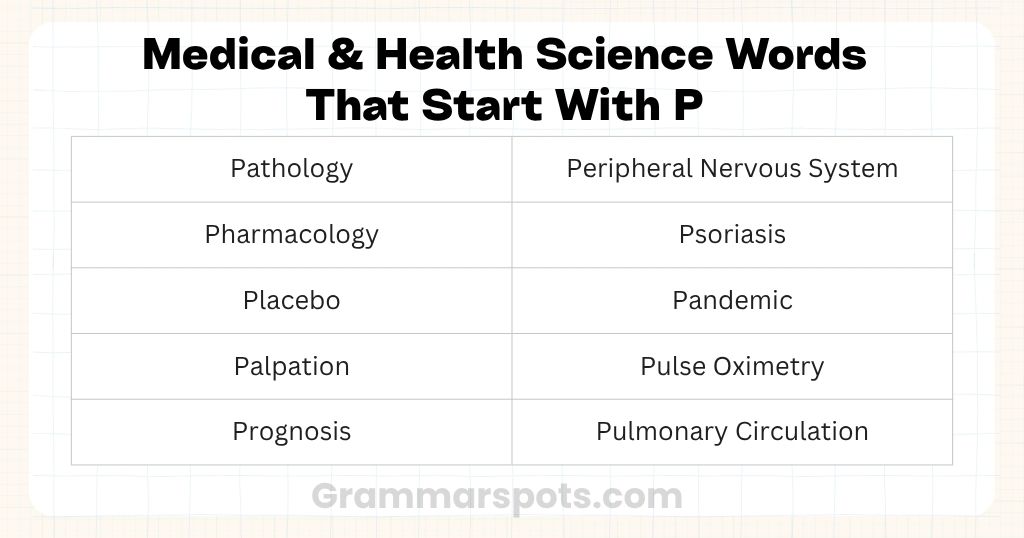
Pathology — The study of disease its causes, development, and effects on the body. Pathologists examine tissue samples and blood to diagnose illness.
Pharmacology — The science of how drugs interact with the body. Explains why aspirin reduces pain and why antibiotics kill bacteria.
Placebo — A treatment with no active ingredient. Patients sometimes improve just from believing they’re being treated. This is measurable and called the placebo effect.
Palpation — Examining the body by pressing and feeling with the hands. Doctors use it to check for swollen lymph nodes or unusual lumps.
Prognosis — A medical prediction about how a disease will develop. Good prognosis means recovery is likely. Poor prognosis means the condition may worsen.
Peripheral Nervous System — All nerves outside the brain and spinal cord. Carries signals from your fingertips and toes back to your spinal cord.
Psoriasis — A skin condition causing rapid cell buildup that forms scales and red patches. Immune-related and not contagious.
Pandemic — A disease spreading across multiple countries and continents simultaneously. Different from an epidemic, which stays more geographically contained.
Pulse Oximetry — A non-invasive method measuring oxygen levels in blood. The small clip placed on your fingertip at the doctor’s office does exactly this.
Pulmonary Circulation — The blood circuit between the heart and lungs. Blood picks up oxygen in the lungs, then returns to the heart to be pumped to the rest of the body.
Patella — The kneecap. A small bone sitting in front of the knee joint that protects it during movement.
Periosteum — The thin membrane covering the outer surface of bones. Contains blood vessels and nerves, and plays a key role in bone repair after fracture.
Technology & Applied Science Words That Start With P
Piezoelectric — Certain materials produce electric voltage when physically compressed or bent. Used in lighters, microphones, and energy-harvesting floor tiles.
Photovoltaic — Converts sunlight directly into electricity. The technology behind every solar panel on a rooftop or satellite.
Pixel — The smallest single unit of a digital image or screen. Every photo on your phone is built from millions of pixels in a grid.
Protocol — A defined set of rules for how systems communicate or how experiments must be conducted. HTTP governs the web. PCR has a strict laboratory protocol.
Pneumatics — Using compressed air or gas to create mechanical movement. Powers dentist drills, bus doors, and many factory machines.
Processor — The chip inside a computer that performs calculations. Every click, scroll, and game frame runs through it.
Photodetector — A device converting detected light into an electrical signal. Found in cameras, TV remotes, and medical imaging scanners.
Polymer Composite — A material combining a polymer with another substance for better strength or heat resistance. Used in aircraft parts, racing cars, and sports equipment.
P-type Semiconductor — A semiconductor material with extra “holes” (positive charge carriers). Works alongside N-type semiconductors in transistors and solar cells.
Proton Exchange Membrane — A key component in hydrogen fuel cells. Allows protons to pass through while blocking electrons, generating usable electricity.
Easy Science Words That Start With P (Grades 3–6)
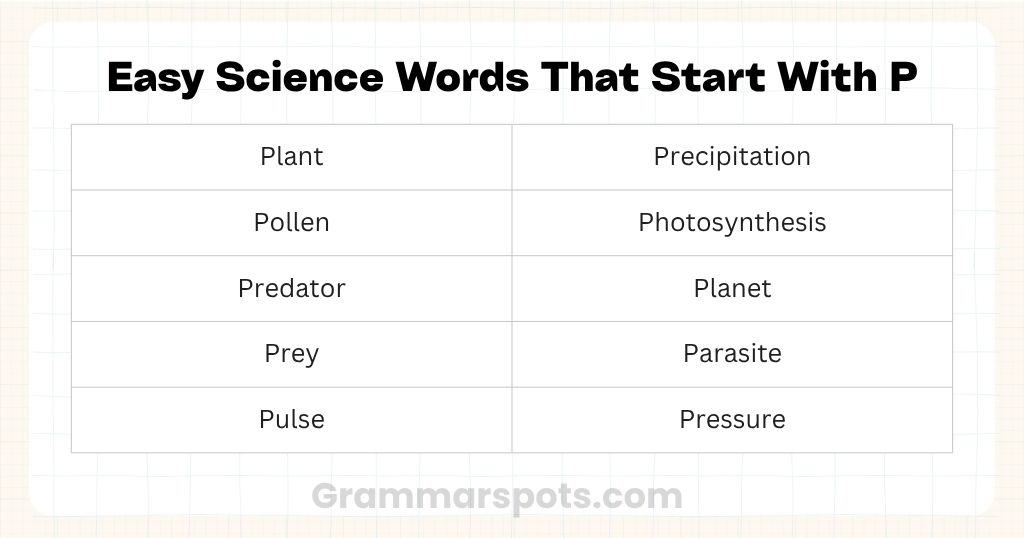
- Plant — A living thing that grows from soil and makes its own food
- Pollen — Tiny powder from flowers needed to make seeds
- Predator — An animal that hunts others for food
- Prey — An animal that gets hunted
- Pulse — The heartbeat you feel at your wrist
- Precipitation — Rain, snow, or hail falling from the sky
- Photosynthesis — How plants turn sunlight into food
- Planet — A large round object orbiting a star
- Parasite — A creature that lives on another and harms it
- Pressure — How hard a force pushes on a surface
- Pupa — An insect’s resting stage before becoming an adult
- Pod — A seed case like a pea pod or bean pod
- Phloem — Plant tubes that carry food made in leaves
- Pollination — Bees or wind moving pollen between flowers
Advanced Science Words That Start With P (High School & Beyond)
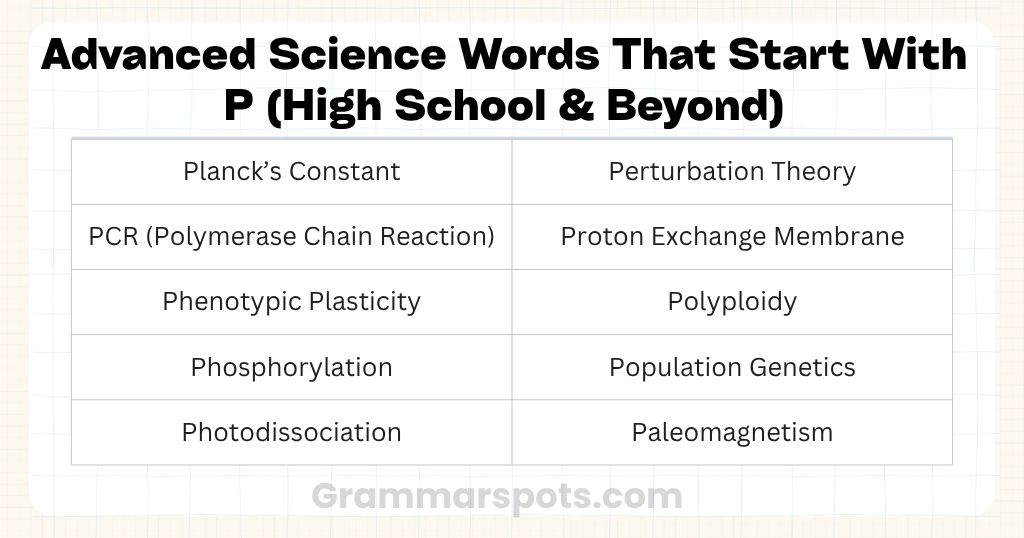
- Planck’s Constant — A fixed number (6.626 × 10⁻³⁴ J·s) connecting a photon’s energy to its frequency. Central to all of quantum physics.
- PCR (Polymerase Chain Reaction) — Lab technique that copies a tiny DNA sample millions of times. Used in disease diagnosis, forensics, and genetic research.
- Phenotypic Plasticity — One organism showing different physical traits depending on its environment, without any DNA change.
- Phosphorylation — Adding a phosphate group to a protein or molecule to activate or deactivate a biological process. Central to how cells produce energy.
- Photodissociation — Light breaking apart a molecule. Happens constantly in Earth’s upper atmosphere, affecting ozone chemistry.
- Perturbation Theory — Mathematical method analyzing small disturbances in a system to predict behavior. Used in quantum mechanics and planetary orbit calculations.
- Proton Exchange Membrane — Selectively allows protons through in hydrogen fuel cells while blocking electrons to generate electrical current.
- Polyploidy — Organism having more than two full sets of chromosomes. Wheat, cotton, and strawberries are naturally polyploid.
- Population Genetics — How gene frequencies shift across generations within a group. The scientific foundation of evolutionary biology.
- Paleomagnetism — Ancient magnetic fields preserved in rocks that revealed Earth’s plates have been moving for billions of years.
Common Confusions: P Words People Mix Up
Phloem vs. Xylem
Phloem carries sugars downward from leaves. Xylem carries water upward from roots. Memory trick: Phloem = Phood transport.
Phenotype vs. Genotype
Genotype is the genetic code inside a cell. Phenotype is what you can actually see eye color, height, leaf shape.
Prokaryote vs. Eukaryote
Prokaryotes (bacteria) have no nucleus. Eukaryotes (animals, plants, fungi) do. The prefix “pro” means before these cells existed before nucleus-based life evolved.
Pathogen vs. Parasite
All parasites harm a host but not all cause disease the way pathogens do. A tapeworm is both. A virus is a pathogen but not a parasite.
Pressure vs. Force
Force is a push or pull. Pressure is that force divided by the area it acts on. A thumbtack pierces wood because all its force concentrates on a tiny point.
Precipitation (weather) vs. Precipitate (chemistry)
One falls from clouds. The other forms inside a test tube. Same Latin root completely different science.
Planet vs. Protoplanet vs. Planetesimal
Planetesimals are small rocky chunks. Several merge into a protoplanet. A protoplanet that clears its orbital path becomes a full planet.
FAQs
How many science words start with P?
Hundreds across all scientific fields. This article covers 140+ of the most common and useful ones.
Why do so many science words start with P?
Most come from Greek prefixes: photo (light), phyto (plant), proto (first), para (beside), peri (around), pneumo (air). Greek is the foundation of scientific language.
What are the most important P words for science exams?
Photosynthesis, protein, proton, pH, pressure, pathogen, pollination, and precipitation appear most often on standardized science tests from middle school through college.
What P science words should a 7th grader know?
Focus on: photosynthesis (with its equation), pressure (with its formula), pH scale, protein structure basics, plate tectonics, predator-prey relationships, and pathogen types.
Are these words hard to learn?
Not once you know the roots. Photosynthesis = photo (light) + synthesis (making). Breaking words into parts makes everything easier to remember.
Conclusion
You now have 140+ science words starting with P sorted by subject, graded by difficulty, and explained clearly without unnecessary padding.
P is genuinely one of the most important letters in science vocabulary. Photosynthesis feeds the world. Plate tectonics reshapes it. Pathogens threaten it. Pulsars sit billions of light-years beyond it.
Learn the words. Learn the roots. The rest of science vocabulary starts to unlock itself.

I’m Hazel, and I studied BSC English at GCUF. I focus on explaining word meanings in simple, clear language that anyone can understand. My goal is helping readers grasp everyday English, confusing terms, and slang used in real conversations and social media. I believe language learning works best when definitions connect to actual life situations. Through careful research and straightforward explanations, I make vocabulary accessible for students, learners, and anyone curious about how English really works in daily use.