

You probably need this for a science test, a vocabulary assignment, or just to understand words you keep seeing in textbooks. The letter R is surprisingly rich in science it covers everything from light physics to cell biology to space astronomy.
This article gives you clean definitions, real examples, and organized categories so you actually remember what you read.
Quick Answer: Top 20 Science Words Starting With R
| Word | Meaning |
| Radiation | Energy released as waves or particles through space |
| Reaction | A chemical change between two or more substances |
| Refraction | Bending of light as it passes into a new medium |
| Respiration | Process cells use to convert glucose into energy |
| RNA | Molecule that carries genetic instructions from DNA |
| Reproduction | Biological process of producing offspring |
| Resistance | Opposition to the flow of electric current |
| Reflection | Bouncing of light off a surface |
| Receptor | Protein that detects and responds to chemical signals |
| Retina | Light-sensitive tissue at the back of the eye |
| Ribosome | Cell structure that assembles proteins from RNA |
| Reactant | Substance that enters and changes in a chemical reaction |
| Replication | Copying of DNA before a cell divides |
| Reflex | Automatic body response that bypasses conscious thought |
| Revolution | One complete orbit of a planet around a star |
| Renewable | Energy source that naturally replenishes over time |
| Rhizome | Horizontal underground stem that stores nutrients |
| Resonance | Strong vibration at an object’s natural frequency |
| Red Giant | Large aging star that has expanded and cooled |
| Runoff | Water flowing over land surface into waterways |
Quick List of 130+ Science Words Starting With R
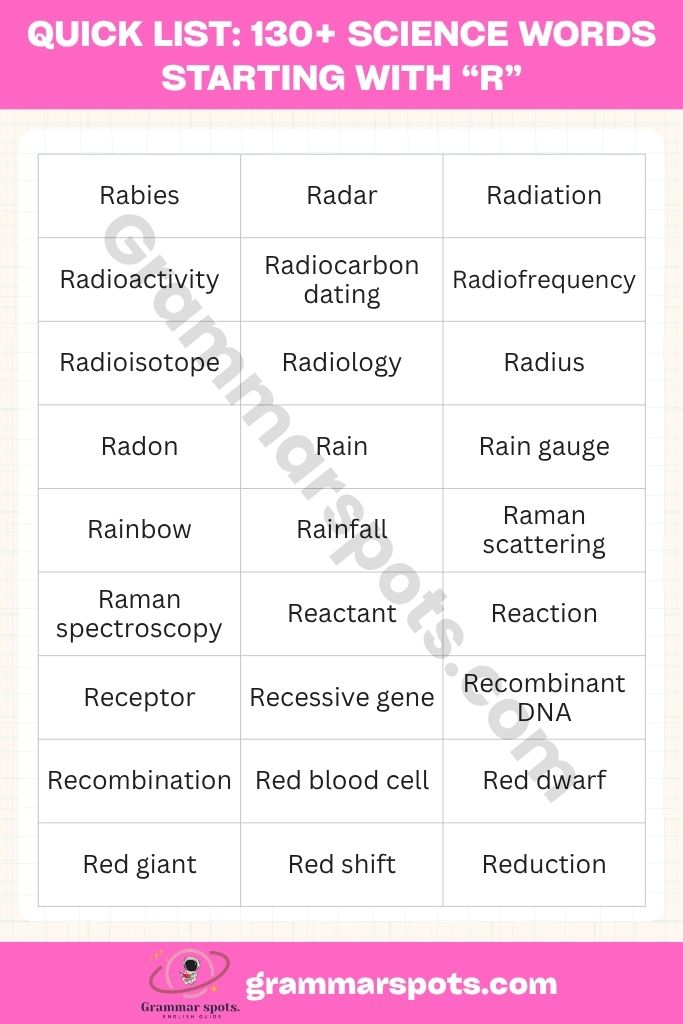
- Rabies
- Radar
- Radiation
- Radioactivity
- Radiocarbon dating
- Radiofrequency
- Radioisotope
- Radiology
- Radius
- Radon
- Rain
- Rain gauge
- Rainbow
- Rainfall
- Raman scattering
- Raman spectroscopy
- Reactant
- Reaction
- Receptor
- Recessive gene
- Recombinant DNA
- Recombination
- Red blood cell
- Red dwarf
- Red giant
- Red shift
- Reduction
- Reflection
- Reflex
- Refraction
- Regeneration
- Regolith
- Relativity
- Renewable energy
- Renin
- Replication
- Reproduction
- Resistance
- Resonance
- Respiration
- Restriction enzyme
- Retina
- Retrovirus
- Revolution
- Rhizome
- Ribonucleoprotein
- Ribonucleic acid (RNA)
- Ribosome
- Richter scale
- Rift
- Rock cycle
Physics Science Words That Start With R
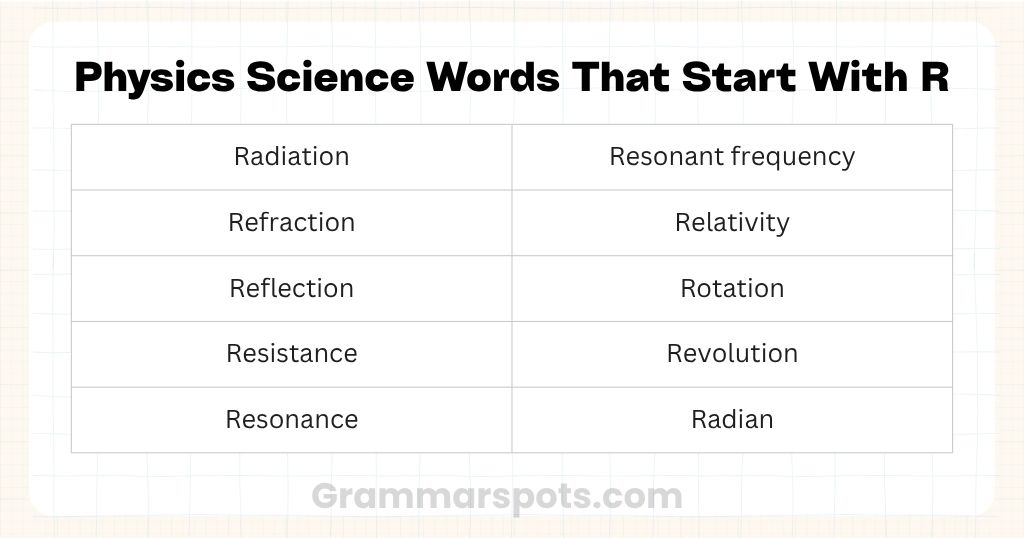
Radiation
Energy that moves through space as waves or particles. Sunlight is radiation. So is heat from a fire. Not all radiation is harmful visible light is a form of radiation too.
Refraction
When light travels from air into water or glass, it slows down and bends. A pencil placed in a glass of water looks broken at the surface that’s refraction in action.
Reflection
Light bouncing off a surface at an angle equal to the angle it hit. Mirrors use reflection. So does radar, which bounces radio waves off objects to detect them.
Resistance
The opposition a material gives to electric current passing through it. Measured in ohms. Thin wires have high resistance; thick copper wires have low resistance.
Resonance
When a vibrating force matches an object’s natural frequency, the object vibrates strongly. This is why a bridge can shake dangerously in wind and why a singer can shatter glass with the right pitch.
Resonant frequency
The specific frequency at which an object naturally vibrates most. Every object has one.
Relativity
Einstein’s theory explaining how time, space, mass, and gravity interact. At speeds close to light, time slows down. Gravity bends space itself.
Rotation
Spinning around an internal axis. Earth rotates once every 24 hours, creating day and night.
Revolution
Moving in a path around an external point. Earth completes one revolution around the Sun every 365 days.
Radian
A unit for measuring angles. One radian equals the angle made when the arc length equals the radius of the circle.
Rotational inertia
The resistance of a spinning object to changes in its rotation. A figure skater pulls arms in to spin faster — rotational inertia at work.
Rectifier
A device that converts alternating current (AC) into direct current (DC). Found in phone chargers and power supplies.
Rotor
The rotating part of an electric motor or generator. Rotors convert electrical energy into mechanical motion — or vice versa.
Rutherford model
Ernest Rutherford’s model of the atom, where a dense positive nucleus sits at the center with electrons orbiting around it.
Rutherford scattering
The deflection of alpha particles by atomic nuclei. Rutherford used this experiment to discover the nucleus.
Chemistry Science Words That Start With R
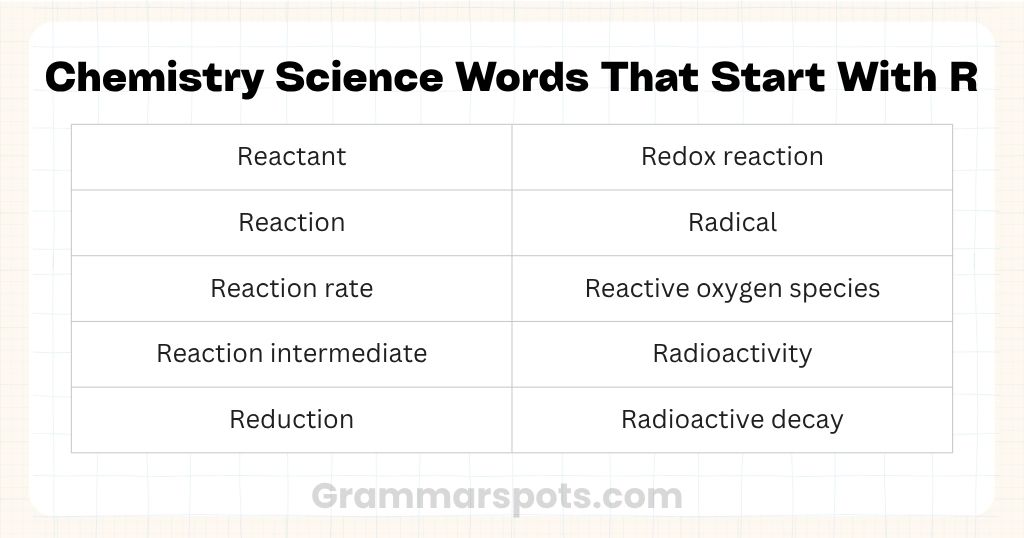
Reactant
Any substance that enters a chemical reaction and gets chemically changed. In burning wood, oxygen and wood are reactants.
Reaction
A process where substances change into new substances by breaking and forming chemical bonds.
Reaction rate
How fast a chemical reaction proceeds. Temperature, concentration, and catalysts all affect it.
Reaction intermediate
A short-lived species formed and consumed during a reaction, never appearing in the final products.
Reduction
A chemical change where a substance gains electrons. Always paired with oxidation in a redox reaction.
Redox reaction
A reaction involving simultaneous electron gain (reduction) and electron loss (oxidation). Batteries, rusting, and metabolism all involve redox reactions.
Radical
An atom or molecule with an unpaired electron. Highly reactive. Free radicals in the body can damage cells antioxidants help neutralize them.
Reactive oxygen species
Chemically active molecules containing oxygen that can damage DNA and proteins inside cells. Linked to aging and disease.
Radioactivity
When an unstable atomic nucleus releases particles or energy spontaneously over time.
Radioactive decay
The process by which an unstable atom loses energy by emitting radiation. Leads to a more stable element.
Radioactive half-life
The time required for half of a radioactive substance to decay. Carbon-14 has a half-life of about 5,730 years.
Radioisotope
A version of an element with an unstable nucleus that emits radiation. Used in cancer therapy and smoke detectors.
Recrystallization
A purification technique where a substance is dissolved in hot solvent then cooled slowly to form pure crystals.
Refractive index
A number describing how much a material slows down light. Water has a refractive index of about 1.33.
Relative density
The ratio of a substance’s density to the density of water. Also called specific gravity.
Reverse osmosis
A filtration process that pushes water through a membrane to remove dissolved salts and contaminants. Used in water purification systems.
Rust
Iron oxide formed when iron reacts with oxygen and water. Rust weakens metal over time.
Radon
A naturally occurring radioactive gas produced from uranium decay in soil. Can accumulate dangerously in enclosed spaces.
Runaway reaction
A chemical reaction that accelerates uncontrollably due to its own heat output. Dangerous in industrial settings.
Raman effect
The shift in wavelength of light when it scatters off molecules. Different molecules produce different patterns, used for identification.
Raman spectroscopy
A technique using the Raman effect to identify chemicals, minerals, and biological materials without destroying the sample.
Raman scattering
The specific scattering of photons by molecules that produces the Raman effect.
Biology Science Words That Start With R
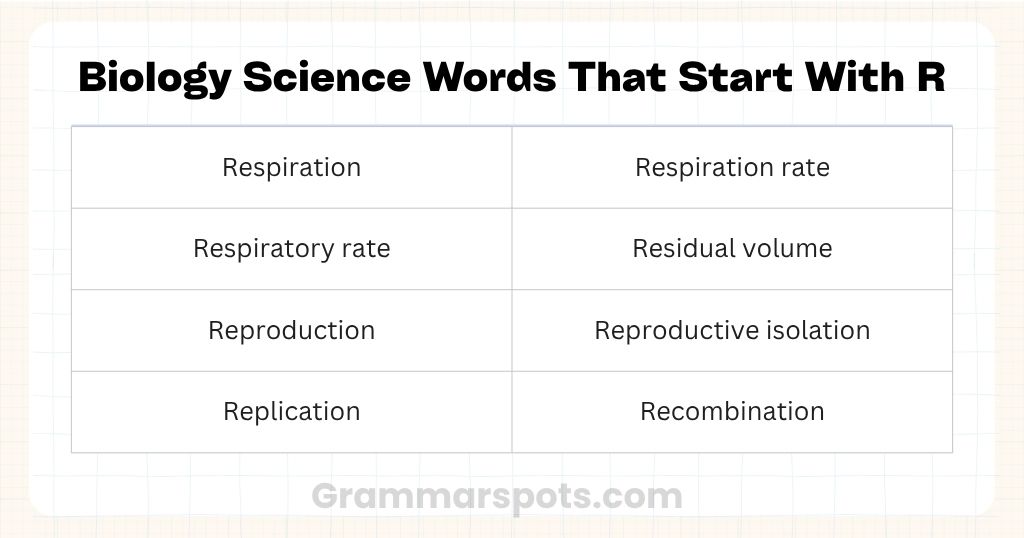
Respiration
The cellular process that converts glucose and oxygen into energy (ATP), carbon dioxide, and water. Every living cell does this continuously.
Respiration rate
How many breaths a person or organism takes per minute. Changes with activity, illness, and stress.
Respiratory rate
The clinical term for breaths per minute, used in medical monitoring.
Residual volume
The amount of air remaining in the lungs after a maximum exhale. Prevents lung collapse.
Reproduction
The process by which organisms produce offspring. Sexual reproduction involves two parents; asexual involves one.
Reproductive isolation
When two populations can no longer interbreed, eventually leading to two separate species.
Replication
The process of copying an entire DNA strand before cell division, so each new cell receives a complete genetic set.
Recombination
During reproduction, chromosomes exchange segments of DNA, creating new genetic combinations and variety.
Recombinant DNA
DNA artificially assembled from multiple sources. Used to produce insulin, vaccines, and genetically modified organisms.
Recombination frequency
The percentage of offspring showing a new gene combination; used to map gene locations on chromosomes.
RNA (Ribonucleic acid)
A single-stranded molecule that carries genetic instructions from DNA to the ribosome for protein synthesis.
Ribosomal RNA (rRNA)
The type of RNA that forms part of the ribosome’s structure and helps catalyze protein building.
RNA polymerase
The enzyme that reads DNA and builds a matching RNA strand during transcription.
Ribosome
A tiny cell structure that reads messenger RNA and assembles proteins from amino acids.
Ribose
A five-carbon sugar that forms the backbone of RNA molecules.
Ribozyme
An RNA molecule that can act as an enzyme one of few non-protein catalysts in biology.
Ribonucleoprotein
A complex of RNA and protein that carries out key cellular functions, including splicing and translation.
Receptor
A protein on or inside a cell that binds to specific molecules and triggers a cellular response.
Receptor potential
A graded electrical signal generated when a sensory receptor is stimulated.
Receptor agonist
A molecule that binds to a receptor and activates it, mimicking the effect of the natural signal.
Recessive gene
A gene that is only expressed when two copies are present one from each parent.
Recessive trait
A physical characteristic that appears only when the recessive gene is inherited from both parents.
Regulator gene
A gene that controls the activity of other genes, switching them on or off as needed.
Regeneration
The regrowth of lost or damaged body parts. Starfish regrow arms; the human liver partially regenerates.
Regenerative medicine
A field that uses stem cells and tissue engineering to repair or replace damaged organs and tissues.
Reflex
An automatic response to a stimulus that does not require conscious brain involvement.
Reflex arc
The neural pathway involved in a reflex from sensory receptor through the spinal cord to the muscle.
Relay neuron
A nerve cell that connects sensory neurons to motor neurons within the spinal cord.
Refractory period
The time after a neuron fires during which it cannot fire again. Limits how fast signals can travel.
Resting potential
The electrical charge difference across a neuron’s membrane when it is not sending a signal. About −70 mV in humans.
Repolarization
The restoration of the neuron’s resting potential after it has fired an electrical signal.
Retina
The light-sensitive inner lining of the eye containing rod and cone cells that convert light into nerve signals.
Retinal
A molecule derived from vitamin A that forms the light-absorbing part of the photoreceptor pigment in the eye.
Retinal pigment
The pigmented layer behind the retina that absorbs excess light and supports photoreceptor cells.
Retrovirus
A virus that uses RNA as its genetic material and converts it into DNA inside the host cell. HIV is a retrovirus.
Retroviral integration
The insertion of viral DNA into the host cell’s chromosome, where it may remain dormant for years.
Retroviral vector
A modified retrovirus used in gene therapy to deliver corrective DNA into patient cells.
Reverse transcriptase
An enzyme retroviruses use to convert their RNA genome into DNA inside host cells.
Red blood cell
The oxygen-carrying cell in blood. Has no nucleus, which allows it to carry more hemoglobin.
Red marrow
Bone marrow found inside flat bones that produces red blood cells, white blood cells, and platelets.
Rhizome
An underground stem that grows horizontally and can sprout new plants. Ginger and turmeric are rhizomes.
Rhizosphere
The narrow zone of soil surrounding plant roots, rich in microbial activity influenced by root secretions.
Rumen
The first stomach chamber in cows and other ruminants, where microbial fermentation of plant material begins.
Roughage
Dietary fiber plant material that the body cannot fully digest but that supports healthy gut function.
Rosette
A circular arrangement of leaves around a central point at the base of a plant. Also seen in bacterial colony shapes.
Riparian zone
The land area directly bordering a river or stream. Rich in biodiversity and important for water quality.
Red tide
A harmful algal bloom that produces toxins dangerous to marine life and humans who eat contaminated seafood.
Reptile
A cold-blooded vertebrate with scales that breathes air and typically lays eggs. Includes snakes, lizards, and crocodilians.
Earth Science Words That Start With R
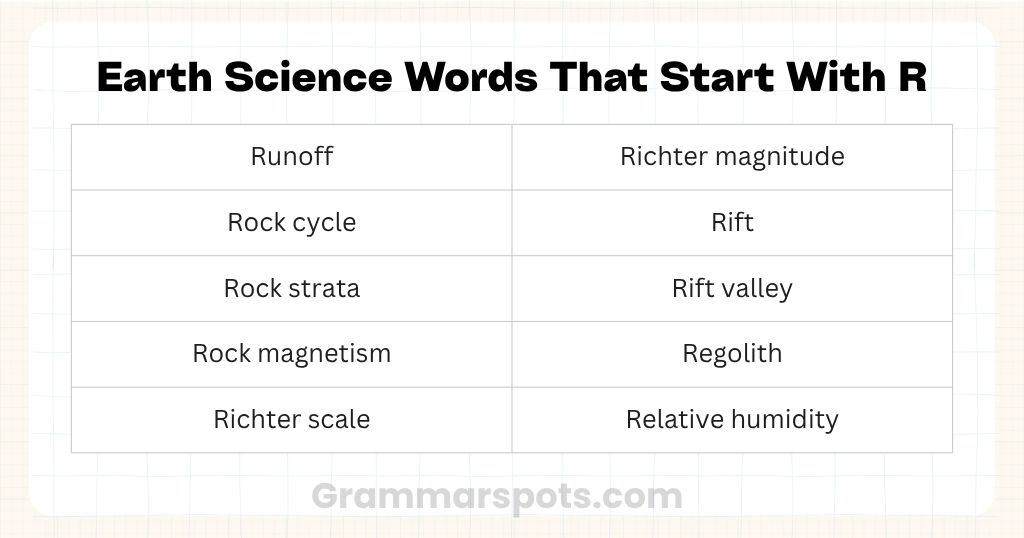
Runoff
Rainwater or snowmelt that flows over the land surface rather than soaking into the ground. Carries sediment and pollutants into waterways.
Rock cycle
The continuous process by which rocks are formed, broken down, and reformed over geological time. Igneous → sedimentary → metamorphic → back again.
Rock strata
Layers of sedimentary rock deposited over time. Each layer represents a different geological period.
Rock magnetism
The magnetic properties recorded in certain rocks when they cooled from magma, preserving the direction of Earth’s magnetic field at that time.
Richter scale
A logarithmic scale measuring the energy released by earthquakes. A magnitude 7 is about 31 times more powerful than magnitude 6.
Richter magnitude
The numerical value assigned to an earthquake on the Richter scale.
Rift
A crack in Earth’s crust where tectonic plates pull apart. The East African Rift is gradually splitting the continent.
Rift valley
A low-lying area formed when Earth’s crust stretches and drops between parallel faults.
Regolith
The loose layer of broken rock, dust, and soil covering solid bedrock. The Moon and Mars are both covered in regolith.
Relative humidity
The percentage of moisture in the air compared to the maximum it could hold at that temperature. 100% = fog or rain.
Rain gauge
An instrument used to measure the amount of rainfall in a specific area over a given period.
Ripple effect
The spreading pattern of waves outward from a disturbance point in water. Also used as a metaphor in ecology for cascading environmental impacts.
Renewable energy
Energy from sources that naturally replenish solar, wind, hydro, and geothermal.
Space & Astronomy Science Words That Start With R
Red giant
An aging star that has exhausted its core hydrogen and expanded enormously. The Sun will become one in about 5 billion years.
Red supergiant
A star far larger than a red giant among the largest stars in the universe by volume. Betelgeuse is an example.
Red dwarf
The most common and longest-lived type of star. Small, cool, and dim. Makes up about 70% of all stars in the Milky Way.
Red shift
The stretching of light toward longer wavelengths when a source moves away from the observer. Proof that the universe is expanding.
Right ascension
The astronomical equivalent of longitude, used to locate objects in the sky. Measured in hours, minutes, and seconds.
Radiation belt
A zone of charged particles trapped by a planet’s magnetic field. Earth’s Van Allen belts protect the surface from harmful solar radiation.
Retrograde
When a planet appears to move backward in the sky relative to Earth’s view. It’s an optical effect of orbital speed differences.
Roche limit
The closest distance at which a moon can orbit a planet without being torn apart by tidal forces. Saturn’s rings likely formed this way.
Rotation axis
The imaginary line through a planet or star around which it rotates. Earth’s axis is tilted 23.5 degrees.
Rocket propulsion
The force generated when combustion products are expelled in one direction, pushing the rocket in the opposite direction. Newton’s third law applied.
Radiometry
The measurement of electromagnetic radiation, including visible light, infrared, and ultraviolet, used in astronomy and remote sensing.
More Post: 140+ Foods That Start With R: Complete List of Fruits, Vegetables, Snacks, Drinks and More
Medical & Health Science Words That Start With R
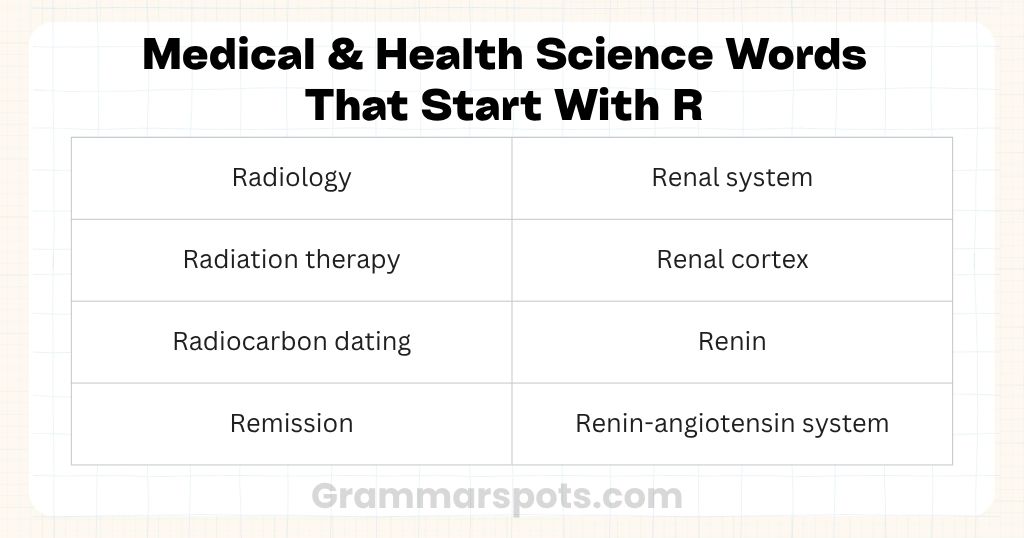
Radiology
The medical specialty using imaging technologies — X-ray, MRI, CT scan, ultrasound — to diagnose and treat disease.
Radiation therapy
The use of high-energy radiation to destroy cancer cells or shrink tumors.
Radiocarbon dating
A technique using carbon-14 decay to estimate the age of organic remains up to about 50,000 years old.
Remission
A period when disease symptoms decrease significantly or disappear entirely. Common term in cancer treatment.
Renal system
The organ system responsible for filtering blood and producing urine — primarily the kidneys, ureters, and bladder.
Renal cortex
The outer layer of the kidney, where blood is filtered through tiny structures called nephrons.
Renin
An enzyme released by the kidneys that helps regulate blood pressure by controlling fluid balance.
Renin-angiotensin system
A hormonal system that regulates blood pressure and fluid balance. A key target for blood pressure medications.
Rabies
A fatal viral infection affecting the nervous system, usually transmitted through animal bites. Preventable by vaccination.
Riparian zone (ecological health context)
Healthy riparian zones filter agricultural runoff before it enters drinking water sources.
Technology & Applied Science Words That Start With R
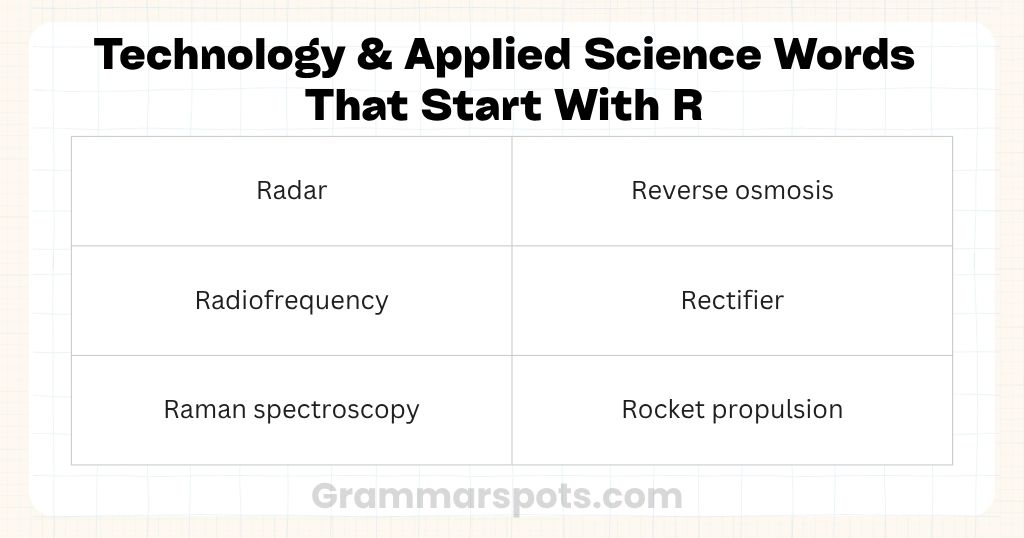
Radar
Radio Detection And Ranging. Sends out radio waves and measures how they bounce back to detect objects, weather, and speed.
Radiofrequency
The electromagnetic frequency range used for wireless communication Wi-Fi, Bluetooth, mobile networks, and broadcast radio.
Raman spectroscopy (applied)
Used in pharmaceuticals to verify drug composition, in forensics to identify unknown substances, and in food safety testing.
Reverse osmosis (applied)
A water purification method that forces water through semi-permeable membranes to remove dissolved contaminants.
Rectifier (applied)
Converts AC power to DC power in electronics. Found in every phone charger and power adapter.
Rocket propulsion (applied)
The engineering application of Newton’s third law to launch vehicles into space.
Rotor (applied)
The rotating component of motors, turbines, and generators. Central to wind turbines, helicopters, and electric vehicles.
Common Confusions: R Words People Mix Up
Respiration vs. Breathing
- Breathing = moving air in and out of the lungs (mechanical)
- Respiration = chemical process inside cells converting glucose to energy
Reflection vs. Refraction
- Reflection = light bounces back off a surface
- Refraction = light bends as it moves between two materials
RNA vs. DNA
- DNA = permanent genetic storage (like a hard drive)
- RNA = temporary messenger carrying instructions (like a USB)
Rotation vs. Revolution
- Rotation = spinning on own axis (Earth’s day)
- Revolution = orbiting another body (Earth’s year)
Red Giant vs. Red Dwarf
- Red giant = large, old, dying star that expanded
- Red dwarf = small, young, long-lived star
Reactant vs. Product
- Reactant = goes into the reaction
- Product = comes out of the reaction
Recessive vs. Dominant gene
- Dominant = expressed even with one copy
- Recessive = only expressed with two copies
Reflex vs. Voluntary action
- Reflex = automatic, no thinking required
- Voluntary = conscious decision involved
FAQs
How many science words start with R?
Hundreds across all fields. This article lists 130+ verified terms used in real science education and practice.
Which R science words appear most on exams?
- Respiration
- Reaction
- Refraction
- Reflection
- Replication
- Reproduction
- RNA
- Resistance
What R words should a 7th grader know?
- RNA
- Reactant
- Resistance
- Refraction
- Replication
- Receptor
- Recessive gene
- Richter scale
- Renewable energy
- Retina
Are R science words hard?
Basic ones rain, rock, root, reflex are straightforward. Advanced terms like ribozyme or retroviral vector need more context. Grouping them by subject makes learning much easier than memorizing a random list.
Which field has the most R words?
Biology especially cell biology and genetics has the highest density of R-starting terms.
Conclusion
This article covered 130+ science words beginning with R organized by subject, by difficulty, and by real-life use. The letter R is one of the most productive in science vocabulary, appearing across physics, chemistry, biology, earth science, medicine, and technology.
Use the quick table for fast review. Use the category sections to understand how each word connects to a field. Use the confusions section before any test where similar terms appear together.
Science vocabulary is not memorization it’s a shortcut to understanding. Each word you learn unlocks a concept, a process, or a field.

I’m Hazel, and I studied BSC English at GCUF. I focus on explaining word meanings in simple, clear language that anyone can understand. My goal is helping readers grasp everyday English, confusing terms, and slang used in real conversations and social media. I believe language learning works best when definitions connect to actual life situations. Through careful research and straightforward explanations, I make vocabulary accessible for students, learners, and anyone curious about how English really works in daily use.