


You need science words starting with T. Maybe for a test, a project, or just to understand what you’re reading in class.
Words like thermodynamics, tectonic, and transpiration sound hard but they follow patterns. Learn the root, and a whole group of words unlocks at once.
This article gives you 170+ real science T-words, organized by field, level, and use. Definitions are short and clear. Lists are clean. No filler.
Quick Answer: 20 Most-Used Science Words Starting With T
- Temperature — Measure of average heat energy in a substance
- Tissue — Group of similar cells working together
- Tectonic — Relating to Earth’s large moving crustal plates
- Thermal — Related to heat or temperature
- Toxin — Poisonous substance produced by a living organism
- Transpiration — Water vapor released by plant leaves
- Tsunami — Large ocean wave triggered by seismic activity
- Taxonomy — Scientific system for classifying living organisms
- Tendon — Tissue connecting muscle to bone
- Thermometer — Instrument used to measure temperature
- Trait — Inherited characteristic passed from parent to offspring
- Turbine — Machine that converts fluid motion into energy
- Trachea — Airway tube connecting throat to lungs
- Troposphere — Lowest layer of Earth’s atmosphere
- Tritium — Radioactive isotope of hydrogen
- Torque — Force that causes rotation
- Thyroid — Neck gland that regulates metabolism
- Translucent — Allowing partial light transmission
- Tundra — Cold treeless biome with permanently frozen ground
- Turbulence — Irregular, chaotic fluid or airflow
Quick List of 170+ Science Words Starting With T
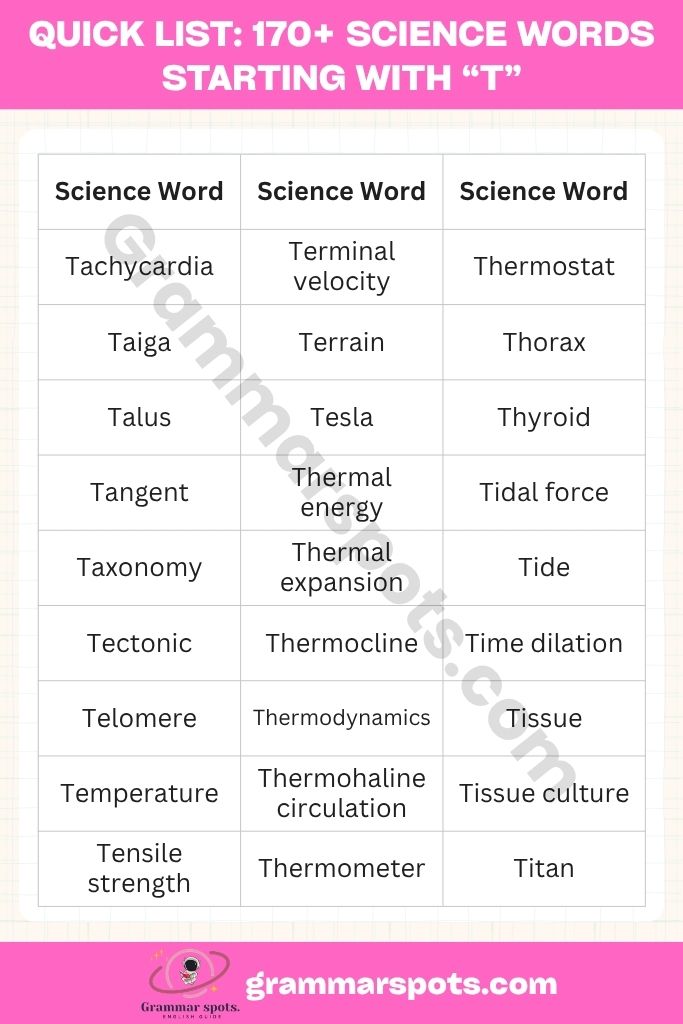
- Tachycardia
- Taiga
- Talus
- Tangent
- Taxonomy
- Tectonic
- Telomere
- Temperature
- Tensile strength
- Terminal velocity
- Terrain
- Tesla
- Thermal energy
- Thermal expansion
- Thermocline
- Thermodynamics
- Thermohaline circulation
- Thermometer
- Thermostat
- Thorax
- Thyroid
- Tidal force
- Tide
- Time dilation
- Tissue
- Tissue culture
- Titan
- Titration
- Topography
- Torque
- Total internal reflection
- Toxin
- Trachea
- Trait
- Transcription
- Translation
- Translucent
- Transparent
- Transpiration
- Transverse wave
- Trilobite
- Tritium
- Tropic of Cancer
- Tropic of Capricorn
- Tropism
- Troposphere
- Trophic cascade
- Trophic level
- Tsunami
- Tumor
- Tundra
- Turbidity
- Turbine
- Turbofan
- Turbulence
- Tungsten
- Tympanum
- Tyrosine
- Trypsin
- Tektite
- Termination shock
- Telescope
- Taiga
- Topsoil
- Transponder
- Tectite
- Thermoregulation
- Thermoplastic
- Tidal wave
- Titanoboa
- Trilobite
- Trophoblast
- Torsion
Physics Science Words That Start With T
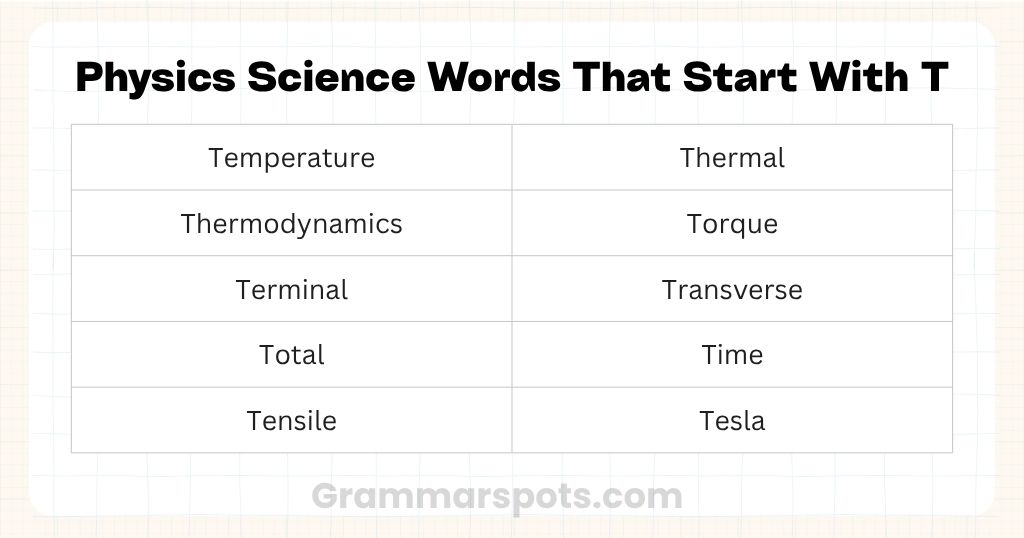
- Temperature — Average kinetic energy of particles in a substance. Higher temperature = faster-moving molecules.
- Thermal energy — Total heat inside an object. A warm bathtub holds more thermal energy than a small boiling cup, even at lower temperature.
- Thermodynamics — Laws governing how heat converts to work and how energy spreads. Every engine and refrigerator runs on these rules.
- Torque — Rotational force. A longer wrench gives more torque on the same bolt that’s why mechanics use long handles.
- Terminal velocity — Speed at which gravity and air resistance balance out on a falling object. Skydivers reach around 200 km/h belly-down.
- Transverse wave — Wave where particles move perpendicular to the wave’s direction. Light and water surface waves are transverse.
- Total internal reflection — When light hits a boundary at a steep angle and fully reflects back. This is how fiber optic cables carry internet data.
- Time dilation — Time passes more slowly near massive objects or at high speeds. GPS satellites correct for this daily or navigation fails.
- Tensile strength — Maximum pulling stress a material withstands before breaking. Critical in bridge cables, aircraft frames, and surgical tools.
- Tesla — Unit of magnetic field strength. MRI machines operate at 1.5–3 tesla.
- Tachyon — Hypothetical particle that moves faster than light. Not yet proven to exist, but studied in theoretical physics.
- Torsion — Twisting stress applied along an axis. Torsion causes spiral fractures in bones and affects bridge design.
- Trajectory — The curved path of a moving object under gravity. Applies to thrown balls, rockets, and planetary orbits.
- Tangential force — Force acting perpendicular to a radius, causing rotation rather than linear motion.
- Thermodynamic equilibrium — State where temperature, pressure, and volume stop changing inside a system.
- Thermocouple — Device that converts temperature differences into electrical voltage. Used in industrial furnaces and ovens.
Chemistry Science Words That Start With T
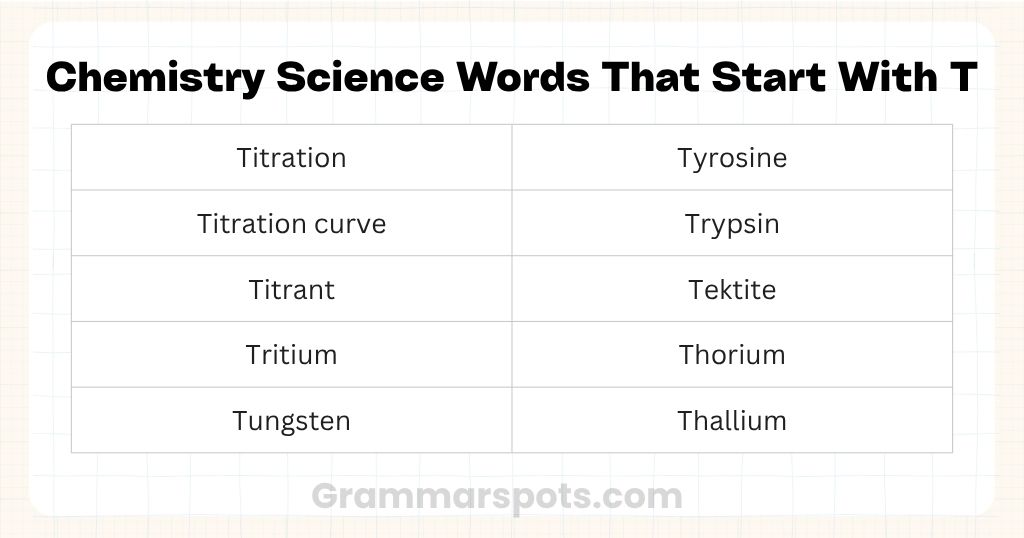
- Titration — Lab method of adding a solution of known concentration to find the concentration of an unknown. Used in food safety and water testing.
- Titration curve — A graph showing pH change during a titration. The steep section identifies the equivalence point.
- Titrant — The solution of known concentration added during a titration process.
- Tritium — Radioactive hydrogen isotope with two neutrons. Used in nuclear fusion research and some luminous watch dials.
- Tungsten — Element with the highest melting point of any pure metal 3,422°C. Found in light bulb filaments and cutting tools.
- Tyrosine — Amino acid the body uses to produce dopamine, adrenaline, and melanin pigment.
- Trypsin — Digestive enzyme from the pancreas that breaks down proteins. It only activates after leaving the pancreas to avoid self-digestion.
- Tektite — Glassy solid formed when meteorite impact melts and rapidly cools surrounding rock.
- Thorium — Radioactive element considered as a safer nuclear fuel alternative to uranium.
- Thallium — Toxic heavy metal element used in some electronics and formerly in rat poison.
- Tantalum — Rare, corrosion-resistant metal used in surgical implants and smartphone capacitors.
- Technetium — First artificially produced element. Radioactive, used in medical imaging scans.
- Tellurium — Brittle metalloid element used in solar panels and as a semiconductor.
- Terbium — Rare earth element used in green phosphors for TV screens and solid-state lighting.
- Thulium — Rare earth metal used in portable X-ray machines and laser applications.
- Tin — Soft metal used since ancient times in alloys, soldering, and food-safe coatings.
- Transmutation — Conversion of one element into another, either through nuclear reactions or radioactive decay.
- Thermoplastic — Plastic that softens when heated and hardens when cooled recyclable and remoldable.
- Trace element — Chemical element needed by organisms in tiny amounts. Zinc, iodine, and fluoride are examples.
Biology Science Words That Start With T
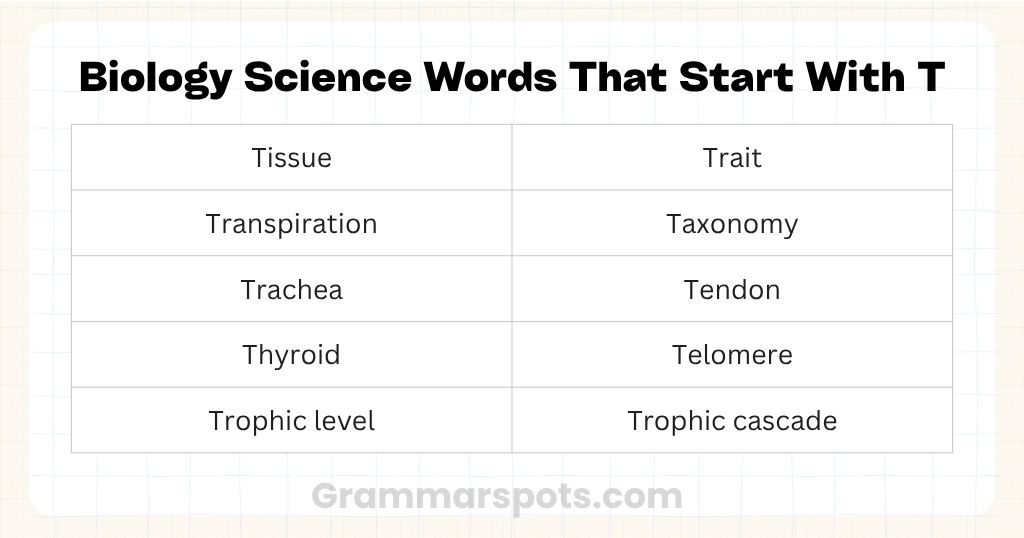
- Tissue — Group of similar cells performing a shared function. Four types in humans: muscle, nerve, connective, epithelial.
- Trait — Heritable characteristic. Some traits are dominant and appear even when only one copy of the gene is present.
- Transpiration — Plants release water vapor through leaf pores called stomata. A large tree can release hundreds of liters daily.
- Taxonomy — Science of naming and classifying organisms. Every species gets a two-part Latin name — genus and species.
- Trachea — Airway tube held open by cartilage rings. A cough reflex protects it when food or liquid enters.
- Tendon — Fibrous cord connecting muscle to bone. Tendons heal slowly due to limited blood supply.
- Thyroid — Butterfly-shaped gland releasing hormones that control metabolic rate and body energy use.
- Telomere — Protective cap on chromosome ends. Shortens with each cell division linked to aging and cellular lifespan.
- Trophic level — Position in a food chain. Plants = level 1, herbivores = level 2, carnivores = level 3+.
- Trophic cascade — When removing or adding a top predator changes the entire food chain below it. Wolves returning to Yellowstone altered river courses.
- Tropism — Plant growth response to a stimulus. Phototropism = toward light. Gravitropism = roots growing downward.
- Transcription — First step of protein synthesis. DNA is copied into messenger RNA inside the cell nucleus.
- Translation — Second step of protein synthesis. Ribosomes read mRNA and assemble a chain of amino acids.
- Transfer RNA (tRNA) — Molecule that carries specific amino acids to the ribosome during translation.
- Transgenic — Organism that has had foreign DNA inserted into its genome using biotechnology.
- Transposon — DNA segment that can move within the genome sometimes called a “jumping gene.”
- Trophoblast — Outer layer of cells of an early embryo that forms the placenta in mammals.
- Trophozoite — Active, feeding stage of certain parasitic organisms like Giardia or Plasmodium.
- Tubulin — Protein that forms microtubules the structural scaffolding inside cells.
- Tumor suppressor gene — Gene that controls cell division. When mutated, cancer becomes more likely.
- T-cell — White blood cell that identifies and destroys infected or abnormal cells in the immune system.
- Thymine — One of the four DNA bases. Pairs with adenine in the double helix structure.
- Tendril — Thin, coiling plant structure used to grip surfaces and support climbing growth.
- Terminal bud — Growing tip at the end of a plant stem that drives upward growth.
- Termination codon — Three-letter DNA sequence signaling the ribosome to stop building a protein.
- Trichome — Hair-like outgrowth on plant surfaces. Functions in defense, water retention, and temperature control.
- Tubule — Tiny tube within an organ. Kidney tubules reabsorb useful substances from filtered blood.
- Taxon — Any unit in biological classification species, genus, family, or order.
- Telophase — Final stage of cell division where two new nuclei form and the cell pinches apart.
- Taphonomy — Study of how organisms decay and become fossils. Helps paleontologists interpret what they find.
- Temporal lobe — Brain region involved in hearing, language comprehension, and memory.
- Telencephalon — Largest part of the forebrain. Responsible for voluntary movement, sensory processing, and thought.
Earth Science Words That Start With T
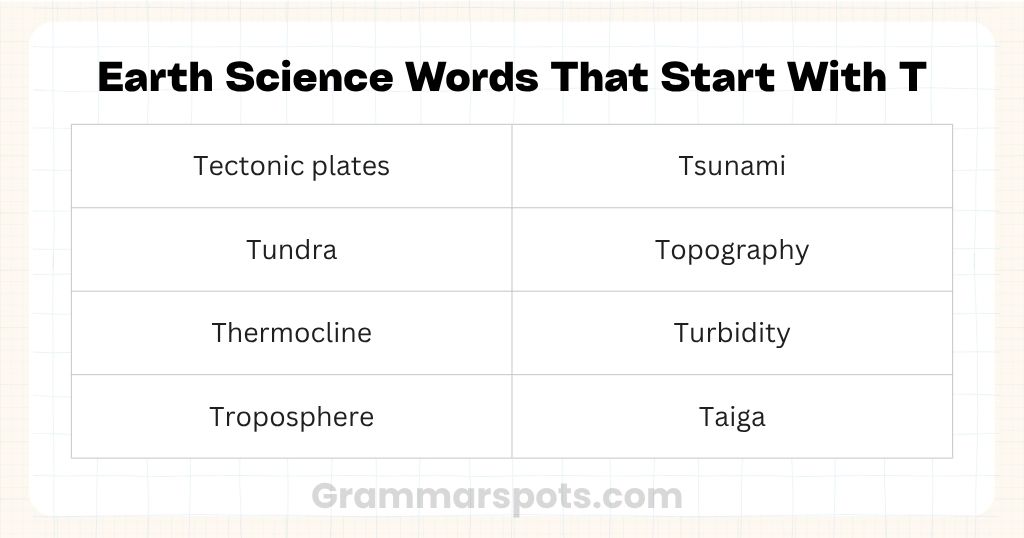
- Tectonic plates — Large sections of Earth’s crust that move slowly on the mantle. Their edges cause earthquakes, volcanoes, and mountain ranges.
- Tsunami — Ocean wave caused by sudden seafloor displacement, usually from an earthquake. Can reach 30+ meters near shore.
- Tundra — Cold biome where permafrost prevents tree growth. Supports mosses, lichens, insects, and Arctic mammals.
- Topography — Shape and features of a land surface hills, valleys, slopes. Read using contour lines on maps.
- Thermocline — Layer in the ocean where temperature drops sharply with depth. Affects how fish, submarines, and sound travel.
- Turbidity — Cloudiness of water caused by suspended particles. High turbidity after rainfall blocks sunlight from aquatic plants.
- Troposphere — Lowest atmosphere layer, 0–12 km high. All weather occurs here. Temperature drops ~6.5°C per kilometer.
- Taiga — Cold forest biome dominated by coniferous trees. Found across Russia, Canada, and Scandinavia.
- Terrain — The physical surface features of a land area.
- Topsoil — Uppermost soil layer, richest in organic matter and nutrients. Crucial for plant growth and agriculture.
- Tremor — Small seismic vibration in the ground. Can precede earthquakes or occur near volcanoes.
- Turbidite — Sediment layer deposited rapidly by an underwater turbidity current. Found in deep-sea geology records.
- Turbidity current — Fast-moving underwater avalanche of sediment-laden water. Carves submarine canyons over time.
- Tidal locking — When a moon’s rotation period matches its orbit period, keeping one face always pointed at its planet.
- Tropic of Cancer — Latitude 23.5°N — northernmost point where the sun is directly overhead at summer solstice.
- Tropic of Capricorn — Latitude 23.5°S — southernmost point where the sun is directly overhead at winter solstice.
- Temperate zone — Climate region between the tropics and polar circles with moderate seasonal temperature changes.
- Transgression — Rise of sea level causing ocean to advance over land. Opposite of regression.
- True north — Direction toward the geographic North Pole, different from magnetic north.
- Talus — Pile of broken rock fragments at the base of a cliff or steep slope.
- Tidal rhythm — Regular biological pattern in coastal organisms linked to tidal cycles.
- Thermoregulation — Process by which organisms or Earth systems maintain stable temperature.
- Tropopause — Boundary between the troposphere and stratosphere where temperature stops falling with altitude.
- Thermosphere — Atmospheric layer above the mesosphere, 80–700 km high. Temperatures rise sharply with altitude here.
- Trilobite — Extinct marine arthropod. One of the earliest complex animals. Lived 520–250 million years ago.
Space & Astronomy Science Words That Start With T
- Titan — Saturn’s largest moon. Has a thick atmosphere and lakes of liquid methane at −179°C.
- Tidal force — Difference in gravitational pull across an object. Creates Earth’s ocean tides. Near a black hole, it would stretch matter apart.
- Time dilation — Time slows near high gravity or high speed. Astronauts on the ISS age slightly slower than people on Earth.
- Telescope — Instrument for observing distant objects. Modern versions detect radio waves, infrared, and X-rays invisible to the eye.
- Termination shock — Boundary where solar wind slows as it meets interstellar space. Voyager 1 crossed it in 2004.
- Trajectory — Curved path of an object in space under gravitational influence.
- Tidal locking — Moon keeps same face toward its planet because its rotation matches its orbital period.
- T-wave — In astronomy, an acoustic wave traveling through seawater sometimes triggered by submarine earthquakes.
- Titanoboa — Giant prehistoric snake, used in paleontology to estimate ancient tropical temperatures from body size.
Medical & Health Science Words That Start With T
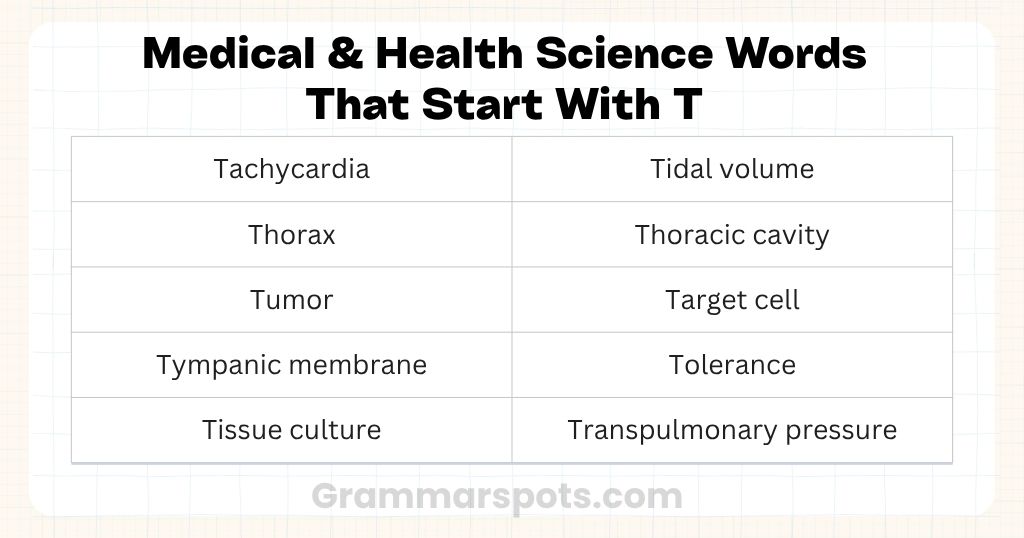
- Tachycardia — Resting heart rate above 100 beats per minute. Caused by stress, dehydration, infection, or cardiac conditions.
- Thorax — Chest region containing the heart, lungs, and esophagus, protected by the rib cage.
- Tumor — Abnormal cell mass. Benign tumors stay localized. Malignant tumors invade tissue and may spread.
- Tympanic membrane — The eardrum. Vibrates in response to sound waves. Also called the tympanum.
- Tissue culture — Growing cells in a lab environment. Used for drug testing, skin graft production, and disease research.
- Tidal volume — Amount of air inhaled or exhaled in a single normal breath about 500 mL in adults.
- Thoracic cavity — The space inside the chest that houses the heart and lungs.
- Target cell — Cell that responds to a specific hormone because it carries the matching receptor.
- Tolerance — In medicine, reduced response to a drug after repeated exposure the body adapts and needs more to get the same effect.
- Transpulmonary pressure — Pressure difference between the inside of the lungs and the pleural space surrounding them.
- Tachometer — In medical contexts, a device measuring heart rate or respiratory rate electronically.
- Tactile — Relating to the sense of touch. Tactile receptors in skin detect pressure, texture, and pain.
- T-cell — Immune cell that destroys infected or cancerous cells. Central to the body’s adaptive immune response.
- Tumour microenvironment — Surrounding tissue, blood vessels, and immune cells that interact with a tumor and affect its behavior.
- Tissue engineering — Building functional biological tissue in a lab using cells and scaffolding. Used in organ repair research.
Technology & Applied Science Words That Start With T
- Turbine — Spinning blade machine converting moving fluid into electricity. Used in wind farms, jet engines, and hydroelectric dams.
- Thermostat — Control device maintaining a set temperature by switching heating or cooling on and off.
- Turbofan — Jet engine type used in commercial aircraft. Bypass air provides most thrust and reduces engine noise.
- Turbulent flow — Irregular, chaotic fluid motion with eddies and vortices. Contrasts with smooth laminar flow.
- Transponder — Device that receives a signal and automatically transmits a response. Used in aircraft tracking and RFID systems.
- Thermistor — Temperature-sensitive resistor. Resistance changes with temperature. Used in digital thermometers and climate control.
- Thermograph — Instrument that continuously records temperature over time onto a chart or digital graph.
- Thermonuclear — Relating to nuclear reactions triggered by extreme heat as in hydrogen bombs and fusion reactors.
- Thermopile — Array of thermocouples connected together to measure radiation or generate small electric current.
- Transect — A measured line or path across a habitat used to survey species or environmental conditions.
- Tachometer — Device measuring rotational speed of a machine, such as an engine’s RPM.
- Tangent — In mathematics and engineering, a line touching a curve at exactly one point without crossing it.
Easy Science Words Starting With T — For Kids & Beginners
- Temperature — How hot or cold something is, measured in degrees Celsius or Fahrenheit
- Transparent — You can see through it clearly. Example: clean glass, clean water
- Translucent — Some light passes through but the view is blurred. Example: frosted glass, wax paper
- Tide — Daily rise and fall of the ocean caused by the Moon’s gravity
- Trait — A feature you inherited from your parents, like eye color or blood type
- Trunk — The main woody stem of a tree that supports branches and carries water upward
- Terrain — The shape of the land flat, hilly, rocky, or sloped
- Thermometer — A tool for measuring temperature
- Tissue — The material your body is built from muscle, nerve, skin are all tissue types
- Taiga — Cold forest with mostly pine and spruce trees. Found in Russia and Canada
- Tendon — Rope-like cord connecting muscle to bone
- Tundra — A cold, flat biome where the ground stays frozen and trees cannot grow
- Toxin — A poison made by a living thing, like venom from a snake or bacteria
- Tadpole — Larval stage of a frog or toad. Lives in water, breathes through gills
Advanced Science Words Starting With T
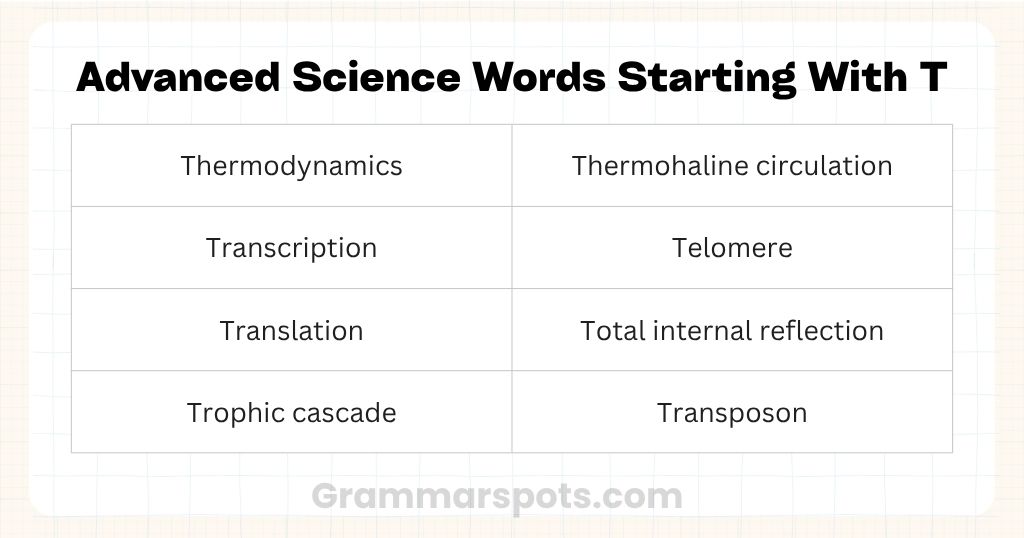
- Thermodynamics — Physics of energy transfer, heat, and entropy across systems
- Transcription — DNA copied into mRNA inside the cell nucleus first step of protein building
- Translation — mRNA read by ribosomes to assemble an amino acid chain second step of protein building
- Thermohaline circulation — Global ocean current driven by water density differences from temperature and salinity. Regulates world climate.
- Telomere — Chromosome end-cap that shortens with each division. Central to aging and cancer biology.
- Total internal reflection — Complete light reflection inside a medium beyond a critical angle. Enables fiber optics.
- Trophic cascade — Top-predator change that restructures an entire ecosystem down to plants and soil.
- Transposon — Jumping gene segment that repositions itself in the genome and can cause mutations.
- Thermocline — Sharp temperature boundary in ocean depth affecting sound travel, marine life, and submarines.
- Thermonuclear — Fusion reactions powered by extreme temperature basis of hydrogen bombs and future clean energy.
- Tachyon — Theoretical particle moving faster than light undetected but discussed in quantum physics.
- Transpulmonary pressure — Lung-to-pleural pressure difference that keeps airways open during breathing.
- Tumor suppressor gene — Gene that halts abnormal cell division. Mutations here are drivers of cancer.
- Taphonomy — Science of how organisms decompose and fossilize. Tells us what conditions preserved ancient life.
Common Confusions: T Science Words People Mix Up
Transpiration vs. Evaporation
- Evaporation happens from any surface puddles, oceans, wet clothes
- Transpiration only happens through living plant tissue
- Both contribute to the water cycle but are measured separately
Transparent vs. Translucent vs. Opaque
- Transparent = full clear light passes through (glass window)
- Translucent = light passes but scatters (frosted glass, skin over a flashlight)
- Opaque = no light passes through (wood, metal)
Tissue vs. Organ
- Tissue = group of similar cells
- Organ = group of different tissues working together
- Heart = organ. Cardiac muscle = tissue inside it.
Tendon vs. Ligament
- Tendon = muscle to bone
- Ligament = bone to bone
- Both are connective tissue different jobs
Torque vs. Force
- Force = push or pull in a straight line
- Torque = twisting or rotational force
- Applying force to a wrench creates torque at the bolt
Tidal wave vs. Tsunami
- “Tidal wave” is a common but incorrect term
- Tides = caused by gravity
- Tsunamis = caused by seafloor displacement during earthquakes
Trachea vs. Esophagus
- Trachea = air tube to the lungs
- Esophagus = food tube to the stomach
- Both run side-by-side in the throat that’s why choking happens
Tumor vs. Cancer
- All cancers involve tumors, but not all tumors are cancer
- Benign tumors don’t spread
- Malignant tumors invade other tissue
FAQs About Science Words That Start With T
How many science words start with T?
Full scientific dictionaries contain thousands. This article covers 170+ across eight fields the most useful for students and curious readers.
Which T words matter most for middle school?
- Temperature
- Tissue
- Trait
- Tectonic
- Transpiration
- Trachea
- Trophic level
Which T words matter most for high school?
- Thermodynamics
- Transcription and Translation
- Telomere
- Torque
- Thermohaline circulation
- Tumor suppressor gene
Do T science words follow patterns?
Yes. Learning the root unlocks many words at once:
- Thermo = heat (thermometer, thermodynamics, thermocline)
- Trans = across or through (transpiration, translucent, transcription)
- Tox = poison (toxin, toxic, detoxification)
Do these appear on standardized tests?
Yes. Terms like taxonomy, tectonic, thermal energy, transpiration, and torque appear regularly on state science exams, SAT, and ACT.
Conclusion
This article organized 170+ science words starting with T across physics, chemistry, biology, earth science, space and astronomy, medicine, and technology. Use the section that matches your current unit biology students start there, general learners start with the top 20.
Science words build on each other, so learning one root like thermo or trans makes five related words instantly readable. That’s the fastest path through any science vocabulary list.

I’m Hazel, and I studied BSC English at GCUF. I focus on explaining word meanings in simple, clear language that anyone can understand. My goal is helping readers grasp everyday English, confusing terms, and slang used in real conversations and social media. I believe language learning works best when definitions connect to actual life situations. Through careful research and straightforward explanations, I make vocabulary accessible for students, learners, and anyone curious about how English really works in daily use.