

You have a science quiz. A vocabulary worksheet. Or you’re just curious why the letter S shows up everywhere in science class.
Here’s why: S is one of the most productive letters in scientific language. It covers motion, matter, living systems, Earth, space, and medicine all at once.
This article gives you 150+ science words starting with S, organized by subject, difficulty, and real-life use. No fluff. No repetition. Just clear, useful definitions.
Quick Answer: 20 Most-Used Science Words Starting With S
| Word | Meaning |
| Solution | A liquid where one substance dissolves completely into another |
| Symbiosis | A close, ongoing relationship between two different species |
| Synapse | The tiny gap between two nerve cells |
| Spectrum | The full range of light or electromagnetic energy |
| Sediment | Small particles of rock or organic matter that settle |
| Stem cell | An unspecialized cell that can develop into many cell types |
| Sublimation | When a solid turns directly into gas, skipping liquid |
| Species | A group of organisms that can reproduce together |
| Solubility | How easily a substance dissolves in another |
| Salinity | The amount of salt dissolved in water |
| Spore | A tiny reproductive cell in fungi or plants |
| Solar wind | A stream of charged particles released by the Sun |
| Seismic wave | A vibration traveling through Earth after an earthquake |
| Sucrose | A natural sugar produced by plants |
| Suspension | A mixture where particles float but do not dissolve |
| Stomata | Tiny pores on plant leaves controlling gas exchange |
| Static electricity | Electric charge that builds up on a surface |
| Surface tension | The pulling force that makes water behave like a skin |
| Stimulus | Anything that causes a biological response |
| Superposition | When two waves overlap and combine into one |
Quick List of 150+ Science Words Starting With S
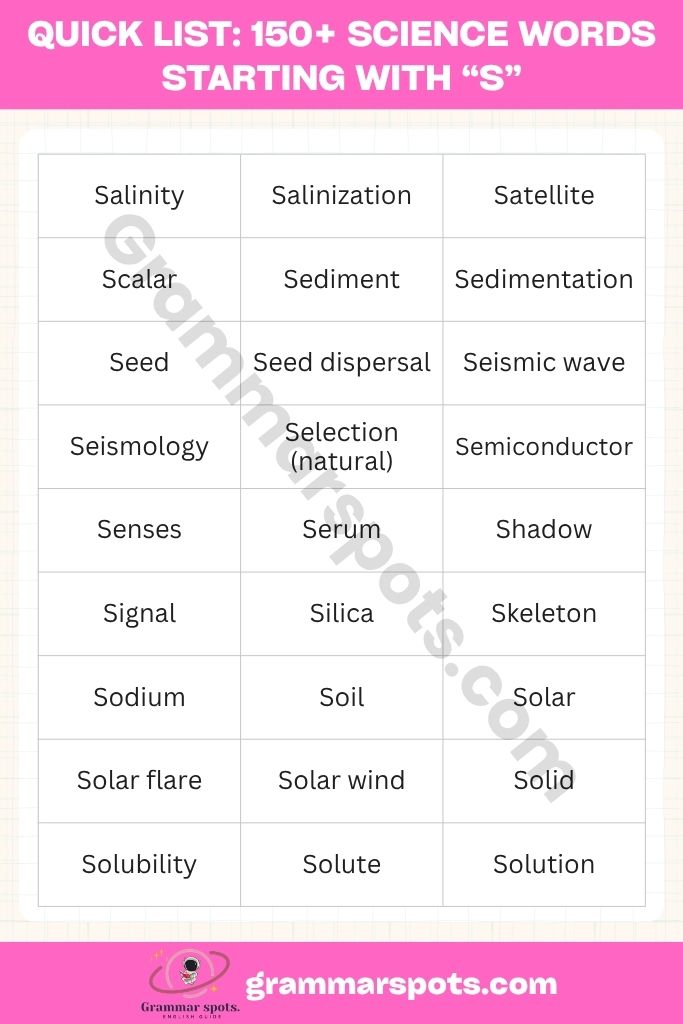
Salinity
Salinization
Satellite
Scalar
Sediment
Sedimentation
Seed
Seed dispersal
Seismic wave
Seismology
Selection (natural)
Semiconductor
Senses
Serum
Shadow
Signal
Silica
Skeleton
Sodium
Soil
Solar
Solar flare
Solar wind
Solid
Solubility
Solute
Solution
Solvent
Sonar
Sound
Space
Species
Spectroscopy
Spectrum
Speed
Spore
Stamen
Star
Static electricity
Stem cell
Stimulus
Stomata
Stochastic
Sublimation
Substrate
Sucrose
Sun
Superconductivity
Superconductor
Superposition
Physics Science Words Starting With S
Speed
How far something travels in a given time. Speed = distance ÷ time. No direction involved.
Scalar
A measurement with size only no direction. Examples:
- Temperature
- Mass
- Speed
Scalar quantity
Same idea as scalar, used formally in equations and force diagrams.
Superposition
When two waves meet, they pass through each other and add up. Creates interference in sound and light.
Static electricity
Charge that builds up on a surface without flowing. A balloon rubbed on hair picks up electrons that’s static electricity.
Static friction
The force stopping an object from moving when a force is applied. Higher than sliding friction.
Sliding friction
Friction between two surfaces already in motion against each other.
Shear force
A force that pushes two parts of a material in opposite directions. Scissors work by shear force.
Surface tension
Water molecules grip each other sideways at the surface. That grip lets small insects walk on water.
Sublimation
Solid to gas no liquid stage. Dry ice does this. So does iodine when gently heated.
Specific heat capacity
The energy needed to raise 1 kg of a substance by 1°C. Water has a high specific heat capacity, which is why oceans warm and cool slowly.
Speed of light
About 300,000 km per second. Nothing with mass can reach it. Light from the Sun takes about 8 minutes to reach Earth.
Stress (physics)
Force applied per unit area inside a material. Related to whether a structure bends, stretches, or breaks.
Spontaneous combustion
When a material ignites without an external flame from heat built up internally. Happens in oily rags stored in piles.
Systematic error
A consistent, repeatable error in measurement caused by a flaw in equipment or method. Not random it skews results the same way every time.
Chemistry Science Words Starting With S
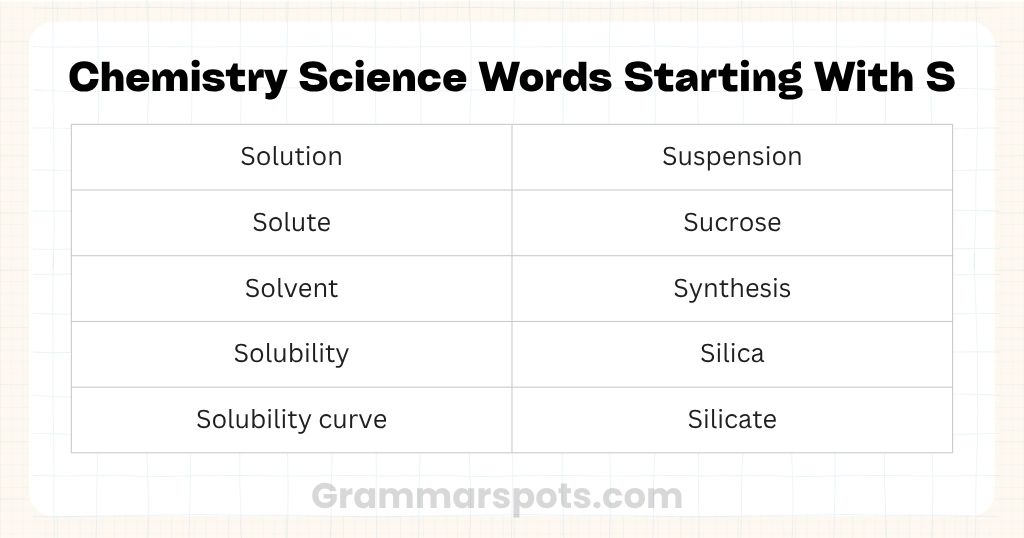
Solution
A uniform mixture where the solute fully dissolves into the solvent. Saltwater. Coffee. Vinegar.
Solute
The substance that dissolves. In saltwater, salt is the solute.
Solvent
The substance doing the dissolving. Water is the universal solvent.
Solubility
How much of a substance dissolves at a given temperature. Sugar has high solubility. Sand has nearly none.
Solubility curve
A graph showing how solubility changes with temperature. Used in chemistry labs to predict crystallization.
Suspension
A mixture where particles don’t dissolve they just float. Let it sit and they settle. Muddy water. Paint.
Sucrose
Table sugar. A carbohydrate made from glucose and fructose bonded together. Plants make it through photosynthesis.
Synthesis
Building a new compound from simpler substances. Hydrogen + oxygen → water. That’s a synthesis reaction.
Silica
Silicon dioxide (SiO₂). Found in sand, quartz, and glass. One of Earth’s most common compounds.
Silicate
A compound containing silicon and oxygen. Most of Earth’s crust is silicate minerals.
Sublevel (chemistry)
The division within an electron shell. Labeled s, p, d, f. Determines how electrons are arranged around an atom.
Substrate concentration
In enzyme reactions, this is how much reactant is available. Higher concentration = faster reaction, up to a limit.
Synthetic fiber
A man-made material created through chemical processes. Nylon, polyester, and acrylic are all synthetic fibers.
Secretion
When a cell or gland releases a substance. Saliva is secreted by salivary glands. Hormones are secreted into the bloodstream.
Semipermeable membrane
A barrier that lets some substances through but blocks others. Cell membranes work this way.
Self-replication
The ability of a molecule (like DNA) to copy itself. Fundamental to life and also studied in chemistry.
Biology Science Words Starting With S
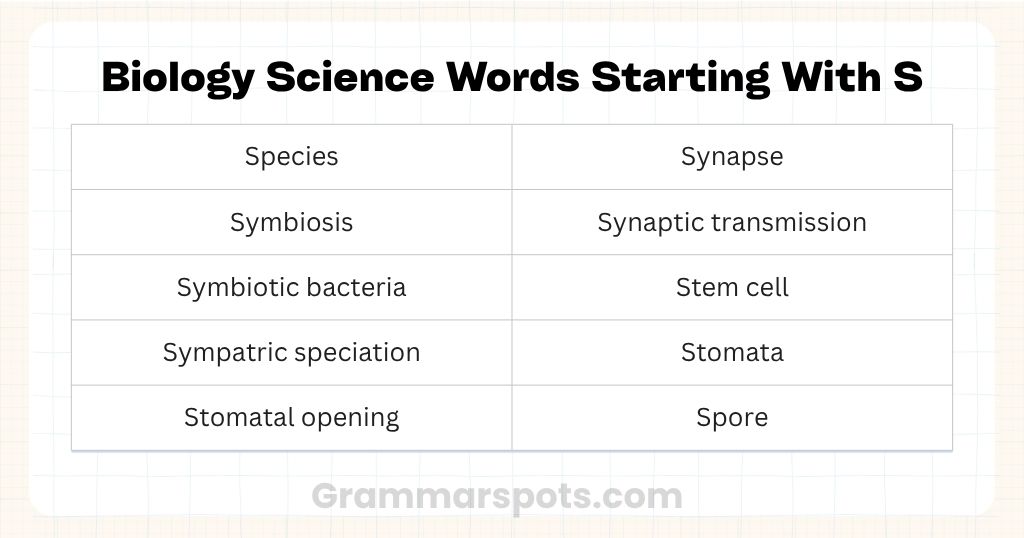
Species
Organisms similar enough to reproduce together and have fertile offspring. Horses and donkeys are different species — their offspring (mules) can’t reproduce.
Symbiosis
A close ongoing relationship between two species:
- Mutualism — both benefit
- Commensalism — one benefits, other unaffected
- Parasitism — one benefits, other harmed
Symbiotic bacteria
Bacteria living inside or on another organism in a beneficial relationship. Gut bacteria help digest food and make vitamins.
Sympatric speciation
A new species forming from an existing one in the same area — without physical separation. Happens through different mating habits or diet.
Synapse
The gap between two neurons. About 20 nanometers wide. Chemical messengers (neurotransmitters) carry signals across it.
Synaptic transmission
The full process of a signal crossing a synapse from electrical signal, to chemical release, to the next neuron picking it up.
Stem cell
An unspecialized cell that can become many cell types depending on what the body needs. Used in treatments for blood disorders and studied for many diseases.
Stomata
Tiny pores on the underside of leaves. Let CO₂ in, release O₂ and water vapor out. Close during hot, dry conditions.
Stomatal opening
The process of stomata widening. Controlled by guard cells responding to light and moisture levels.
Spore
A tiny reproductive unit used by fungi, mosses, and ferns instead of seeds. One mushroom can release billions.
Stamen
The male reproductive part of a flower. Produces pollen. Insects carry pollen from stamen to pistil during pollination.
Stimulus
Anything causing a biological response:
- Light = stimulus for plants to grow toward
- Pain = stimulus for pulling your hand away
- Loud sound = stimulus for a startle response
Stress (biology)
A condition where an organism’s normal function is disrupted. Caused by heat, drought, infection, or physical damage.
Skeleton
The 206-bone framework of the adult human body. Protects organs, gives shape, anchors muscles.
Skeletal muscle
Muscle attached to bone. Moves voluntarily you control it consciously.
Smooth muscle
Muscle found in internal organs like the stomach and intestines. Works involuntarily you don’t control it consciously.
Spinal cord
The bundle of nerves running from the brain down the back. Carries signals between the brain and the rest of the body.
Sensory neuron
A nerve cell that carries information from sense organs to the brain or spinal cord.
Sexual reproduction
Reproduction requiring two parents, combining genetic material. Produces offspring with genetic variation.
Sex cell
A reproductive cell sperm in males, egg in females. Each carries half the usual number of chromosomes.
Selection pressure
Any environmental factor that affects which organisms survive and reproduce. Drives natural selection.
Natural selection
The process where organisms better suited to their environment survive and reproduce more. Darwin’s central idea.
Seed
A protective structure holding a plant embryo and stored food. Germinates when conditions are right.
Seed dispersal
How plants spread seeds away from the parent plant:
- Wind (dandelions)
- Animals (burrs, berries)
- Water (coconuts)
- Explosive pods (touch-me-nots)
Stem
The main structural support of a plant. Transports water and nutrients between roots and leaves.
Earth Science Words Starting With S
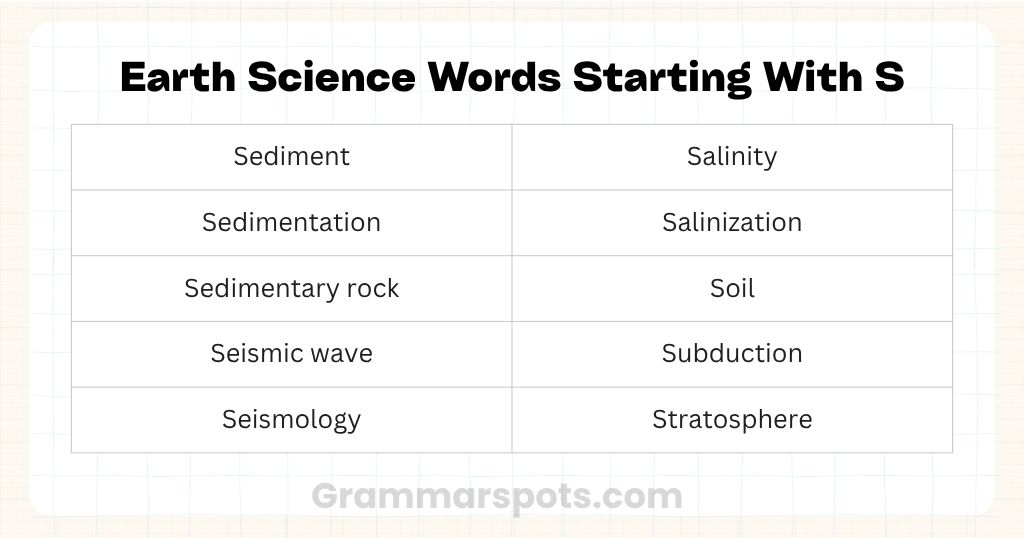
Sediment Particles of rock, sand, shells, or organic matter deposited by wind, water, or ice.
up beaches, river deltas, and ocean floors.
Sedimentation
The process of sediment settling out of water. Used in water treatment plants to separate particles before purification.
Sedimentary rock
Rock formed from compressed layers of sediment over long periods. Sandstone and limestone are sedimentary rocks.
Seismic wave
Energy waves moving through Earth after an earthquake. Different layers of Earth change their speed helping scientists map the interior.
Seismology
The study of earthquakes and seismic waves. Seismologists determine quake location, depth, and magnitude from wave patterns.
Salinity
Salt concentration in water. Ocean water is about 3.5% saline. The Dead Sea is nearly 10 times saltier.
Salinization
When soil absorbs too much salt, making it difficult for plants to grow. A growing problem in irrigated farmland.
Soil
A living mix of minerals, organic matter, water, air, and billions of microorganisms. Not just dirt a complex ecosystem.
Subduction
When one tectonic plate slides under another. Creates deep ocean trenches and triggers earthquakes and volcanoes.
Stratosphere
The second layer of Earth’s atmosphere, 12–50 km above the surface. Contains the ozone layer.
Shortwave radiation
High-energy radiation from the Sun, including ultraviolet light. Earth absorbs it and re-emits it as longer-wave infrared heat.
Silica
Silicon dioxide the primary component of most sand and many rocks. Also used to make glass.
Space & Astronomy Science Words Starting With S
Solar wind
A constant stream of charged particles (mostly electrons and protons) released by the Sun. Creates auroras when it hits Earth’s magnetic field.
Solar flare
A sudden burst of energy from the Sun’s surface. Can disrupt radio signals and power grids on Earth.
Solar energy
Energy produced by the Sun through nuclear fusion. Reaches Earth as light and heat.
Solar eclipse
When the Moon passes between Earth and the Sun, blocking sunlight. A total eclipse turns day into brief darkness.
Solar system
The Sun and everything gravitationally bound to it — planets, moons, asteroids, comets, and more.
Solar cell
A device that converts sunlight into electricity. Found in solar panels on rooftops, satellites, and calculators.
Solar panel
A collection of solar cells assembled to generate larger amounts of electricity from sunlight.
Spectrum
The full range of electromagnetic radiation. Visible light is a small part. Also: each element emits a unique spectral pattern — its chemical fingerprint.
Spectral line
A specific wavelength of light emitted or absorbed by an element. Used to identify elements in stars from billions of miles away.
Spectroscopy
The analysis of light to identify substances. Tells astronomers what distant stars and planets are made of.
Satellite
Any object orbiting another in space. The Moon is a natural satellite. GPS and weather satellites are artificial ones.
Star
A massive ball of hydrogen gas held together by gravity. Nuclear fusion inside releases energy as light and heat.
Star cluster
A group of stars born from the same cloud of gas and dust, moving through space together.
Stellar evolution
The life cycle of a star from birth in a nebula, through a main sequence phase, to death as a white dwarf, neutron star, or black hole.
Supernova
A massive stellar explosion at the end of a large star’s life. Briefly outshines an entire galaxy. Spreads heavy elements across space.
Space-time
Einstein’s concept combining three dimensions of space with time into one four-dimensional framework. Gravity bends space-time.
Superconductor
A material conducting electricity with zero resistance at very low temperatures. Used in MRI machines and particle accelerators.
Superconductivity
The physical property of zero electrical resistance in certain materials below a critical temperature.
More Post: 130+ Foods That Start With S: Complete List of Fruits, Vegetables, Snacks, Drinks and More
Medical & Health Science Words Starting With S
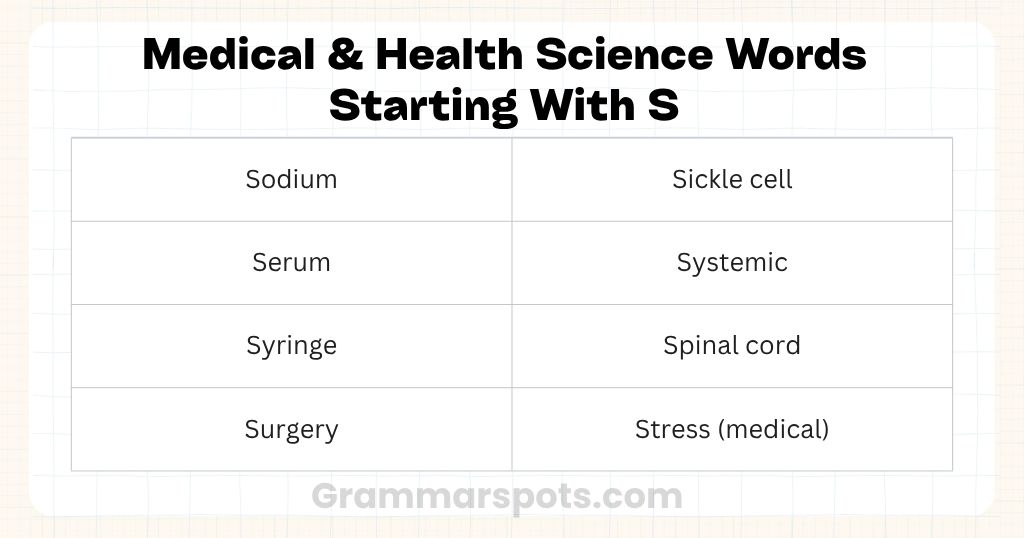
Sodium
Element Na. Essential for nerve signals, fluid balance, and muscle function. Too much raises blood pressure. Too little causes cramps and confusion.
Serum
The liquid part of blood after clotting factors and cells are removed. Used in blood tests, vaccine production, and antivenom.
Syringe
A tube-and-plunger device for injecting or withdrawing fluids. Delivers vaccines. Modern designs prevent reuse to stop disease spread.
Surgery
A medical procedure physically entering the body to repair, remove, or replace tissue. Open surgery uses large incisions; minimally invasive uses tiny tools and cameras.
Sickle cell
An abnormal red blood cell shaped like a crescent. Found in sickle cell disease a genetic condition causing pain and reduced oxygen delivery.
Systemic
Affecting the whole body, not just one area. A systemic infection spreads through the bloodstream. A systemic error affects an entire process.
Spinal cord
Connects brain to body through the vertebral column. Carries motor and sensory signals. Damage can cause paralysis.
Stress (medical)
The body’s physiological response to threat or pressure. Releases cortisol and adrenaline. Chronic stress damages the heart, immune system, and brain.
Secretion
A substance produced and released by a gland or cell. Insulin is secreted by the pancreas. Mucus is secreted by airway cells.
Technology & Applied Science Words Starting With S
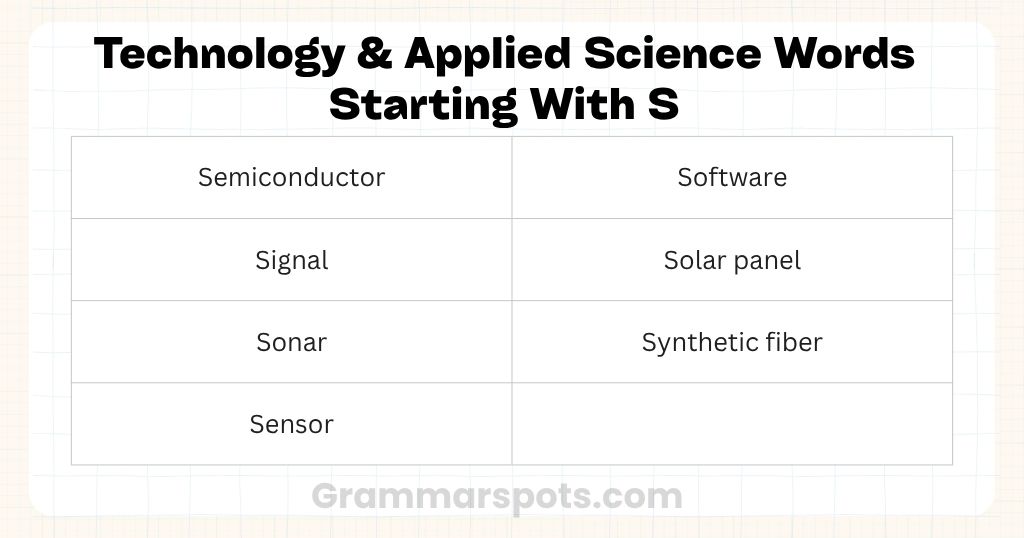
Semiconductor
A material with electrical conductivity between a conductor and an insulator. Silicon semiconductors power every modern computer chip.
Signal
Information carried through a medium electrical wire, fiber optic cable, or wireless radio waves. Every phone call is a signal.
Sonar
Sound Navigation And Ranging. Sends sound pulses and listens for echoes to detect underwater objects. Used in ships, submarines, and fishing boats.
Sensor
A device detecting a physical condition and converting it to a readable signal:
- Light sensors in cameras
- Motion sensors in security systems
- Pressure sensors in tires
- Temperature sensors in thermostats
Software
Instructions that tell hardware what to do. Operating systems, apps, and games are all software. Without it, a computer is nonfunctional hardware.
Solar panel
(See Space section same term, applied use here.) Converts sunlight into electricity for homes, vehicles, and portable devices.
Synthetic fiber
Man-made material from chemical processes. Nylon and polyester are synthetic. Lighter, cheaper, and often more durable than natural fibers for specific uses.
Easy Science Words Starting With S
Solid
Matter with a fixed shape. Ice, wood, and rock are solids.
Sound
Vibrations traveling through air. Guitar strings vibrate → air moves → your eardrum detects it.
Sun
The star at the center of our solar system. Provides light and heat that make life on Earth possible.
Soil
The top layer of Earth where plants grow. Contains minerals, organic material, air, and water.
Seed
A plant’s way of making new plants. Contains a tiny embryo and stored food inside a protective coat.
Shadow
Forms when an object blocks light. The shadow appears on the opposite side from the light source.
Skeleton
The framework of bones inside your body. Gives shape. Protects organs. Anchors muscles.
Sky
Earth’s atmosphere as seen from the surface. Looks blue because air scatters blue light more than other colors.
Senses
Sight, hearing, touch, taste, smell. They collect information from the environment and send it to the brain.
Stem
The part of a plant that holds it upright and carries water from roots to leaves.
Advanced Science Words Starting With S
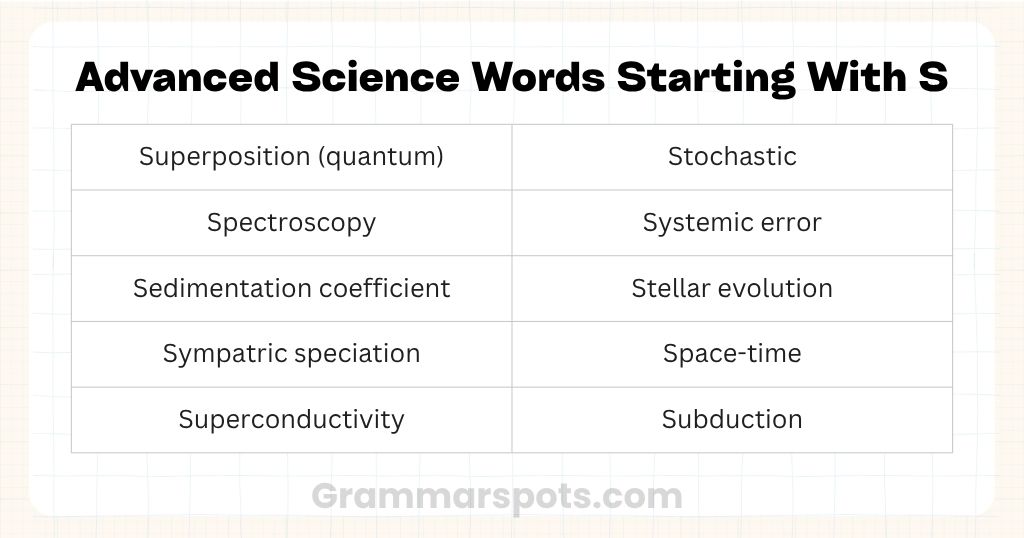
Superposition (quantum)
A particle can exist in multiple states simultaneously until observed. The foundation of quantum computing.
Spectroscopy
Analyzing light to identify matter. Used to detect drugs in labs, examine stars, and test food purity.
Sedimentation coefficient
Measures how fast a particle sinks in a centrifuge. The “S” in ribosome names (30S, 50S) stands for Svedberg a sedimentation unit.
Sympatric speciation
New species forming within the same geographic area through behavioral or dietary changes. Rare but scientifically documented.
Superconductivity
Zero electrical resistance in certain materials at very low temperatures. Powers MRI scanners and experimental maglev trains.
Stochastic
Randomly determined but statistically predictable over time. Used in genetics (random mutations), climate modeling, and physics.
Systemic error
A non-random error affecting all measurements in the same direction. Caused by calibration flaws or biased methodology.
Stellar evolution
The complete life cycle of a star from nebula, through hydrogen burning, to final collapse or explosion.
Space-time
Einstein’s unified framework combining three spatial dimensions with time. Mass curves space-time, creating what we experience as gravity.
Subduction
Tectonic plate sliding under another. Drives mountain building, ocean trench formation, and volcanism.
Substrate concentration
In enzyme kinetics: the amount of reactant available. Increasing it speeds up reactions until enzymes are saturated.
Self-replication
A molecule’s ability to copy itself accurately. DNA does this. Also studied in origin-of-life research and nanotechnology.
Common Confusions
Solution vs. Suspension
In a solution, particles dissolve completely and stay mixed forever. In a suspension, particles float temporarily and settle over time. Saltwater = solution. Muddy water = suspension.
Speed vs. Velocity
Speed is magnitude only. Velocity includes direction. “60 km/h” is speed. “60 km/h north” is velocity.
Stamen vs. Pistil
Stamen = male flower part (makes pollen). Pistil = female flower part (receives pollen). Opposite roles, often confused on biology tests.
Stoma vs. Stomata
Stoma = one pore. Stomata = multiple pores. Like “bacterium” vs. “bacteria.” Same structure, just singular vs. plural.
Symbiosis vs. Mutualism
Mutualism is one type of symbiosis. Symbiosis is the broader category it includes parasitism too.
Solute vs. Solvent
Solute dissolves. Solvent dissolves it. In saltwater: salt = solute, water = solvent. The solvent is usually the larger quantity.
Static vs. Current electricity
Static electricity is stored charge it doesn’t flow until triggered. Current electricity flows continuously through a circuit.
Skeletal vs. Smooth muscle
Skeletal muscle is voluntary you control it. Smooth muscle is involuntary it works in organs without conscious input.
Where These Words Appear in Real Life
In hospitals:
- Sodium levels checked in every blood test
- Serum analyzed to detect infections and antibodies
- Stem cells used in bone marrow transplants
- Synaptic activity measured in brain scans
In your kitchen:
- Solution: coffee is water + dissolved compounds
- Sucrose: the sugar in nearly every packaged food
- Surface tension: why oil and water separate
- Sublimation: frost-free freezers use the principle to prevent ice buildup
Outdoors:
- Sediment forming beaches, deltas, and riverbeds
- Stomata on every leaf around you
- Symbiosis between bees and flowers happening constantly
- Seismic monitoring along fault lines
In technology:
- Semiconductors inside every chip-based device
- Signals carrying every call, message, and video
- Sonar in ships, submarines, and fish finders
- Sensors in phones, cars, smoke detectors, and industrial equipment
In space research:
- Solar wind affecting satellites and communications
- Spectroscopy identifying what distant planets are made of
- Superconductors inside particle accelerators like CERN
FAQs
How many science words start with S?
Thousands, across all scientific fields. This article covers 150+, focused on the most studied and tested terms.
Which S words appear most on exams?
- Symbiosis
- Sediment
- Spectrum
- Solubility
- Stimulus
- Sublimation
- Surface tension
- Superposition
Are these words hard to learn?
Less hard when you know the roots. “Sol-” = sun or dissolve. “Seismo-” = earthquake. “Syn-” = together. Roots unlock dozens of words at once.
Which field uses the most S words?
Biology leads. But chemistry, physics, and earth science all have strong S vocabularies.
Can younger students use this list?
Yes. The Easy section (grades 3–5) and 7th Grade section are built for younger readers. The Advanced section targets high school and beyond.
Conclusion
You now have 150+ science words starting with S, organized across physics, chemistry, biology, earth science, space, medicine, and technology. Use the alphabetical list for quick reference, go straight to your subject section when studying for a quiz, and check the Common Confusions section before any test.
The real-life section shows where these words actually appear outside textbooks in hospitals, kitchens, labs, and space research.
Science vocabulary builds on itself, so every word you learn here makes the next one easier to understand. S is a strong place to start.

I’m Hazel, and I studied BSC English at GCUF. I focus on explaining word meanings in simple, clear language that anyone can understand. My goal is helping readers grasp everyday English, confusing terms, and slang used in real conversations and social media. I believe language learning works best when definitions connect to actual life situations. Through careful research and straightforward explanations, I make vocabulary accessible for students, learners, and anyone curious about how English really works in daily use.