

You are studying for a test. Or helping a kid with homework. Maybe you just saw the word wavelength in an article and wanted to know what it actually means.
Whatever brought you here this list has you covered. Over 140 science words starting with W, organized by subject, with clear meanings and real-world context.
Quick Answer: 20 Most-Used Science Words Starting With W
| Word | Meaning |
| Wave | Energy moving through a medium |
| Wavelength | Distance between two wave peaks |
| Water cycle | Full path water takes through Earth’s systems |
| Weight | Gravitational force acting on an object |
| Work | Force applied over a distance |
| Watt | Unit of power |
| White blood cell | Immune cell that fights infection |
| White dwarf | Dense, dying star about Earth’s size |
| Weathering | Natural breakdown of rocks over time |
| Warm front | Boundary where warm air meets cold air |
| Water table | Underground level where water is stored |
| Water vapor | Water in its invisible gas state |
| Wetland | Permanently or seasonally saturated land |
| Warm-blooded | Animal that regulates its own body heat |
| Wind | Horizontal movement of air |
| Wormhole | Theoretical tunnel through space-time |
| White matter | Brain tissue that connects nerve regions |
| Windpipe | Air-carrying tube from throat to lungs |
| Work-energy theorem | Work done equals change in kinetic energy |
| Wind erosion | Removal of soil or rock particles by wind |
Quick List of 140+ Science Words Starting With W
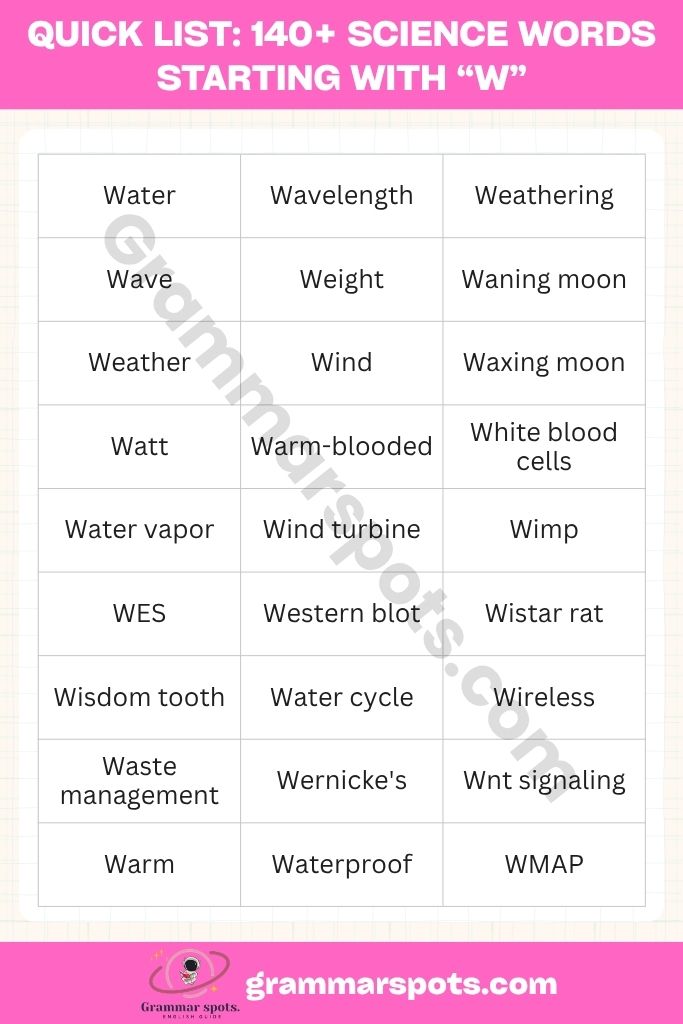
- Warm front
- Warm-blooded
- Water
- Water cycle
- Water pressure
- Water table
- Water treatment
- Water vapor
- Watt
- Wave
- Wave function
- Wave interference
- Wave speed
- Waveform
- Wavelength
- Weak acid
- Weak base
- Weak force
- Weak gravitational lensing
- Weak interaction
- Weak nuclear force
- Weather
- Weathering
- Welding
- Wetland
- White blood cell
- White dwarf
- White light
- White matter
- Whooping cough
- Wide-field imaging
- Wilson’s disease
- Wind
- Wind energy
- Wind erosion
- Windpipe
- Wing
- Wireless transmission
- Wolf-Rayet star
- Work
- Work function
- Work-energy theorem
- Worm
- Wormhole
- Wound healing
Physics Science Words Starting With W
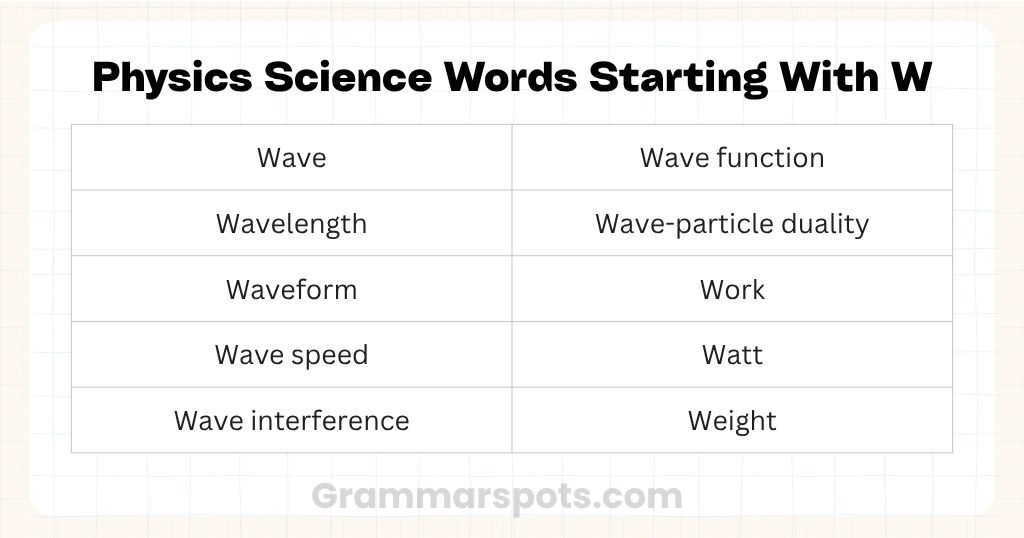
- Wave — A disturbance that transfers energy without moving matter from place to place
- Wavelength — Distance from one wave crest to the next; measured in meters or nanometers
- Waveform — The shape of a wave when plotted on a graph over time
- Wave speed — How fast a wave travels through a medium; calculated as frequency × wavelength
- Wave interference — When two waves meet and either add together or cancel each other out
- Wave function — A mathematical expression describing the probable location of a quantum particle
- Wave-particle duality — The principle that light and matter behave as both waves and particles
- Work — Energy transferred when a force moves an object; W = Force × Distance
- Watt — SI unit of power; one watt equals one joule per second
- Weight — The gravitational force on an object; Weight = Mass × Gravitational acceleration
- Work-energy theorem — The net work done on an object equals its change in kinetic energy
- Warped space-time — The curvature of space and time caused by massive objects
- Weak nuclear force — One of four fundamental forces; drives radioactive decay
- Weak interaction — Subatomic force mediated by W and Z bosons
- Work function — Minimum energy required to release an electron from a metal surface
Chemistry Science Words Starting With W
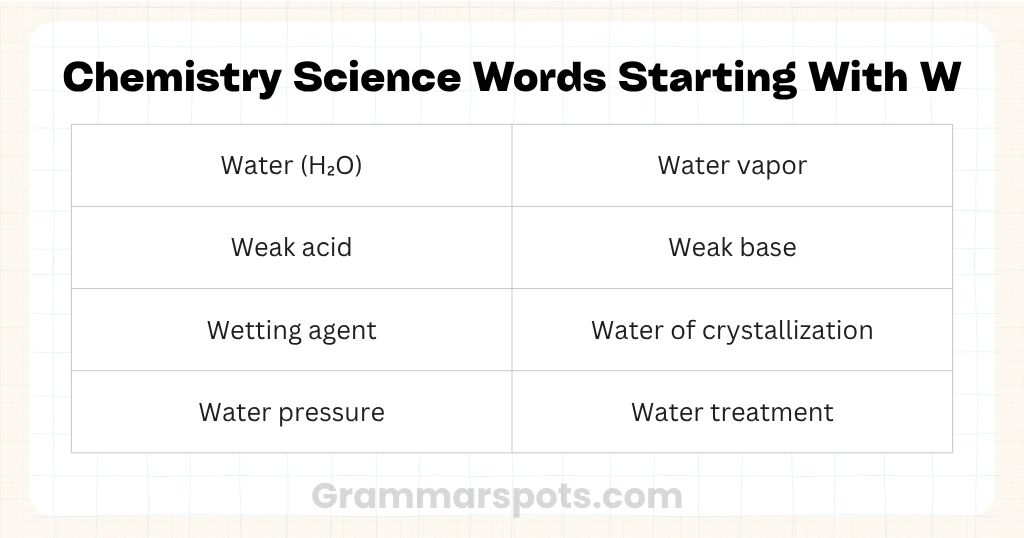
- Water (H₂O) — A molecule of two hydrogen atoms and one oxygen atom; essential for all life
- Water vapor — The gas phase of water; invisible and present in the air around you
- Weak acid — An acid that only partially ionizes in solution; vinegar is a common example
- Weak base — A base that does not fully dissociate in water; baking soda dissolved in water
- Wetting agent — A substance that lowers surface tension so liquids spread more easily
- Water of crystallization — Water molecules chemically locked inside a crystal structure
- Water pressure — Force exerted by water on a surface per unit area
- Water treatment — Chemical and physical processes that make water safe for drinking
- White phosphorus — A highly reactive, waxy form of phosphorus that ignites in air
- Wurtz reaction — A coupling reaction in organic chemistry that joins two alkyl halides
Biology Science Words Starting With W
- White blood cell (Leukocyte) — Immune system cell that identifies and destroys pathogens
- Warm-blooded (Endothermic) — Generates internal body heat independent of environment
- Windpipe (Trachea) — Cartilage-ringed tube that carries air from throat to lungs
- Wing — A modified limb adapted for flight or gliding
- Worm — An invertebrate with a soft, elongated body; earthworms belong to phylum Annelida
- White matter — Myelin-coated nerve fibers in the brain that carry signals between regions
- Wound healing — A four-stage process: hemostasis, inflammation, proliferation, remodeling
- Wild type — The normal, naturally occurring form of a gene or organism
- Water potential — A measure of the tendency of water to move across a membrane
- Woody stem — A stem reinforced with lignin; found in trees and shrubs
- Water mold — A fungus-like organism that lives in moist environments; causes crop diseases
- Whorl — A circular arrangement of leaves, petals, or other plant organs around a stem
Earth Science Words Starting With W
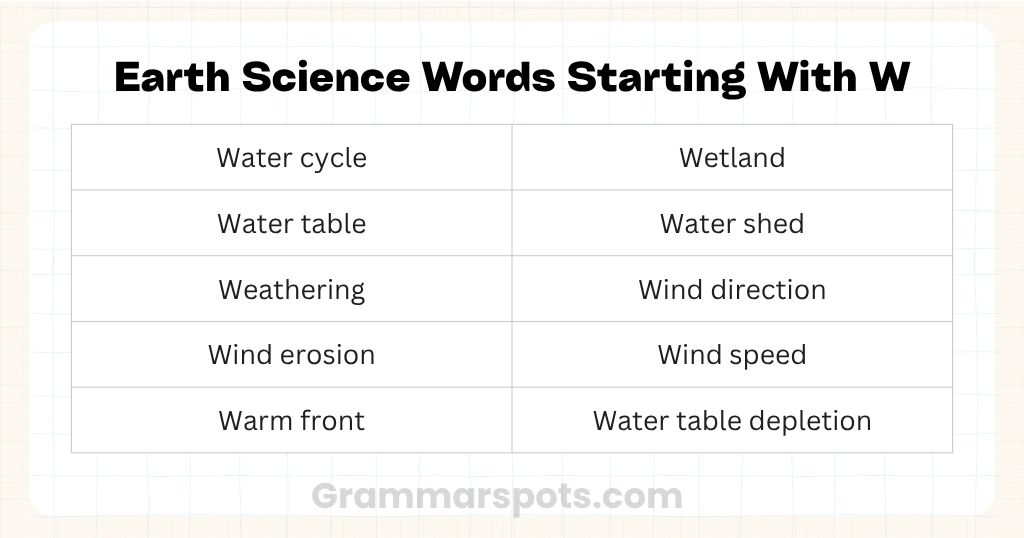
- Water cycle — The continuous movement of water through evaporation, condensation, and precipitation
- Water table — Upper boundary of the underground zone saturated with groundwater
- Weathering — The in-place breakdown of rocks by physical, chemical, or biological processes
- Wind erosion — The removal and transport of soil or rock particles by moving air
- Warm front — A weather boundary where advancing warm air rides over cooler air
- Wetland — A land area permanently or seasonally covered in shallow water
- Water shed — A land area that drains into a single river or lake system
- Wind direction — The compass direction from which wind originates
- Wind speed — Rate at which air moves horizontally across a surface
- Water table depletion — The lowering of groundwater level due to overuse or drought
- Weathered rock — Rock that has been physically or chemically altered at Earth’s surface
- Wave-cut platform — A flat rocky surface formed by wave erosion at the base of a cliff
Space & Astronomy Science Words Starting With W
- White dwarf — A collapsed stellar remnant left after a sun-like star exhausts its fuel
- Wormhole — A hypothetical tunnel connecting two separate points in space-time
- Wolf-Rayet star — An extremely hot, massive star shedding its outer layers through stellar winds
- Weak gravitational lensing — The slight bending of light by gravity used to map dark matter
- Wide-field imaging — Telescope technique capturing large sections of sky in one image
- White hole — A theoretical region of space-time that matter can exit but never enter
- Winter solstice — The day with the shortest period of daylight in a hemisphere
- Wobble method — A technique for detecting exoplanets by measuring a star’s gravitational wobble
Medical & Health Science Words Starting With W
- White blood cell count — A blood test measuring immune cell levels; elevated counts signal infection
- Windpipe blockage — Obstruction of the trachea requiring emergency airway intervention
- Wilson’s disease — A genetic disorder causing toxic copper buildup in organs
- Whooping cough (Pertussis) — A contagious bacterial disease causing severe coughing fits
- Wrist fracture — A break in one or more of the eight carpal bones in the wrist
- Wound infection — Bacterial invasion of damaged tissue; delays the healing process
- Wernicke’s area — Brain region in the temporal lobe responsible for understanding language
- White coat hypertension — Temporary blood pressure rise caused by stress in a clinical setting
- Withdrawal — The physical response when the body is deprived of a substance it depends on
- Wasting disease — A condition causing progressive loss of body mass and muscle
Technology & Applied Science Words Starting With W
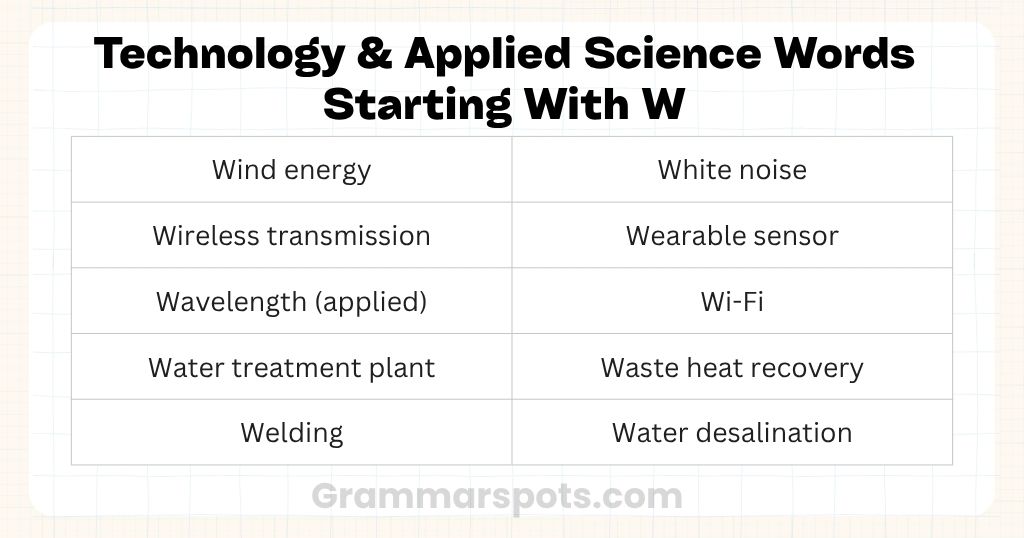
- Wind energy — Electrical power generated by turbines driven by moving air
- Wireless transmission — Sending data through electromagnetic waves without physical cables
- Wavelength (applied) — Specific wave ranges selected for medical imaging, communications, or industrial use
- Water treatment plant — A facility that filters, disinfects, and distributes clean drinking water
- Welding — Joining metal pieces using intense heat, pressure, or laser energy
- White noise — A random mix of all sound frequencies used to mask other sounds
- Wearable sensor — A body-mounted device that monitors health data in real time
- Wi-Fi — Wireless local area networking using radio wavelengths
- Waste heat recovery — Capturing and reusing heat generated as a byproduct of industrial processes
- Water desalination — Removing salt from seawater to produce drinkable fresh water
Easy Science Words Starting With W (Beginners & Kids)
- Water — Liquid made of hydrogen and oxygen; essential for all living things
- Wind — Moving air created by differences in air pressure
- Weather — The current state of the atmosphere including temperature, rain, and wind
- Wave — Energy moving through water, air, or space
- Weight — How strongly gravity pulls you toward Earth
- Worm — A soft, legless animal that lives in soil and helps break down dead matter
- Wing — A body structure that allows birds, bats, and insects to fly
- Wood — Hard plant material from tree trunks and branches
- Winter — The coldest season, when Earth tilts away from the sun
- Warm — Having more heat energy than the surrounding environment
Memory trick: Most W science words connect to water or weather. Wave, wind, water cycle, water vapor, warm front, wetland once you see that pattern, the words are easier to remember.
Advanced Science Words Starting With W
- Wave function collapse — The process by which a quantum particle’s possibilities reduce to one definite state upon observation
- Weak gravitational lensing — Subtle distortion of background galaxies used to trace invisible dark matter
- Work function — The precise energy threshold needed to eject an electron from a metal; central to the photoelectric effect
- Warped space-time — The geometric bending of the universe’s fabric by mass; the actual mechanism behind gravity
- Wobble method — Detection of exoplanets through Doppler-shifted starlight caused by planetary gravitational pull
- White matter tractography — MRI-based brain mapping of nerve fiber pathways used in neurosurgery planning
- Wurtz reaction — Organic synthesis reaction combining two alkyl halides via sodium metal
- Wild-type allele — The standard reference version of a gene against which mutations are compared
- Water potential gradient — The driving force that determines which direction water moves across cell membranes
- Wein’s displacement law — States that the peak wavelength emitted by a black body is inversely proportional to its temperature
Common Confusions: W Science Words
Weathering vs. Erosion
- Weathering = rock breaks down in place
- Erosion = broken pieces get moved somewhere else
- Rain weakening a cliff face is weathering; that same rain carrying sand to a river is erosion
Weight vs. Mass
- Mass = amount of matter (stays the same everywhere)
- Weight = gravitational force on that mass (changes by location)
- 60 kg of mass weighs 588 N on Earth and 96 N on the Moon
Wave vs. Waveform
- Wave = the actual moving energy
- Waveform = a graph showing the shape of that wave
- One is physical; the other is a mathematical picture of it
White Matter vs. Gray Matter
- Gray matter = processes and thinks
- White matter = connects regions and carries signals
- Damage to white matter disconnects areas even if those areas still work
Warm Front vs. Cold Front
- Warm front = warm air gradually slides over cold air; brings slow steady rain
- Cold front = cold air aggressively pushes warm air up; brings fast, stormy weather
Watt vs. Watt-hour
- Watt = rate of power use right now
- Watt-hour = total energy used over time
- Your electricity bill measures watt-hours, not watts
Science Words Starting With W for 7th Grade
- Wavelength — know the unit (meters) and what changes it
- Work — know the formula: W = F × d and the unit (joules)
- Water cycle stages — evaporation, condensation, precipitation, collection
- Weathering vs. erosion — know the difference clearly
- Warm-blooded vs. cold-blooded — link to endothermic and ectothermic
- White blood cells — name the function in the immune system
- Water table — understand why it rises and falls
- Watt — connect it to voltage and current in electricity units
FAQs About Science Words That Start With W
How many science words start with W?
Hundreds exist across all fields. This article covers 140+ of the most tested and commonly used ones organized by subject.
Which W words appear most on science exams?
- Wave
- Wavelength
- Weight
- Work
- Water cycle
- Weathering
- White blood cell
What is the most important W word in biology?
Water every biological process depends on it.
What is the most important W word in physics?
Work and wavelength both qualify. Work ties into force and energy. Wavelength ties into light, sound, and quantum physics.
What is a wormhole in simple terms?
A shortcut through space-time like folding a sheet of paper so two distant points touch. Einstein’s equations allow them. None have been observed.
Are W science words hard to learn?
Most connect to familiar things water, wind, weather. The harder ones use familiar words with precise scientific meanings attached. Learn those everyday connections first.
Conclusion
These 140+ words span physics, chemistry, biology, earth science, astronomy, medicine, and technology. From words a 6-year-old knows like water and wind, to terms that fill graduate textbooks like wave function collapse and weak gravitational lensing.
Use this list to study for a specific subject using the category sections, check a definition fast using the master reference, understand word pairs using the confusions section, or prep for 7th grade exams using that dedicated section.
Science vocabulary is not about memorizing definitions. It is about seeing how words connect to the real world and W words cover a surprisingly wide part of that world.

I’m Hazel, and I studied BSC English at GCUF. I focus on explaining word meanings in simple, clear language that anyone can understand. My goal is helping readers grasp everyday English, confusing terms, and slang used in real conversations and social media. I believe language learning works best when definitions connect to actual life situations. Through careful research and straightforward explanations, I make vocabulary accessible for students, learners, and anyone curious about how English really works in daily use.