


You might have a science test. A vocabulary assignment. Or you just noticed Y is weirdly rare in science and got curious.
Here is the truth: Y is one of the least common starting letters in English scientific vocabulary. There are roughly 130–150 real scientific terms not thousands. This article finds all of them, organizes them by subject, and explains each one clearly.
No repetition. No fluff. Just clean science vocabulary you can actually use.
20 Most-Used Science Words That Start With Y
| Word | Meaning (under 15 words) |
| Yeast | Single-celled fungus used in baking, brewing, and genetics research |
| Yttrium | Metallic element used in electronics, lasers, and cancer treatment |
| Yield | Amount of product obtained from a chemical reaction |
| Y-chromosome | Sex chromosome that triggers male biological development |
| Yolk | Nutrient-rich center of an egg that feeds the embryo |
| Ytterbium | Rare earth metal used in atomic clocks and fiber optics |
| Yaw | Rotation of a vehicle around its vertical axis |
| Young’s Modulus | Measurement of how stiff a solid material is |
| Yellowstone Caldera | Supervolcano system beneath Yellowstone National Park |
| Yocto | Scientific prefix meaning one septillionth (10⁻²⁴) |
| Yotta | Scientific prefix meaning one septillion (10²⁴) |
| Yellow Dwarf | A mid-sized stable star — the Sun belongs to this class |
| Yersinia | Bacterial genus that includes the plague-causing species |
| Y-axis | Vertical axis on a graph or coordinate system |
| Yellow Marrow | Fat-storing tissue found inside long bones |
| Ylem | Primordial matter hypothesized to exist before the Big Bang |
| Yield Point | Stress level where a material permanently deforms |
| Yardang | Wind-eroded rock ridge formation found in deserts |
| Yucca | Desert plant with a unique exclusive relationship with yucca moths |
| Yellow Fever | Viral disease spread by Aedes mosquitoes in tropical regions |
Quick List of 135+ Science Words Starting With Y
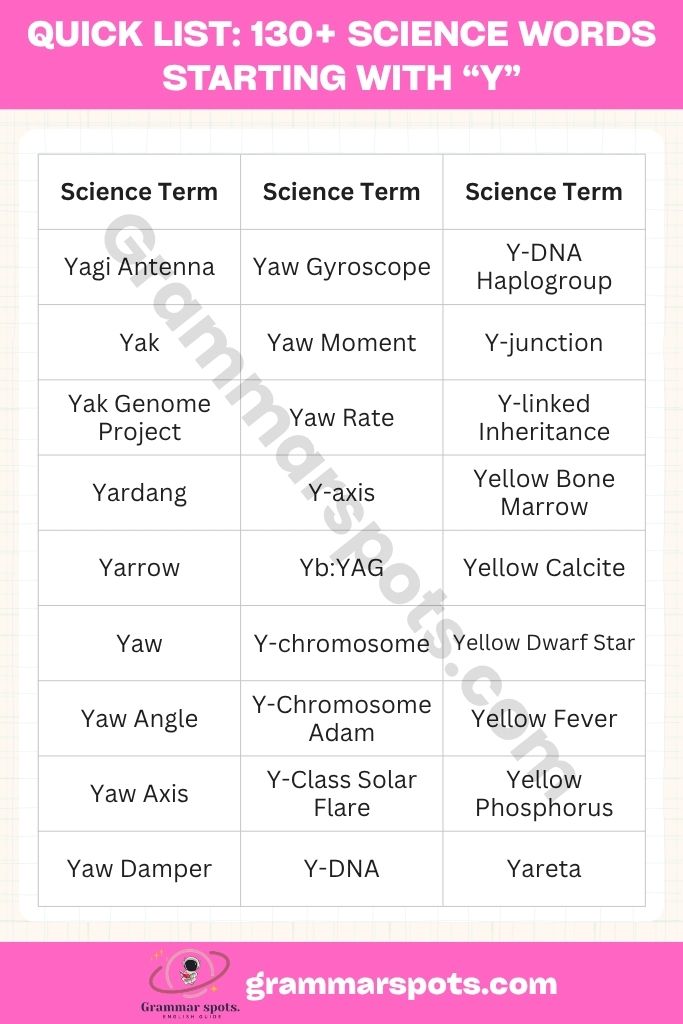
Yagi Antenna
Yak (Bos grunniens)
Yak Genome Project
Yareta
Yardang
Yarrow
Yaw
Yaw Angle
Yaw Axis
Yaw Control Surface
Yaw Damper
Yaw Gyroscope
Yaw Instability
Yaw Moment
Yaw Rate
Yaw Rate Sensor
Y-axis
Yb (symbol — Ytterbium)
Yb:YAG
Y-chromosome
Y-Chromosome Adam
Y-Chromosome Microdeletion
Y-Class Solar Flare
Y-Coupler
Y-DNA
Y-DNA Haplogroup
Y-DNA Genealogy
Y-junction
Y-linked Inheritance
Yellow Bone Marrow
Yellow Calcite
Yellow Dwarf Star
Yellow Fever
Yellow Fever Vaccine
Yellow Jaundice
Yellow Light
Yellow Marrow
Yellow Phosphorus
Yellow River (Huang He)
Yellow Spectral Class
Yellow-banded Poison Dart Frog
Yellowcake
Yellow-Green Algae
Yellowstone Caldera
Yellowstone Hotspot
Yellowtail (Marine Biology)
Yellowwood (Botany)
Yersinia
Yersinia enterocolitica
Yersinia pestis
Yersinia pseudotuberculosis
Yersiniosis
Yield (Chemical)
Yield (Crop/Soil)
Yield (Semiconductor)
Yield Criterion
Yield Locus
Yield Point
Yield Ratio
Yield Strength
Yield Surface
Yield Tensor
Yildun
Ylem
Yocto (prefix)
Yoctogram
Yoctometer
Yoctosecond
Biology Science Words That Start With Y
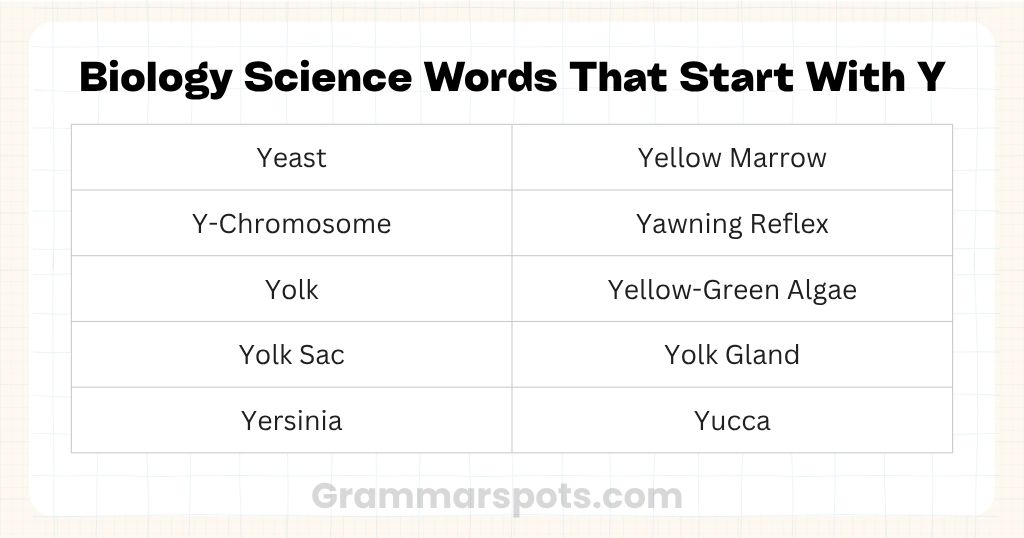
Yeast
A single-celled fungus and one of science’s most studied organisms. It breaks down sugar into carbon dioxide and alcohol. In genetics labs, scientists use yeast because its cells share key similarities with human cells.
Y-Chromosome
One of two human sex chromosomes. People with XY chromosomes are typically male. The Y-chromosome carries fewer genes than X, but the SRY gene on it triggers male development in embryos.
Yolk
The yellow center of an egg. It provides fats, proteins, and vitamins to a developing embryo. In human embryology, a small yolk sac appears early in pregnancy and produces the first blood cells.
Yolk Sac
One of the first structures to form in vertebrate embryos. Even in humans — who have no nutritive yolk the yolk sac produces early blood cells and germ cells before permanent organs take over.
Yersinia
A genus of bacteria. The species Yersinia pestis caused the bubonic plague. Some Yersinia species still cause food-borne infections today, especially in people with weakened immune systems.
Yucca
A desert plant with sword-shaped leaves. Its relationship with the yucca moth is a textbook example of mutualistic symbiosis neither organism can reproduce without the other.
Yellow Marrow
Fat-storing tissue inside long bones. It replaces red marrow as a person ages. Under extreme stress or blood loss, yellow marrow can revert to producing blood cells.
Yawning Reflex
Still debated in science. Leading theories include brain cooling and social communication. Studies show contagious yawning links to empathy stronger in people with close social bonds.
Yellow-Green Algae
A class of algae (Xanthophyceae) with yellow-green pigmentation. Found in freshwater and soil. They store energy as oils rather than starch making them different from green algae.
Yolk Gland
Found in flatworms (platyhelminthes). It produces yolk cells that nourish fertilized eggs. Unlike vertebrate yolk, it is a separate organ not part of the egg itself.
Y-Organ
An endocrine gland in crustaceans (crabs, lobsters, shrimp). It produces molting hormones called ecdysteroids that trigger shell shedding. Equivalent in function to glands in insects.
Yolk Plug
A mass of large, yolk-filled cells visible at the blastopore during early amphibian embryo development. It marks where the gut opening will eventually form.
Yak (Bos grunniens)
A large bovid native to Himalayan highlands. Studied in zoology and genetics. The yak genome project mapped adaptations to high altitude and low oxygen relevant to human high-altitude medicine.
Yareta
A dense, cushion-shaped plant from the Andes. Extremely slow-growing some colonies are over 3,000 years old. Scientists study it for survival strategies in harsh, low-oxygen alpine environments.
Yarrow
A flowering plant (Achillea millefolium) studied in medicinal botany and pharmacology. Contains compounds with anti-inflammatory properties. Also used in ecological studies as a pollinator attractor.
Chemistry Science Words That Start With Y
Yield (Chemical Reaction)
The actual amount of product formed compared to the theoretical maximum. Expressed as a percentage. A 90% yield is excellent. Below 50% usually means redesigning the reaction.
Yttrium (Y — Element 39)
A silvery-white transition metal. Used in:
- Red phosphors in older television screens
- Strengthening alloys in jet engines
- Radioactive cancer treatment devices
Ytterbium (Yb — Element 70)
A soft rare earth metal. Key uses:
- Atomic clocks (most accurate time-measuring devices built)
- Fiber optic amplifiers in undersea internet cables
- Ytterbium lasers used in industrial cutting
Yellow Phosphorus
The most reactive form of phosphorus. It:
- Glows faintly in the dark (chemiluminescence)
- Ignites spontaneously in air
- Is highly toxic — tightly controlled in research settings
Yukawa Potential
A mathematical model describing how strong nuclear force acts between particles in an atomic nucleus. Named after Hideki Yukawa, the first Japanese Nobel laureate in Physics (1949).
Yttrium Aluminum Garnet (YAG)
A synthetic crystalline material used as a laser medium. YAG lasers are used in:
- Eye surgery
- Metal cutting and welding
- Dental procedures
Yb:YAG
A variant of YAG doped with ytterbium. Produces high-power, efficient laser beams. Used in industrial manufacturing and scientific research.
Yellowcake
A powdered uranium concentrate produced during uranium ore processing. Named for its yellow color. It is the intermediate product between raw ore and nuclear fuel.
Yield Ratio (Metallurgy)
The ratio of yield strength to ultimate tensile strength in a metal. A high yield ratio means the metal has little plastic deformation before it breaks important in structural engineering decisions.
Physics Science Words That Start With Y
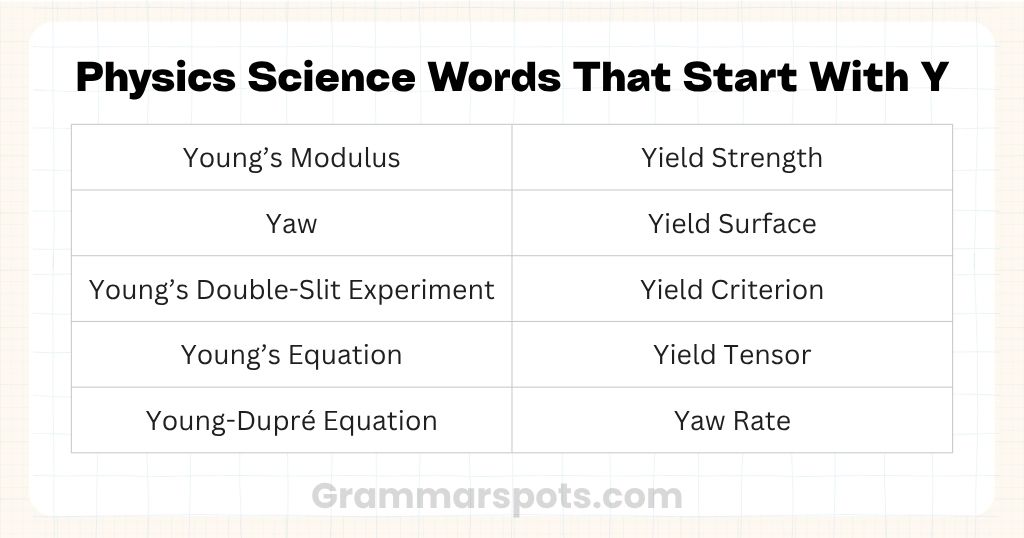
Young’s Modulus
Measures the stiffness of a solid. A high value = stiff (steel). A low value = flexible (rubber). Civil and mechanical engineers use this number to choose materials for safe construction.
Yaw
One of three aircraft rotation types:
- Yaw = nose moves left or right (vertical axis)
- Pitch = nose moves up or down
- Roll = one wing dips lower
Young’s Double-Slit Experiment
Thomas Young shone light through two narrow slits and observed an interference pattern — proving light behaves as a wave. Repeating it with electrons helped launch quantum mechanics.
Young’s Equation (Surface Tension)
Describes the contact angle of a liquid droplet on a solid surface. Used in designing waterproof materials, medical implants, and inkjet printers.
Young-Dupré Equation
Extends Young’s Equation to calculate the work of adhesion — how much energy is needed to separate a liquid from a solid surface. Used in coatings and adhesive science.
Yield Strength
The calculated stress value at which a material begins to permanently deform. Slightly different from yield point yield point is the observable moment; yield strength is the number engineers use in formulas.
Yield Surface (Plasticity Theory)
A three-dimensional boundary in stress space. Inside the surface: elastic behavior. Outside: permanent deformation. Used in advanced structural analysis.
Yield Criterion
A mathematical rule that defines exactly when a material transitions from elastic to plastic behavior under complex loading. The Von Mises and Tresca criteria are the most widely used.
Yield Tensor
A tensor quantity describing yield behavior in materials under multi-directional stress. Used in computational materials science and finite element analysis.
Yaw Rate
The speed at which a vehicle rotates around its vertical axis, measured in degrees per second. Critical in:
- Aircraft navigation systems
- Car stability control systems
- Spacecraft attitude control
Yaw Gyroscope
A gyroscope specifically oriented to detect and measure yaw rotation. Standard equipment in aircraft, missiles, and autonomous vehicles.
Y-Coupler (Optics)
A Y-shaped optical fiber component that splits one light signal into two paths, or combines two signals into one. Used in fiber optic communication networks.
Y-Junction (Physics)
A point in a waveguide or circuit where one path splits into two. Applies to:
- Microwave waveguides
- Optical fiber networks
- Quantum circuit design
Young’s Interference Fringes
The alternating light and dark bands produced in Young’s Double-Slit Experiment. The spacing between fringes allows precise calculation of light wavelength.
Earth Science Words That Start With Y
Yellowstone Caldera
A supervolcano caldera roughly 55 kilometers wide beneath Yellowstone National Park. If it erupted at full power, ash would cover North America and affect global climate. Currently monitored 24/7 by USGS.
Yardang
Wind sculpts these ridge-like rock formations in deserts by eroding soft rock faster than hard rock. Yardangs also exist on Mars evidence of Mars’s ancient, thicker atmosphere.
Yellow River (Huang He)
China’s Yellow River carries one of Earth’s highest sediment loads. The yellow color comes from loess fine silt eroded from the Loess Plateau. Scientists study it for erosion modeling and flood dynamics.
Yield (Soil Science)
The amount of crop produced per unit of land area. Soil scientists measure:
- Mineral content
- Water retention capacity
- Microbial activity
- pH balance
Declining yield is an early indicator of soil degradation.
Yukon Permafrost
Permanently frozen ground in northern Canada. As global temperatures rise, Yukon permafrost thaws and releases trapped methane a greenhouse gas more potent than carbon dioxide.
Yucatan Peninsula (Geology)
Site of the Chicxulub crater the impact point of the asteroid that ended the Cretaceous period 66 million years ago. The K-Pg boundary layer found worldwide traces back to this location.
Yellowstone Hotspot
A mantle plume — a column of hot rock rising from deep in the Earth’s mantle. The North American tectonic plate moves over it, creating a track of ancient calderas stretching from Oregon to Wyoming.
Yellow Calcite (Mineralogy)
A yellow variety of calcite mineral. Color comes from iron oxide impurities. Used in geology for studying mineral formation conditions and as a semiprecious stone.
Space & Astronomy Science Words That Start With Y
Yellow Dwarf Star
Our Sun is a yellow dwarf a G-type main-sequence star. These stars:
- Burn hydrogen in their cores
- Stay stable for 8–10 billion years
- Make long-term planetary habitability possible
Ylem
George Gamow used this term for the hot, dense mix of neutrons, protons, and electrons in the first moments after the Big Bang. It comes from ancient Greek. Rarely used today, but appears in historical cosmology texts.
Light-Year
A unit of distance, not time. One light-year = roughly 9.46 trillion kilometers the distance light travels in one Earth year. The nearest star system (Alpha Centauri) sits 4.37 light-years away.
Y-Type Dwarf
The coldest class of brown dwarf stars. Some Y-dwarfs have surface temperatures below 100°C cooler than an oven. NASA’s WISE telescope detected the first confirmed Y-dwarfs in 2011.
Young Stellar Object (YSO)
A star in the early stages of formation, still embedded in its gas and dust cloud. Astronomers study YSOs to understand how solar systems like ours originally formed.
Young Stellar Cluster
A group of stars that formed from the same molecular cloud within the last few million years. These clusters help astronomers measure star formation rates and stellar evolution timelines.
Yildun
The official IAU name for Delta Ursae Minoris — a white star in the Little Dipper constellation. Located about 183 light-years from Earth.
Y-Class Solar Flare
Not yet an official flare classification — the current scale ends at X-class. However, Y-class is discussed in solar physics literature for theoretical flares far beyond current observed maximums.
Yellow Spectral Class
Stars classified as G-type (yellow) on the Harvard spectral classification system. Surface temperatures range from about 5,200 to 6,000 Kelvin. Our Sun sits near the middle of this range.
Medical & Health Science Words That Start With Y
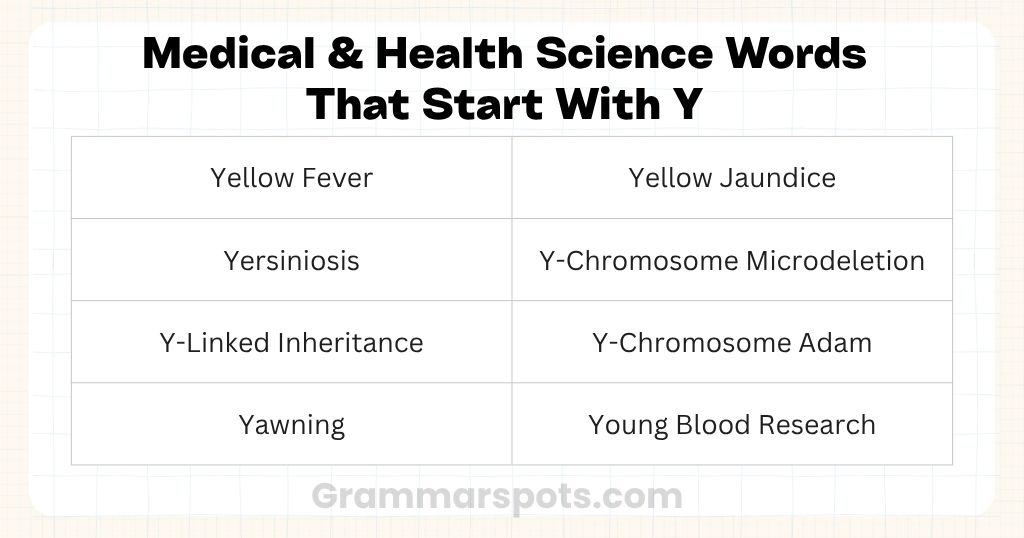
Yellow Fever
A viral hemorrhagic disease transmitted by Aedes mosquitoes. The name comes from jaundice liver damage causes skin and eyes to turn yellow. A vaccine exists but millions in at-risk regions lack access.
Yersiniosis
Infection caused by Yersinia enterocolitica. Symptoms mimic appendicitis severe abdominal pain and fever leading to unnecessary surgeries before the real diagnosis is confirmed.
Y-Linked Inheritance
Genes on the Y-chromosome pass only from biological father to son. Scientists use Y-chromosome DNA to trace paternal ancestry across thousands of years. Forensic labs use Y-STR markers in criminal cases.
Yawning (Neurological Symptom)
Excessive yawning can signal:
- Epilepsy
- Brain tumors
- Liver failure
- Certain medication side effects
Neurologists track yawning frequency during neurological assessments.
Yellow Jaundice
Not a disease itself a symptom of liver stress or failure. Causes include:
- Yellow fever
- Hepatitis
- Gallstones
- Medication overdose
Skin and eyes turn yellow due to bilirubin buildup in the blood.
Y-Chromosome Microdeletion
Missing segments on the Y-chromosome that cause male infertility. One of the most common genetic causes of low sperm production. Diagnosed through genetic testing before fertility treatments.
Y-Chromosome Adam
The most recent common patrilineal ancestor of all living human males — traced through Y-DNA analysis. Not literally one man, but a statistical concept in population genetics.
Young Blood Research (Geroscience)
A field studying whether blood plasma from young donors can reverse aging markers in older recipients. Early trials showed promising results in mice. Human trials ongoing as of 2024.
Technology & Applied Science Words That Start With Y
Yttrium Iron Garnet (YIG)
A synthetic crystal that interacts precisely with magnetic fields. Used in:
- Radar microwave filters
- Radio frequency oscillators
- Wireless communication sensors
Yttria-Stabilized Zirconia (YSZ)
A ceramic that performs at extreme temperatures without cracking. Used in:
- Jet engine turbine blade coatings
- Dental crowns
- Oxygen sensors in vehicle exhaust systems
Yagi Antenna
Invented by Japanese engineers Yagi and Uda in the 1920s. The classic rooftop TV antenna. Still used in:
- Amateur radio
- Long-range Wi-Fi
- Cellular network direction finding
Yield (Semiconductor)
The percentage of functional chips produced per silicon wafer. A 1% yield improvement can save semiconductor manufacturers millions of dollars per production run.
Yaw Control Surface
The rudder on an aircraft — the control surface that manages yaw rotation. On spacecraft, yaw control uses thruster firings instead of physical rudders.
Yaw Damper
An automatic system on commercial aircraft that detects and corrects unwanted yaw oscillation. Without it, long flights develop a side-to-side swaying motion called “Dutch roll.”
Yoctometer
One septillionth of a meter (10⁻²⁴ m). Smaller than any currently observable particle. Used in theoretical physics discussing sub-subatomic scales.
Yottabyte
One septillion bytes (10²⁴ bytes). No single device holds this much data yet. Discussed in computing projections for future global data storage needs.
Common Confusions With Y Science Words
Yeast vs Bacteria
- Yeast = fungus with a nucleus (eukaryote)
- Bacteria = no nucleus (prokaryote)
- Both are microscopic and can ferment — but they are biologically very different
Yttrium vs Ytterbium
- Both named after Ytterby, Sweden
- Yttrium = element 39, used in lasers and electronics
- Ytterbium = element 70, used in atomic clocks
- Same naming origin, completely different elements
Yield Point vs Yield Strength
- Yield point = the observable moment deformation begins
- Yield strength = the calculated stress number engineers use in formulas
- Often used interchangeably, but technically distinct
Yellow Fever vs Yellow Jaundice
- Yellow fever = a specific virus
- Yellow jaundice = a symptom from many causes (hepatitis, gallstones, medication)
- Yellow fever can cause jaundice, but jaundice is not yellow fever
Yaw vs Pitch vs Roll
- Yaw = nose moves left or right
- Pitch = nose moves up or down
- Roll = one wing tilts lower than the other
Y-axis vs Y-chromosome
- Y-axis = a graphing tool in mathematics and physics
- Y-chromosome = a biological sex chromosome
- The shared letter is coincidence — no connection
Young’s Modulus vs Yield Strength
- Young’s Modulus measures stiffness (how much a material resists stretching)
- Yield strength measures when permanent deformation begins
- Both describe material behavior, but at different stages
Science Words That Start With Y for Kids
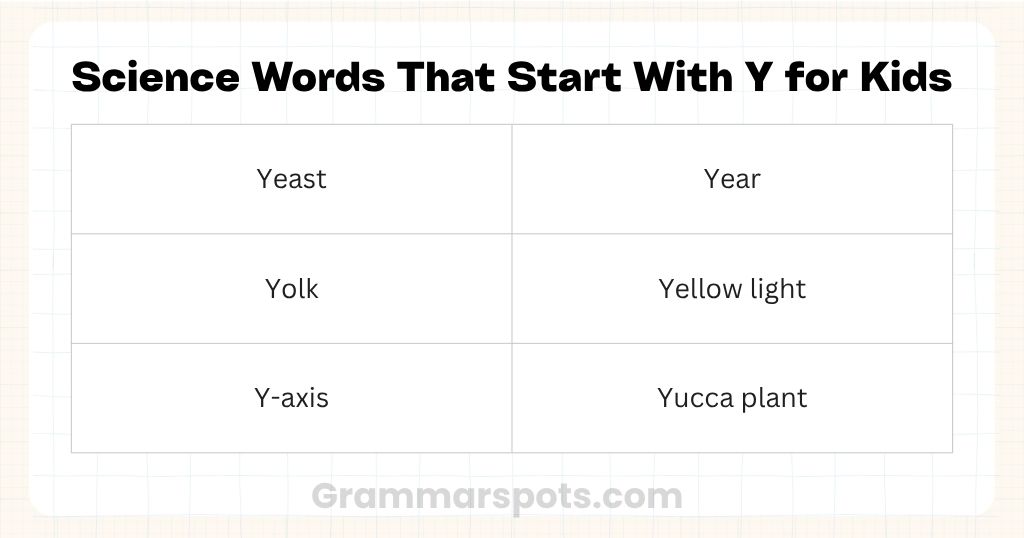
Start with these if you are in grades 3 through 6:
- Yeast — Tiny fungus that makes bread rise by releasing gas
- Yolk — Yellow center of an egg; feeds the baby bird growing inside
- Y-axis — The up-down line on any graph or chart
- Year — One complete trip Earth makes around the Sun (365.25 days)
- Yellow light — A visible color of light between green and orange on the spectrum
- Yucca plant — A spiky desert plant that barely needs water to survive
Memory trick: Yeast makes things rise. Yolk feeds what is growing. Y-axis goes up. Easy pattern.
Science Words That Start With Y — 7th Grade
These appear most in middle school science classes and standardized tests:
- Y-chromosome — Genetics and heredity units
- Yeast — Cell biology and fermentation lab work
- Young’s Modulus — Forces and materials in physical science
- Yield — Chemistry equations and percentage calculations
- Yellow Dwarf — Space science and stellar classification
- Yaw — Forces, motion, and flight science units
- Yellowstone Caldera — Earth science and geology
- Yardang — Erosion and weathering topics
Where These Words Actually Get Used
In a hospital:
- Doctors test for Yersinia when a patient has unexplained abdominal pain
- Yellow fever is checked in travelers from tropical regions
- Neurologists record yawning frequency as a neurological symptom marker
In a bakery:
- Yeast fermentation is the entire science behind bread rising
- Temperature control is critical — too hot kills yeast, too cold stops it
In an airplane:
- Pilots monitor yaw rotation continuously
- Yaw dampers automatically correct unwanted side-to-side swaying in flight
In a semiconductor factory:
- Yield is tracked every production cycle
- A 3% yield improvement changes the entire economics of chip manufacturing
In a genetics lab:
- Y-STR markers on the Y-chromosome are used in forensic DNA analysis
- Y-DNA haplogroups trace paternal human migration across continents
In space research:
- Yellow dwarf classification tells astronomers a star’s stability and lifespan
- Y-type dwarfs sit at the edge between the coldest stars and the largest planets
FAQs
How many science words start with Y?
Between 130 and 150 genuine scientific terms, depending on how subspecialty variants are counted. This article covers 135.
Which science subject has the most Y words?
Biology has the most, followed by chemistry and physics. Earth science and astronomy have a smaller but important set.
Are Y science words hard to learn?
The names look unfamiliar Yukawa, Ytterbium, Yottabyte. But the concepts behind most are not harder than other science vocabulary. Learning that Yttrium and Ytterbium both come from Ytterby (a Swedish village) makes both words stick at once.
Do Y words appear on standardized tests?
Yes. Yeast, yield, Y-chromosome, and Young’s Modulus appear regularly on 7th through 10th grade science assessments.
Is “year” a science word?
Yes, and there are multiple types:
- Solar year = Earth’s orbit around the Sun
- Sidereal year = measured against fixed stars
- Lunar year = based on Moon cycles
- Light-year = a unit of distance, not time
What is the single most important Y word in science?
Depends on the field:
- Biology: yeast — central to genetics research for decades
- Physics: Young’s Modulus — used daily in engineering
- Medicine: yellow fever — still affects millions of people annually
Conclusion
You now have 135 verified science words starting with Y, organized by subject biology, chemistry, physics, earth science, space, medicine, and technology. Each section includes real explanations, not just definitions. Kid-friendly terms are separated from 7th grade and advanced vocabulary so every reader finds their level.
Common confusions are cleared up, real-world usage is shown, and the full alphabetical list gives you a single reference point for everything Y-related in science.
Use this list by subject, not all at once. One word understood deeply stays with you far longer than twenty memorized the night before a test.

I’m Hazel, and I studied BSC English at GCUF. I focus on explaining word meanings in simple, clear language that anyone can understand. My goal is helping readers grasp everyday English, confusing terms, and slang used in real conversations and social media. I believe language learning works best when definitions connect to actual life situations. Through careful research and straightforward explanations, I make vocabulary accessible for students, learners, and anyone curious about how English really works in daily use.