

You need science words that start with Z for a test, homework, a word list, or just curiosity.
Z is rare in everyday English. In science, it punches well above its weight. Physics, biology, chemistry, astronomy all of them claim Z words as their own.
This article gives you 160+ words, organized by field, with clear meanings and real context. No fluff. No repetition.
Quick Answer: 20 Most-Used Science Words Starting With Z
| Word | Meaning |
| Zero | A value representing no quantity or null measurement |
| Zinc | Metallic element, atomic number 30, essential for health |
| Zone | A defined region with specific environmental characteristics |
| Zygote | Fertilized egg cell formed when sperm meets egg |
| Zenith | Point in the sky directly above an observer |
| Zeolite | Porous mineral used in filtration and water softening |
| Zoonosis | Disease that passes naturally from animals to humans |
| Zirconium | Strong metallic element used in nuclear reactors |
| Zooplankton | Tiny animals that drift freely in water bodies |
| Zeta | Greek letter used across physics and mathematics |
| Zeeman Effect | Splitting of spectral lines caused by magnetic fields |
| Zymase | Yeast enzyme that drives sugar fermentation |
| Zona Pellucida | Protective protein layer surrounding a mammalian egg |
| Zwitterion | Molecule carrying both positive and negative charges simultaneously |
| Zero Gravity | State where gravitational effects appear absent |
| Zygomorphic | Flower with bilateral — one-way — symmetry |
| Zeaxanthin | Eye-protective pigment found in corn and leafy greens |
| Zodiacal Light | Faint glow from sunlight scattering off solar system dust |
| Zooxanthellae | Algae living inside coral tissue, essential for reef health |
| Zymogen | Inactive enzyme precursor that activates when needed |
Quick List of 160+ Science Words That Start With Z
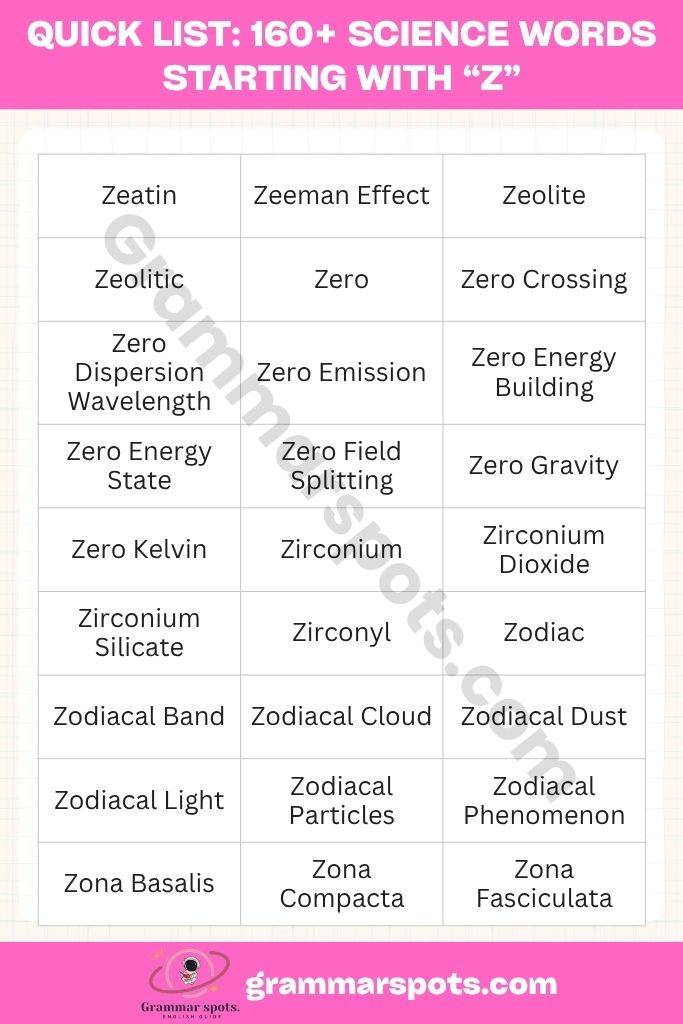
- Zeatin
- Zeeman Effect
- Zeolite
- Zeolitic
- Zero
- Zero Crossing
- Zero Dispersion Wavelength
- Zero Emission
- Zero Energy Building
- Zero Energy State
- Zero Field Splitting
- Zero Gravity
- Zero Kelvin
- Zirconium
- Zirconium Dioxide
- Zirconium Silicate
- Zirconyl
- Zodiac
- Zodiacal Band
- Zodiacal Cloud
- Zodiacal Dust
- Zodiacal Light
- Zodiacal Particles
- Zodiacal Phenomenon
- Zona Basalis
- Zona Compacta
- Zona Fasciculata
- Zona Glomerulosa
- Zona Incerta
- Zona Intermedia
- Zona Orbicularis
- Zona Pellucida
- Zona Pellucida Proteins
- Zona Reticularis
- Zonally Averaged
- Zonal Average
- Zonal Flow
- Zonal Harmonics
- Zonal Statistics
- Zonal Wind
- Zonation
- Zonation Pattern
- Zone Boundary
- Zone Hypothesis
- Zone Melting
- Zone of Aeration
- Zone of Inhibition
- Zone of Proximal Development
- Zone of Saturation
- Zone Plate
- Zone Refining
- Zone Time
- Zonula
Physics Science Words That Start With Z
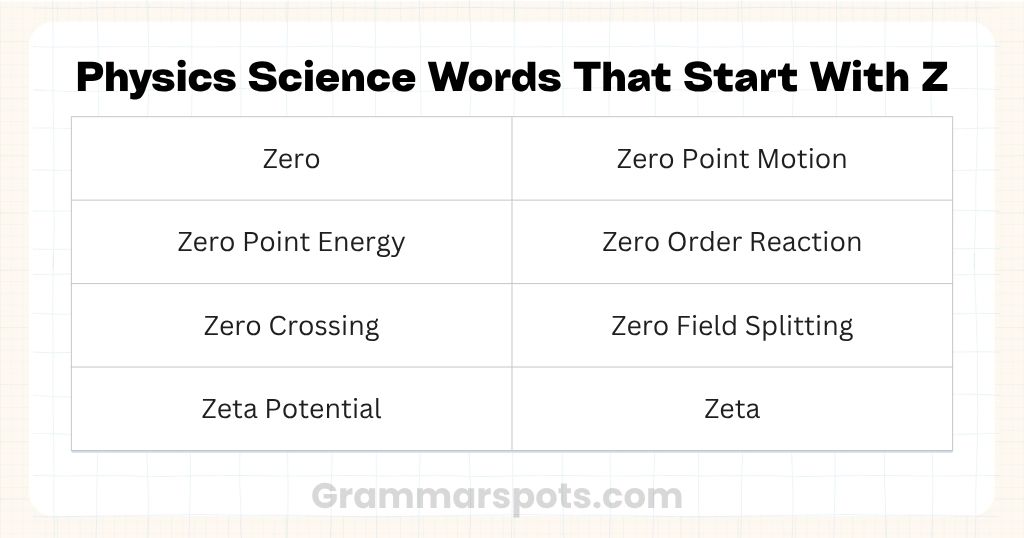
Zero
Not just “nothing.” In physics, zero is a precise measurement point. Zero Kelvin (−273.15°C) is absolute zero the coldest temperature theoretically possible. Atoms stop vibrating completely at this point.
Zero Point Energy
At absolute zero, particles still hold a tiny minimum amount of energy. That energy is called zero-point energy. It comes from quantum mechanics and has been experimentally confirmed.
Zero Point Motion
The constant small vibration of atoms even at absolute zero. This is why helium stays liquid under normal pressure at very low temperatures the atoms keep moving just enough.
Zero Order Reaction
A reaction where speed stays constant regardless of how much substance is present. Many drug absorption processes in the body follow zero-order kinetics.
Zero Crossing
When a wave sound, electrical, or otherwise crosses from positive to negative through zero. Electrical engineers and audio engineers track these in signal processing.
Zero Field Splitting
A quantum mechanical effect where energy levels of a molecule split even without an external magnetic field. Relevant in electron paramagnetic resonance studies.
Zeta Potential
The electric charge on the surface of a particle suspended in liquid. High zeta potential keeps particles separated. Low zeta potential causes them to clump. Used in medicine, paint, and food science.
Zeta (ζ)
A Greek letter appearing across physics in impedance, fluid dynamics, and damping ratios.
Zeeman Effect
When atoms are placed in a magnetic field, their spectral lines split. This splitting is the Zeeman Effect. Astronomers use it to measure magnetic fields of stars millions of miles away.
Zeeman Splitting
The measurable separation between the split spectral lines produced by the Zeeman Effect.
Zero Dispersion Wavelength
The wavelength at which a fiber-optic cable produces no signal dispersion. Engineers target this wavelength when designing high-speed data cables.
Zero Variance
A statistical physics term describing a system where all measurements are identical — no spread, no deviation.
Chemistry Science Words That Start With Z
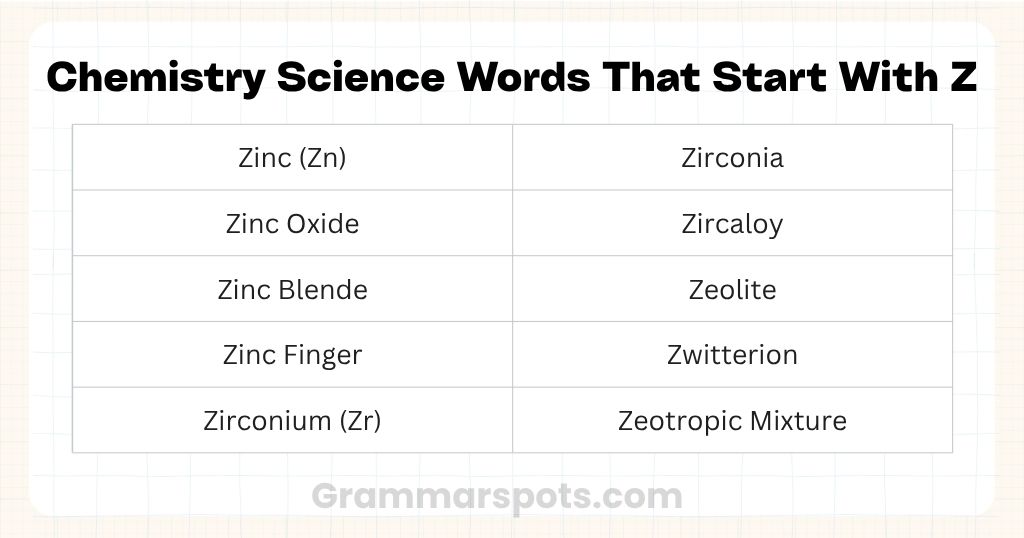
Zinc (Zn)
Element 30 on the periodic table. Used in batteries, sunscreen (zinc oxide), and galvanizing steel against rust. Also an essential mineral your immune system needs it.
Zinc Oxide
White powder used in sunscreen, rubber production, and paint. Reflects UV light effectively.
Zinc Blende
Natural mineral form of zinc sulfide. Its crystal structure is used as a standard model in solid-state chemistry.
Zinc Finger
A small protein structure stabilized by zinc. Used in genetic engineering to cut DNA at precise locations a key tool in gene therapy.
Zirconium (Zr)
A corrosion-resistant metal used in nuclear reactor fuel rod casings. Absorbs very few neutrons critical for controlled nuclear reactions.
Zirconia
Zirconium dioxide. Used to make cubic zirconia (diamond substitute in jewelry) and in dental crowns.
Zircaloy
Zirconium-based alloy designed specifically for nuclear reactor use.
Zeolite
A porous mineral with a sponge-like structure. Traps molecules by size. Used in water purification, cat litter, oil refining, and industrial filtration.
Zwitterion
A molecule with both a positive and negative charge in different locations, but neutral overall. Amino acids exist as zwitterions at normal body pH.
Zeotropic Mixture
A liquid mixture that boils across a temperature range rather than at one fixed point. Many refrigerant blends are zeotropic.
Zigzag Chain
A molecular structure where atoms are arranged in a repeating zigzag pattern common in polymer chemistry.
Zinc Compounds (full list)
- Zinc Acetate
- Zinc Bromide
- Zinc Carbonate
- Zinc Chloride
- Zinc Ferrite
- Zinc Gluconate
- Zinc Nitrate
- Zinc Phosphate
- Zinc Protoporphyrin
- Zinc Selenide
- Zinc Sulfate
- Zinc Sulfide
- Zinc Telluride
Zymosterol
A sterol compound involved in cholesterol biosynthesis inside cells.
Zirconyl
An ionic form of zirconium (ZrO²⁺) found in various chemical compounds.
Zirconate
A salt or compound containing zirconium and oxygen used in ceramics and electronics.
Biology Science Words That Start With Z
Zygote
The single fertilized cell formed when sperm meets egg. Carries DNA from both parents. Divides repeatedly to form a complete organism. Every human started here.
Zona Pellucida
The protein shell surrounding a mammalian egg. Controls which sperm can enter. After fertilization, the embryo must break through it to implant in the uterus.
Zona Pellucida Proteins
Specific proteins (ZP1, ZP2, ZP3, ZP4) that form the zona pellucida. They act as molecular locks, allowing only compatible sperm to enter.
Zooplankton
Tiny animals drifting in oceans and lakes. Cannot swim against currents. Form a critical link in aquatic food chains blue whales eat billions of them daily.
Zoonosis
A disease that jumps from animals to humans. Rabies, Ebola, and bird flu are all zoonoses. One of the most important concepts in modern public health.
Zymogen
An enzyme that stays inactive until triggered. The digestive enzyme pepsin starts as pepsinogen and activates only in stomach acid — preventing your stomach from digesting itself.
Zymogen Granule
A small storage packet inside a cell that holds inactive zymogens until they’re needed.
Zeaxanthin
A yellow pigment in corn, egg yolks, and leafy greens. Protects the retina from blue light damage. Low levels are linked to age-related vision loss.
Zygomorphic
A flower that can only be divided into equal halves one way — bilateral symmetry. Orchids and snapdragons are zygomorphic.
Zoospore
A reproductive cell with a tail (flagellum) that lets it swim through water. Produced by algae and some fungi.
Zygospore
A thick-walled spore formed during sexual reproduction in certain fungi. Resistant to harsh environmental conditions.
Zygomycota
A group of fungi that reproduce via zygospores. Some species cause infections in people with weakened immune systems.
Zooxanthellae
Photosynthetic algae living inside coral tissue. They feed the coral and give it color. When ocean water warms too much, coral expels them — causing coral bleaching.
Zoochory
Seed dispersal by animals. When animals eat fruit and deposit seeds elsewhere — zoochory.
Zooid
An individual organism within a colonial animal, like a coral polyp or a unit of a jellyfish colony.
Zoospore
A motile spore that swims using flagella — produced by algae, water molds, and some fungi.
Zoobiotic
Describing organisms that live in or on animals as parasites or symbionts.
Zonociliate
An organism that has cilia arranged in zones or bands around its body.
Zeatin
A plant hormone (cytokinin) that promotes cell division and growth. Found naturally in corn.
Zeatin Riboside
A modified form of zeatin found in plant tissue, also biologically active in cell regulation.
Zeatin Glucoside
An inactive storage form of zeatin in plant cells — converted to active zeatin when needed.
Zoeae
Early larval stage of crustaceans like crabs and shrimp. Zoeae are tiny, free-swimming, and look nothing like the adult form.
Earth Science Words That Start With Z
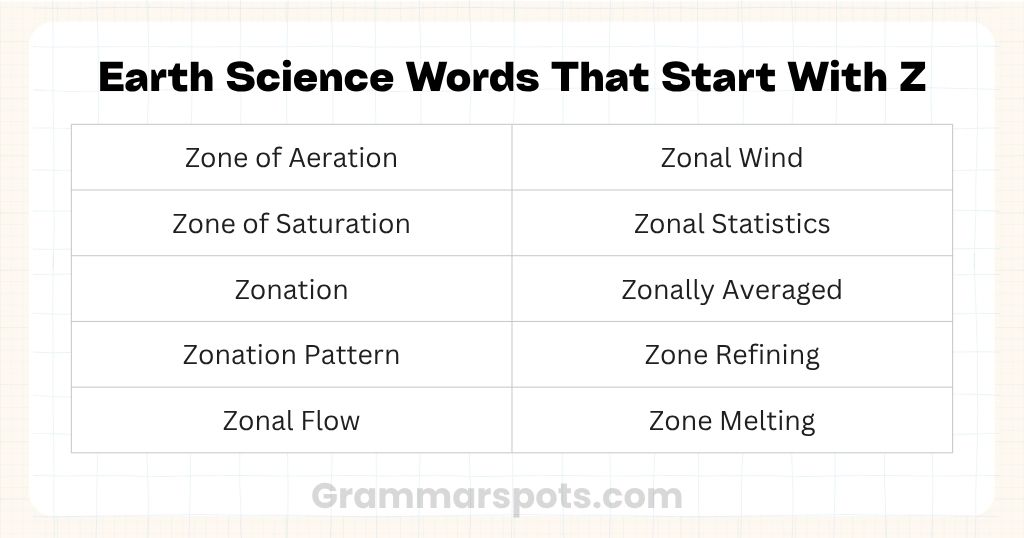
Zone of Aeration
The soil and rock layer just below the surface where pore spaces hold air. Water passes through this zone before reaching the water table.
Zone of Saturation
Below the zone of aeration, every pore and crack fills with groundwater. The top of this zone is the water table.
Zonation
The arrangement of living things in distinct bands based on environmental conditions. Clearly visible on rocky coastlines — different species live at different tide heights.
Zonation Pattern
The specific layout of species zones in an ecosystem — used in ecological mapping and conservation planning.
Zonal Flow
Wind that moves roughly east or west along latitude lines. When zonal flow weakens, weather becomes more chaotic and extreme events increase.
Zonal Wind
Horizontal wind blowing along a parallel of latitude — the east-west component of atmospheric circulation.
Zonal Statistics
In geographic information systems (GIS), calculations made within defined geographic boundaries — average rainfall, temperature range, vegetation cover.
Zonally Averaged
A value averaged across all longitudes at a given latitude. Used in climate modeling.
Zone Refining
Moving a narrow melted zone through a rod of material to push impurities to one end. Produces extremely pure metals and crystals.
Zone Melting
The industrial process behind zone refining — critical for producing pure silicon for electronics.
Zone Boundary
The edge where one environmental or geological zone meets another.
Zeolite (Earth Science)
Zeolites form naturally when volcanic lava contacts groundwater. Used in geology to date formations and study how rocks formed.
Zoned Crystal
A crystal where chemical composition varies from center to edge — formed when conditions changed during crystal growth. Tells geologists about past environments.
Space & Astronomy Science Words That Start With Z
Zenith
The point in the sky directly above an observer. Measured at exactly 90° from the horizon in every direction.
Zenith Angle
The angle between a celestial object and the zenith. A star directly overhead = 0°. At the horizon = 90°. Affects how much atmosphere light travels through.
Zenith Distance
The angular distance of a celestial object from the zenith — the complement of altitude in sky measurements.
Zenith Telescope
A telescope pointed straight up, used to determine latitude and make precise star position measurements.
Zenith Hourly Rate (ZHR)
The number of meteors an observer would see per hour during a meteor shower under perfect conditions with the radiant point directly overhead.
Zodiac
The belt of sky containing the twelve constellations the Sun appears to travel through over one year. Used in astronomy for positional reference.
Zodiacal Light
A soft, pyramid-shaped glow visible on very dark nights, stretching from the horizon. Caused by sunlight scattering off dust spread through the inner solar system.
Zodiacal Band
An extremely faint band of light connecting both sides of zodiacal light across the sky. Requires perfect dark-sky conditions to see.
Zodiacal Cloud
The diffuse cloud of dust spread along the solar system’s plane — the source of zodiacal light and the gegenschein.
Zodiacal Dust
Microscopic dust particles spread through the inner solar system. Mostly from asteroid collisions and comet debris.
Zodiacal Particles
Individual dust grains that make up the zodiacal cloud. Studied to understand solar system formation.
Zero Gravity
In orbit, astronauts appear weightless because they’re in constant free fall around Earth. Gravity hasn’t disappeared everything is falling at the same rate.
Zero Energy State
The lowest possible energy state of a quantum system used in astrophysics to describe ground-state conditions of atoms in space.
Medical & Health Science Words That Start With Z
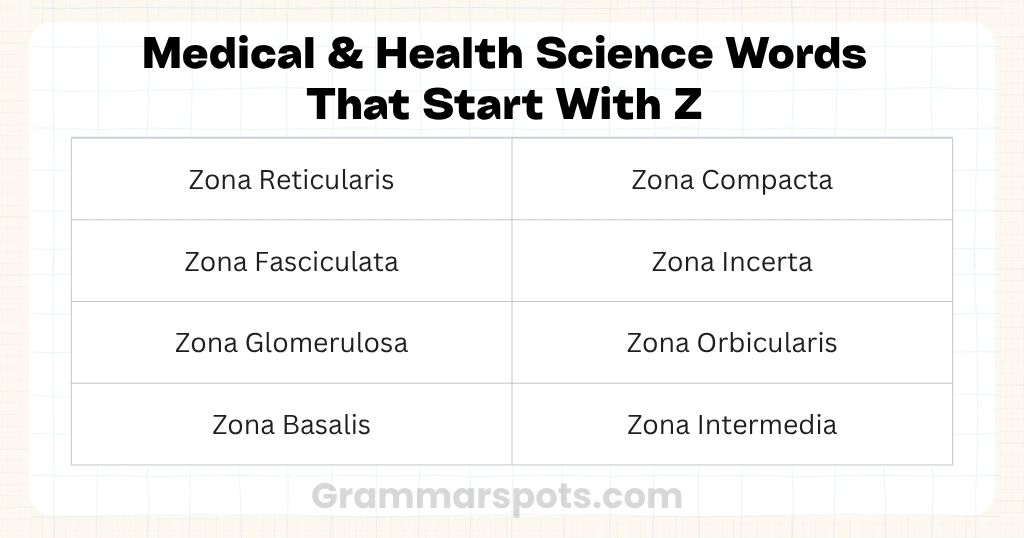
Zona Reticularis
The innermost layer of the adrenal cortex. Produces androgens (sex hormones).
Zona Fasciculata
The middle layer of the adrenal cortex. Produces cortisol the body’s primary stress hormone.
Zona Glomerulosa
The outermost layer of the adrenal cortex. Produces aldosterone, which controls blood pressure and salt balance.
Zona Basalis
The deep layer of the uterine lining that remains after menstruation and regenerates the outer layer.
Zona Compacta
The dense surface layer of the uterine lining shed during menstruation.
Zona Incerta
A region in the brain (part of the subthalamus) involved in motor control and sensory processing.
Zona Orbicularis
A ring of fibers in the hip joint capsule that helps keep the femoral head in the socket.
Zona Intermedia
A transitional zone in the adrenal cortex between the fasciculata and reticularis layers.
Zona Granulosa
The layer of cells surrounding the developing egg inside an ovarian follicle. Produces estrogen.
Zonula Occludens
Tight junctions between cells that prevent substances from leaking between them — critical in the blood-brain barrier.
Zone of Inhibition
The clear ring around an antibiotic disc on a bacterial culture plate where bacteria cannot grow. Larger ring = stronger antibiotic effect against that specific bacteria.
Zinc Deficiency
A condition caused by insufficient zinc intake. Symptoms include weakened immunity, slow wound healing, and altered taste and smell.
Zenobiotic
A chemical foreign to a living organism — including drugs, pesticides, and pollutants. The liver processes most xenobiotics.
Zymotic Disease
An older medical term for infectious disease caused by microorganisms. Rarely used today but appears in historical medical literature.
Zoonosis (Medical)
Disease of animal origin affecting humans. WHO monitors hundreds of active zoonotic diseases globally. New ones emerge regularly near areas of human-wildlife overlap.
Zoopathology
The study of animal diseases — important for both veterinary medicine and understanding zoonotic threats.
Zymogenic Cell
A cell in the stomach lining that produces and secretes zymogens (inactive enzyme precursors).
Technology & Applied Science Words That Start With Z
Zero Emission
A vehicle or system releasing no greenhouse gases during operation. Electric vehicles are zero-emission at the point of use.
Zero Energy Building
A building that produces as much energy as it consumes annually — combining solar panels, high insulation, and smart energy design.
Zone Plate
A device that focuses light using diffraction rather than lenses. Used in X-ray microscopy where glass lenses fail because X-rays pass straight through them.
Zone Time
The standard time used in a specific geographic zone the basis for time zone systems globally.
Zoom (Optics)
Changing focal length to make distant objects appear closer without physically moving. Modern zoom lenses achieve this by moving internal glass elements.
Zinc Smelting
The industrial process of extracting pure zinc from ore using heat and reduction reactions.
Zinc Electrode
A zinc-based electrical terminal used in batteries and electrochemical cells. Common in zinc-carbon and zinc-air batteries.
Zone Refining / Zone Melting
A purification process central to semiconductor manufacturing. Pure silicon for computer chips is produced this way.
Zircaloy
A zirconium alloy used to encase nuclear fuel rods. Chosen because it barely absorbs neutrons, keeping chain reactions controlled.
Zero Point Field
A theoretical background field of quantum energy present even in a perfect vacuum. Active area of research in quantum physics.
Zoetrope
An early optical device a spinning drum with sequential images that created the illusion of motion. The conceptual ancestor of cinema and animation.
Zoetropic Image
A still image that, when placed in a zoetrope and spun, appears to move. The principle behind frame-by-frame animation.
Easy Science Words That Start With Z (For Kids)
- Zero — No quantity. The starting point of measurement.
- Zinc — A metal your body needs to stay healthy. Found in seeds, meat, and nuts.
- Zone — An area with its own conditions — climate zone, danger zone, comfort zone.
- Zoom — Getting closer with a lens or microscope without physically moving.
- Zygote — The first cell of a new living thing.
- Zenith — Look straight up. That point is the zenith.
- Zoology — The science of studying animals.
- Zodiac — The group of star patterns the Sun travels through each year.
- Zooplankton — Tiny drifting animals in water, too small to see without a microscope.
- Zoonosis — When a disease passes from an animal to a person.
- Zeolite — A rock full of tiny holes that filters water and traps impurities.
- Zeaxanthin — A pigment in your food that protects your eyes.
Advanced Science Words That Start With Z
- Zero Point Energy — Minimum energy a quantum system holds even at absolute zero
- Zeta Potential — Electrokinetic charge at the boundary of a suspended particle and its liquid
- Zeeman Effect — Magnetic-field-induced splitting of atomic spectral emission lines
- Zwitterion — Dipolar ion with spatially separated charges and zero net charge
- Zona Pellucida Proteins (ZP1–ZP4) — Glycoproteins forming the extracellular matrix of mammalian oocytes
- Zymogen Activation — Proteolytic cleavage converting an inactive enzyme precursor into active form
- Zero Dispersion Wavelength — Wavelength at which fiber-optic signal dispersion equals zero
- Zonal Harmonics — Mathematical functions describing axis-symmetric distributions in geophysics and electrostatics
- Zero Field Splitting — Energy level separation in molecules without an external magnetic field
- Zeotropic Mixture — A multi-component liquid mixture with a gliding boiling temperature range
- Zodiacal Light Polarimetry — Measuring polarization of zodiacal light to study interplanetary dust properties
- Zymosterol — An intermediate compound in the cellular biosynthesis of cholesterol
- Zymogenic Activity — The enzymatic output of cells that produce and store inactive zymogens
- Zero Point Field — Quantum vacuum energy field present even in the absence of matter
- Zonula Occludens — Tight cellular junctions forming selective barriers in epithelial tissues
Common Confusions With Z Science Words
Zygote vs. Embryo vs. Fetus
- Zygote: day 0–1, single fertilized cell
- Embryo: weeks 2–8, active rapid development
- Fetus: week 9 to birth, organs forming and maturing
Same organism — different stages.
Zenith vs. Nadir
- Zenith: directly above you
- Nadir: directly below (through Earth)
Exact opposites. Many students swap them.
Zero Gravity vs. Microgravity vs. Weightlessness
- Zero gravity: no gravitational force at all (theoretical)
- Microgravity: very small residual gravity still present in orbit
- Weightlessness: the sensation experienced during free fall
All three terms get used loosely — but they’re not identical.
Zoonosis vs. Zoonotic
- Zoonosis: the noun — the disease itself
- Zoonotic: the adjective — describing that disease
“Rabies is a zoonosis.” / “Rabies is a zoonotic disease.”
Zymase vs. Zymogen
- Zymase: a specific enzyme in yeast that ferments sugar
- Zymogen: any enzyme that starts inactive and gets activated later
One is specific. One is a category.
Zoology vs. Biology vs. Botany
- Biology: all living things
- Zoology: animals only (a branch of biology)
- Botany: plants only (another branch)
FAQs
How many science words start with Z?
Over 160 meaningful scientific terms across all major fields this article covers them all.
Which field has the most Z science words?
Biology and chemistry lead. Biology contributes zygote, zooplankton, zoonosis, zymogen, zooxanthellae, and many more. Chemistry adds zinc compounds, zirconium, zeolite, and zwitterion.
What Z words appear most on science tests?
- Zygote
- Zinc
- Zonation
- Zoonosis
- Zero (in physics contexts)
- Zeolite
- Zone of Inhibition
Is zodiac a science word?
Partly. Astronomers use it as a positional reference for mapping the sky. The twelve constellations are real star groupings. Astrology borrowed the concept separately.
What does Z represent in science notation?
- Z = atomic number (chemistry)
- Z = impedance (electrical engineering)
- Z = zenith angle (astronomy)
- Z = all integers (mathematics)
Are Z science words hard to learn?
Some are simple (zero, zinc, zone). Others take context (zwitterion, zeeman effect). Learning them by field not as a random list makes them stick faster.
Conclusion
This article organized 160+ science words starting with Z across physics, chemistry, biology, earth science, space, medicine, and technology.
Each word appears once. No section repeats another. Definitions stay short. Context stays real.
Use the quick-answer table for fast revision. Use the field sections for deeper understanding. Use the confusions section before any exam where Z vocabulary appears.

I’m Hazel, and I studied BSC English at GCUF. I focus on explaining word meanings in simple, clear language that anyone can understand. My goal is helping readers grasp everyday English, confusing terms, and slang used in real conversations and social media. I believe language learning works best when definitions connect to actual life situations. Through careful research and straightforward explanations, I make vocabulary accessible for students, learners, and anyone curious about how English really works in daily use.