

Math vocabulary is the foundation of clear thinking in every branch of mathematics. Whether you’re studying geometry, algebra, statistics, or calculus, knowing the right terms helps you understand lessons faster, solve problems more accurately, and perform better on exams.
This guide covers 60+ verified math words that start with R from everyday terms like ratio and rounding to advanced concepts like Riemann sums and Rolle’s Theorem. Every term includes a simple definition, a real example, and a note on why it matters.
Quick List: 60+ Math Words That Start With R
- Radical
- Radicand
- Radius
- Random Sample
- Random Variable
- Range
- Rank
- Rate
- Rate of Change
- Ratio
- Rational Expression
- Rational Inequality
- Rational Number
- Rational Root Theorem
- Ray
- Real Axis
- Real Line
- Real Number
- Reciprocal
- Rectangle
- Rectangular Coordinates
- Rectangular Prism
- Recurrence Relation
- Reduced Row Echelon Form
- Reflection
- Reflection Symmetry
- Reflex Angle
- Regular Polygon
- Regular Tetrahedron
- Relative Error
- Relative Frequency
- Remainder
- Remainder Theorem
- Residual
- Resultant
- Rhombohedron
- Rhombus
- Riemann Sum
- Right Angle
- Right Prism
- Right Triangle
- Rigid Transformation
- Ring
- Rise
- Rise Over Run
- Rolle’s Theorem
- Roman Numerals
- Root
- Root Mean Square
- Root of an Equation
- Rotation
- Rotational Symmetry
- Rounding
- Row
- Row Echelon Form
- Rule of Signs
- Run
- Radian
- Regression
- Recurrence Relation
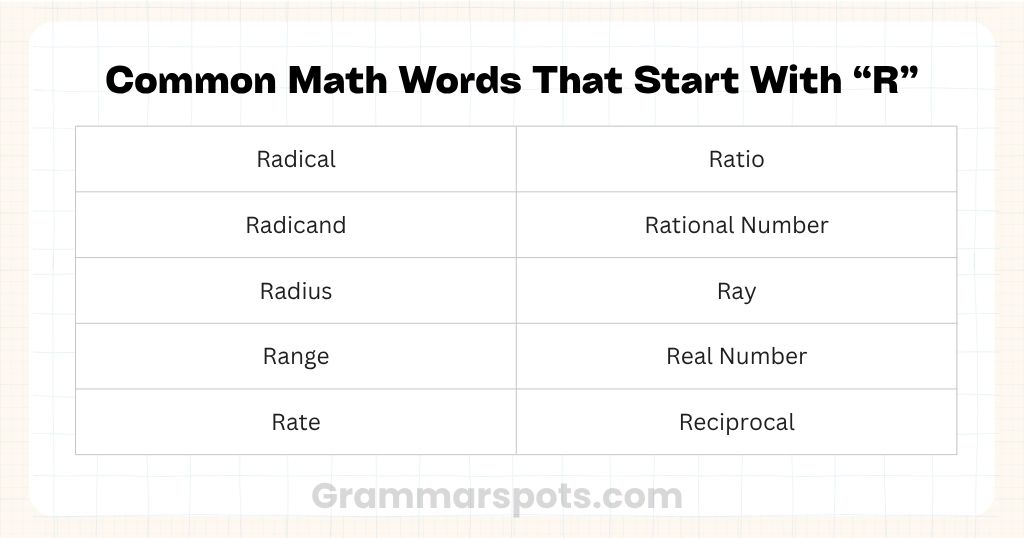
Common Math Words That Start With R
Radical
Meaning: The symbol (√) used to indicate a root of a number or expression.
Example: √64 = 8
Why It Matters: Used in solving quadratic equations, Pythagorean theorem, and simplifying expressions.
Radicand
Meaning: The number or expression written under a radical sign.
Example: In √(x + 4), the radicand is (x + 4).
Why It Matters: Identifying the radicand correctly is essential before simplifying any root.
Radius
Meaning: The distance from the center of a circle to any point on its edge.
Example: A circle with radius 5 cm has area = π × 5² = 78.5 cm².
Why It Matters: Used in every circle formula area, circumference, arc length.
Range
Meaning:
- Algebra: All possible output values of a function.
- Statistics: Highest value minus lowest value in a data set.
Example: Data set {4, 9, 13, 20} → Range = 20 − 4 = 16.
Why It Matters: Measures the spread of data and defines the output boundaries of functions.
Rate
Meaning: A ratio comparing two quantities with different units.
Example: 120 km in 3 hours = rate of 40 km/h.
Why It Matters: Appears in speed, cost, density, and flow problems.
Ratio
Meaning: A comparison of two quantities by division.
Example: 15 boys and 10 girls → ratio 15:10 = 3:2.
Why It Matters: Core to proportions, scale drawings, and probability.
Rational Number
Meaning: Any number expressible as a fraction p/q where q ≠ 0.
Example: 3/5, −2, 0.75, and 8 are all rational numbers.
Why It Matters: Forms a fundamental category in number classification.
Ray
Meaning: A part of a line starting at one fixed endpoint and extending infinitely in one direction.
Example: →AB starts at A and passes through B forever.
Why It Matters: Used to define angles and in coordinate geometry.
Real Number
Meaning: Any number on the number line, including all rational and irrational numbers.
Example: −5, 0, √3, π, and 4.7 are all real numbers.
Why It Matters: The number system underlying most of mathematics.
Reciprocal
Meaning: The multiplicative inverse of a number what you multiply by to get 1.
Example: Reciprocal of 3/4 = 4/3.
Why It Matters: Essential for dividing fractions and solving equations.
Rectangle
Meaning: A quadrilateral with four right angles and opposite sides equal.
Example: A 6 m × 4 m rectangle has area = 24 m².
Why It Matters: One of the most used shapes in area and perimeter problems.
Reflection
Meaning: A transformation that flips a figure over a line to produce a mirror image.
Example: Reflecting (3, 2) over the y-axis gives (−3, 2).
Why It Matters: Central to symmetry, coordinate geometry, and transformations.
Reflex Angle
Meaning: An angle greater than 180° and less than 360°.
Example: 270° is a reflex angle.
Why It Matters: Needed for full-rotation problems and bearings.
Regular Polygon
Meaning: A polygon where all sides are equal and all angles are equal.
Example: A regular pentagon has 5 equal sides and interior angles of 108° each.
Why It Matters: Appears in tessellations, proofs, and design.
Remainder
Meaning: What is left over after dividing a number when it doesn’t divide evenly.
Example: 19 ÷ 4 = 4 remainder 3.
Why It Matters: Used in division, modular arithmetic, and number theory.
Remainder Theorem
Meaning: When polynomial f(x) is divided by (x − a), the remainder equals f(a).
Example: f(x) = x² + 2x + 1 divided by (x − 2) → remainder = f(2) = 9.
Why It Matters: Shortens polynomial division significantly.
Rhombus
Meaning: A quadrilateral with all four sides equal but angles not necessarily 90°.
Example: A rhombus with side 6 cm and height 4 cm has area = 6 × 4 = 24 cm².
Why It Matters: Connects to squares and parallelograms in classification problems.
Right Angle
Meaning: An angle that measures exactly 90°.
Example: All four corners of a square are right angles.
Why It Matters: Foundation of the Pythagorean theorem and trigonometry.
Right Triangle
Meaning: A triangle containing one 90° angle.
Example: Sides 5, 12, 13 form a right triangle: 5² + 12² = 13².
Why It Matters: Underpins all of trigonometry and the Pythagorean theorem.
Roman Numerals
Meaning: A number system using letters (I, V, X, L, C, D, M) to represent values.
Example: XIV = 14; XL = 40; CM = 900.
Why It Matters: Appears in clocks, book chapters, and historical mathematics.
Root
Meaning: A value that, when multiplied by itself a given number of times, produces the original number.
Example: √81 = 9 (square root); ∛27 = 3 (cube root).
Why It Matters: Used in solving equations, geometry, and scientific formulas.
Rotation
Meaning: A transformation that turns a figure around a fixed center point by a given angle.
Example: Rotating point (2, 0) by 90° counterclockwise gives (0, 2).
Why It Matters: Used in geometry, animation, robotics, and physics.
Rounding
Meaning: Approximating a number to a chosen place value.
Example: 3.768 rounded to the nearest tenth = 3.8.
Why It Matters: Used in estimation, budgeting, and measurement.
Row
Meaning: A horizontal line of elements in a matrix or table.
Example: In a 3×4 matrix, there are 3 rows and 4 columns.
Why It Matters: Foundational for matrix operations and data organization.
Run
Meaning: The horizontal distance between two points on a graph.
Example: From (1, 2) to (5, 6), the run = 5 − 1 = 4.
Why It Matters: Part of the slope formula: slope = rise/run.
Rise
Meaning: The vertical distance between two points on a graph.
Example: From (1, 2) to (5, 6), the rise = 6 − 2 = 4.
Why It Matters: Part of slope calculation alongside run.
Rise Over Run
Meaning: Slope expressed as vertical change divided by horizontal change.
Example: Rise = 6, Run = 3 → Slope = 6/3 = 2.
Why It Matters: The most practical way to calculate and visualize slope.
Related Post: 55+ Math Words That Start With S (With Meanings and Examples)
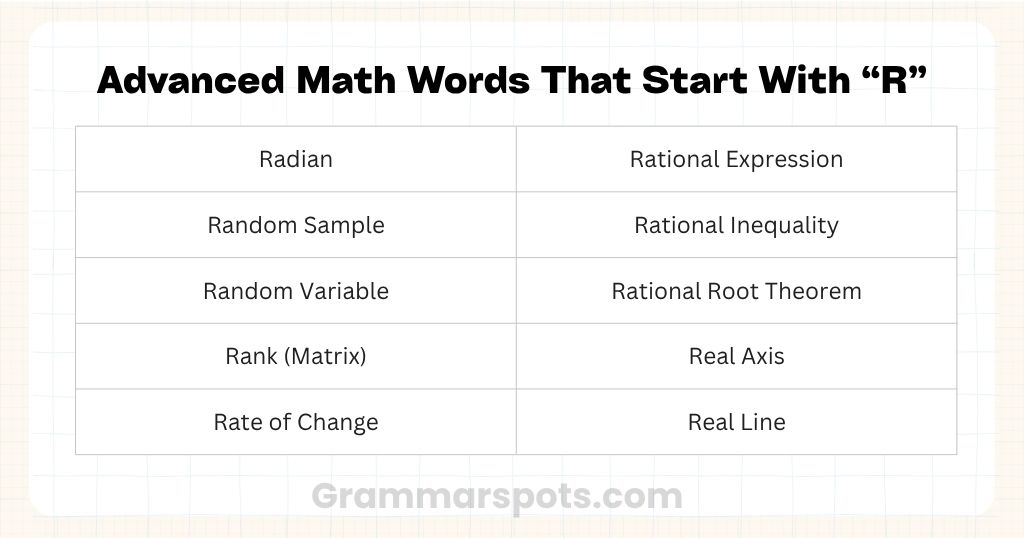
Advanced Math Words That Start With R
Radian
Meaning: A unit of angle measurement where one radian equals the angle formed when arc length equals the radius.
Math Branch: Trigonometry / Calculus
Example: 180° = π radians; 360° = 2π radians.
Why It Matters: Standard unit in calculus; simplifies derivative formulas for trig functions.
Random Sample
Meaning: A subset of a population selected so every member has an equal chance of being chosen.
Math Branch: Statistics
Example: Randomly selecting 50 students from a school of 1,000 to survey.
Why It Matters: Ensures unbiased, representative data collection.
Random Variable
Meaning: A variable whose value is determined by a random event’s outcome.
Math Branch: Statistics / Probability
Example: X = number shown when rolling a die takes values 1–6.
Why It Matters: Foundation of probability distributions, used in finance and data science.
Rank (Matrix)
Meaning: The number of linearly independent rows or columns in a matrix.
Math Branch: Linear Algebra
Example: A 3×3 identity matrix has rank 3.
Why It Matters: Determines whether a system of equations has a unique solution.
Rate of Change
Meaning: How much one quantity changes relative to another equivalent to slope or derivative.
Math Branch: Calculus / Algebra
Example: Position changes from 0 to 80 km in 2 hours → rate of change = 40 km/h.
Why It Matters: Describes speed, growth, and change across science and economics.
Rational Expression
Meaning: A fraction where both numerator and denominator are polynomials.
Math Branch: Algebra
Example: (x² − 1)/(x + 3) is a rational expression, undefined when x = −3.
Why It Matters: Used in solving advanced equations and simplifying complex formulas.
Rational Inequality
Meaning: An inequality involving a rational expression.
Math Branch: Algebra
Example: (x + 2)/(x − 1) > 0 — requires sign analysis to solve.
Why It Matters: Tests understanding of rational functions and critical values.
Rational Root Theorem
Meaning: Identifies all possible rational roots of a polynomial with integer coefficients.
Math Branch: Algebra
Example: For 2x³ − x − 6 = 0, possible rational roots include ±1, ±2, ±3, ±6, ±1/2, ±3/2.
Why It Matters: Narrows down root-finding for higher-degree polynomials.
Real Axis
Meaning: The horizontal axis in the complex plane, representing all real numbers.
Math Branch: Complex Numbers
Example: The number 5 + 0i plots on the real axis at position 5.
Why It Matters: Needed to understand complex number graphing and operations.
Real Line
Meaning: A straight line representing all real numbers from −∞ to +∞.
Math Branch: Number Theory
Example: Every rational and irrational number has a unique position on the real line.
Why It Matters: Visualizes the complete set of real numbers and inequality solutions.
Rectangular Coordinates
Meaning: A system that locates points using an (x, y) pair on perpendicular axes.
Math Branch: Coordinate Geometry
Example: Point (3, −2) is 3 units right and 2 units down from the origin.
Why It Matters: The standard coordinate system for graphing in two dimensions.
Rectangular Prism
Meaning: A 3D solid with six rectangular faces, also called a cuboid.
Math Branch: 3D Geometry
Example: A box 4 cm × 3 cm × 2 cm has volume = 24 cm³.
Why It Matters: Used in volume, surface area, and packing problems.
Recurrence Relation
Meaning: A formula that defines each term of a sequence using one or more previous terms.
Math Branch: Sequences / Discrete Mathematics
Example: Fibonacci: F(n) = F(n−1) + F(n−2), with F(1) = F(2) = 1.
Why It Matters: Models population growth, loan repayment, and algorithm complexity.
Reduced Row Echelon Form (RREF)
Meaning: A matrix form where every pivot = 1 and all other entries in pivot columns = 0.
Math Branch: Linear Algebra
Example: RREF allows direct reading of solutions to a system of equations.
Why It Matters: The end goal of Gaussian elimination in solving matrix equations.
Reflection Symmetry
Meaning: A shape has reflection symmetry if one half is a mirror image of the other.
Math Branch: Geometry
Example: A rectangle has 2 lines of reflection symmetry.
Why It Matters: Used in shape classification and geometric proofs.
Regular Tetrahedron
Meaning: A 3D solid with four equilateral triangular faces, all sides equal.
Math Branch: 3D Geometry
Example: Each face of a regular tetrahedron is an equilateral triangle with equal edge lengths.
Why It Matters: One of the five Platonic solids; studied in solid geometry.
Relative Error
Meaning: The ratio of absolute error to the actual value, often expressed as a percentage.
Math Branch: Measurement
Example: Actual = 50 cm, Measured = 52 cm → Relative error = 2/50 = 4%.
Why It Matters: Measures accuracy of measurements in science and engineering.
Relative Frequency
Meaning: The proportion of times an event occurs out of total observations.
Math Branch: Statistics
Example: Heads appear 40 times in 100 coin flips → relative frequency = 0.40.
Why It Matters: Connects experimental results to theoretical probability.
Residual
Meaning: The difference between an observed data value and the value predicted by a regression model.
Math Branch: Statistics
Example: Predicted score = 78, actual = 82 → residual = +4.
Why It Matters: Analyzing residuals shows how well a model fits real data.
Resultant
Meaning: A single vector representing the combined effect of two or more vectors.
Math Branch: Vectors
Example: 3 N east + 4 N north → resultant = 5 N northeast.
Why It Matters: Used in physics and engineering to combine forces or velocities.
Rhombohedron
Meaning: A 3D solid with six rhombus-shaped faces a special type of parallelepiped.
Math Branch: 3D Geometry
Example: A cube is a special case of a rhombohedron where all faces are squares.
Why It Matters: Appears in crystallography and advanced solid geometry.
Riemann Sum
Meaning: An approximation of area under a curve by summing areas of rectangles beneath it.
Math Branch: Calculus
Example: To estimate ∫₀⁴ x² dx, divide [0,4] into rectangles and sum their areas.
Why It Matters: Defines the concept of the definite integral.
Right Prism
Meaning: A prism whose lateral faces are perpendicular to its bases.
Math Branch: 3D Geometry
Example: A cylinder is the limiting case of a right prism with a circular base.
Why It Matters: Used in volume and surface area calculations.
Rigid Transformation
Meaning: A transformation that preserves the shape and size of a figure (reflections, rotations, translations).
Math Branch: Geometry
Example: Rotating a triangle 90° is a rigid transformation side lengths don’t change.
Why It Matters: Distinguishes transformations that preserve congruence from those that don’t.
Ring (Abstract Algebra)
Meaning: A set with two operations (addition and multiplication) satisfying algebraic axioms.
Math Branch: Abstract Algebra
Example: The set of integers ℤ forms a ring under standard addition and multiplication.
Why It Matters: Foundational structure in university-level algebra and cryptography.
Rolle’s Theorem
Meaning: If f is continuous on [a, b], differentiable on (a, b), and f(a) = f(b), then f′(c) = 0 for some c in (a, b).
Math Branch: Calculus
Example: f(x) = x² − 4 on [−2, 2]: f(−2) = f(2) = 0, so f′(0) = 0 confirms the theorem.
Why It Matters: Leads directly to the Mean Value Theorem.
Root Mean Square (RMS)
Meaning: The square root of the average of squared values in a data set.
Math Branch: Statistics / Engineering
Example: RMS of {2, 4, 6} = √[(4 + 16 + 36)/3] = √(56/3) ≈ 4.32.
Why It Matters: Used in electrical engineering and measuring signal strength.
Root of an Equation
Meaning: A value of x that makes an equation equal to zero.
Math Branch: Algebra
Example: For x² − 9 = 0, roots are x = 3 and x = −3.
Why It Matters: Finding roots is the core task in solving polynomial equations.
Rotational Symmetry
Meaning: A shape has rotational symmetry if it looks the same after being rotated less than 360°.
Math Branch: Geometry
Example: A regular hexagon has rotational symmetry of order 6 (looks same every 60°).
Why It Matters: Used in geometry, design, and crystallography.
Row Echelon Form
Meaning: A matrix form where each row’s leading entry is to the right of the one above, and zero rows are at the bottom.
Math Branch: Linear Algebra
Example: A staircase pattern of leading entries in a matrix indicates row echelon form.
Why It Matters: Used in Gaussian elimination to solve systems of linear equations.
Rule of Signs (Descartes)
Meaning: The number of positive real roots of a polynomial equals the number of sign changes in its coefficients, or fewer by an even number.
Math Branch: Algebra
Example: f(x) = x³ − x² + x − 1 has 3 sign changes → 3 or 1 positive real roots.
Why It Matters: Quickly estimates how many positive or negative roots a polynomial has.
Regression
Meaning: A statistical method that finds the mathematical relationship between variables to make predictions.
Math Branch: Statistics
Example: A linear regression line through a scatter plot predicts exam score from study hours.
Why It Matters: Used in data science, economics, medicine, and social research.
Related Post: 40+ Math Words That Start With T (With Meanings and Examples)
Geometry Words That Start With R
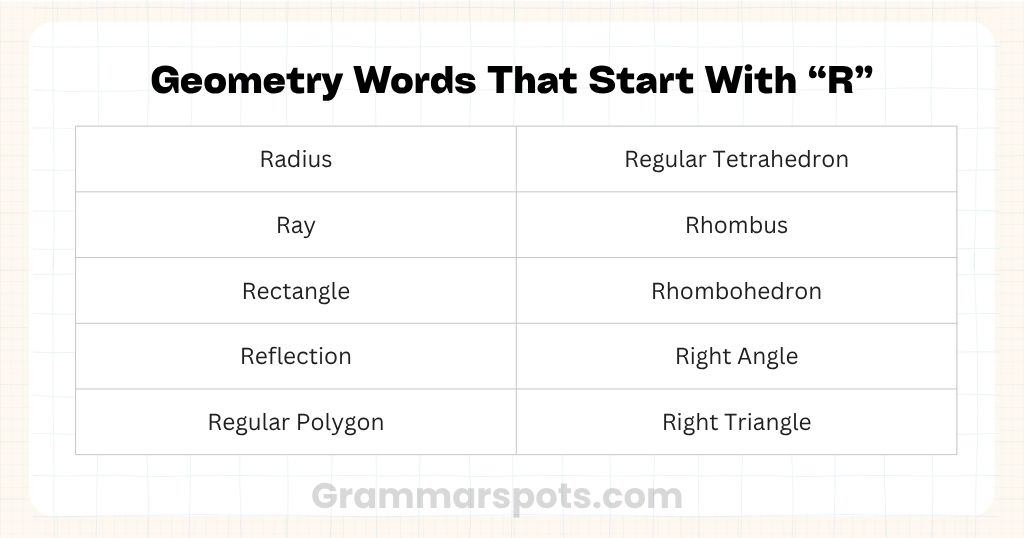
- Radius – Distance from center to edge of a circle
- Ray – Half-line starting from a fixed point
- Rectangle – Four-sided shape with four right angles
- Reflection – Mirror-image transformation
- Reflex Angle – Angle between 180° and 360°
- Regular Polygon – All sides and angles equal
- Regular Tetrahedron – Four equilateral triangular faces
- Rhombus – Four equal sides, no required right angles
- Rhombohedron – 3D solid with six rhombus faces
- Right Angle – Exactly 90°
- Right Prism – Prism with perpendicular lateral faces
- Right Triangle – Triangle with one 90° angle
- Rigid Transformation – Preserves shape and size
- Rotation – Turning around a fixed point
- Rotational Symmetry – Identical appearance after partial rotation
- Reflection Symmetry – Mirror-image match across a line
- Rectangular Prism – 3D box shape
Algebra Terms That Start With R
- Radical – Root symbol (√)
- Radicand – Expression under the radical
- Rational Expression – Polynomial fraction
- Rational Inequality – Inequality with a rational expression
- Rational Root Theorem – Lists possible rational roots
- Reciprocal – Multiplicative inverse
- Recurrence Relation – Term defined by previous terms
- Remainder Theorem – Remainder = f(a) when dividing by (x − a)
- Root – Value producing zero in a function
- Root of an Equation – Solution that satisfies f(x) = 0
- Rule of Signs – Counts possible positive/negative roots
Statistics Terms That Start With R
- Random Sample – Unbiased selection from a population
- Random Variable – Value determined by chance
- Range – Highest minus lowest value
- Regression – Predicts relationships between variables
- Relative Frequency – Event count ÷ total observations
- Residual – Observed minus predicted value
- Root Mean Square – Square root of mean of squared values
Calculus Terms That Start With R
- Radian – Angle unit preferred in calculus
- Rate of Change – How fast a quantity changes
- Riemann Sum – Rectangle approximation of area under a curve
- Rolle’s Theorem – Guarantees a zero derivative between equal values
Related Post: 55+ Math Words That Start With Q (With Meanings and Examples)
Coordinate Geometry Terms That Start With R
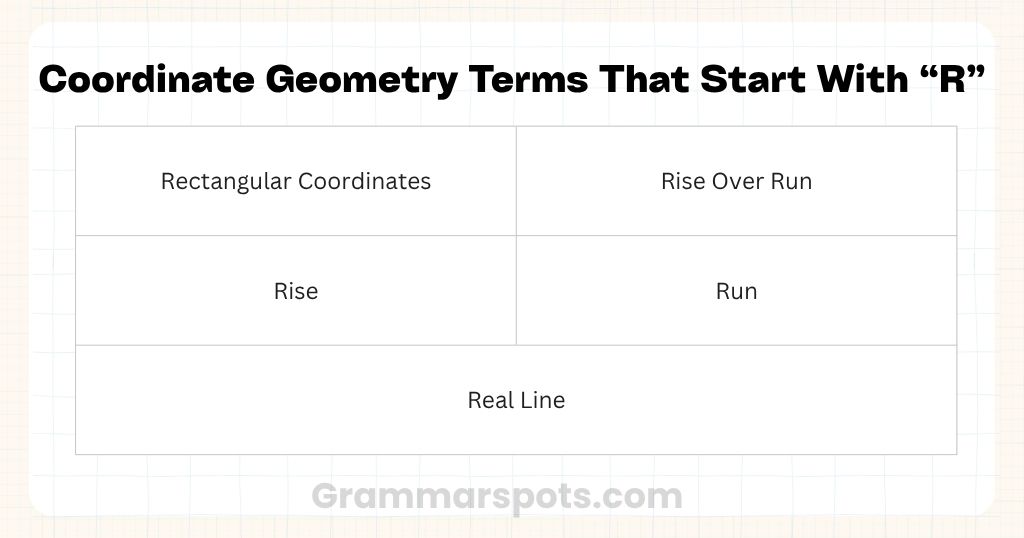
- Rectangular Coordinates – Standard (x, y) grid system
- Rise – Vertical distance between two points
- Run – Horizontal distance between two points
- Rise Over Run – Slope as vertical/horizontal ratio
- Real Line – Complete number line from −∞ to +∞
Number Theory and Number Systems Words
- Rational Number – Expressible as p/q
- Real Number – All numbers on the number line
- Real Axis – Horizontal axis in the complex plane
- Roman Numerals – Letter-based number system
- Row – Horizontal line in a matrix
Real-World Applications
Geometry (Radius, Rectangle, Right Triangle, Rotation):
- Architects use radius to design arches and domes
- Engineers apply right triangle calculations in structural analysis
- Game developers use rotation in character animation
Statistics (Regression, Residual, Random Sample):
- Medical researchers use regression to link lifestyle habits to health outcomes
- Polling organizations rely on random samples for election forecasting
- Sports analysts use residuals to measure player performance vs. predictions
Calculus (Riemann Sum, Rate of Change, Radian):
- Physicists use Riemann sums to calculate work done by variable forces
- Economists model supply and demand using rate of change
- Engineers use radians in wave and signal calculations
Arithmetic (Ratio, Rate, Rounding, Remainder):
- Chefs use ratios to scale recipes
- Shoppers use rates to compare unit prices
- Accountants use rounding in financial reports
Vectors (Resultant):
- Pilots calculate resultant velocity when accounting for crosswind
- Structural engineers calculate resultant forces on bridges
Tips for Remembering Math Words Starting With R
- Group by field Sort terms into geometry, algebra, statistics, and calculus before studying
- Write your own examples Create one original sentence per term instead of copying definitions
- Use flashcards Term on front, definition and example on back; sketch geometry terms
- Connect related words Radius → circle → circumference; Rise and Run → Slope → Rate of Change
- Build a vocabulary journal Add new R-terms as you encounter them in class or textbooks
- Practice in context Spot R-terms in actual math problems and textbook exercises
Commonly Confused Terms
Range vs. Domain
- Domain = all valid inputs of a function
- Range = all possible outputs
- Memory tip: Domain goes in, Range comes out
Radius vs. Diameter
- Radius = center to edge
- Diameter = edge to edge through center (= 2 × radius)
- Students often substitute one for the other in circle formulas always check which the problem gives
Ratio vs. Rate
- Ratio compares same-unit quantities (boys to girls)
- Rate compares different-unit quantities (km per hour)
Rational vs. Irrational Number
- Rational = expressible as a fraction (3/4, 0.5, 7)
- Irrational = not expressible as a fraction (π, √2, e)
- Common mistake: treating 3.14 as π it is only an approximation
Reflection vs. Rotation
- Reflection flips a shape over a line
- Rotation turns a shape around a point
- Both are transformations, but produce different orientations
Remainder vs. Residual
- Remainder = leftover after arithmetic division
- Residual = difference between observed and predicted value in statistics
Radical vs. Radicand
- Radical = the √ symbol itself
- Radicand = the expression under the √ symbol
Rise vs. Run
- Rise = vertical change
- Run = horizontal change
- Getting these reversed gives the reciprocal slope a common exam error
FAQs About Math Words That Start With R
Q1: What are the most important math words starting with R for school students?
- For primary school: ratio, remainder, rounding, rectangle, right angle
- For middle school: radical, radius, range, reciprocal, rotation
- For high school: radian, regression, Riemann sum, rational root theorem, recurrence relation
Q2: What is the difference between root and radical?
A radical is the symbol (√). A root is the result. In √25 = 5, the radical is the symbol and 5 is the square root.
Q3: What is a Riemann sum and why does it matter?
A Riemann sum approximates area under a curve using rectangles. As rectangles become infinitely narrow, the approximation becomes the exact definite integral the core idea of integral calculus.
Q4: How is ratio different from rate?
A ratio compares two quantities with the same unit (3:2). A rate compares quantities with different units (60 km/h). All rates are ratios, but not all ratios are rates.
Q5: What is the Rational Root Theorem used for?
It lists all possible rational roots of a polynomial, reducing the trial-and-error needed to solve higher-degree equations.
Q6: What is the difference between rotation and reflection in geometry?
Rotation turns a figure around a center point. Reflection flips it over a line. Both preserve shape and size, making them rigid transformations.
Q7: What is a recurrence relation?
A formula where each term depends on previous terms. Example: the Fibonacci sequence F(n) = F(n−1) + F(n−2). Common in sequences, algorithms, and financial modeling.
Q8: Why are radians used instead of degrees in calculus?
Because radian-based derivatives of trig functions are cleaner. The derivative of sin(x) in radians is simply cos(x). In degrees, an extra conversion factor would appear in every formula.
Conclusion
Math words starting with R span every area of the subject from simple ideas like ratio, remainder, and rounding used in primary school, to advanced tools like Riemann sums, regression, recurrence relations, and Rolle’s Theorem studied in university mathematics.
Each term in this guide carries a precise meaning. Learning these words properly not just memorizing definitions but understanding examples and applications builds the kind of mathematical fluency that pays off in exams, competitive tests, and real problem-solving.
Use the category sections to focus your study by topic, return to the table for quick reference, and revisit the commonly confused terms before any exam.

I’m Hazel, and I studied BSC English at GCUF. I focus on explaining word meanings in simple, clear language that anyone can understand. My goal is helping readers grasp everyday English, confusing terms, and slang used in real conversations and social media. I believe language learning works best when definitions connect to actual life situations. Through careful research and straightforward explanations, I make vocabulary accessible for students, learners, and anyone curious about how English really works in daily use.