

Math vocabulary is the foundation of clear thinking and problem-solving. If you’re searching for math words that start with S, this guide covers everything from basic terms like sum and square to advanced concepts like standard deviation and stochastic processes.
Whether you’re a student completing an assignment, a teacher building a word wall, or a parent helping with homework this list gives you accurate definitions, simple examples, and real-world context. Every term here is a verified mathematical word. Nothing added just to fill the list.
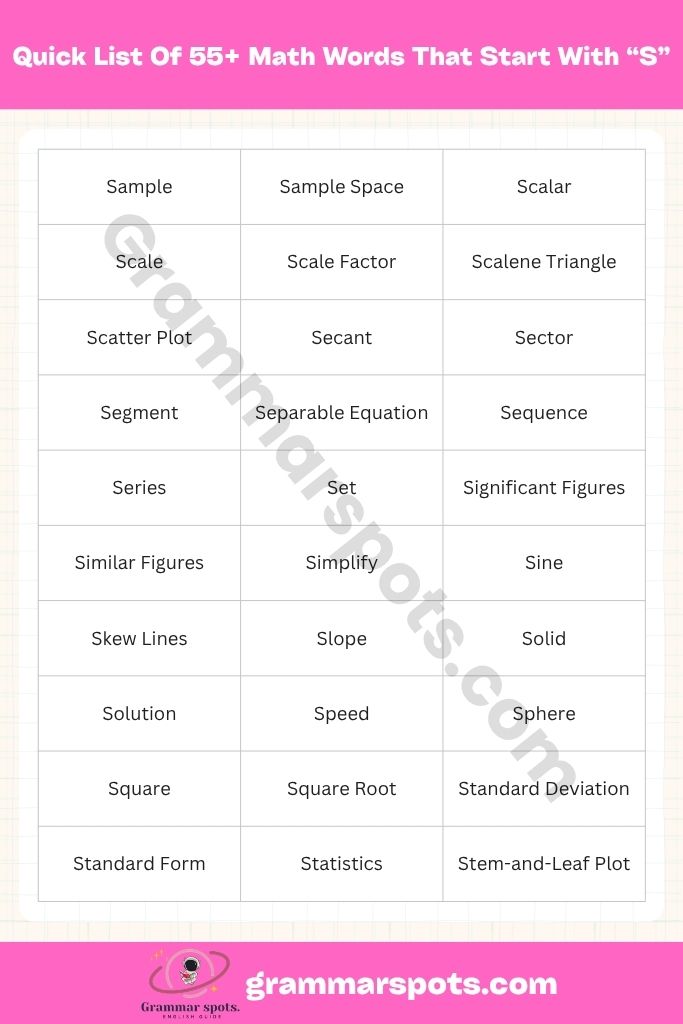
Quick List: 55+ Math Words That Start With S
- Sample
- Sample Space
- Scalar
- Scale
- Scale Factor
- Scalene Triangle
- Scatter Plot
- Secant
- Sector
- Segment
- Separable Equation
- Sequence
- Series
- Set
- Significant Figures
- Similar Figures
- Simplify
- Sine
- Skew Lines
- Slope
- Solid
- Solution
- Speed
- Sphere
- Square
- Square Root
- Standard Deviation
- Standard Form
- Statistics
- Stem-and-Leaf Plot
- Stirling Numbers
- Stochastic
- Straight Angle
- Strophoid
- Subset
- Substitution
- Subtraction
- Sum
- Supplementary Angles
- Surd
- Surface Area
- Sylvester Matrix
- Symmetry
- Synthetic Division
- System of Equations
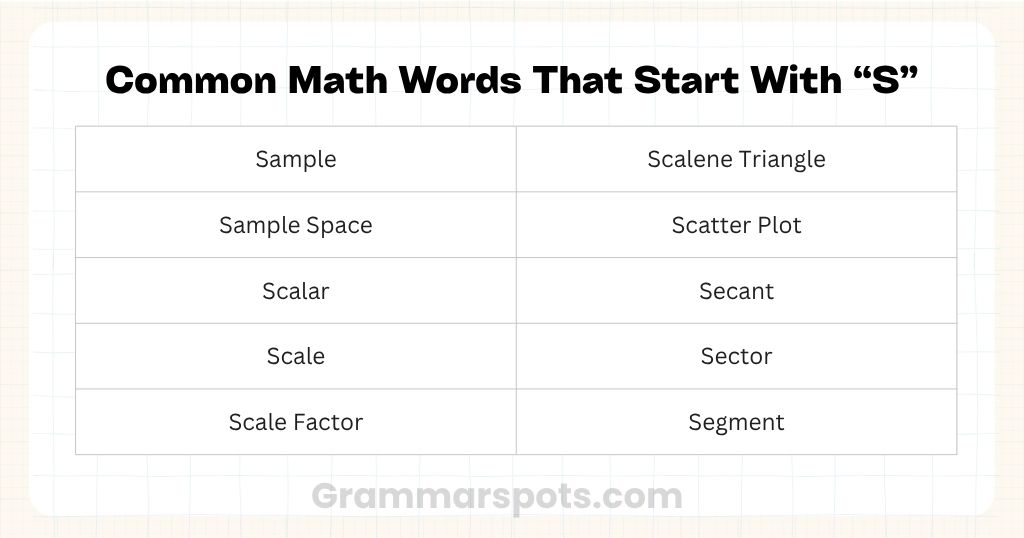
Common Math Words That Start With S
Sample
Meaning: A selected portion of a larger group used to represent the whole population.
Example: A teacher surveys 30 out of 300 students those 30 are the sample.
Why It Matters: Almost no study measures an entire population. A fair sample makes results reliable.
Sample Space
Meaning: The complete set of all possible outcomes in a probability experiment.
Example: Rolling a die gives sample space {1, 2, 3, 4, 5, 6}.
Why It Matters: Without defining sample space, no probability can be calculated correctly.
Scalar
Meaning: A quantity that has magnitude only no direction.
Example: Temperature (25°C) and mass (10 kg) are scalars. Velocity is not it has direction.
Why It Matters: Scalars are contrasted with vectors throughout physics and linear algebra.
Scale
Meaning: A ratio comparing the size of a drawing or model to the actual object.
Example: A map at scale 1:100,000 means 1 cm on paper equals 1 km in reality.
Why It Matters: Used in maps, blueprints, and architectural drawings.
Scale Factor
Meaning: The number by which every dimension of a shape is multiplied to resize it.
Example: Applying a scale factor of 3 to a triangle triples every side length.
Why It Matters: Links geometry, proportion, and real-life model building.
Scalene Triangle
Meaning: A triangle where all three sides and all three angles are different.
Example: A triangle with sides 4 cm, 7 cm, and 9 cm is scalene.
Why It Matters: Triangle classification is a core geometry skill.
Scatter Plot
Meaning: A graph showing pairs of numerical values as points to reveal trends or correlations.
Example: Plotting study hours vs. test scores for 25 students produces a scatter plot.
Why It Matters: One of the most practical tools in data analysis and statistics.
Secant
Meaning:
- Trigonometry: The reciprocal of cosine — sec θ = 1/cos θ
- Geometry: A line that crosses a circle at two points
Example: If cos θ = 0.5, then sec θ = 2.
Why It Matters: Used in trigonometric identities and circle theorems.
Sector
Meaning: A “pie slice” region of a circle bounded by two radii and one arc.
Example: A pizza slice cut from the center is a sector.
Why It Matters: Used to calculate arc length, pie chart segments, and circular areas.
Segment
Meaning: A part of a line with two endpoints. Also, the region of a circle cut off by a chord.
Example: Points A and B connected by a straight line form segment AB.
Why It Matters: Segments are the building blocks of all polygons.
Sequence
Meaning: An ordered list of numbers following a specific rule.
Example: 3, 6, 9, 12 is an arithmetic sequence each term increases by 3.
Why It Matters: Sequences appear in finance, algorithms, and calculus foundations.
Series
Meaning: The sum of the terms of a sequence.
Example: 3 + 6 + 9 + 12 = 30 is the series for the sequence above.
Why It Matters: Series are used in calculus, physics, and financial math.
Set
Meaning: A well-defined collection of distinct objects or numbers, written in curly brackets.
Example: The set of odd numbers under 10 is {1, 3, 5, 7, 9}.
Why It Matters: Set theory underpins logic, probability, and modern algebra.
Significant Figures
Meaning: The meaningful digits in a number that reflect its precision, starting from the first non-zero digit.
Example: 0.00452 has three significant figures: 4, 5, and 2.
Why It Matters: Essential in science labs and engineering for accurate rounding.
Similar Figures
Meaning: Shapes with identical angles but proportional not equal side lengths.
Example: Rectangles 3×6 and 6×12 are similar each side is doubled.
Why It Matters: Similarity is central to geometry proofs and scale drawing.
Simplify
Meaning: To reduce an expression or fraction to its most compact form without changing its value.
Example: 18/24 simplifies to 3/4 by dividing both parts by 6.
Why It Matters: Unsimplified answers are often marked wrong even if the method was correct.
Sine
Meaning: In a right triangle, the ratio of the opposite side to the hypotenuse.
Example: Opposite = 3, hypotenuse = 5 → sin θ = 3/5 = 0.6.
Why It Matters: Sine models waves, sound, and light. It’s one of the three core trig ratios.
Skew Lines
Meaning: Lines in 3D space that are neither parallel nor intersecting they exist on different planes.
Example: The top edge of a bookshelf and a line on the floor at an angle are skew lines.
Why It Matters: Relevant in 3D geometry, architecture, and spatial reasoning.
Slope
Meaning: The steepness of a line, measured as rise divided by run.
Example: A line rising 4 units for every 2 horizontal units has slope = 4/2 = 2.
Why It Matters: Slope is used in construction, economics, and coordinate geometry.
Solid
Meaning: A three-dimensional geometric figure with length, width, and height.
Example: A cube, cone, and cylinder are all solids.
Why It Matters: Students calculate volume and surface area of solids throughout geometry.
Solution
Meaning: The value (or values) that make an equation or inequality true.
Example: The solution to 3x = 12 is x = 4.
Why It Matters: Finding solutions is the central goal of algebra.
Speed
Meaning: The rate at which distance is covered over time calculated as distance ÷ time.
Example: 150 km covered in 3 hours = speed of 50 km/h.
Why It Matters: One of the first real-world applications of math students encounter.
Sphere
Meaning: A perfectly round 3D solid where every surface point is equidistant from the center.
Example: A basketball closely approximates a sphere.
Why It Matters: Students compute sphere volume and surface area in geometry.
Square
Meaning:
- Shape: A rectangle with four equal sides and four right angles
- Operation: A number multiplied by itself (e.g., 5² = 25)
Example: A 6 m × 6 m room has a square floor with area 36 m².
Why It Matters: Squares appear in the Pythagorean theorem, area formulas, and algebra.
Square Root
Meaning: A value that, when multiplied by itself, gives the original number.
Example: √49 = 7 because 7 × 7 = 49.
Why It Matters: Used in the Pythagorean theorem, statistics, and algebra.
Standard Deviation
Meaning: A measure of how spread out data values are from the mean.
Example: Scores clustered near 75 have a low standard deviation. Scores ranging 40–100 have a high one.
Why It Matters: Used in research, quality control, finance, and any field requiring data consistency checks.
Standard Form
Meaning: A conventional way of writing numbers or equations for large numbers: A × 10ⁿ; for lines: Ax + By = C.
Example: 4,500,000 in standard form is 4.5 × 10⁶.
Why It Matters: Standard form simplifies working with very large or very small numbers.
Statistics
Meaning: The branch of mathematics dealing with collecting, organizing, analyzing, and interpreting data.
Example: Calculating the average score of a class and finding which score appeared most often are both statistics tasks.
Why It Matters: Statistics drives decision-making in science, business, government, and everyday life.
Stem-and-Leaf Plot
Meaning: A data display that splits values into a stem (leading digit) and leaf (trailing digit) to show distribution.
Example: For data {12, 15, 21, 23, 29}: stems are 1 and 2; leaves are 2, 5 and 1, 3, 9.
Why It Matters: Quickly shows data shape and spread without complex software.
Straight Angle
Meaning: An angle measuring exactly 180°, forming a perfectly straight line.
Example: A flat, unfolded ruler forms a straight angle.
Why It Matters: Straight angles are used in proofs and in understanding supplementary angle pairs.
Subset
Meaning: A set whose every element also belongs to a larger set.
Example: {2, 4} is a subset of {1, 2, 3, 4, 5}.
Why It Matters: Subsets are foundational to set theory, logic, and probability.
Substitution
Meaning: Replacing a variable with a known value or expression to solve or simplify.
Example: If x = 3, substitute into 2x + 1 to get 2(3) + 1 = 7.
Why It Matters: One of the two main methods for solving systems of equations.
Subtraction
Meaning: The operation of finding the difference between two numbers.
Example: 15 − 9 = 6.
Why It Matters: One of the four basic operations and the basis for understanding negative numbers.
Sum
Meaning: The result obtained by adding two or more numbers.
Example: The sum of 12 and 8 is 20.
Why It Matters: Extends from simple addition all the way to sigma notation (∑) in calculus.
Supplementary Angles
Meaning: Two angles whose measures add up to 180°.
Example: 110° and 70° are supplementary because 110 + 70 = 180.
Why It Matters: Appear constantly in geometry proofs involving straight lines and parallel lines.
Surface Area
Meaning: The total area of all outer faces of a three-dimensional solid.
Example: A cube with side 4 cm has surface area = 6 × 4² = 96 cm².
Why It Matters: Used in packaging design, construction, and material estimation.
Symmetry
Meaning: A property where a shape or equation is identical on both sides of a line or point.
Example: The letter “A” has vertical line symmetry.
Why It Matters: Appears in geometry, art, nature, and the graphing of functions.
System of Equations
Meaning: Two or more equations with the same variables, solved together to find values satisfying all equations simultaneously.
Example: x + y = 10 and x − y = 4 → solved together: x = 7, y = 3.
Why It Matters: Used in economics, engineering, and science to solve multi-variable problems.
Related Post: 40+ Math Words That Start With T (With Meanings and Examples)
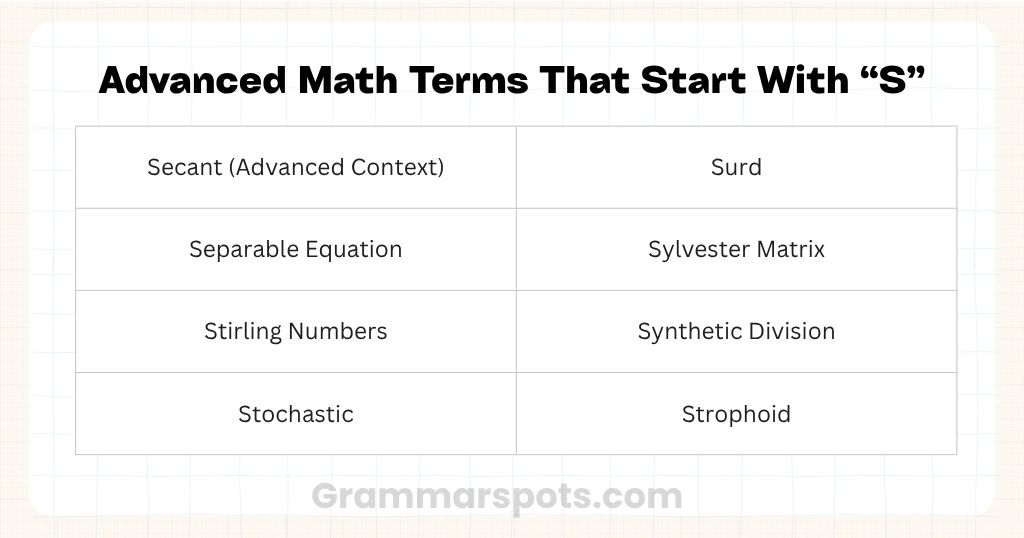
Advanced Math Terms That Start With S
Secant (Advanced Context)
Already covered under Common Terms see Trigonometry category below for its identity role.
Separable Equation
Meaning: A differential equation where variables can be separated to opposite sides before integrating.
Example: dy/dx = xy → separated as dy/y = x dx → both sides integrated separately.
Why It Matters: The most common entry point in solving differential equations in physics and engineering.
Stirling Numbers
Meaning: Two families of numbers (first and second kind) that count ways to partition or permute sets.
Example: S(4, 2) counts ways to split a 4-element set into exactly 2 non-empty subsets.
Why It Matters: Used in combinatorics, discrete math, and advanced probability.
Stochastic
Meaning: Describes a process governed by probability rather than fixed outcomes.
Example: Stock price movements are modeled as stochastic because future values are probabilistic.
Why It Matters: Central to financial modeling, machine learning, weather forecasting, and physics.
Strophoid
Meaning: An algebraic curve generated geometrically from a fixed point and a moving line, producing a loop.
Example: Its equation: y² = x²(a + x)/(a − x).
Why It Matters: Studied in classical curve theory and applied in mechanical linkage design.
Surd
Meaning: An irrational root that cannot be simplified to a whole number or fraction.
Example: √7 is a surd. √9 = 3 is not it resolves to a whole number.
Why It Matters: Surds appear when exact answers are required rather than decimal approximations.
Sylvester Matrix
Meaning: A matrix built from the coefficients of two polynomials, used to test for common roots.
Example: Applied when computing the resultant of two polynomials in advanced algebra.
Why It Matters: Used in computer algebra systems, algebraic geometry, and root-finding algorithms.
Synthetic Division
Meaning: A shorthand method of dividing a polynomial by a linear binomial (x − c).
Example: Dividing x³ − 6x² + 11x − 6 by (x − 2) via synthetic division gives x² − 4x + 3.
Why It Matters: Faster than long division and essential in pre-calculus polynomial work.
Geometry Terms That Start With S
- Scalene Triangle — all sides unequal
- Sector — pie-slice region of a circle
- Segment — bounded part of a line or circle
- Similar Figures — same shape, proportional size
- Skew Lines — non-parallel, non-intersecting lines in 3D
- Solid — any 3D geometric figure
- Sphere — perfectly round 3D shape
- Square — four equal sides, four right angles
- Straight Angle — exactly 180°
- Supplementary Angles — two angles totaling 180°
- Surface Area — total outer area of a solid
- Symmetry — mirror-balanced property
Related Post: 60+ Math Words That Start With U (With Meanings and Examples)
Statistics and Probability Terms That Starting With S
- Sample — representative portion of a population
- Sample Space — all possible experiment outcomes
- Scatter Plot — graph of paired data points
- Standard Deviation — measure of data spread
- Statistics — field of data collection and analysis
- Stem-and-Leaf Plot — digit-based data display
- Stochastic — probability-governed process
Algebra Terms Starting With S
- Scalar — magnitude without direction
- Sequence — ordered number list by rule
- Series — sum of sequence terms
- Set — collection of distinct elements
- Simplify — reduce to simplest form
- Solution — value satisfying an equation
- Standard Form — conventional equation/number notation
- Subset — set contained within a larger set
- Substitution — replacing variables with values
- Synthetic Division — efficient polynomial division
- System of Equations — simultaneous equations solved together
Trigonometry Terms Starting With S
- Secant — reciprocal of cosine (sec θ = 1/cos θ)
- Sine — ratio of opposite side to hypotenuse
Related Post: 60+ Math Words That Start With R (With Meanings and Examples)
Measurement Math Words That Start With S
- Scale — ratio of model to reality
- Scale Factor — multiplier for resizing shapes
- Significant Figures — precision digits in a measurement
- Speed — distance covered per unit of time
Real-World Applications
Architecture and Construction:
- Scale, scale factor, surface area, and symmetry appear in blueprints and material planning.
Medicine and Research:
- Standard deviation, sample, and statistics drive clinical trials and medical studies.
Finance and Economics:
- Stochastic processes model stock markets.
- Series and sequences appear in loan and interest calculations.
Physics and Engineering:
- Sine, secant, and scalar quantities power wave calculations and structural analysis.
Computer Science:
- Sets, subsets, and stochastic algorithms underpin machine learning and data structures.
Navigation and Geography:
- Speed, scale, and slope are used in GPS systems and route planning.
Learning Tips for Math Words That Start With S
- Group by theme cluster shape words (sphere, solid, sector), data words (sample, statistics), and algebra words (substitution, series) separately rather than memorizing alphabetically.
- Draw geometry terms sketch sector vs. segment, scalene vs. square visual memory strengthens spatial concepts.
- Use contrasting pairs supplementary vs. complementary, scalar vs. vector, similar vs. congruent. Learning opposites deepens understanding.
- Apply to real data calculate the standard deviation of your last five test scores. Build a scatter plot from class data.
- Create your own examples personal examples stick better than textbook ones.
- Keep a running vocabulary section add new S-words as they appear in class. Review weekly using spaced repetition.
Commonly Confused Terms
Sum vs. Product
- Sum = result of addition
- Product = result of multiplication
- Students frequently swap these in word problems.
Similar vs. Congruent
- Similar = same shape, different size
- Congruent = same shape and same size
- Two figures being similar does not make them congruent.
Sequence vs. Series
- Sequence = ordered list: 2, 4, 6, 8
- Series = sum of that list: 2 + 4 + 6 + 8 = 20
- These are related but not interchangeable.
Speed vs. Velocity
- Speed = magnitude only (scalar)
- Velocity = magnitude + direction (vector)
- Both use distance ÷ time, but velocity requires a stated direction.
Sector vs. Segment (Circle)
- Sector = pie slice bounded by two radii and an arc
- Segment = region between a chord and its arc no radii
- These look similar and are frequently mixed up in circle problems.
Standard Deviation vs. Variance
- Variance = average of squared differences from the mean
- Standard deviation = square root of variance
- Standard deviation is reported more often because it uses the same units as the data.
Set vs. Sequence
- Set = unordered, no duplicates: {3, 1, 4} = {1, 3, 4}
- Sequence = ordered, can repeat: (1, 3, 1, 4) is valid
- Order and repetition are what separate these two.
FAQs About Math Words That Start With S
Q1: What are the most common math words that start with S?
The most frequently tested are: sum, subtraction, square, square root, slope, simplify, solution, set, sequence, symmetry, and statistics.
Q2: What S-words appear in geometry?
Key geometry terms include: scalene triangle, sector, segment, sphere, square, solid, surface area, supplementary angles, straight angle, symmetry, similar figures, and skew lines.
Q3: What does standard deviation mean in simple terms?
It measures how spread out data values are from the average. Small standard deviation = data clusters tightly. Large standard deviation = data is widely spread.
Q4: What is the difference between a sequence and a series?
A sequence is an ordered list (1, 2, 3, 4). A series is what you get when you add them: 1 + 2 + 3 + 4 = 10.
Q5: What is a surd?
A surd is a square root (or other root) that cannot simplify to a whole number or fraction. √5 is a surd. √25 = 5 is not.
Q6: What is a stochastic process?
A mathematical model where outcomes involve randomness probabilities are assigned but exact results cannot be predicted. Used in finance, weather, and machine learning.
Q7: How do you calculate slope?
Use: slope (m) = (y₂ − y₁) ÷ (x₂ − x₁). Positive slope rises left to right. Negative slope falls left to right.
Q8: Are speed and velocity the same thing?
No. Speed is a scalar (magnitude only). Velocity is a vector (magnitude + direction). A car going 60 km/h is speed. A car going 60 km/h north is velocity.
Conclusion
Math words starting with S cover every major area of the subject:
- Arithmetic: sum, subtraction, square root
- Geometry: sphere, sector, surface area, symmetry, supplementary angles
- Algebra: sequence, series, substitution, system of equations
- Statistics: sample, scatter plot, standard deviation
- Advanced: stochastic, synthetic division, surd, separable equation
Learning this vocabulary gives you the language to understand problems clearly, communicate solutions accurately, and move confidently across every branch of mathematics.

I’m Hazel, and I studied BSC English at GCUF. I focus on explaining word meanings in simple, clear language that anyone can understand. My goal is helping readers grasp everyday English, confusing terms, and slang used in real conversations and social media. I believe language learning works best when definitions connect to actual life situations. Through careful research and straightforward explanations, I make vocabulary accessible for students, learners, and anyone curious about how English really works in daily use.