


Math vocabulary builds the foundation for understanding every branch of the subject. Whether you’re a student, teacher, or parent, knowing these terms helps make math clearer and more approachable. This guide covers 60+ math words starting with U from beginner to advanced with accurate definitions, examples, and real-world uses.
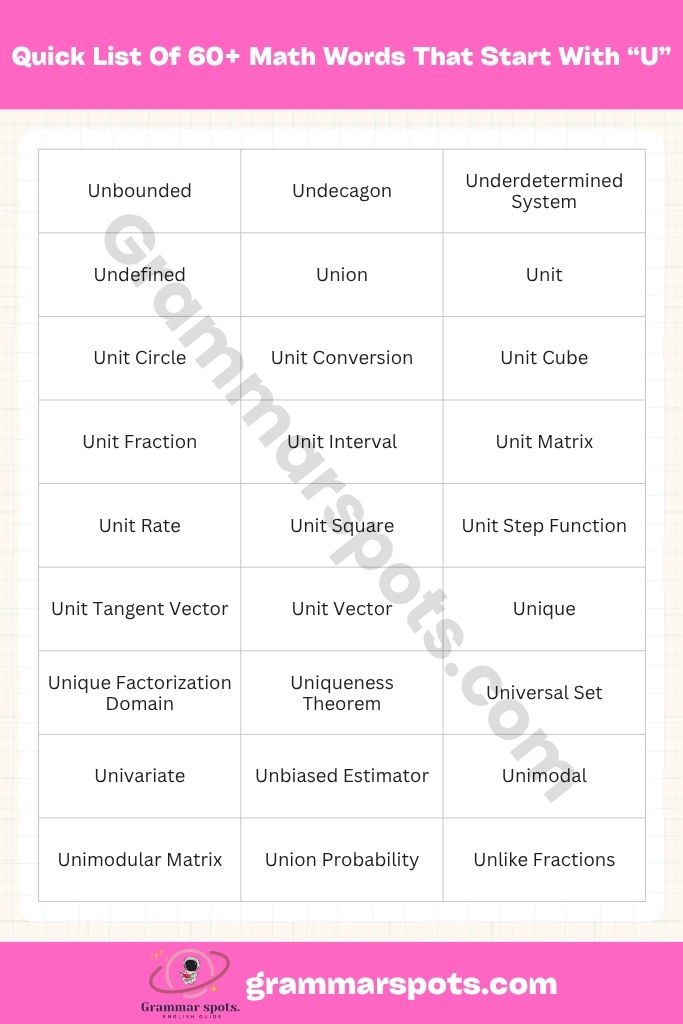
Quick List: 60+ Math Words That Start With U
- Unbounded
- Undecagon
- Underdetermined System
- Undefined
- Union
- Unit
- Unit Circle
- Unit Conversion
- Unit Cube
- Unit Fraction
- Unit Interval
- Unit Matrix
- Unit Rate
- Unit Square
- Unit Step Function
- Unit Tangent Vector
- Unit Vector
- Unique
- Unique Factorization Domain
- Uniqueness Theorem
- Universal Set
- Univariate
- Unbiased Estimator
- Unimodal
- Unimodular Matrix
- Union Probability
- Unlike Fractions
- Unlike Terms
- Unordered Pair
- Unramified
- Unstable Equilibrium
- Upper Bound
- Upper Limit
- Upper Quartile
- Upper Riemann Sum
- Upper Triangular Matrix
- Upward Parabola
- Ultrafilter
- Ultrametric
- Umbral Calculus
- Unary Operation
- Uncountable Set
- Undirected Graph
- Uniform Continuity
- Uniform Convergence
- Uniform Distribution
- Uniform Polyhedron
- Uniform Random Variable
- Uniform Scale
- Uniform Spacing
- Unknown
- Unweighted Graph
- Urysohn’s Lemma
- Utility Function
- Unknown Quantity
- Unit Normal Vector
- Uniform Probability
- Union of Sets
- Unit Cube Volume
- Unary Negation
- Undecidable Problem
- Unsigned Integer
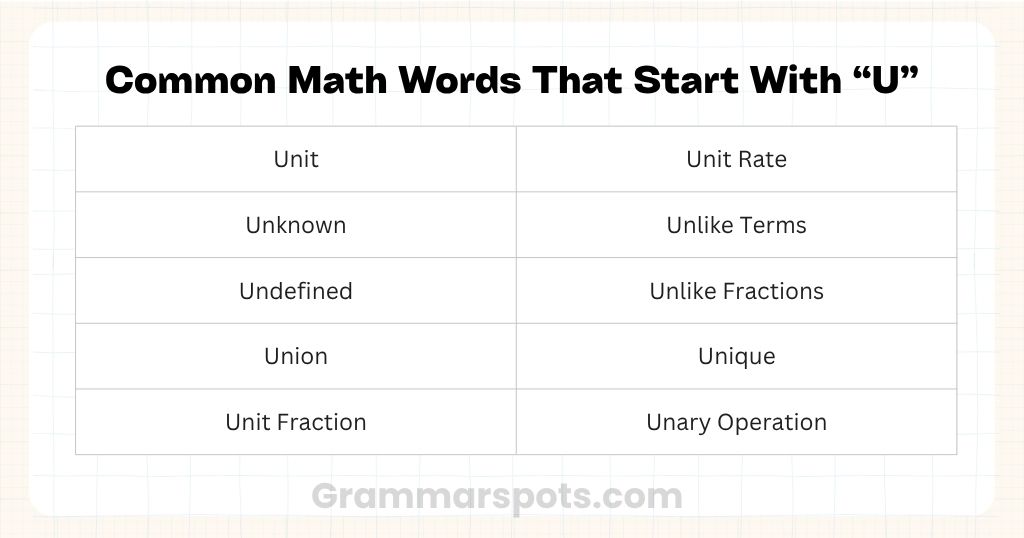
Common Math Words That Start With U
1. Unit
- Meaning: A standard quantity used for measurement.
- Example: The ribbon is 4 units long on the number line.
- Why it matters: Every measurement needs a unit to be meaningful. Without it, “5” could mean anything.
2. Unknown
- Meaning: A value that hasn’t been found yet, usually written as a variable.
- Example: In 3 + x = 9, the unknown is x = 6.
- Why it matters: Solving for unknowns is the core task of algebra.
3. Undefined
- Meaning: An expression or operation that has no valid mathematical result.
- Example: 8 ÷ 0 is undefined.
- Why it matters: Recognizing undefined expressions prevents errors in equations, graphs, and calculus.
4. Union
- Meaning: The set containing all elements from two or more sets, without repeating.
- Example: A = {1, 2, 3}, B = {3, 4, 5} → A ∪ B = {1, 2, 3, 4, 5}
- Why it matters: Union is a foundational operation in set theory and probability.
5. Unit Fraction
- Meaning: A fraction with 1 as the numerator and any positive integer as the denominator.
- Example: 1/2, 1/5, 1/9 are all unit fractions.
- Why it matters: All fractions can be built from unit fractions they’re the simplest fractional building blocks.
6. Unit Rate
- Meaning: A ratio comparing a quantity to 1 unit of another quantity.
- Example: 120 miles in 2 hours = 60 miles per hour.
- Why it matters: Unit rates make comparisons fast and simple in everyday situations.
7. Unlike Terms
- Meaning: Terms in an expression with different variables or exponents that cannot be combined.
- Example: 4x and 7y are unlike terms.
- Why it matters: Combining unlike terms is one of the most common algebra mistakes.
8. Unlike Fractions
- Meaning: Fractions with different denominators.
- Example: 1/3 and 1/5 are unlike fractions.
- Why it matters: Adding or subtracting unlike fractions requires finding a common denominator first.
9. Unique
- Meaning: Exactly one no more, no less.
- Example: x + 4 = 9 has a unique solution: x = 5.
- Why it matters: Many theorems prove both that a solution exists and that it is unique.
10. Unary Operation
- Meaning: An operation that applies to a single number.
- Example: −(−5) = 5 uses unary negation. √9 = 3 uses a unary square root.
- Why it matters: Distinct from binary operations (which need two inputs), unary operations matter in logic, algebra, and computer science.
11. Undecagon
- Meaning: A polygon with 11 sides and 11 angles.
- Example: A regular undecagon has interior angles summing to 1,620°.
- Why it matters: Builds understanding of polygon properties and interior angle formulas.
12. Unordered Pair
- Meaning: A set of two elements where order doesn’t matter.
- Example: {3, 7} = {7, 3} as an unordered pair.
- Why it matters: Distinguishes set-based thinking (order irrelevant) from coordinate pairs (order critical).
13. Unknown Quantity
- Meaning: Any quantity in a problem whose value must be determined.
- Example: “A number plus 6 equals 14” the unknown quantity is 8.
- Why it matters: Setting up equations always begins with identifying the unknown quantity.
14. Unary Negation
- Meaning: The operation of changing a number’s sign making a positive number negative or vice versa.
- Example: Unary negation of 5 = −5.
- Why it matters: Essential in algebra and programming; different from subtraction, which is a binary operation.
15. Union of Sets
- Meaning: The combined collection of all elements from multiple sets.
- Example: {a, b} ∪ {b, c} = {a, b, c}
- Why it matters: Core vocabulary for Venn diagrams, logic, and probability problems.
Related Post: 35+ Math Words That Start With V (With Meanings and Examples)
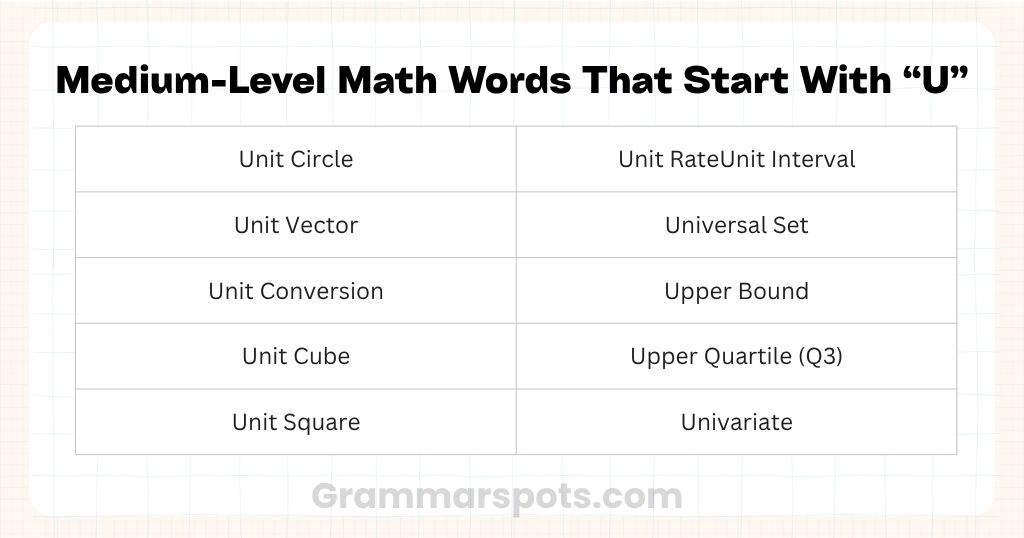
Medium-Level Math Words That Start With U
16. Unit Circle
- Meaning: A circle with radius 1 centered at the origin of a coordinate plane.
- Example: The point (1, 0) on the unit circle represents 0°; (0, 1) represents 90°.
- Why it matters: Defines all sine and cosine values the backbone of trigonometry.
17. Unit Vector
- Meaning: A vector with a magnitude of exactly 1.
- Example: i = (1, 0) and j = (0, 1) are standard unit vectors.
- Why it matters: Used to express direction without magnitude in physics and engineering.
18. Unit Conversion
- Meaning: Changing a measurement from one unit to an equivalent in another unit.
- Example: 3 km = 3,000 m
- Why it matters: Essential in science, cooking, construction, and international measurement systems.
19. Unit Cube
- Meaning: A cube with edge length 1, giving a volume of 1 cubic unit.
- Example: A 1 cm × 1 cm × 1 cm box is a unit cube.
- Why it matters: Used to introduce and visualize volume by counting cubes.
20. Unit Square
- Meaning: A square with side length 1 and area 1 square unit.
- Example: On a coordinate grid, the unit square has corners at (0,0), (1,0), (1,1), (0,1).
- Why it matters: Foundational in understanding area and coordinate geometry.
21. Unit Interval
- Meaning: The set of all real numbers between 0 and 1, written [0, 1].
- Example: 0.5, 0.99, and 0 are all in the unit interval.
- Why it matters: Appears constantly in probability, analysis, and topology.
22. Universal Set
- Meaning: The complete set of all elements relevant to a given problem.
- Example: If studying digits, the universal set is {0, 1, 2, 3, 4, 5, 6, 7, 8, 9}.
- Why it matters: Defines the boundaries of any set theory problem and is needed for complement operations.
23. Upper Bound
- Meaning: A value greater than or equal to every element in a set.
- Example: For {3, 6, 9}, the number 10 is an upper bound.
- Why it matters: The least upper bound (supremum) is central to calculus and real analysis.
24. Upper Quartile (Q3)
- Meaning: The median of the upper half of a dataset the 75th percentile.
- Example: In {2, 4, 6, 8, 10, 12}, Q3 = 10.
- Why it matters: Used in box plots and measuring data spread.
25. Univariate
- Meaning: Data or analysis involving only one variable.
- Example: Measuring only students’ heights is univariate.
- Why it matters: The starting point of statistics before moving to bivariate and multivariate analysis.
26. Unimodal
- Meaning: A distribution with exactly one peak.
- Example: A bell curve is unimodal.
- Why it matters: Indicates the data clusters around a single central value.
27. Upward Parabola
- Meaning: A parabola opening upward, occurring when the x² coefficient is positive.
- Example: y = x² + 3 opens upward.
- Why it matters: Has a minimum vertex used in optimization problems.
28. Unbounded
- Meaning: A set or function that extends infinitely with no finite limit.
- Example: The set of all positive integers is unbounded.
- Why it matters: Bounded vs. unbounded distinctions matter in calculus and linear programming.
29. Uniform Scale
- Meaning: Resizing a figure by the same factor in all directions.
- Example: Doubling a square’s dimensions uniformly keeps it a square, just larger.
- Why it matters: Preserves shape proportions in maps, blueprints, and scale models.
30. Union Probability
- Meaning: The probability that at least one of two events occurs: P(A ∪ B) = P(A) + P(B) − P(A ∩ B).
- Example: P(rolling a 2 or an even number) uses union probability.
- Why it matters: One of the most used formulas in probability theory.
31. Unit Matrix (Identity Matrix)
- Meaning: A square matrix with 1s on the diagonal and 0s everywhere else.
- Example: The 2×2 unit matrix: [[1, 0], [0, 1]]
- Why it matters: Multiplying any matrix by the unit matrix leaves it unchanged the matrix equivalent of multiplying by 1.
32. Unsigned Integer
- Meaning: A whole number that is zero or positive no negative values.
- Example: 0, 1, 45, 200 are unsigned integers.
- Why it matters: Fundamental in computer science and digital systems where only non-negative counts are needed.
Related Post: 40+ Math Words That Start With W (With Meanings and Examples)
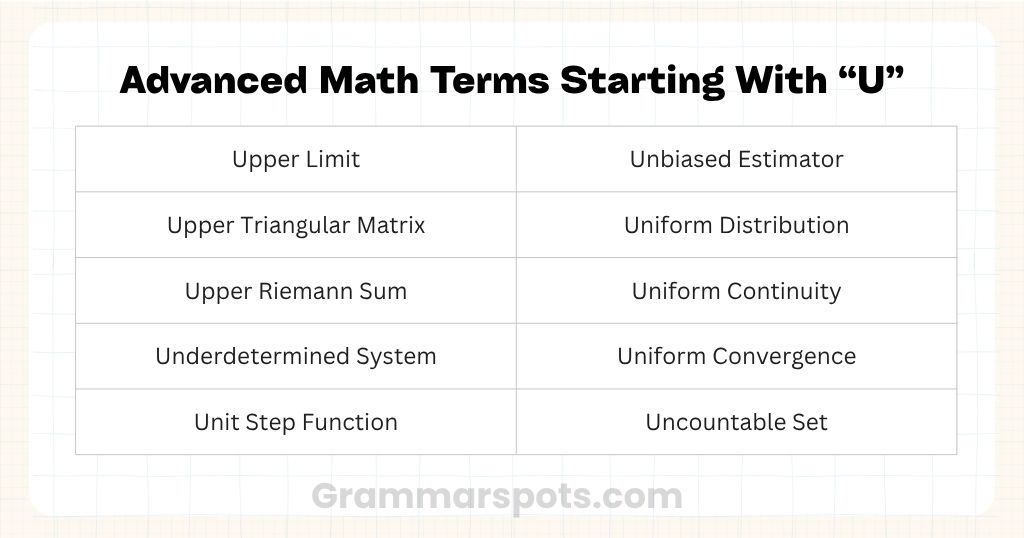
Advanced Math Terms Starting With U
33. Upper Limit
- Meaning: The top boundary value b in a definite integral ∫ₐᵇ f(x) dx.
- Example: In ∫₀⁵ x dx, the upper limit is 5.
- Why it matters: Defines where integration stops along the x-axis.
34. Upper Triangular Matrix
- Meaning: A square matrix where all entries below the main diagonal are zero.
- Example: [[3, 5], [0, 4]] is upper triangular.
- Why it matters: Simplifies solving linear systems through back-substitution.
35. Upper Riemann Sum
- Meaning: An area approximation under a curve using the maximum function value on each subinterval.
- Example: For f(x) = x² on [0, 2], each rectangle’s height is the highest point in its interval.
- Why it matters: Together with the lower Riemann sum, it brackets the true integral value.
36. Underdetermined System
- Meaning: A system with fewer equations than unknowns, producing infinitely many solutions.
- Example: x + y = 5 with two unknowns has no single solution.
- Why it matters: Appears in data modeling when insufficient information is available.
37. Unit Step Function
- Meaning: A function equal to 0 for negative inputs and 1 for non-negative inputs.
- Example: H(x) = 0 if x < 0; H(x) = 1 if x ≥ 0
- Why it matters: Models systems that switch on at a specific moment widely used in engineering and differential equations.
38. Unbiased Estimator
- Meaning: A statistical estimator whose expected value equals the true population parameter.
- Example: The sample mean x̄ is an unbiased estimator of the population mean μ.
- Why it matters: Ensures estimates don’t systematically lean too high or too low.
39. Uniform Distribution
- Meaning: A probability distribution where every outcome in a range is equally likely.
- Example: Rolling a fair die each of 6 outcomes has probability 1/6.
- Why it matters: The baseline distribution for comparing all others.
40. Uniform Continuity
- Meaning: A function is uniformly continuous if the same closeness margin works across the entire domain.
- Example: f(x) = 2x is uniformly continuous; f(x) = x² is not on all of ℝ.
- Why it matters: Stronger than pointwise continuity required in integration theory.
41. Uniform Convergence
- Meaning: A sequence of functions converges uniformly if they all approach the limit at the same rate everywhere.
- Example: fₙ(x) = x/n converges uniformly to 0 on [0, 1].
- Why it matters: Allows limits and integrals to be swapped safely.
42. Uncountable Set
- Meaning: A set so large it cannot be put into a one-to-one correspondence with the natural numbers.
- Example: The set of all real numbers ℝ is uncountable.
- Why it matters: Cantor’s proof that ℝ is uncountable was a landmark in the foundations of mathematics.
43. Unstable Equilibrium
- Meaning: A state where a small disturbance causes the system to move away from that state.
- Example: A ball balanced on top of a hill any small push sends it rolling away.
- Why it matters: Used in differential equations, physics modeling, and dynamical systems.
44. Utility Function
- Meaning: A mathematical function that assigns a numerical value representing the usefulness or preference of an outcome.
- Example: U(x) = √x might model how much satisfaction an amount x of money brings.
- Why it matters: Central to economics, game theory, and optimization problems.
45. Unit Tangent Vector
- Meaning: A unit vector pointing in the direction of a curve’s tangent at a given point.
- Example: For a circular path, the unit tangent vector points along the circle at each point.
- Why it matters: Used in vector calculus to describe the direction of motion along a curve.
46. Unit Normal Vector
- Meaning: A unit vector perpendicular to a surface or curve at a given point.
- Example: For a flat horizontal plane, the unit normal vector points straight up: (0, 0, 1).
- Why it matters: Used in surface integrals, physics, and 3D geometry.
47. Uniform Random Variable
- Meaning: A random variable that is equally likely to take any value in a specified range.
- Example: Picking a random number between 0 and 10 with equal likelihood.
- Why it matters: Foundational in probability simulations and statistical modeling.
48. Uniform Probability
- Meaning: A probability model where all outcomes are equally likely.
- Example: Flipping a fair coin P(heads) = P(tails) = 0.5.
- Why it matters: The simplest and most intuitive probability model for equally likely outcomes.
49. Uniform Spacing
- Meaning: Equal distances between successive points or values in a sequence or partition.
- Example: {0, 0.25, 0.5, 0.75, 1.0} has uniform spacing of 0.25.
- Why it matters: Used in numerical integration and interpolation to ensure consistent accuracy.
50. Undirected Graph
- Meaning: A graph where edges have no direction connections work both ways.
- Example: A friendship network where “A knows B” means “B knows A.”
- Why it matters: Models symmetric relationships in computer science and network analysis.
51. Unweighted Graph
- Meaning: A graph where all edges are treated equally — no distances or costs assigned.
- Example: A basic road map where every road is treated the same.
- Why it matters: Simplifies graph algorithms like breadth-first search.
52. Uniform Polyhedron
- Meaning: A 3D solid where every face is a regular polygon and every vertex is identical.
- Example: All Platonic solids (cube, tetrahedron, etc.) are uniform polyhedra.
- Why it matters: Studied in 3D geometry for their symmetry properties.
Related Post: 40+ Math Words That Start With T (With Meanings and Examples)
Rare and Expert-Level Math Words That Start With U
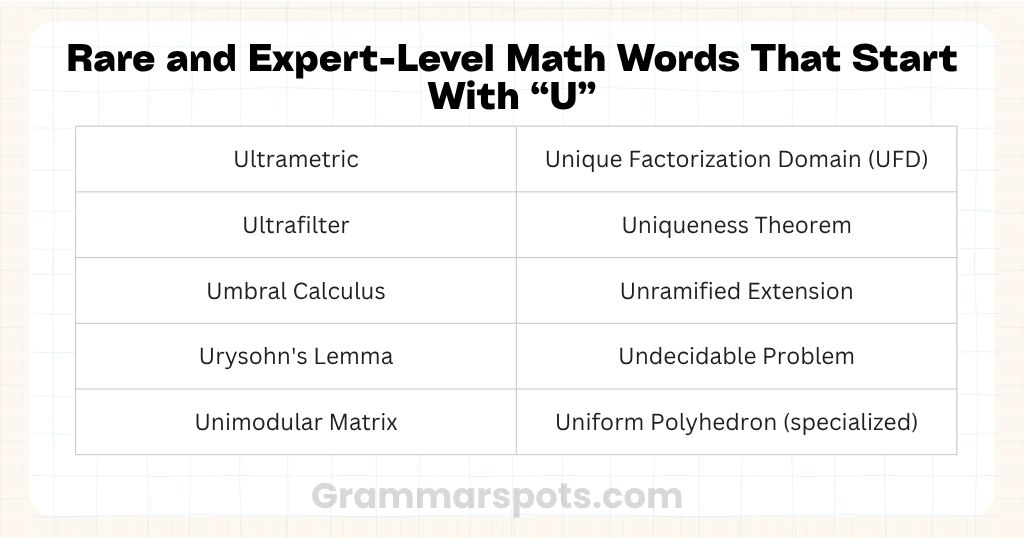
53. Ultrametric
- Meaning: A distance function satisfying a stronger triangle inequality: d(x,z) ≤ max(d(x,y), d(y,z)).
- Example: Used in p-adic number systems.
- Why it matters: Appears in number theory and hierarchical data clustering.
54. Ultrafilter
- Meaning: A maximal collection of subsets of a set satisfying specific filter properties.
- Example: Used in constructing hyperreal numbers and in model theory.
- Why it matters: Foundational in non-standard analysis and mathematical logic.
55. Umbral Calculus
- Meaning: A symbolic method for deriving identities involving polynomial sequences using formal notation.
- Example: Connects Bernoulli numbers and Stirling numbers through symbolic manipulation.
- Why it matters: Provides elegant shortcuts in combinatorics and generating functions.
56. Urysohn’s Lemma
- Meaning: A theorem stating that two disjoint closed sets in a normal topological space can be separated by a continuous function.
- Example: Used to prove Tietze’s Extension Theorem.
- Why it matters: A cornerstone result in point-set topology.
57. Unimodular Matrix
- Meaning: A square integer matrix with determinant equal to +1 or −1.
- Example: [[1, 1], [0, 1]] is unimodular since its determinant is 1.
- Why it matters: Preserves integer lattice structure important in number theory and cryptography.
58. Unique Factorization Domain (UFD)
- Meaning: An algebraic structure where every element factors uniquely into irreducibles.
- Example: The integers ℤ are a UFD: 12 = 2 × 2 × 3 in exactly one way.
- Why it matters: Generalizes the Fundamental Theorem of Arithmetic to broader algebraic systems.
59. Uniqueness Theorem
- Meaning: A theorem asserting that a mathematical object satisfying certain conditions is the only one of its kind.
- Example: The uniqueness theorem for differential equations guarantees exactly one solution given initial conditions.
- Why it matters: Confirms that mathematical solutions are not only findable but singular.
60. Unramified Extension
- Meaning: A field extension in which primes in the base field do not split in complicated ways.
- Example: Studied in algebraic number theory and algebraic geometry.
- Why it matters: Distinguishes well-behaved extensions from more complex ones in number theory.
61. Undecidable Problem
- Meaning: A mathematical problem for which no algorithm can always give a correct yes/no answer.
- Example: Turing’s Halting Problem it is undecidable whether any given program will eventually stop.
- Why it matters: Defines the fundamental limits of what mathematics and computation can solve.
62. Uniform Polyhedron (specialized)
- Meaning: A broader class of 3D shapes where every vertex is equivalent, including non-convex forms.
- Example: The great icosahedron is a uniform polyhedron.
- Why it matters: Extends geometric symmetry beyond the standard Platonic solids.
Geometry Terms That Start With U
- Undecagon
- Unit Circle
- Unit Cube
- Unit Square
- Uniform Scale
- Uniform Polyhedron
Statistics Terms Starting With U
- Univariate
- Unimodal
- Upper Quartile
- Uniform Distribution
- Unbiased Estimator
- Uniform Random Variable
- Uniform Probability
Algebra Terms Starting With U
- Unknown
- Unlike Terms
- Upper Bound
- Underdetermined System
- Unique
- Utility Function
Calculus and Analysis Terms That Start With U
- Upper Limit
- Upper Riemann Sum
- Unbounded
- Uniform Continuity
- Uniform Convergence
- Unit Step Function
- Unit Tangent Vector
- Unit Normal Vector
- Unstable Equilibrium
Set Theory Terms Starting With U
- Union
- Universal Set
- Uncountable Set
- Unordered Pair
- Union of Sets
Graph Theory Terms That Start With U
- Undirected Graph
- Unweighted Graph
Real-World Applications
Measurement
- Unit and unit conversion are used in cooking, science labs, construction, and international trade.
Engineering and Signal Processing
- The unit step function models circuit switching and system activation.
Finance and Economics
- Utility functions help model decision-making, pricing, and risk.
Computer Science
- Undirected and unweighted graphs power social networks, GPS routing, and search algorithms.
- Undecidable problems define the theoretical limits of computing.
- Unsigned integers are the basis of digital counting systems.
Architecture and Design
- Uniform scale ensures every dimension on a blueprint shrinks or grows by the same ratio.
Data Science and Research
- Unbiased estimators and uniform distributions underpin survey design, clinical trials, and machine learning.
Tips for Remembering Math Words Starting With U
- Use the prefix “uni-“ it means one. Unit (one standard), unique (one solution), unimodal (one peak), univariate (one variable). One prefix unlocks many words.
- Group by topic study geometry U-words one day, statistics the next. Themed sessions build faster recall.
- Draw it unit circle, unit cube, upward parabola, undecagon these are all visual. Sketching locks in meaning.
- Flashcards write the term on one side, definition and example on the other.
- Apply it don’t just define unit rate; solve a unit rate problem. Use the word in context.
Commonly Confused Terms
Union vs. Intersection
- Union (∪) = everything from both sets combined.
- Intersection (∩) = only what both sets share.
- Tip: “Union” = unite = bring everything together.
Unknown vs. Variable
- A variable is any symbol representing a quantity.
- An unknown is specifically what you’re solving for.
- Every unknown is a variable, but not every variable is an unknown.
Upper Bound vs. Maximum
- Maximum = the largest actual element in the set (may not exist).
- Upper bound = any value ≥ all elements (many can exist).
- The set (0, 1) has no maximum but has infinitely many upper bounds.
Undefined vs. Indeterminate
- Undefined = no valid result exists (e.g., 5 ÷ 0).
- Indeterminate = the form could yield different values in context (e.g., 0/0 in limits).
Uniform Continuity vs. Continuity
- Continuous = works point by point.
- Uniformly continuous = the same margin of closeness works across the entire domain at once.
Unit Rate vs. Ratio
- Ratio compares two quantities (e.g., 3:4).
- Unit rate expresses that comparison with a denominator of 1 (e.g., 60 mph).
FAQs About Math Words That Start With U
What is the most common math word starting with U?
Unit it appears in every branch of math and science, from elementary measurement to university-level calculus and linear algebra.
What U-words appear in middle school math?
- Unit, unknown, union, unit rate, unit fraction, unlike fractions, unlike terms, upper quartile, universal set, and undecagon.
What U-words appear in high school math?
- Unit circle, unit vector, upper bound, uniform distribution, univariate, unimodal, upper limit, and upward parabola.
What does “undefined” mean in math?
An expression with no valid mathematical result. The clearest case is dividing by zero, which breaks the rules of arithmetic.
What is the difference between union and universal set?
- Union = an operation combining two sets.
- Universal set = the complete pool of all elements for a given problem.
Why is the unit circle so important?
It defines all sine and cosine values directly from coordinates. Every angle in trigonometry maps to a point on the unit circle.
Are there U-words in calculus?
Yes upper limit, upper Riemann sum, unbounded, uniform continuity, uniform convergence, and unit step function.
What is a unimodal distribution?
A data distribution with exactly one peak, like a bell curve. Two peaks = bimodal.
Conclusion
These 60+ math words starting with U span every level from unit and unknown in early grades to uniform convergence and ultrafilter in graduate mathematics. Use the quick list for fast reference, the table to sort by difficulty, the categories to study by topic, and the FAQ to clear up confusion. The prefix “uni-“ alone connects more than a dozen terms. Start with what’s relevant to your level and build from there.

I’m Hazel, and I studied BSC English at GCUF. I focus on explaining word meanings in simple, clear language that anyone can understand. My goal is helping readers grasp everyday English, confusing terms, and slang used in real conversations and social media. I believe language learning works best when definitions connect to actual life situations. Through careful research and straightforward explanations, I make vocabulary accessible for students, learners, and anyone curious about how English really works in daily use.