

Math vocabulary shapes how students think, solve, and communicate. If you are searching for math words that start with W, this guide covers 40+ verified terms from basic classroom words to advanced university-level concepts. Each entry includes a clear definition, a practical example, and its place in mathematics. No fillers. No repeated content. Every word here is genuinely mathematical.
Quick List: 40+ Math Words That Start With W
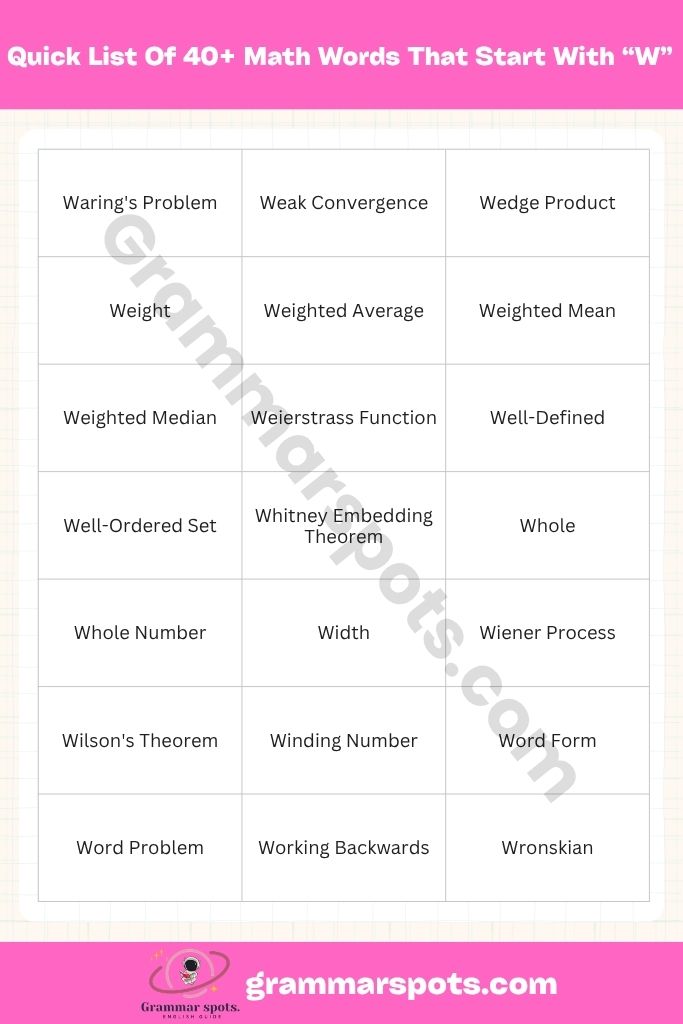
- Waring’s Problem
- Weak Convergence
- Wedge Product
- Weight
- Weighted Average
- Weighted Mean
- Weighted Median
- Weierstrass Function
- Well-Defined
- Well-Ordered Set
- Whitney Embedding Theorem
- Whole
- Whole Number
- Width
- Wiener Process
- Wilson’s Theorem
- Winding Number
- Word Form
- Word Problem
- Working Backwards
- Wronskian
- W-Shape
- Witness
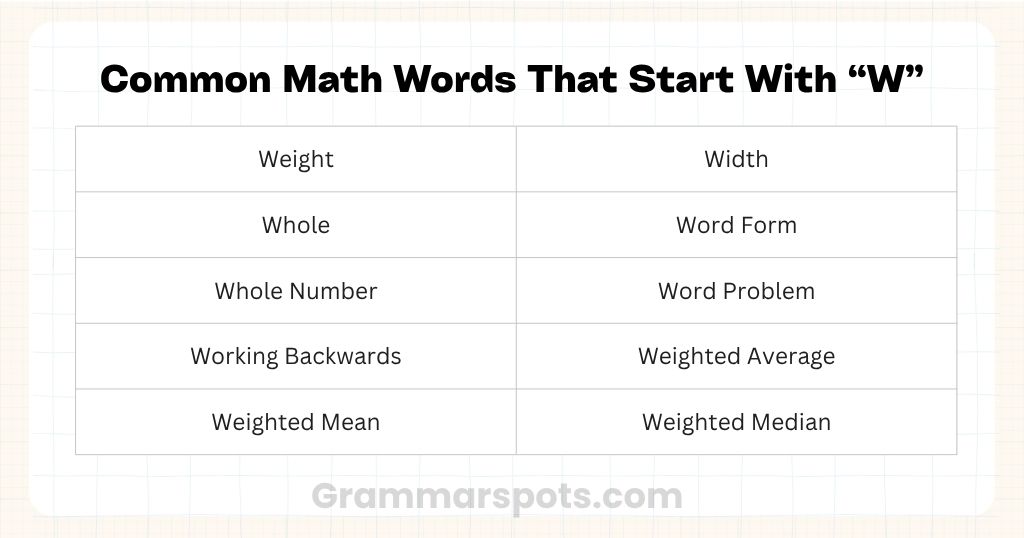
Common Math Words That Start With W
1. Weight
Meaning: A measure of how heavy an object is, expressed in units such as grams, kilograms, pounds, or ounces.
Example: The bag weighed 8 kilograms.
Why It Matters: Weight is used in measurement, unit conversion, and real-world word problems across all grade levels.
2. Whole
Meaning: In fractions, the whole is the complete unit before it is divided into equal parts.
Example: If a pizza is the whole, then ¼ represents one of four equal pieces.
Why It Matters: Understanding the whole is essential for comparing fractions, adding fractions, and interpreting part-whole relationships correctly.
3. Whole Number
Meaning: Any non-negative number with no fraction or decimal part: 0, 1, 2, 3, 4 …
Example: 7 is a whole number. 7.5 is not.
Why It Matters: Whole numbers are one of the first number sets students learn. They form the basis for all later number work integers, fractions, and real numbers.
4. Width
Meaning: The side-to-side measurement of a shape or object usually the shorter horizontal dimension.
Example: A rectangle with length 10 cm and width 4 cm has an area of 40 cm².
Why It Matters: Width is used in calculating area, perimeter, and volume across geometry problems at every grade level.
5. Word Form
Meaning: Writing a number using words instead of digits.
Example: 4,507 written in word form is “four thousand five hundred seven.”
Why It Matters: Word form builds number sense and is tested in place value units from early elementary through middle school.
6. Word Problem
Meaning: A math problem written in sentence or story form, where the reader must identify the operation needed and solve it.
Example: “Rania has 36 pencils and gives 9 to her classmates. How many does she have left?”
Why It Matters: Word problems develop real-world reasoning. Students must translate language into math a skill tested on every standardized exam.
7. Working Backwards
Meaning: A problem-solving strategy where you start from the known result and reverse each step to find the original value.
Example: “A number was doubled, then 6 was subtracted. The result is 14. What was the number?”
- 14 + 6 = 20 → 20 ÷ 2 = 10
Why It Matters: Working backwards builds algebraic thinking and helps students check their answers by reversing operations.
8. Weighted Average
Meaning: An average where each value is multiplied by an assigned weight (importance level) before being summed and divided.
Example: Exam worth 60%, quiz worth 40%: Exam score = 80, Quiz score = 90.
(80 × 0.6) + (90 × 0.4) = 48 + 36 = 84
Why It Matters: Used in grading systems, financial indices, and statistical analysis whenever values carry unequal importance.
9. Weighted Mean
Meaning: The numerical result of a weighted average calculation.
Formula: Weighted Mean = Σ(value × weight) ÷ Σ(weights)
Example: Scores: 70 (weight 2), 90 (weight 3)
(70×2 + 90×3) ÷ (2+3) = (140 + 270) ÷ 5 = 82
Why It Matters: The weighted mean gives a more accurate central value than a simple mean when data points have different levels of significance.
10. Weighted Median
Meaning: The value that divides a weighted dataset so that the total weight below it equals the total weight above it.
Example: In income distribution studies, the weighted median accounts for how many people fall in each income bracket giving a fairer middle value than a simple median.
Why It Matters:
Weighted median is used in economics, demography, and robust statistics where outliers and unequal sampling exist.
11. Well-Defined
Meaning: A mathematical operation, function, or object is well-defined when its result is consistent regardless of how the input is represented.
Example: Adding ½ + ¼: whether you write ½ as 2/4 or 4/8, the result is always ¾. The operation is well-defined.
Why It Matters: Well-definedness is essential in abstract algebra and set theory. A definition that gives different results for equivalent inputs is mathematically invalid.
12. W-Shape
Meaning: A graph pattern shaped like the letter W, commonly seen in quartic (degree-4) polynomial functions with two local minima and one local maximum between them.
Example: f(x) = x⁴ − 4x² produces a W-shaped curve with valleys at x = ±√2 and a peak at x = 0.
Why It Matters: Identifying the W-shape helps students understand polynomial behavior, turning points, and curve sketching in algebra and calculus.
Related Post: 55+ Math Words That Start With X (With Meanings and Examples)
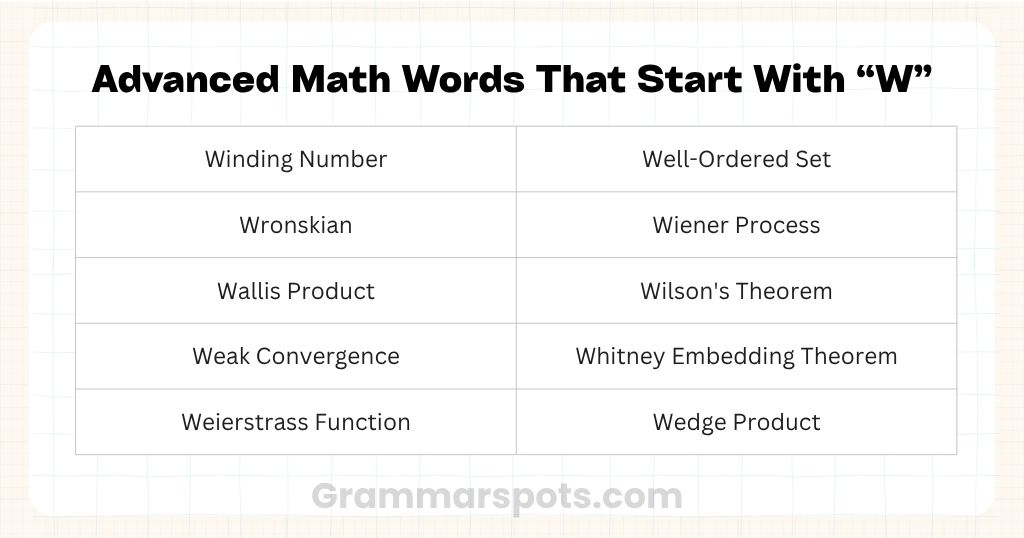
Advanced Math Words That Start With W
13. Winding Number
Meaning: A value that counts how many times a closed curve wraps around a given point in the plane. Counterclockwise wrapping counts as positive; clockwise as negative.
Example: A circle drawn once counterclockwise around a point has winding number +1.
Branch: Topology, Complex Analysis
Why It Matters: Used in Cauchy’s integral theorem, computer graphics polygon algorithms, and electromagnetic field theory.
14. Wronskian
Meaning: A determinant used to test whether a set of functions is linearly independent in differential equations.
Formula (two functions):
W(f, g) = f·g′ − f′·g
Example: f(x) = sin x, g(x) = cos x
W = sin x·(−sin x) − cos x·cos x = −sin²x − cos²x = −1 ≠ 0
Result: linearly independent.
Branch: Differential Equations, Linear Algebra
Why It Matters: If the Wronskian is nonzero, the functions form a valid solution set for a differential equation.
15. Wallis Product
Meaning: An infinite product formula that converges to π/2, discovered by John Wallis in 1655.
Formula:
π/2 = (2/1)·(2/3)·(4/3)·(4/5)·(6/5)·(6/7)·…
Branch: Calculus, Infinite Series
Why It Matters: One of the earliest known representations of π using an infinite product. It connects calculus, limits, and number theory historically.
16. Weak Convergence
Meaning: A sequence {xₙ} converges weakly to x if for every bounded linear functional f, f(xₙ) → f(x). This is a gentler condition than norm (strong) convergence.
Branch: Real Analysis, Functional Analysis
Why It Matters: Weak convergence is fundamental in probability theory, partial differential equations, and modern analysis. Strong convergence implies weak convergence, but not the other way around.
17. Weierstrass Function
Meaning: A continuous function that is differentiable nowhere meaning no tangent line exists at any point on the curve. Introduced by Karl Weierstrass in 1872.
Branch: Real Analysis
Why It Matters: It disproved the widely held assumption that continuity implies differentiability. It is a foundational counterexample in real analysis and the mathematics of fractals.
18. Well-Ordered Set
Meaning: A set in which every non-empty subset has a least (smallest) element under the given ordering.
Example:
- ✅ {0, 1, 2, 3, …} — every subset has a smallest element → well-ordered
- ❌ {…, −2, −1, 0, 1, 2, …} — the subset of all negative integers has no smallest element → not well-ordered
Branch: Set Theory, Mathematical Logic
Why It Matters: Well-ordering underpins mathematical induction and is equivalent to the Axiom of Choice in Zermelo–Fraenkel set theory.
19. Wiener Process
Meaning: A continuous-time stochastic process used to model random, unpredictable motion over time. Also called Brownian motion in mathematics.
Branch: Probability Theory, Stochastic Calculus
Why It Matters: The Wiener process is the mathematical foundation for the Black-Scholes model in finance, diffusion models in physics, and population models in biology.
20. Wilson’s Theorem
Meaning: A number theory result stating that a natural number p > 1 is prime if and only if (p − 1)! ≡ −1 (mod p).
Example:
p = 5: (5−1)! = 24. 24 mod 5 = 4 ≡ −1 mod 5 ✓ → 5 is prime.
p = 4: (4−1)! = 6. 6 mod 4 = 2 ≠ −1 → 4 is not prime.
Branch: Number Theory
Why It Matters: Wilson’s Theorem gives a precise mathematical test for primality and appears in number theory proofs and competitions.
21. Whitney Embedding Theorem
Meaning: A theorem stating that any smooth m-dimensional manifold can be embedded in Euclidean space ℝ²ᵐ.
Branch: Differential Topology
Why It Matters: It proves that abstract geometric surfaces always have a concrete representation in higher-dimensional space bridging abstract and applied geometry.
22. Wedge Product
Meaning: An operation in exterior algebra that combines two vectors to produce a quantity representing the oriented area (or volume) spanned by them.
Notation: u ∧ v
Example: In 3D space, u ∧ v produces a bivector whose magnitude equals the area of the parallelogram formed by u and v.
Branch: Linear Algebra, Differential Geometry
Why It Matters: The wedge product generalizes the cross product and is central to differential forms, integration on manifolds, and multivariable calculus.
23. Witness
Meaning: In logic and proof theory, a witness is a specific value or example that proves an existential statement is true.
Example: “There exists an even prime number.”
Witness: 2. It is even and prime proving the statement.
Branch: Logic, Proof Theory, Computational Complexity
Why It Matters: In computer science, a problem is in the class NP if a witness can be verified in polynomial time. The concept is central to the P vs NP problem.
Related Post: 35+ Math Words That Start With V (With Meanings and Examples)
Rare and Specialized Math Words That Start With W
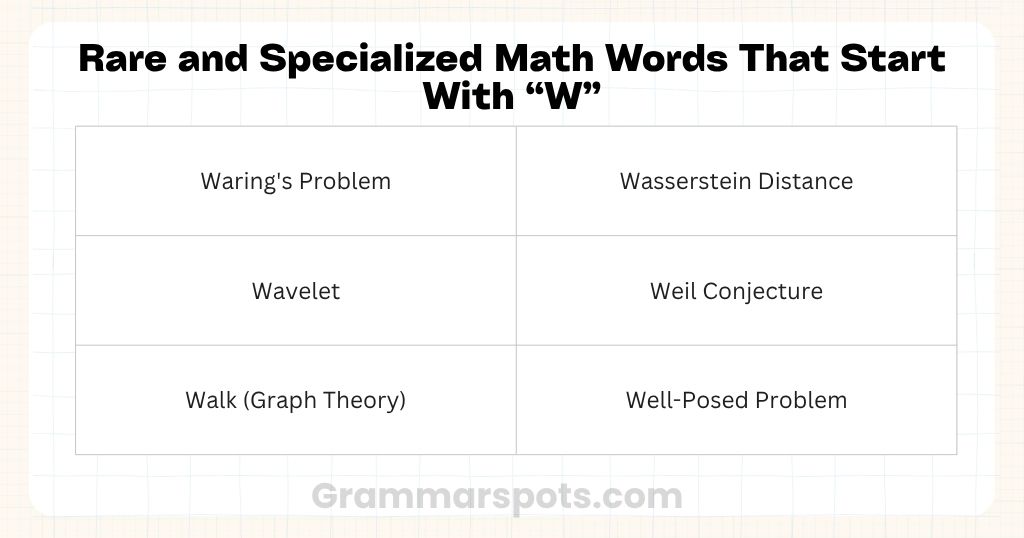
24. Waring’s Problem
Meaning: A number theory question asking: for each integer k, what is the minimum number of k-th powers needed to represent every positive integer as a sum?
Example:
- k = 2 (squares): every positive integer = sum of at most 4 perfect squares (Lagrange, 1770)
- k = 3 (cubes): every positive integer = sum of at most 9 cubes
Branch: Number Theory
25. Wasserstein Distance
Meaning: A measure of the distance between two probability distributions, calculated by finding the minimum “cost” of transforming one distribution into the other.
Branch: Probability Theory, Optimal Transport
Why It Matters: Used in machine learning (generative models, GANs), statistics, and economics to compare distributions in a geometrically meaningful way.
26. Wavelet
Meaning: A small oscillating wave-like function used to decompose signals into components at different scales and frequencies.
Branch: Applied Mathematics, Signal Processing
Why It Matters: Wavelets are used in image compression (JPEG 2000), audio processing, and data analysis. They improve on Fourier analysis by capturing both frequency and location information.
27. Weil Conjecture
Meaning: A set of conjectures (proved by Pierre Deligne in 1974) about the number of solutions to polynomial equations over finite fields, connecting number theory and algebraic geometry.
Branch: Algebraic Geometry, Number Theory
Why It Matters: Proving the Weil Conjectures was one of the landmark achievements of 20th-century mathematics, leading to the development of étale cohomology.
28. Waring–Goldbach Problem
Meaning: An extension of Waring’s Problem asking whether every sufficiently large integer can be expressed as a sum of k-th powers of prime numbers.
Branch: Analytic Number Theory
29. Walk (Graph Theory)
Meaning: A sequence of vertices and edges in a graph where each consecutive pair of vertices is connected by an edge. Vertices and edges may be repeated.
Example: In a city map modeled as a graph, a walk from point A to point D might pass through B and C, revisiting edges.
Branch: Graph Theory, Discrete Mathematics
Why It Matters: Walks are foundational in graph theory, network analysis, and algorithms like Google’s PageRank.
30. Well-Posed Problem
Meaning: A mathematical problem is well-posed (in the sense of Hadamard) if it satisfies three conditions:
- A solution exists
- The solution is unique
- The solution depends continuously on the initial data
Branch: Applied Mathematics, Differential Equations
Why It Matters: Well-posedness determines whether a mathematical model is reliable. Ill-posed problems can produce unstable or non-unique solutions, making them unsuitable for practical applications.
31. Wythoff’s Game
Meaning: A two-player mathematical strategy game involving two piles of objects. Players alternate removing any number from one pile, or equal amounts from both. The player who takes the last object wins.
Branch: Combinatorics, Game Theory
Why It Matters Wythoff’s Game connects the golden ratio and Beatty sequences to winning strategies — an elegant intersection of number theory and combinatorial game theory.
32. Windowed Fourier Transform
Meaning: A variation of the Fourier transform that analyzes a signal in localized time windows, capturing both frequency and time information simultaneously.
Branch: Applied Mathematics, Signal Analysis
Why It Matters: Unlike the standard Fourier transform, the windowed version handles non-stationary signals — those whose frequency content changes over time, such as speech and music.
Geometry Math Words That Start With W
- Width — side-to-side measurement of a shape
- Winding Number — times a curve wraps around a point
- Wedge Product — oriented area between two vectors
- W-Shape — curve pattern with two minima in quartic graphs
Statistics Math Words That Start With W
- Weight — importance factor assigned to a data value
- Weighted Average — average accounting for unequal importance
- Weighted Mean — calculated result of weighted averaging
- Weighted Median — midpoint value in a weighted dataset
- Wasserstein Distance — measure of difference between probability distributions
Number Theory Math Words That Start With W
- Whole Number — non-negative integers: 0, 1, 2, 3…
- Wilson’s Theorem — primality test using factorials and modular arithmetic
- Waring’s Problem — expressing integers as sums of k-th powers
- Waring–Goldbach Problem — Waring’s Problem restricted to prime bases
- Weil Conjecture — solutions to polynomial equations over finite fields
Problem Solving and General Math
- Word Form — writing numbers using words
- Word Problem — math expressed in sentence or story form
- Working Backwards — solving by reversing from the known result
- Well-Posed Problem — a problem with existence, uniqueness, and stability of solution
- Witness — a value that proves an existential mathematical statement
Related Post: 60+ Math Words That Start With U (With Meanings and Examples)
Applied and Advanced Math Words That Start With W
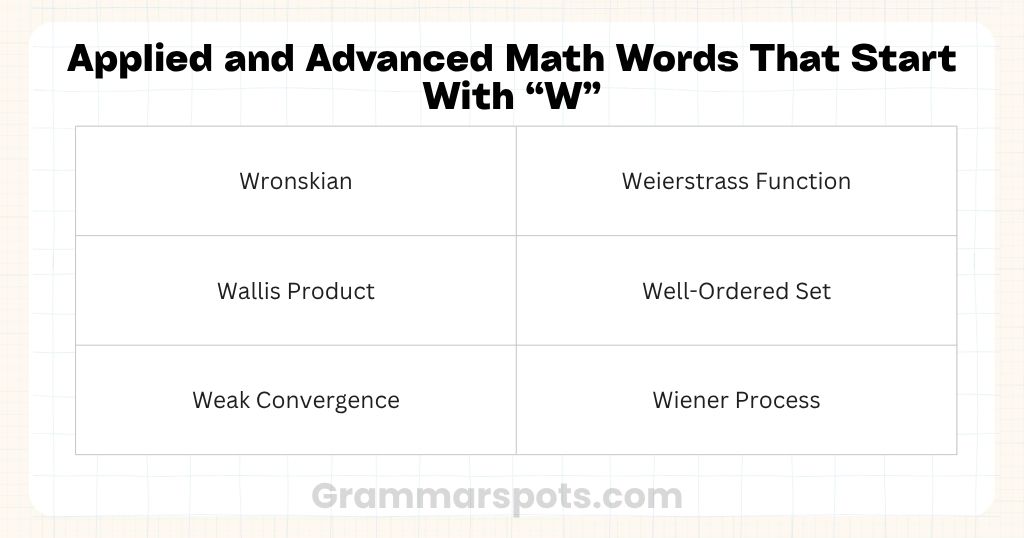
- Wronskian — determinant testing linear independence of functions
- Wallis Product — infinite product converging to π/2
- Weak Convergence — convergence under linear functionals
- Weierstrass Function — continuous but nowhere differentiable
- Well-Ordered Set — every subset has a least element
- Wiener Process — mathematical model of random continuous motion
- Wavelet — localized wave function for signal decomposition
- Windowed Fourier Transform — time-localized frequency analysis
- Walk (Graph Theory) — sequence of vertices and edges in a graph
Real-World Applications
Measurement and Science:
- Weight is used in chemistry labs, cooking, medicine, and engineering every day
Education and Grading:
- Weighted average and weighted mean determine final course grades in schools and universities worldwide
Finance:
- Wiener process is the foundation of Black-Scholes option pricing and algorithmic trading models
Computer Graphics and GIS:
- Winding number determines whether a point lies inside or outside a polygon — used in rendering engines and mapping software
Engineering and Physics:
- Wronskian is applied when solving differential equations that model circuits, bridges, and fluid flow
Machine Learning:
- Wasserstein distance is used in training generative adversarial networks (GANs)
Signal Processing and Media:
- Wavelets compress images (JPEG 2000) and process audio signals
Everyday Reasoning:
- Working backwards and word problems build the logical thinking used in budgeting, planning, and decision-making
Learning Tips for Math Words That Start With W
- Group by topic study weight, weighted mean, and weighted median together rather than in alphabetical isolation
- Write your own examples for each term, create one original sentence or problem
- Keep a vocabulary journal write the term, a definition in your own words, and one example per entry
- Sketch graphs draw the W-shape curve and winding number diagrams to anchor visual terms in memory
- Use flashcards for advanced terms write the term on one side; formula, branch, and key idea on the other
- Teach it back explaining Wronskian or well-ordered set to someone else confirms genuine understanding
- Use spaced repetition review cards at increasing intervals: day 1, day 3, day 7, day 14
Commonly Confused Terms
Whole Number vs. Natural Number vs. Integer
| Term | Includes 0? | Includes Negatives? | Includes Fractions? |
| Natural Number | Debated (usually No) | No | No |
| Whole Number | Yes | No | No |
| Integer | Yes | Yes | No |
Key point: Whole numbers = {0, 1, 2, 3, …}. Integers extend in both directions.
Weighted Mean vs. Weighted Average vs. Weighted Median
- Weighted average the method of averaging with unequal importance
- Weighted mean the calculated number produced by that method
- Weighted median the middle value in a weighted distribution (not an average)
Width vs. Length
- Length conventionally the longer dimension
- Width conventionally the shorter or horizontal dimension
In some contexts (grids, tables, 3D shapes), these labels shift. Always follow the definition given in the specific problem.
Weak Convergence vs. Strong Convergence
- Strong convergence the sequence gets close in actual value (norm)
- Weak convergence the sequence satisfies a weaker condition under linear functionals
Strong convergence always implies weak convergence. The reverse is not always true.
Walk vs. Path (Graph Theory)
- Walk vertices and edges may repeat
- Path vertices (and therefore edges) must all be distinct
Every path is a walk, but not every walk is a path.
Word Form vs. Standard Form vs. Expanded Form
- Standard form 4,507
- Word form four thousand five hundred seven
- Expanded form 4,000 + 500 + 7
All three represent the same number in different formats.
Winding Number vs. Degree (Topology)
- Winding number measures how many times a curve wraps around a specific point
- Degree of a map measures how many times one topological space wraps around another globally
Both count “wrapping,” but winding number is local; degree is global.
Frequently Asked Questions
Q1: What are the most common math words starting with W for elementary students?
- Whole number
- Width
- Weight
- Word problem
- Word form
- Whole (in fractions)
These cover number sense, measurement, and geometry the three core strands in early math education.
Q2: What is the difference between whole number and natural number?
Natural numbers traditionally start at 1 and do not include 0. Whole numbers start at 0. Some modern definitions include 0 in natural numbers, so always check which convention your textbook uses.
Q3: How does weighted average differ from a regular average?
A regular average treats all values equally. A weighted average assigns each value a different level of importance. Course grades, stock indices, and census data all use weighted averages.
Q4: What is the Wronskian used for?
It tests whether a set of functions is linearly independent in differential equations. A nonzero Wronskian at any point in an interval confirms the functions form a valid, independent solution set.
Q5: Why is the Weierstrass function important?
It proved that a function can be continuous everywhere but differentiable nowhere. This overturned a major mathematical assumption in 1872 and became a cornerstone example in real analysis.
Q6: What is a wavelet used for in math?
Wavelets decompose signals into components at different scales. They are used in image compression, audio processing, and data analysis particularly where both frequency and time location matter.
Q7: What does well-posed mean in mathematics?
A well-posed problem has a solution that exists, is unique, and depends continuously on the input data. Problems that fail any of these conditions are called ill-posed.
Q8: What is the Wiener process in simple terms?
It is a mathematical model for random continuous movement imagine a particle moving unpredictably at every moment. It is the basis for modeling financial markets, particle diffusion, and biological systems.
Conclusion
Math words that start with W range from foundational terms whole number, width, weight, and word problem to advanced concepts including the Wronskian, Weierstrass function, Wiener process, and Wasserstein distance. This guide covers 40+ verified terms organized by level, subject, and application. Whether you are a student building vocabulary, a teacher designing lessons, or a researcher reviewing concepts, every term here is accurate, relevant, and directly useful in mathematics.

I’m Hazel, and I studied BSC English at GCUF. I focus on explaining word meanings in simple, clear language that anyone can understand. My goal is helping readers grasp everyday English, confusing terms, and slang used in real conversations and social media. I believe language learning works best when definitions connect to actual life situations. Through careful research and straightforward explanations, I make vocabulary accessible for students, learners, and anyone curious about how English really works in daily use.