

DF usually means “Da Fck” in texting, a quick way to say “what the fck” when you’re shocked or annoyed. People type it when something catches them off guard or makes zero sense.
You’re Here Because Someone Just Hit You With “DF”
You probably just got a “DF” text and had no clue how to take it. Was your friend mad? Confused? Messing around? The problem is that two letters can mean about ten different things depending on who sent it and where you saw it.
You might’ve said something weird and got “df??” back, or maybe you’re scrolling Instagram comments and keep seeing it pop up. It’s one of those terms that looks simple but actually carries a bunch of different vibes.
The Real Feeling Behind Those Two Letters
When someone types “DF,” they’re usually reacting fast. It’s not a thought-out response. It’s the text version of your face when something makes you go “wait, what?” The reason people use it instead of typing out the full phrase is speed and punch. Same vibe as SUS in chat when something feels off, or OOP when you witness drama unfold—pure reaction, zero filter.
It hits harder than spelling everything out. Sometimes it’s genuine confusion, sometimes it’s annoyance, and sometimes it’s just shock. The feeling behind it ranges from playful teasing to actual irritation, so you’ve got to read the room (or the chat).
Where You’ll Actually See DF Pop Up
You’ll see “DF” show up in group chats when someone shares a wild story that doesn’t add up. Like if your friend says they ran into their ex at 3 AM at a gas station in another city, someone’s definitely replying with “df were you even doing there?”
It pops up when plans fall apart suddenly. Your friend cancels last minute and someone in the chat goes “df, we’ve been planning this for weeks.”
People also use it as a one-word reaction to ridiculous posts. Somebody shares a screenshot of a crazy price tag or a bizarre news headline, and the comment section fills up with “DF” because no other words are needed.
In gaming chats, you might see it when a teammate does something unexpected or the game glitches. It’s the go-to response when reality doesn’t match what should’ve happened. You’ll spot it right next to GG after matches, but unlike GG’s sportsmanship, DF shows genuine confusion.
Read Also: What Does SOS Really Mean When Someone Texts It?
Reading the Room: Why Context Changes Everything
Here’s where things get tricky. “DF” from your best friend who’s laughing at your joke is completely different from “DF” from someone who seems genuinely upset with you.
When it’s playful:
If there are laughing emojis, if the conversation has been jokey, if you just said something ridiculous on purpose, “DF” is probably them playing along. They’re entertained, not offended.
When it’s serious:
If the message before was tense, if you said something that could’ve hurt someone’s feelings, or if they’ve been short with you already, “DF” might mean you crossed a line. It’s their way of saying “really? you’re going there?”
Warning about misreading:
The biggest mistake people make is assuming “DF” is always angry. Sometimes it’s pure surprise. If your friend hasn’t seen you in years and you text “I’m in town,” they might respond “DF! when did you get here?” That’s excitement, not anger.
Another warning:
If you’re texting someone you don’t know that well, “DF” can sound way more aggressive than you meant it. What feels like casual shock to you might read as hostile to them. Save it for people who get your texting style.
The relationship matters too. “DF” to your brother who just told you he ate your leftovers is different from “DF” to a coworker who made a mistake. One’s acceptable sibling banter, the other could get you reported to HR.
Read More: What Does CS Mean in Text? From Girls, Instagram & TikTok Explained
Places Where DF Will Get You in Trouble
Don’t use “DF” in work emails, period. Even if you’re friendly with your coworkers, it looks unprofessional in writing. Same goes for any message to teachers, bosses, clients, or anyone’s parents.
Skip it in serious conversations. If someone’s telling you about a real problem they’re facing, responding with “DF” makes you sound dismissive. They need empathy, not shock slang.
Avoid it with people you just met or barely know. You don’t know their sense of humor yet, and it could come off way harsher than you intended.
Don’t use it in public comments where your name’s attached if you care about your reputation. What’s funny in a private group chat can look immature or rude on your public profile.
And definitely don’t use it when someone’s already upset with you. It’ll just make things worse because it sounds like you’re not taking them seriously.
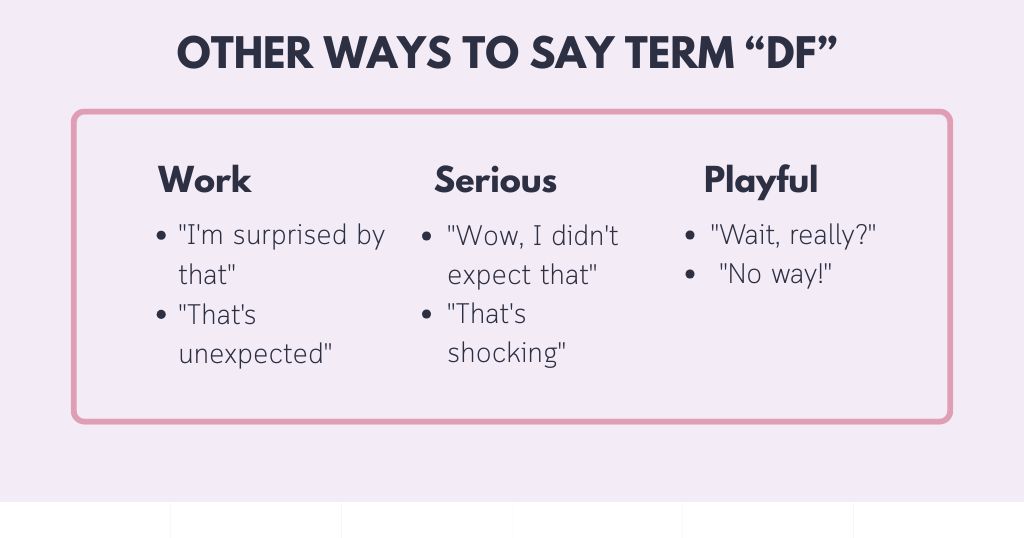
Better alternatives for these situations:
- At work: “I’m surprised by that” or “That’s unexpected”
- In serious talks: “Wow, I didn’t expect that” or “That’s shocking”
- With new people: “Wait, really?” or “No way!”
- Publicly: Just skip the comment or use “This is wild”
If you’re constantly second-guessing abbreviations at work, you’re not alone. Terms like BYW and TBC work in professional emails, but DF? Never.
DF Isn’t Always Slang: Other Meanings That Matter
Sometimes “DF” has nothing to do with cursing. If you’re in a statistics class and see “df = 15” in your notes, that’s “degrees of freedom,” a math concept. It shows up in data analysis and has zero connection to texting slang.
In some Roblox communities, players talk about “DF” when they mean rare items or specific game features. The context makes it obvious they’re not cursing.
On dating apps or in bio sections, you might see someone write “DF” to mean “drug-free.” It’s their way of sharing lifestyle info.
In business or tech contexts, it could stand for “data file” or relate to digital systems. If someone’s talking about computers and types “check the DF,” they’re probably not swearing.
The point is: if the conversation has nothing to do with emotions or reactions, “DF” probably means something technical instead.
Does Platform Change What DF Means in Text?
Instagram: Usually shows up in comments as a reaction to wild posts. Someone shares a transformation photo or a shocking before-and-after, and comments say “DF” to express amazement.
Snapchat: More likely to appear in one-on-one chats as a quick response. If you send a snap of something crazy happening, you might get “df??” back. Some friend groups also use it to mean “don’t flirt” as a jokey boundary thing, but that’s less common.
TikTok: You’ll see it in comments under confusing or bizarre videos. It’s the text version of the confused face people make. Sometimes creators put “DF does this even mean” in their captions when they’re genuinely puzzled by a trend.
WhatsApp: Works the same as regular texting. Shows up in group chats when someone shares news that makes no sense or when plans change suddenly.
Gaming chats (Discord, Roblox, etc.): Usually used the same way as texting—reacting to something unexpected during gameplay. If a teammate makes a strange move or a game glitches, someone might type “df just happened?”
The platform doesn’t change the core meaning much, but it does affect how casual or public your use of it is.
Read Also: What Does OTG Mean in Text? (It’s Not Always “On the Go”)
Why People Get DF Wrong (And How to Avoid It)
People think it’s always aggressive. It’s not. Tone matters more than the words themselves. “DF that’s amazing!” is positive shock, not anger.
Some assume it’s directed at them personally. Usually it’s about the situation, not you. If someone says “df is going on with this weather,” they’re not blaming you for the rain.
Older generations might not know it’s slang. If your aunt sees “DF” somewhere, she might think it’s an abbreviation for something formal. The generation gap is real with this one.
It gets confused with other acronyms. In certain contexts, people mix it up with technical terms or think it’s a typo. Always check what the conversation’s about before jumping to conclusions. Just like people mix up NM meaning or wonder if MFS is even real, DF gets lumped in with technical terms when the context isn’t clear.
Overusing it kills the impact. If you respond “df” to everything, it stops meaning anything. It becomes background noise instead of an actual reaction.
What to Say Back When Someone Sends You DF
If it seems playful: Match their energy. “I know right??” or “It’s wild” keeps the vibe going.
If you’re not sure: Ask for clarity. “Wait, are you confused or mad?” isn’t awkward, it’s smart communication. Same approach works when you get NP in text and it feels off, or someone hits you with WSP out of nowhere—just ask.
If they seem annoyed: Address whatever triggered it. “My bad, let me explain” or “Sorry, that came out wrong” shows you’re paying attention.
If it’s about something you shared: Give context. They’re reacting to incomplete information, so fill in the gaps.
In a group chat: You can ignore it if ten other people are responding, or jump in with your own reaction if you’ve got something to add.
Examples Texts That Show DF in Action
Scenario 1: Your friend texts you a photo of a $15 smoothie.
You: “df, that better cure diseases”
Scenario 2: Someone in the group chat says they’re bringing their new partner to game night without asking.
Group member: “df? we don’t even know them”
Scenario 3: Your coworker shares in Slack that the meeting got moved to 6 AM.
You: don’t respond with DF here, just say “Is that a typo?”
Scenario 4: Your sister tells you she’s dropping out of college to become a professional gamer.
You: “df, are you serious or is this a bit?”
Scenario 5: A mutual friend screenshots a ridiculous DM they got.
You: “DF is wrong with people”
Scenario 6: Your gaming teammate explains why they suddenly quit the match.
You: “df happened? we were winning”
Notice how the examples sound like actual conversations, not scripted responses. That’s the key to using “DF” right.
Read More: What Does PFP Mean in Text? The Two Definitions You Need to Know
Who’s Actually Using DF (And Who Isn’t)
Younger texters (teens to late twenties) use “DF” way more than older folks. If you’re over 40 and suddenly start using it, it might seem like you’re trying too hard unless it’s already natural for you.
It’s more common in informal friend groups than in mixed-age chats. Family group texts with your parents and grandparents? Probably skip it.
People who text fast tend to use more abbreviations like this. If you’re someone who types out full sentences with proper punctuation, “DF” might not fit your style anyway. Just like IMHO or AFAIK feel more natural to some people than others.
Questions People Actually Ask About DF
Is DF always rude or offensive?
Not always. It’s casual and includes a curse word, so it’s inappropriate for formal settings, but among friends it’s often just expressive. The rudeness depends entirely on tone and context.
Can you use DF sarcastically?
Absolutely. “Oh DF, you actually showed up on time for once” is clearly sarcastic teasing if that’s your dynamic with someone.
Does DF mean the same thing everywhere?
The core meaning stays consistent, but how acceptable it is varies. In professional spaces it’s never okay, in friend groups it’s usually fine, and with strangers it’s risky.
What if someone uses DF and I don’t curse?
You don’t have to match their language. Respond however you normally would. They’re not expecting you to curse back.
Is it outdated or still current?
Still current as of 2026. Texting slang evolves fast, but “DF” has stuck around because it’s short and punchy.
What does it mean when a girl texts DF?
Same thing as when anyone texts it. There’s no secret gendered meaning. It’s a reaction to whatever just happened in the conversation.
Bottom Line on Understanding DF
You came here confused about two letters, and now you know “DF” is basically a gut reaction in text form. It’s shock, confusion, or annoyance compressed into the smallest possible package. Whether you use it yourself depends on your style, your relationship with who you’re texting, and whether you’re okay with casual cursing in your messages.
Just remember that tone doesn’t translate automatically in text, so when in doubt, add context or use something clearer. Save “DF” for people who already know how you communicate, and you’ll be fine.

I’m Hazel, and I studied BSC English at GCUF. I focus on explaining word meanings in simple, clear language that anyone can understand. My goal is helping readers grasp everyday English, confusing terms, and slang used in real conversations and social media. I believe language learning works best when definitions connect to actual life situations. Through careful research and straightforward explanations, I make vocabulary accessible for students, learners, and anyone curious about how English really works in daily use.