

OMK usually means “On My Knees” in texting and social media. People use it to show extreme admiration or attraction, often in a flirty or playful way when reacting to someone they find incredibly appealing.
You’re Not the Only One Confused by “OMK”
OMK shows up in the most random places, group chats, comments, even DMs and it can catch you off guard. It often appears in comment sections or replies, especially when people are reacting quickly. It’s not as straightforward as LOL or BRB, and it’s definitely trickier than something like FR or NP. The tricky part? OMK doesn’t just have one meaning—it changes completely depending on who’s using it and where they’re typing it.
What makes this acronym weird is that it can be super flirty in one context and mean something totally unrelated in another. You might see it under a celebrity’s Instagram photo, in a gaming Discord server, or even in a news headline about military families. Same three letters, completely different worlds.
The Real Story Behind “OMK”
In casual texts, OMK is usually used to express strong attraction or admiration. It’s dramatic, yeah, but that’s kind of the point. The phrase captures that feeling when you see someone so attractive that you lose all chill.
People choose this over just saying “they’re hot” because it adds humor and exaggeration. It’s self-aware and a bit ridiculous, which makes it funnier than a straightforward compliment. The term lets you be thirsty without taking yourself too seriously.
Unlike “OMG,” which shows general surprise, OMK is specifically about desire or admiration. It’s got a flirty edge built right in. Think of it as the texting equivalent of that cartoon character whose jaw drops to the floor—it’s over-the-top on purpose.
Read Also: What Does IGH Mean in Text? (It’s Not What You Think)
Where You’ll Actually See “OMK” Pop Up
You’ll mostly see OMK when someone’s reacting to visual content. A friend posts a photo looking good? OMK might appear in the comments. Someone shares a picture of their celebrity crush? That’s prime OMK territory.
In group chats, it’s the go-to reaction when everyone’s collectively losing it over someone’s appearance. One person starts with OMK, and suddenly three other people are agreeing. It creates this shared moment of appreciation.
People also use it as a caption for their own posts when they’re feeling themselves. Posting a good selfie with “OMK for this lighting” is a playful way to acknowledge you know you look great. It’s confident without sounding arrogant because the humor keeps it light.
The phrase works in DMs too, especially when flirting. Responding to someone’s photo with just “omk” tells them exactly what you’re thinking without having to spell it out.
Why Tone & Context Changes Everything with “OMK”
Here’s where people mess up. OMK always sounds flirty or thirsty, so using it in the wrong situation gets awkward fast.
When it sounds playful:
Between friends joking around, under influencer posts, or in fan communities obsessing over celebrities. The vibe is lighthearted and exaggerated.
When it gets weird:
If you’re not close with someone, dropping OMK can come off creepy or too intense. Commenting it on a coworker’s LinkedIn headshot? Absolutely not. Using it with someone you just met? They’ll probably think you’re coming on way too strong.
Misinterpretation warning:
If the other person doesn’t know this slang, they might think you made a typo or they’ll Google it and find completely different meanings (more on that below). You could accidentally confuse someone who thinks you’re talking about a military charity or a scientific term.
The relationship context matters big time. OMK from your best friend who hypes you up constantly? Sweet and funny. OMK from a random person who barely knows you? Uncomfortable.
Tone also shifts based on who you’re talking about. “OMK for Pedro Pascal” sounds like normal internet behavior. “OMK for my chemistry teacher” sounds inappropriate and strange.
More Post: What Does MFS Mean? Guide to This Confusing Acronym
Places Where “OMK” Will Make Things Awkward
Skip OMK completely in these situations:
Professional settings: Work emails, LinkedIn messages, team Slack channels, or anything involving your boss, clients, or professional contacts. Even if your workplace is casual, this crosses a line.
With people you don’t know well: Acquaintances, classmates you barely talk to, or anyone who might misread your intentions. What feels like a joke to you could feel like unwanted attention to them.
Serious conversations: If someone shares bad news, personal struggles, or anything emotionally heavy, OMK is wildly inappropriate. It’s a playful term that requires a playful context.
Public comments on non-celebrities: Commenting OMK on a stranger’s public post (especially someone who isn’t a public figure) can feel invasive. They didn’t ask for that kind of attention.
When you’re not sure about the dynamic: If you have to wonder whether it’s okay, it’s probably not. OMK requires established comfort and shared understanding of the joke.
Use regular compliments instead: “You look great,” “Love this photo,” or “You’re killing it” work in way more situations without the risky undertones.
Say It Different: Other Ways to Express the Same Vibe
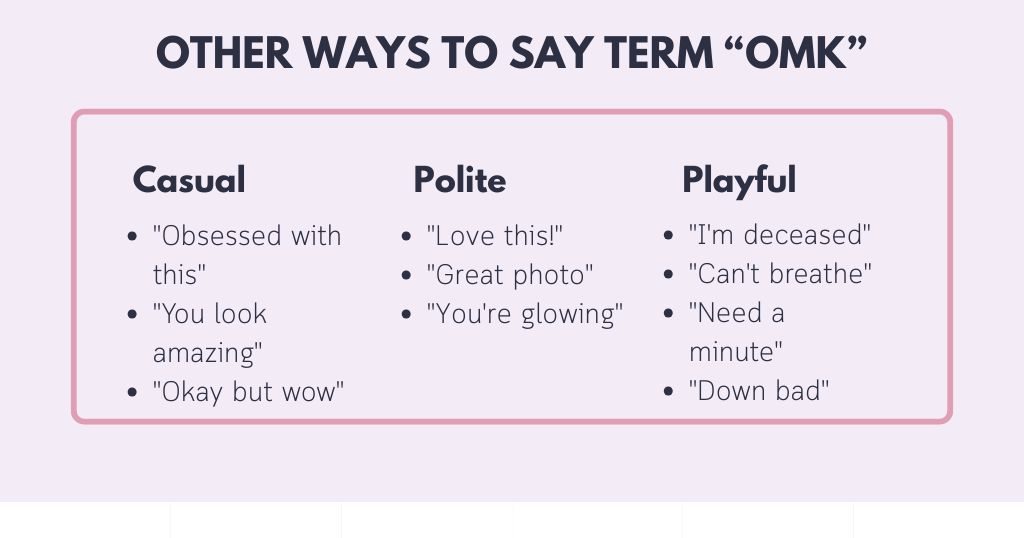
Casual/Friendly:
- “Obsessed with this”
- “You look amazing”
- “Okay but wow”
- “Respectfully looking” (internet humor)
Polite/Safe:
- “Love this!”
- “Great photo”
- “You’re glowing”
- Simple emoji reactions (🔥, ❤️, 😍)
Playful/Joking (similar energy):
- “I’m deceased”
- “Can’t breathe”
- “Need a minute”
- “Down bad” (similar vibe, different phrase)
- “I’m deceased” or DKM (dead from laughing, similar dramatic energy)
When you want to be clear:
- “You’re gorgeous”
- “Looking incredible”
- Just saying what you mean in actual words
Read More: What Does Camp Mean in Text? Decode the Slang Before You Use It
Real Conversations People Actually Have
Scrolling through Instagram, see a celebrity’s new photoshoot
Comment: “omk he’s unreal 😭”
Friend sends a selfie in the group chat
You: “OMK STOP you look so good”
Them: “STOPP you’re lying”
Reacting to a movie scene with an attractive actor
Text to friend: “just watched that scene omk i need to sit down”
Someone posts gym progress photos
Comment: “the dedication!! omk 💪”
Or you might see something like thicc used in similar contexts where people are admiring physical appearance.
Caption on your own post when you’re feeling confident
Your caption: “golden hour got me like… omk for natural lighting”
In a fan account comment section
Person 1: “new interview just dropped”
Person 2: “omk the outfit though??”
DM reaction to someone’s story
You: “omk where’d you get that jacket”
Friend shows you their Tinder match
You: “okay omk I see why you swiped right”
Wait, “OMK” Doesn’t Always Mean That?
Here’s where it gets messy. OMK doesn’t always mean what you think.
In completely different contexts: In Arabic-speaking communities, OMK can be shorthand for a very harsh insult involving someone’s mother. If you see this in a heated argument on Instagram or TikTok comments, it’s not the cute English slang—it’s a serious insult. The tone and context will usually make this obvious, but it’s worth knowing this meaning exists to avoid confusion.
Military and charity spaces: “Our Military Kids” or “Operation: Military Kids” are real programs supporting children of deployed service members. If you’re reading news articles or donation pages and see OMK, this is what they mean.
Gaming communities: In certain games like DayZ, OMK refers to specific gear or clothing items. You’ll see this in gaming forums and Discord servers focused on that game.
Scientific writing: “Owl Monkey Kidney” cells (OMK cells) show up in biology research papers. Unless you’re reading medical journals, you won’t run into this one.
Fan communities: Some Tokio Hotel fans use “Oh My Kaulitz” (referencing the band members’ last name) as their version of OMG. This is super niche and you’ll only see it in dedicated fan spaces.
The platform usually tells you which meaning applies. TikTok comments? Probably the slang. A news website? Probably the organization. A research paper? Definitely the science term. Context clues matter just as much as they do with terms like OT or ND, which also shift meaning based on where you see them.
Does Age or App Choice Change How “OMK” Gets Used?
OMK feels most natural on Instagram, TikTok, and Twitter. These platforms thrive on quick reactions and visual content, which is exactly when people use this phrase. Snapchat sees it too, but less frequently.
You probably won’t see it much on Facebook or LinkedIn. The demographics skew older or more professional, and OMK hasn’t really crossed over to those spaces.
Discord use varies. In casual friend servers or fan communities, OMK shows up. In gaming servers, it might mean something completely different (back to that gear reference).
Age matters here. If you’re under 30 and chronically online, you probably know this slang. If you’re older or don’t spend much time on social media, you might’ve never encountered it. That gap can create confusion when someone uses it assuming everyone knows what it means.
The phrase feels more common among women and LGBTQ+ communities, where playful thirst comments are normalized. Straight guys use it too, but less frequently—they’re more likely to just say “she’s hot” directly.
Read Also: What Does SMB Mean in Text? The Answer Nobody Actually Explains
Why People Get “OMK” Wrong (And How to Avoid It)
People think it’s a typo: If someone’s never seen OMK before, they might assume you meant OMG and your finger slipped—kind of like how people confuse BYW with BTW or wonder if YHU is just a typo for “you”. They’ll just ignore it or correct you, missing your point entirely.
Tone gets lost: Without facial expressions, OMK can feel more intense than you intended.
Overuse kills the impact: If everything is OMK, it stops feeling special. The phrase works because it’s supposed to represent peak admiration—use it for actual peak moments.
Context confusion: Seeing OMK without context is confusing. Is this flirty? Friendly? A typo? An acronym for something else? The surrounding conversation matters, but people don’t always provide enough of it.
Cultural mismatches: If you use the English slang OMK in a space where people primarily speak Arabic or another language, you risk serious miscommunication. Always consider who you’re talking to.
Different generations: Your mom probably has no idea what OMK means in slang terms. Using it with someone outside your age group often requires explanation, which kills the casual vibe.
Your Burning Questions About “OMK”
Is OMK rude or disrespectful?
Not in casual contexts between friends or in fan spaces, but it can be if you use it inappropriately. Commenting it on someone’s professional content or using it with people who don’t welcome that kind of attention crosses boundaries.
Can guys use OMK or is it mainly a girl thing?
Anyone can use it. It’s slightly more common in women-dominated online spaces, but guys use it too—sometimes ironically, sometimes genuinely. It’s not gendered, just less universal than something like LOL.
Does it always mean you’re attracted to someone?
Mostly, yeah. The core meaning revolves around admiration or desire. You might occasionally see it used for non-romantic things (like “OMK this pizza”), but that’s playing with the phrase rather than using it straight.
Is it the same as simping?
Similar energy, different concept. Simping implies doing too much for someone who doesn’t reciprocate. OMK is just expressing attraction, no action required. You can be OMK for someone without simping.
Will older people understand this?
Probably not unless they’re very online. It’s generational slang that hasn’t broken into mainstream vocabulary. If you use it with someone over 40, be ready to explain.
Can it be sarcastic?
Sometimes people use it sarcastically to mock someone being overly thirsty, but this requires really clear context. Sarcasm in text is risky because tone doesn’t translate well. Most of the time, people mean it genuinely.
Bottom Line on Using “OMK” in Texts
OMK works when everyone’s in on the joke and the situation calls for playful exaggeration. It’s internet language for “this person is so attractive I’ve lost all composure,” wrapped in humor so it doesn’t sound too serious. Know your audience, read the room, and you’ll be fine. When in doubt, regular words work just as well.

I’m Hazel, and I studied BSC English at GCUF. I focus on explaining word meanings in simple, clear language that anyone can understand. My goal is helping readers grasp everyday English, confusing terms, and slang used in real conversations and social media. I believe language learning works best when definitions connect to actual life situations. Through careful research and straightforward explanations, I make vocabulary accessible for students, learners, and anyone curious about how English really works in daily use.