

PPL is shorthand for “people.” It’s one of the most common text abbreviations you’ll see in messages, comments, and casual online conversation.
You Saw “PPL” and Now You’re Here
You saw “ppl” in a text or comment and paused for a second. Maybe someone wrote “why are ppl like this” or “met so many new ppl tonight,” and you’re wondering if there’s more to it than just a shortened word. Or maybe you’re noticing it everywhere and want to know if you’re missing something. It’s like seeing OTG in a message and assuming it always means “on the go” context matters.
You’re not alone. The term pops up constantly, but what throws people off is that it can mean totally different things depending on where you see it. In a gym chat, it’s a workout plan. In medical notes, it’s an allergy test. But in everyday texting? It’s just “people,” plain and simple.
The Real Vibe Behind Typing “PPL” Instead of People
When someone types “ppl” instead of spelling out “people,” they’re usually moving fast. It’s the typing equivalent of talking quickly with a friend. There’s no special emotion attached to it most of the time—it’s just easier.
But here’s the thing: using “ppl” also signals something about the conversation. It says “we’re being casual here.” If someone suddenly starts spelling everything out completely in a group chat, it can feel stiff or even a little cold. The abbreviation keeps things light and flowing.
People also use it when they’re making observations about human behavior in general. “Ppl are so weird about coffee orders” or “some ppl never reply to texts” — it creates a tiny bit of distance, like you’re commenting on the world rather than calling out specific individuals.
Where This Shortcut Actually Shows Up
You’ll see “ppl” show up naturally in:
Quick reactions — “Wait, ppl actually eat that?”
Complaints or venting — “Why do ppl leave their carts in parking spots?”
Sharing experiences — “There were way too many ppl at the mall today”
General statements — “Ppl change, that’s just life”
It fits into the rhythm of texting because it’s fast to type and doesn’t interrupt the flow. Most people don’t even think about it anymore—it’s automatic, like saying “gonna” instead of “going to” when you talk.
The key is that it almost always appears in informal spaces. You won’t see it in work emails, professional messages, or anything where you’re trying to sound polished.
Related: What Does OMK Mean in Text? Here’s What It Actually Means in 2026
Tone & Context: Why “PPL” Can Feel Different Every Time
Here’s where things get tricky. The same sentence can land completely differently based on who you’re talking to and what’s going on.
“Some ppl just don’t understand” could be:
- A casual observation between friends
- A passive-aggressive jab in an argument
- A genuine expression of frustration
The tone doesn’t come from the word itself. It comes from everything around it—punctuation, timing, and your relationship with the person.
Watch out for misreads: If you’re texting someone you don’t know well, using “ppl” in a serious conversation can make you seem dismissive. Imagine telling a coworker who’s upset, “That’s just how ppl are.” It sounds like you’re brushing them off, even if you don’t mean it that way.
When it sounds harsh: Overusing “ppl” when you’re talking about specific people can come off cold. “Those ppl didn’t even try” feels more cutting than “they didn’t even try.” The abbreviation can create emotional distance you might not intend.
Times When “PPL” Makes You Look Bad
Skip “ppl” completely in these situations:
Work emails or messages to your boss. Even if your workplace is casual, this abbreviation makes you sound like you’re texting a friend, not communicating professionally. Write “people” instead.
Serious or sensitive conversations. If someone’s going through something difficult, using shortcuts can make it seem like you’re not taking them seriously. “I’m here if you need to talk about ppl at work” feels way less supportive than taking the extra second to type it out.
First messages to someone new. Whether it’s a dating app, a potential client, or a new classmate, starting with abbreviations sets the wrong tone. It’s too casual too fast. Same goes for YWD it can sound dismissive if you don’t know the person well.)
Public posts where you want to sound credible. If you’re sharing information or making a point you want people to take seriously, “ppl” undermines that. It works for casual observations but not when you’re trying to be heard.
Anytime you’re already frustrated. If you’re annoyed and typing fast, “ppl” can accidentally make you sound more irritated than you are. It’s a small thing, but it adds up.
Read More: GP Meaning in Text: That Changes Based on Who Sent It
Saying the Same Thing PPL, Just Differently
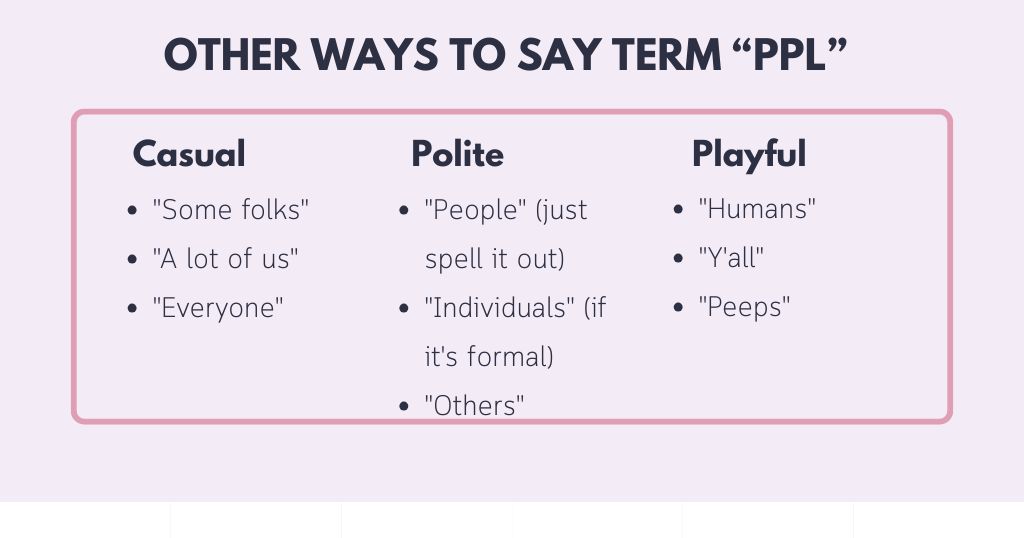
When you want to sound friendly:
- “Some folks”
- “A lot of us”
- “Everyone”
When you’re being polite or professional:
- “People” (just spell it out)
- “Individuals” (if it’s formal)
- “Others”
When you’re being playful:
- “Humans”
- “Y’all”
- “Peeps” (which has its own casual vibe—similar to how PFP has two totally different meanings depending on context)
You don’t need to overthink this. The rule is simple: if you’d say it out loud to that person, you can probably type it.
Actual Messages People Send With PPL
“Too many ppl at the coffee shop rn, going somewhere else”
“Ppl really be posting everything on social media”
“Some ppl never learned to merge in traffic”
“Met a bunch of new ppl at the party last night”
“Do ppl still use that app?”
“Why are ppl obsessed with that show?”
“Can’t believe how many ppl showed up”
“Ppl keep asking me the same question”
Notice how each one sounds like something you’d actually see in a text. They’re not trying to be clever or force the term in—they just flow naturally.
Does Your Age or App Change How “PPL” Lands?
“Ppl” has been around since texting started getting popular in the early 2000s. Back then, people shortened words to save characters because texts had limits. That’s not really an issue anymore, but the habit stuck.
Younger users type it without thinking. For them, it’s just how you write in casual spaces. Older folks might spell it out more often, not because they don’t know the abbreviation, but because they’re used to different typing habits.
On Instagram or Twitter, you’ll see it constantly in comments. On Snapchat, it shows up in story captions. In group chats, it’s everywhere. The platform doesn’t really change the meaning—it’s more about the speed and casualness of the conversation.
One interesting shift: some people now intentionally spell out “people” in casual texts to sound warmer or more thoughtful. It’s like they’re slowing down for a second to be more present in the conversation.
Read Also: What Does IR Mean in Text? Here’s What People Actually Use It For
Misreading “PPL”: What Goes Wrong and Why
“Does it make me sound lazy?”
Not to most people. It’s just standard texting language at this point. The only time it might come across as lazy is if you’re typing it in a situation that calls for more effort—like a thank-you message or an apology.
“Is it always about actual people?”
In texting, yes. But if you see “PPL” in all caps, especially in a fitness or professional context, it might mean something totally different. Kind of like how GG doesn’t always mean “good game” anymore, or how IGHT changes based on tone. In the gym, it stands for “Push, Pull, Legs,” which is a workout routine. In business, it can mean “Pay Per Lead.” Context is everything.
“Can it sound rude?”
It can, but usually not on its own. It’s more about what you’re saying and how. “Some ppl are so annoying” has the same tone whether you write “ppl” or “people.” The rudeness is in the statement, not the abbreviation.
“Why do some people use it in every sentence?”
Typing habits. Once you start using shortcuts, they become automatic. Some people type “ppl” so often they don’t even notice. It’s like saying “like” or “um” when you talk—it just happens. It’s the same reason people constantly use NM or WTV without thinking twice.
Wait, PPL Means Something Else Outside Texting?
Just so you’re not confused if you see it somewhere unexpected:
In the gym: Push, Pull, Legs. It’s a way to organize workouts. One day you do pushing exercises (chest, shoulders), the next day pulling (back, biceps), then legs. If a friend texts “starting PPL tomorrow,” they’re talking about their gym routine, not a group of people.
In aviation: Private Pilot License. It’s the certification that lets someone fly small planes for fun. You’ll only see this if you’re around people who are into flying.
In medical settings: Penicilloyl Polylysine. It’s used in allergy testing for penicillin. Unless you’re in healthcare, you probably won’t come across this one.
In marketing: Pay Per Lead. Companies pay for each potential customer they get. Businesspeople might text about “PPL campaigns” when they’re talking about advertising.
The thing is, if you’re just texting with friends, “ppl” means people 99% of the time. The other meanings only show up in specific professional or hobby contexts.
Replying When Someone Drops “PPL” in the Chat
If it’s casual small talk:
Just keep the same energy. If they wrote “so many ppl here,” you can say “yeah it’s packed” or whatever fits.
If it feels off or cold:
Don’t read too much into the abbreviation itself. Look at the whole message. If something seems wrong, it’s probably the content, not the shorthand.
If you’re not sure what they mean:
Ask. “Wait, are you talking about people or your gym thing?” clears it up fast and doesn’t make things weird. Just like you’d clarify what someone means by DTM better to ask than assume.
If it’s in a professional setting:
Match their tone if they used it first, but don’t start using it yourself in work messages. Let them set the level of casualness.
Final Thoughts on This Tiny Abbreviation
“Ppl” is just a faster way to say people. It’s been around for years, it’s not going anywhere, and most of the time it doesn’t mean anything deeper than “I’m typing quickly in a casual conversation.”
The main thing to remember is context. In a text to a friend, it’s completely normal. In an email to your professor or boss, spell it out. When you’re venting, it keeps things light. When you’re being serious, sometimes taking the extra second to type the full word shows you care.
You don’t need to overthink it. If it feels natural for the conversation you’re having, use it. If it doesn’t, don’t. That’s really all there is to it.
Questions People Actually Ask About “PPL”
Is “ppl” considered rude or unprofessional?
Not in casual texts, but yes in professional settings. Save it for friends and informal chats.
Can “ppl” be sarcastic?
The term itself isn’t sarcastic, but the sentence can be. “Oh sure, because ppl always tell the truth” is sarcastic because of the context, not the abbreviation.
Does it mean the same thing everywhere?
In texting, yes—it’s “people” worldwide. But in specific fields like fitness or business, PPL can mean something completely different.
Do younger people use it more than older people?
Generally, yes. It’s a texting habit that started with character limits, and younger generations grew up typing this way.
Should I use it when texting someone for the first time?
Probably not. Start with full words until you get a feel for how casual they are. You can always loosen up later.
Is there a difference between “ppl” and “peeps”?
Kind of. “Ppl” is neutral and just means people. “Peeps” is more playful and feels a bit more friendly or cutesy. Use “peeps” when you’re being extra casual or joking around.

I’m Hazel, and I studied BSC English at GCUF. I focus on explaining word meanings in simple, clear language that anyone can understand. My goal is helping readers grasp everyday English, confusing terms, and slang used in real conversations and social media. I believe language learning works best when definitions connect to actual life situations. Through careful research and straightforward explanations, I make vocabulary accessible for students, learners, and anyone curious about how English really works in daily use.