


Math vocabulary beginning with C covers nearly every branch of the subject from basic geometry and arithmetic to advanced statistics and abstract algebra. This guide gives you 60+ verified math terms, each with a clear definition, example, and classroom use.
Quick List: 60+ Math Words That Start With C
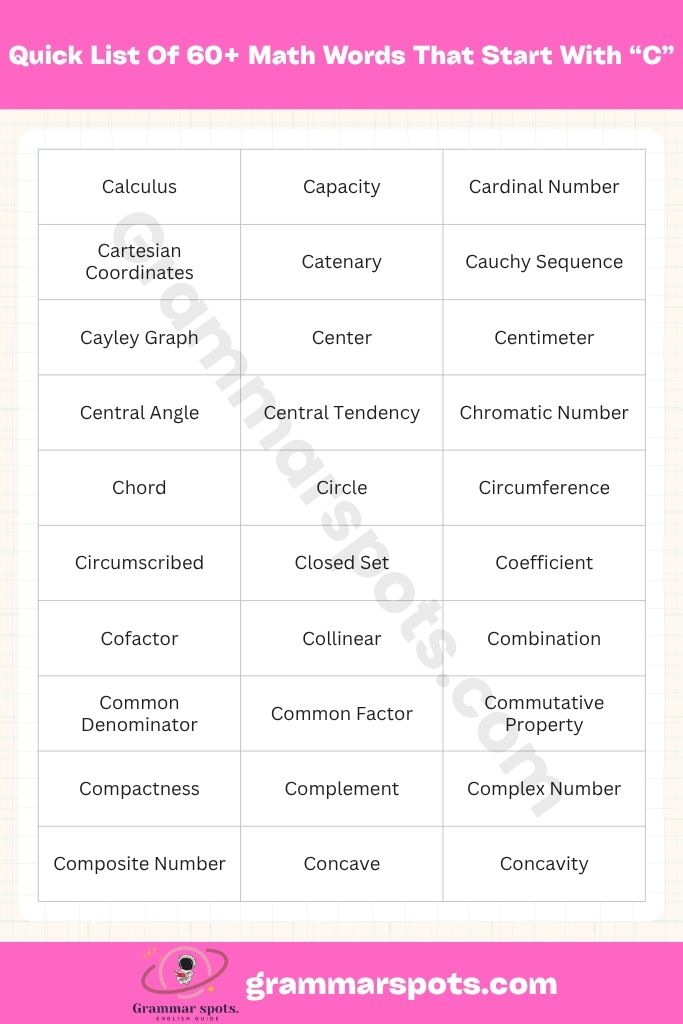
- Calculus
- Capacity
- Cardinal Number
- Cartesian Coordinates
- Catenary
- Cauchy Sequence
- Cayley Graph
- Center
- Centimeter
- Central Angle
- Central Tendency
- Chromatic Number
- Chord
- Circle
- Circumference
- Circumscribed
- Closed Set
- Coefficient
- Cofactor
- Collinear
- Combination
- Common Denominator
- Common Factor
- Commutative Property
- Compactness
- Complement
- Complex Number
- Composite Number
- Concave
- Concavity
- Congruent
- Conic Section
- Constant
- Convergence
- Coordinate
- Coplanar
- Correlation
- Cosecant
- Cosine
- Cotangent
- Counterexample
- Covariance
- Cross Product
- Cube
- Cube Root
- Cyclic Group
- Cylinder
- Commutator
- Cofactor
- Circumradius
- Collinearity
- Complementary Angles
- Convex
- Corollary
- Counting Numbers
- Cramer’s Rule
- Critical Point
- Cross-Section
- Cumulative Frequency
- Cyclic Quadrilateral
- Cylindrical Coordinates
Common Math Words That Start With C
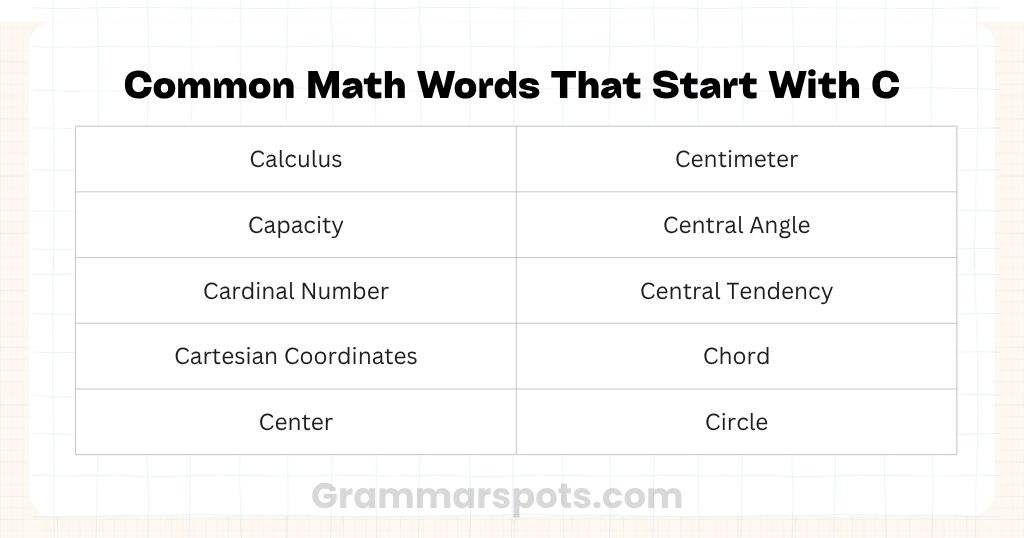
Calculus
Meaning: The branch of mathematics dealing with rates of change (differentiation) and accumulation (integration).
Example: Finding how fast a balloon expands as air is added uses calculus.
Why it matters: Foundation of physics, engineering, and economics.
Capacity
Meaning: The maximum volume a container can hold.
Example: A water bottle has a capacity of 1 liter.
Why it matters: Used in everyday measurement and unit conversion problems.
Cardinal Number
Meaning: A number that tells how many items are in a set.
Example: The cardinal number of {a, b, c} is 3.
Why it matters: Distinguishes counting size from ordering position.
Cartesian Coordinates
Meaning: A system for locating points using two perpendicular axes (x and y).
Example: The point (3, −2) is 3 units right and 2 units down from the origin.
Why it matters: All standard graphing depends on this system.
Center
Meaning: The point equidistant from all points on a circle or sphere.
Example: The center of x² + y² = 25 is (0, 0).
Why it matters: Used in circle geometry, statistics, and data distributions.
Centimeter
Meaning: A metric unit of length equal to one-hundredth of a meter.
Example: A standard pencil is about 19 centimeters long.
Why it matters: Common in measurement problems at all school levels.
Central Angle
Meaning: An angle with its vertex at the center of a circle and sides along two radii.
Example: A 90° central angle cuts off one-quarter of the circle.
Why it matters: Used to calculate arc length and sector area.
Central Tendency
Meaning: A value that represents the center of a data set mean, median, or mode.
Example: For {4, 6, 6, 8, 10}, the mean is 6.8.
Why it matters: Starting point for all statistical analysis.
Chord
Meaning: A line segment connecting two points on a circle’s circumference.
Example: A diameter is the longest chord in a circle.
Why it matters: Used in circle theorems and geometric proofs.
Circle
Meaning: A closed curve where every point is the same distance from the center.
Example: A coin is approximately circular.
Why it matters: Central to geometry, trigonometry, and real-world design.
Circumference
Meaning: The distance around the outside of a circle. Formula: C = 2πr.
Example: A circle with radius 5 cm has circumference ≈ 31.4 cm.
Why it matters: Introduces π and connects geometry with measurement.
Circumscribed
Meaning: A shape drawn around another, touching all its outer vertices.
Example: A circumscribed circle passes through all three vertices of a triangle.
Why it matters: Used in geometric constructions and design.
Circumradius
Meaning: The radius of the circle circumscribed around a polygon.
Example: The circumradius of an equilateral triangle with side 6 is 2√3.
Why it matters: Used in triangle geometry and trigonometric identities.
Coefficient
Meaning: The number multiplying a variable in an algebraic expression.
Example: In 7x², the coefficient is 7.
Why it matters: Essential for solving equations and simplifying expressions.
Collinear
Meaning: Three or more points lying on the same straight line.
Example: Points (1,1), (2,2), and (3,3) are collinear.
Why it matters: Tested in coordinate geometry and proofs.
Combination
Meaning: A selection of items where order does not matter. Formula: C(n,r) = n! / r!(n−r)!
Example: Choosing 3 toppings from 10 options is a combination.
Why it matters: Core to probability and discrete mathematics.
Common Denominator
Meaning: A shared multiple of the denominators of two or more fractions.
Example: To add ½ + ⅓, use 6 as the common denominator.
Why it matters: Required for adding and subtracting fractions.
Common Factor
Meaning: A number that divides two or more numbers exactly.
Example: Common factors of 12 and 18 are 1, 2, 3, and 6.
Why it matters: Used in simplifying fractions and factoring expressions.
Commutative Property
Meaning: Changing the order of numbers does not change the result in addition or multiplication.
Example: 4 + 9 = 9 + 4 and 3 × 7 = 7 × 3.
Why it matters: One of the fundamental laws of arithmetic.
Complement
Meaning: In set theory, all elements not in a given set. In geometry, two angles summing to 90°.
Example (Set): If U = {1–5} and A = {1,2}, complement of A = {3,4,5}.
Example (Geometry): 35° and 55° are complementary angles.
Why it matters: Used in both probability and geometry.
Complementary Angles
Meaning: Two angles whose measures add up to exactly 90°.
Example: A 40° angle and a 50° angle are complementary.
Why it matters: Foundational in triangle geometry and trigonometry.
Complex Number
Meaning: A number in the form a + bi, where i = √(−1).
Example: 3 + 4i is a complex number.
Why it matters: Extends the real number system; used in engineering and advanced algebra.
Composite Number
Meaning: A whole number greater than 1 with more than two factors.
Example: 12 is composite it factors as 1×12, 2×6, 3×4.
Why it matters: Contrasts with prime numbers; used in factoring and cryptography.
Concave
Meaning: A shape or polygon that curves inward with at least one interior angle greater than 180°.
Example: A star polygon is concave.
Why it matters: Distinguishing concave from convex shapes matters in geometry and optics.
Congruent
Meaning: Two shapes that are identical in size and shape, regardless of position.
Example: Two triangles with equal sides and angles are congruent.
Why it matters: Used in proofs, constructions, and real-world design.
Conic Section
Meaning: A curve formed by slicing a cone producing a circle, ellipse, parabola, or hyperbola.
Example: A thrown ball follows a parabolic path.
Why it matters: Appears in physics (planetary orbits) and engineering (satellite dishes).
Constant
Meaning: A fixed value that does not change in an expression or equation.
Example: In y = 3x + 5, the number 5 is a constant.
Why it matters: Distinguishing constants from variables is basic to algebra.
Convergence
Meaning: A sequence or series approaches a fixed finite value.
Example: 1 + ½ + ¼ + ⅛ + … converges to 2.
Why it matters: Central to calculus and real analysis.
Convex
Meaning: A shape where all interior angles are less than 180° and no part curves inward.
Example: A regular hexagon is convex.
Why it matters: Used in geometry, optimization, and computer graphics.
Coordinate
Meaning: A number indicating position on a line or in a plane.
Example: In (4, 7), 4 is the x-coordinate and 7 is the y-coordinate.
Why it matters: Foundation of all graphing and spatial reasoning.
Coplanar
Meaning: Points or lines that all lie within the same plane.
Example: Any three non-collinear points are always coplanar.
Why it matters: Important in 3D geometry and spatial reasoning.
Corollary
Meaning: A statement that follows directly from a proven theorem, requiring little additional proof.
Example: The corollary to the Pythagorean theorem tells us that a triangle with sides 3, 4, 5 is a right triangle.
Why it matters: Used in formal mathematical proofs.
Correlation
Meaning: A measure of how strongly two variables are related, ranging from −1 to +1.
Example: Height and shoe size have strong positive correlation.
Why it matters: Core to statistics, data science, and research.
Cosine
Meaning: In a right triangle, the ratio of the adjacent side to the hypotenuse.
Example: cos(60°) = 0.5.
Why it matters: One of the three primary trigonometric ratios.
Counting Numbers
Meaning: The set of positive integers used to count: 1, 2, 3, 4, 5, …
Example: You use counting numbers when counting apples in a basket.
Why it matters: The most fundamental number set in mathematics.
Counterexample
Meaning: A single specific case that disproves a general statement.
Example: 2 disproves “all prime numbers are odd.”
Why it matters: One counterexample is enough to invalidate any universal claim.
Cube
Meaning: A 3D solid with six equal square faces, or a number raised to the power of 3.
Example: 4³ = 64. A dice is a cube.
Why it matters: Appears in volume problems and algebraic expressions.
Cube Root
Meaning: A value that, multiplied by itself three times, equals a given number.
Example: ∛27 = 3 because 3 × 3 × 3 = 27.
Why it matters: Used in volume calculations and radical expressions.
Cumulative Frequency
Meaning: A running total of frequencies in a data set, added up in order.
Example: If 5 students scored below 50 and 8 scored below 60, the cumulative frequency at 60 is 13.
Why it matters: Used to draw cumulative frequency graphs and find medians.
Cylinder
Meaning: A 3D shape with two parallel circular bases and a curved lateral surface.
Example: A soup can is a cylinder.
Why it matters: Volume and surface area of cylinders are standard geometry topics.
Related Post: 60+ Math Words That Start With A (With Meanings and Examples)
Advanced Math Words That Start With C
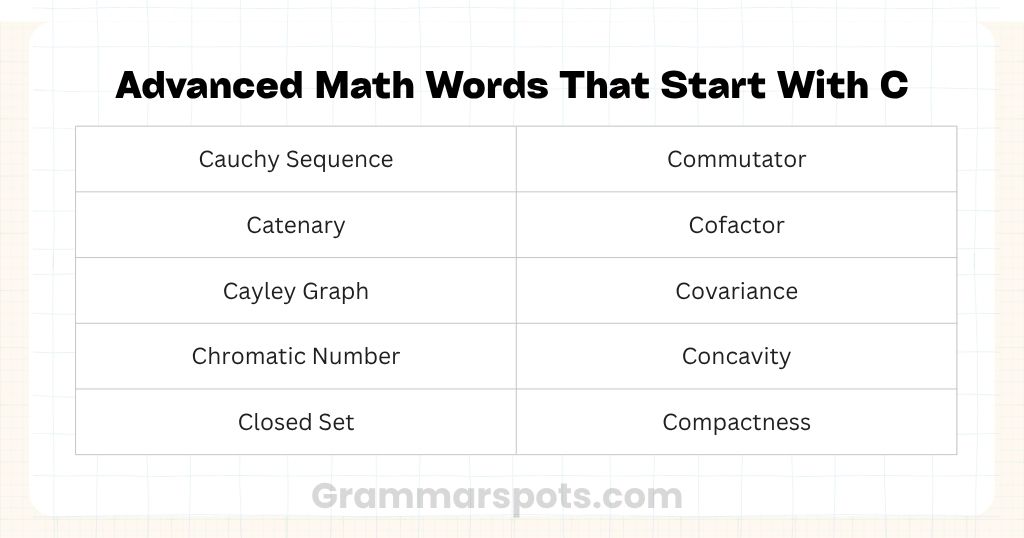
Catenary
Meaning: The curve formed by a hanging chain or cable under its own weight, described by hyperbolic cosine.
Example: The Gateway Arch in St. Louis follows a catenary curve.
Why it matters: Used in bridge and arch engineering.
Cauchy Sequence
Meaning: A sequence where terms become arbitrarily close to each other as the sequence progresses.
Example: The sequence 1, 1.4, 1.41, 1.414, … (approaching √2) is a Cauchy sequence.
Why it matters: Defines completeness of the real number system in analysis.
Cayley Graph
Meaning: A graph representing the structure of a mathematical group based on its generators.
Why it matters: Used in abstract algebra, computer science, and network design.
Chromatic Number
Meaning: The minimum number of colors needed to color a graph so no two adjacent vertices share a color.
Example: A map of four regions may need a chromatic number of 2 or 3.
Why it matters: Used in scheduling, frequency assignment, and map coloring problems.
Closed Set
Meaning: A set that contains all its limit points.
Example: The set [0, 1] (including endpoints) is closed.
Why it matters: Fundamental in topology and real analysis.
Cofactor
Meaning: The signed minor of an element in a matrix, used in computing determinants.
Why it matters: Essential for matrix inversion and solving linear systems.
Commutator
Meaning: In group theory, [a, b] = a⁻¹b⁻¹ab, measuring how far two elements are from commuting.
Why it matters: Used in abstract algebra and quantum mechanics.
Compactness
Meaning: A topological property: a set is compact if it is closed and bounded.
Example: The interval [0, 1] is compact; (0, 1) is not.
Why it matters: Central to proofs in analysis and functional mathematics.
Concavity
Meaning: In calculus, a function is concave up when f″(x) > 0 and concave down when f″(x) < 0.
Why it matters: Used to identify inflection points and curve behavior.
Covariance
Meaning: Measures how two variables change together. Positive = same direction; negative = opposite directions.
Formula: Cov(X, Y) = E[(X − μₓ)(Y − μᵧ)]
Why it matters: Used in finance and data science for risk modeling.
Cramer’s Rule
Meaning: A method for solving a system of linear equations using determinants.
Example: Used to solve 2×2 or 3×3 systems algebraically.
Why it matters: Provides a direct formula-based solution for linear systems.
Critical Point
Meaning: A point on a function where the derivative equals zero or is undefined.
Example: f(x) = x² has a critical point at x = 0.
Why it matters: Used to find maximum and minimum values in optimization.
Cross Product
Meaning: A vector operation producing a vector perpendicular to two given vectors in 3D space.
Why it matters: Used in physics (torque, magnetic force) and computer graphics.
Cyclic Group
Meaning: A group generated by repeated application of a single element.
Example: The integers mod 5 under addition form a cyclic group.
Why it matters: Foundational in abstract algebra and cryptography.
Cyclic Quadrilateral
Meaning: A four-sided polygon with all four vertices lying on a circle.
Example: The opposite angles of a cyclic quadrilateral always add to 180°.
Why it matters: Used in circle theorems and geometric proofs.
Cylindrical Coordinates
Meaning: A 3D coordinate system using radius, angle, and height (r, θ, z) instead of x, y, z.
Why it matters: Simplifies integration and geometry problems involving circular symmetry.
Geometry Terms
- Circle · Chord · Circumference · Circumscribed · Circumradius
- Central Angle · Collinear · Congruent · Conic Section · Convex · Concave
- Coordinate · Coplanar · Cross-Section · Cube · Cylinder
- Cyclic Quadrilateral · Complementary Angles
Related Post: 50+ Math Words That Start With B (With Meanings and Examples)
Algebra & Number Theory Terms
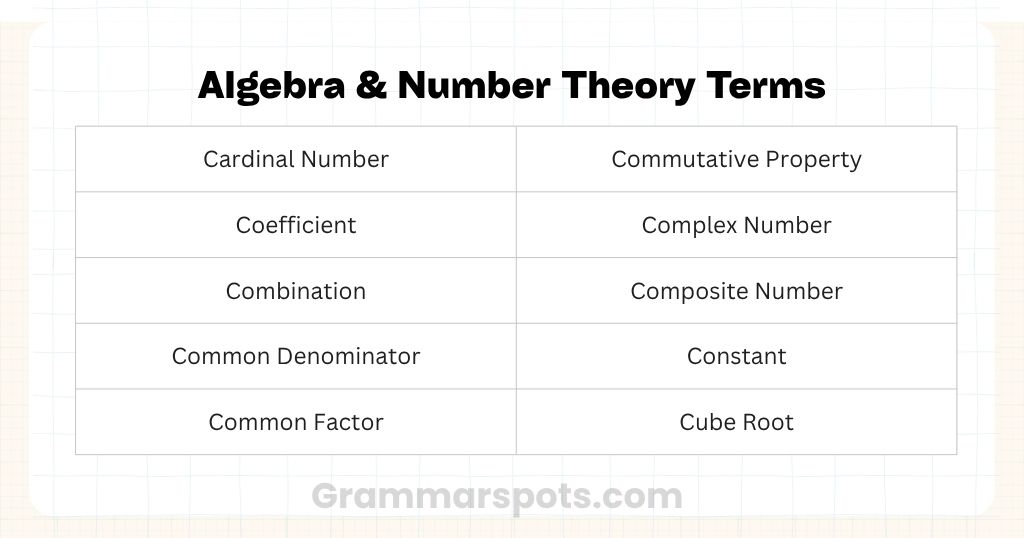
- Cardinal Number · Coefficient · Combination · Common Denominator
- Common Factor · Commutative Property · Complex Number
- Composite Number · Constant · Counting Numbers · Cube Root
Trigonometry Terms
- Cosine · Cosecant · Cotangent
Statistics & Data Terms
- Central Tendency · Correlation · Covariance · Cumulative Frequency
Related Post: 45+ Math Words That Start With D (With Meanings and Examples)
Calculus & Analysis Terms
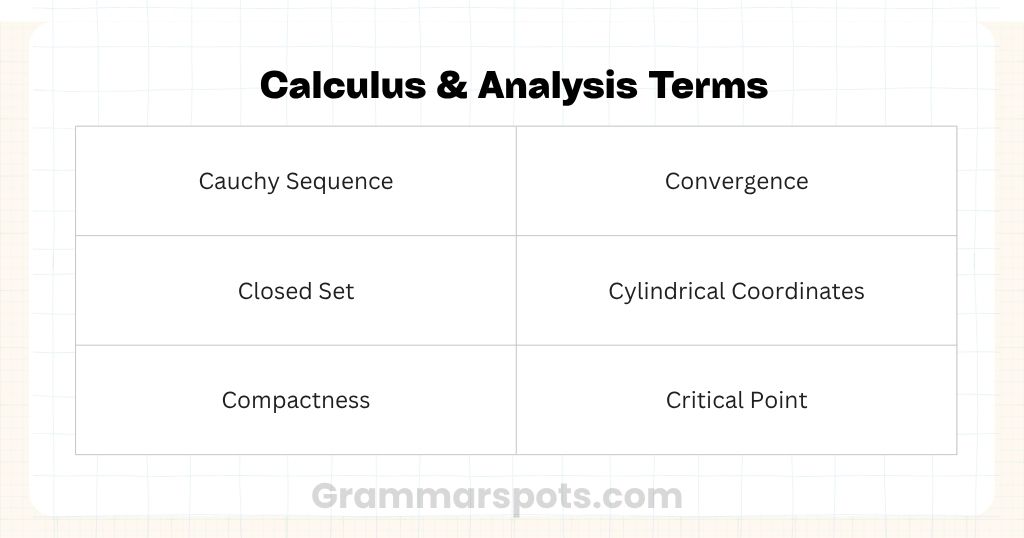
- Calculus · Catenary · Cauchy Sequence · Closed Set · Compactness
- Concavity · Convergence · Critical Point · Cylindrical Coordinates
Logic & Proof Terms
- Complement · Corollary · Counterexample
Advanced / Abstract Terms
- Cayley Graph · Chromatic Number · Cofactor · Commutator
- Cramer’s Rule · Cross Product · Cyclic Group
Real-World Applications
Measurement & Everyday Life
- Centimeter and capacity appear in cooking, construction, and science labs.
Engineering & Architecture
- Catenary curves shape suspension bridges and arches.
- Cylinders and cross-sections appear in mechanical design.
- Conic sections describe satellite dish and telescope shapes.
Physics
- Cross products calculate torque and magnetic force.
- Cylindrical coordinates simplify field equations.
Data Science & Finance
- Correlation and covariance are used in risk modeling and machine learning.
- Cumulative frequency helps visualize test score distributions.
Computer Science
- Cyclic groups power modern encryption algorithms.
- Chromatic numbers solve scheduling and network-coloring problems.
- Cayley graphs model data network structures.
Related Post: 55+ Math Words That Start With E (With Meanings and Examples)
Commonly Confused Terms
Circumference vs. Perimeter
Circumference is only for circles. Perimeter applies to polygons. Never use them interchangeably.
Complement vs. Supplement
Complementary angles sum to 90°. Supplementary angles sum to 180°. Memory tip: Comes before S alphabetically, 90 comes before 180.
Congruent vs. Similar
Congruent = same shape and same size. Similar = same shape, different size.
Combination vs. Permutation
Combination: order does not matter (choosing toppings). Permutation: order matters (arranging runners on a podium).
Composite vs. Prime
Composite numbers have more than two factors. Primes have exactly two. Note: 1 is neither.
Correlation vs. Causation
Correlation shows two variables move together it never proves one causes the other.
Convergence vs. Divergence
A convergent series approaches a finite limit. A divergent series grows without bound or never settles.
Concave vs. Convex
Concave curves or polygons dip inward. Convex ones bulge outward with all interior angles under 180°.
FAQs About Math Words That Start With C
What C-words do elementary students need most?
Circle, centimeter, cube, capacity, common factor, common denominator, composite number, and counting numbers.
What C-words appear most in algebra?
Coefficient, constant, commutative property, complex number, and combination.
What does C stand for in math formulas?
- C = circumference in geometry (C = 2πr)
- C(n,r) = combinations in probability
- C = speed of light in physics formulas
Is a circle a polygon?
No. Polygons are made of straight line segments. A circle is a smooth curve a different type of shape entirely.
What is the difference between a chord and a radius?
A radius runs from the center to the circumference. A chord connects any two circumference points. A diameter is a chord passing through the center.
How is a critical point different from an inflection point?
A critical point is where the derivative equals zero (potential max or min). An inflection point is where concavity changes direction these are different features of a curve.
Is correlation always between −1 and +1?
Yes. A value of +1 means perfect positive relationship, −1 means perfect negative, and 0 means no linear relationship.
Conclusion
These 60+ math terms starting with C span arithmetic, geometry, algebra, statistics, trigonometry, calculus, and abstract algebra. The most common ones circle, coefficient, constant, and correlation appear across school years and standardized tests. The advanced terms Cauchy sequence, cyclic group, covariance become essential in higher education and technical fields. Use the subject-specific categories and commonly confused sections to study smarter, not harder.

I’m Hazel, and I studied BSC English at GCUF. I focus on explaining word meanings in simple, clear language that anyone can understand. My goal is helping readers grasp everyday English, confusing terms, and slang used in real conversations and social media. I believe language learning works best when definitions connect to actual life situations. Through careful research and straightforward explanations, I make vocabulary accessible for students, learners, and anyone curious about how English really works in daily use.