

Math vocabulary starting with P covers nearly every branch of the subject from basic arithmetic to advanced calculus. Whether you’re a student, teacher, or parent, this guide gives you accurate definitions, clear examples, and practical context for every term.
Quick List: 40+ Math Words That Start With P
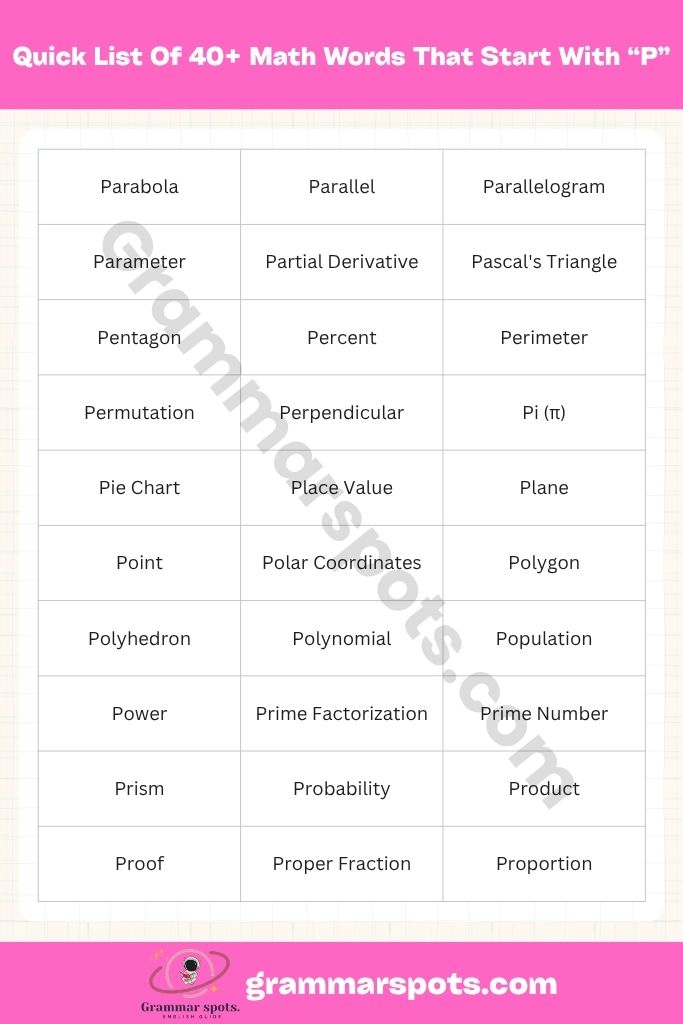
- Parabola
- Parallel
- Parallelogram
- Parameter
- Partial Derivative
- Pascal’s Triangle
- Pentagon
- Percent
- Perimeter
- Permutation
- Perpendicular
- Pi (π)
- Pie Chart
- Place Value
- Plane
- Point
- Polar Coordinates
- Polygon
- Polyhedron
- Polynomial
- Population
- Power
- Prime Factorization
- Prime Number
- Prism
- Probability
- Product
- Proof
- Proper Fraction
- Proportion
- Projection
- Pseudoprime
- P-adic Number
- P-value
- Pythagorean Theorem
- Percentile
- Placeholder
- Positive Integer
- Postulate
- Pythagorean Triple
- Piecewise Function
- Perfect Number
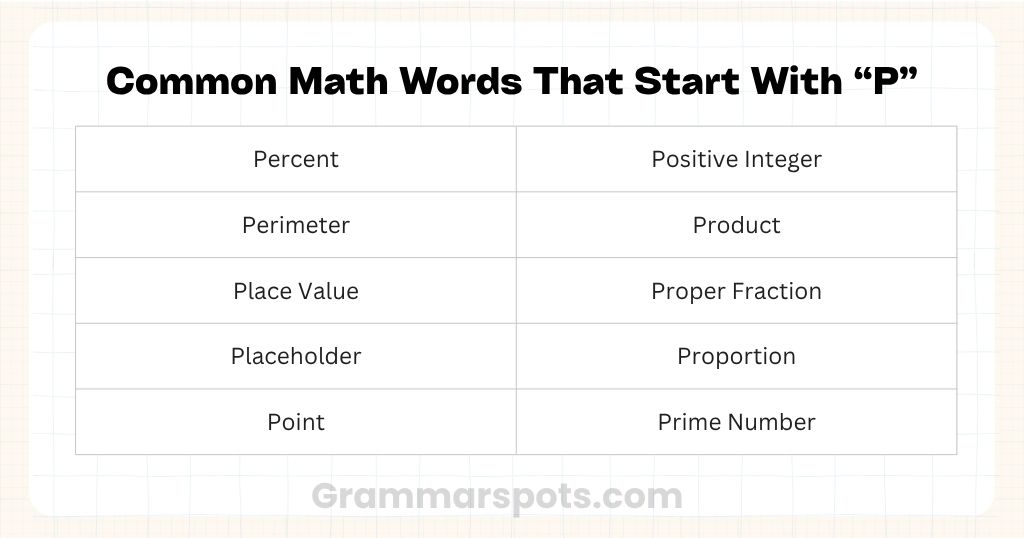
Common Math Words That Start With P
1. Percent
Meaning: A ratio expressed as parts per 100.
Example: 42 out of 100 students passed that’s 42%.
Why it matters: Used in grades, discounts, taxes, and data interpretation.
2. Perimeter
Meaning: The total distance around the boundary of a 2D shape.
Example: A rectangle with sides 5 cm and 3 cm has a perimeter of 16 cm.
Why it matters: Essential for measurement, fencing problems, and standardized tests.
3. Place Value
Meaning: The value of a digit based on its position in a number.
Example: In 472, the digit 4 represents 400.
Why it matters: Underpins all arithmetic, decimals, and number reading.
4. Placeholder
Meaning: A zero used to hold a digit’s position in a number without changing its value.
Example: In 305, the zero is a placeholder in the tens position.
Why it matters: Critical for understanding decimals and large number notation.
5. Point
Meaning: An exact location in space with no size or dimension.
Example: Point A is at coordinates (3, 5).
Why it matters: The most basic building block of all geometry.
6. Positive Integer
Meaning: A whole number greater than zero (1, 2, 3, 4 …).
Example: The numbers 1, 5, and 100 are all positive integers.
Why it matters: Defines the counting numbers and anchors number line understanding.
7. Product
Meaning: The result of multiplying two or more numbers.
Example: The product of 6 and 8 is 48.
Why it matters: One of the four core operation terms students must know.
8. Proper Fraction
Meaning: A fraction where the numerator is smaller than the denominator.
Example: 3/4 is proper; 7/3 is not.
Why it matters: Foundation for comparing and ordering fractions.
9. Proportion
Meaning: An equation showing two ratios are equal.
Example: 2/4 = 5/10 is a proportion.
Why it matters: Used in scaling, map reading, and unit conversion.
10. Prime Number
Meaning: A whole number greater than 1 with exactly two factors: 1 and itself.
Example: 2, 3, 5, 7, and 11 are prime numbers.
Why it matters: Building blocks of all whole numbers; critical for factorization and cryptography.
11. Prime Factorization
Meaning: Expressing a number as a product of its prime factors.
Example: 60 = 2² × 3 × 5.
Why it matters: Used to find GCF and LCM both essential for fraction work.
12. Power
Meaning: An expression where a base is multiplied by itself a set number of times.
Example: 2⁵ = 32 (base 2, power/exponent 5).
Why it matters: Appears in scientific notation, algebra, and exponential functions.
Related Post: 55+ Math Words That Start With Q (With Meanings and Examples)
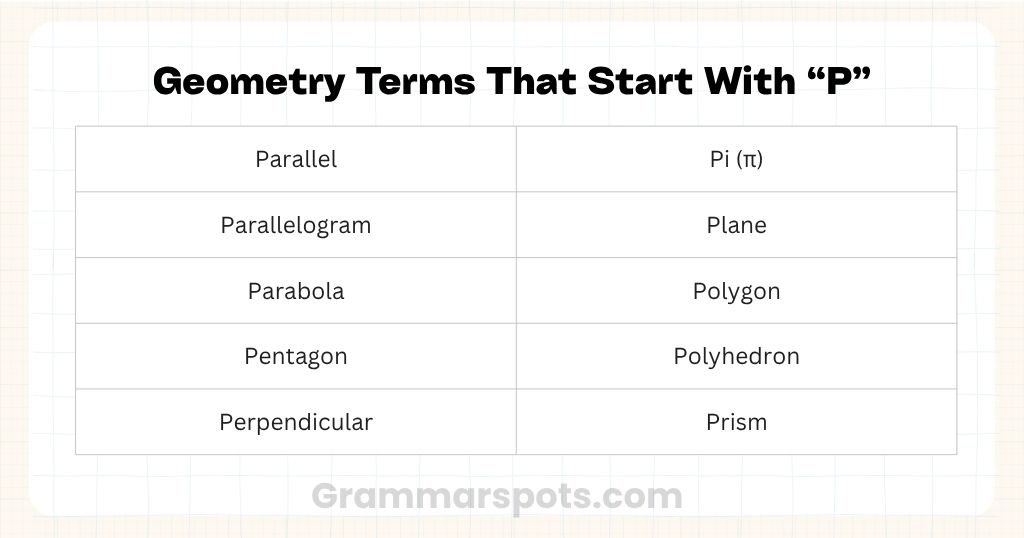
Geometry Terms That Start With P
13. Parallel
Meaning: Lines in the same plane that never intersect and stay the same distance apart.
Example: The two rails of a train track are parallel.
Why it matters: Core concept in coordinate geometry and angle relationships.
14. Parallelogram
Meaning: A quadrilateral with two pairs of parallel, equal-length sides.
Example: A rectangle is a special parallelogram with right angles.
Why it matters: Area = base × height; a key geometry formula.
15. Parabola
Meaning: A symmetric U-shaped curve formed by the graph of a quadratic equation.
Example: y = x² produces a parabola opening upward.
Why it matters: Models projectile paths, satellite dishes, and bridge arches.
16. Pentagon
Meaning: A five-sided polygon. A regular pentagon has equal sides and 108° interior angles.
Example: The U.S. Pentagon building is shaped like a regular pentagon.
Why it matters: Introduces interior angle sums and regular polygon properties.
17. Perpendicular
Meaning: Two lines that intersect at exactly 90°.
Example: The x-axis and y-axis are perpendicular.
Why it matters: Fundamental to right-angle geometry and the Pythagorean Theorem.
18. Pi (π)
Meaning: The ratio of a circle’s circumference to its diameter ≈ 3.14159…; an irrational constant.
Example: A circle with diameter 10 has circumference = 10π ≈ 31.4.
Why it matters: Appears in all circle, sphere, and cylinder formulas.
19. Plane
Meaning: A flat, two-dimensional surface extending infinitely in all directions.
Example: The coordinate plane is where equations are graphed.
Why it matters: The setting for all 2D geometry and graphing.
20. Polygon
Meaning: A closed 2D figure made entirely of straight sides.
Example: Triangles, squares, and hexagons are all polygons.
Why it matters: Classification and properties of polygons are central to geometry.
21. Polyhedron
Meaning: A 3D solid with flat polygonal faces, straight edges, and vertices.
Example: A cube has 6 square faces and is a regular polyhedron.
Why it matters: Connects to Euler’s formula: V − E + F = 2.
22. Prism
Meaning: A 3D solid with two identical parallel polygonal bases connected by rectangles.
Example: A triangular prism has two triangle bases and three rectangular faces.
Why it matters: Volume and surface area of prisms are core 3D geometry skills.
23. Projection
Meaning: Mapping a point or figure onto a line or plane mathematically like casting a shadow.
Example: Dropping a perpendicular from point P to line L gives P’s projection onto L.
Why it matters: Used in linear algebra, 3D graphics, and engineering drawings.
24. Pythagorean Theorem
Meaning: In a right triangle: a² + b² = c², where c is the hypotenuse.
Example: Legs 3 and 4 give hypotenuse √(9+16) = 5.
Why it matters: One of the most used formulas in all of mathematics and engineering.
Related Post: 60+ Math Words That Start With R (With Meanings and Examples)
Statistics Math Words That Start With P
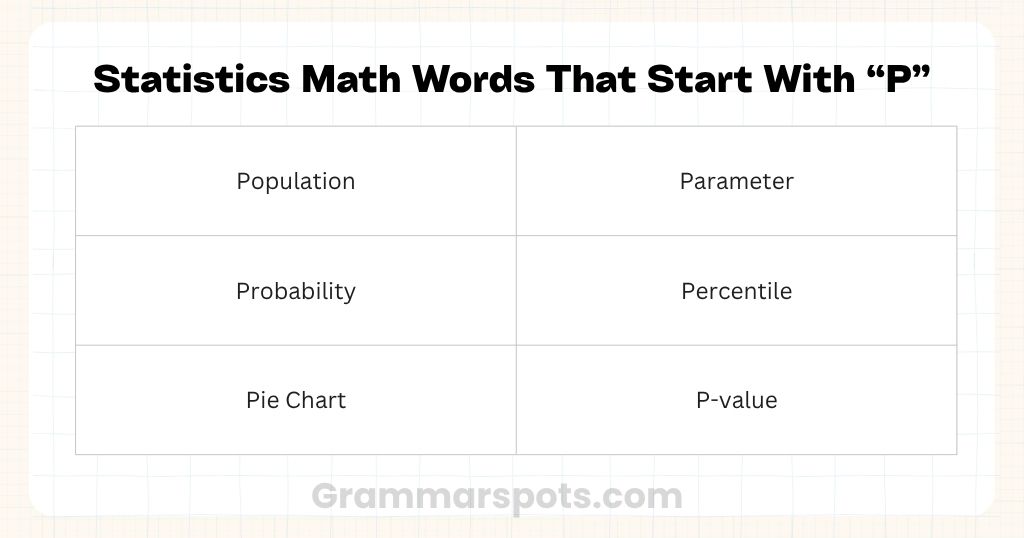
25. Population
Meaning: The complete group being studied in a statistical analysis.
Example: All students enrolled in a school district.
Why it matters: Distinguishing population from sample is statistics’ first major concept.
26. Probability
Meaning: A number between 0 and 1 measuring how likely an event is to occur.
Example: Flipping heads on a fair coin: probability = 0.5.
Why it matters: Foundation of statistics, risk assessment, and scientific research.
27. Pie Chart
Meaning: A circular graph divided into sectors proportional to each category’s share of the total.
Example: A pie chart showing budget spending, with housing taking 40% of the circle.
Why it matters: One of the most widely used tools for displaying part-to-whole data.
28. Parameter
Meaning: A value that describes a characteristic of an entire population.
Example: The true average height of all adults in a country is a parameter.
Why it matters: Parameters vs. statistics is a foundational distinction in inferential statistics.
29. Percentile
Meaning: The value below which a given percentage of data falls.
Example: Scoring in the 90th percentile means you scored higher than 90% of test-takers.
Why it matters: Used to interpret standardized test scores, growth charts, and rankings.
30. P-value
Meaning: The probability of obtaining results as extreme as observed, assuming the null hypothesis is true.
Example: A p-value of 0.03 means a 3% chance of these results under the null hypothesis.
Why it matters: Determines statistical significance in research and experiments.
Related Post: 35+ Math Words That Start With O | Meanings, Examples & Uses
Advanced Math Words That Start With P
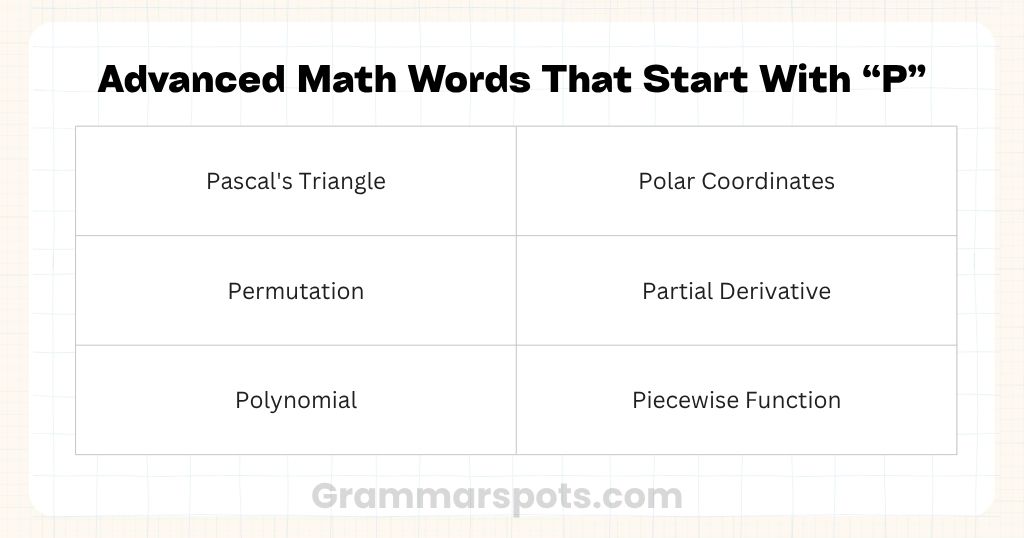
Meaning: A triangular number array where each entry is the sum of the two entries above it.
31. Pascal’s Triangle
Example: Row 4 is 1, 4, 6, 4, 1 the coefficients in (a + b)⁴.
Why it matters: Encodes binomial coefficients, combinations, and probability patterns.
32. Permutation
Meaning: An ordered arrangement of items. P(n, r) = n!/(n−r)!
Example: P(5, 3) = 60 ways to arrange 3 books chosen from 5.
Why it matters: Essential for counting problems where order matters.
33. Polynomial
Meaning: An algebraic expression with variables raised to non-negative integer exponents.
Example: 3x² + 2x − 5 is a polynomial with three terms.
Why it matters: Central to algebra, calculus, and computational mathematics.
34. Polar Coordinates
Meaning: A system locating points by distance from the origin (r) and angle from a reference (θ).
Example: The point (4, 90°) lies 4 units directly above the origin.
Why it matters: Simplifies many problems in physics, engineering, and calculus.
35. Partial Derivative
Meaning: The derivative of a multivariable function with respect to one variable, holding others constant.
Example: For f(x, y) = x²y, the partial derivative with respect to x is 2xy.
Why it matters: Core tool in multivariable calculus, physics, and machine learning.
36. Piecewise Function
Meaning: A function defined by different expressions over different intervals of its domain.
Example: f(x) = x if x ≥ 0; f(x) = −x if x < 0 defines the absolute value function.
Why it matters: Models real-world scenarios where rules change at certain thresholds.
37. Postulate
Meaning: A statement accepted as true without proof, used as a starting point for reasoning.
Example: “Through any two points there is exactly one line” is a geometric postulate.
Why it matters: Postulates form the logical foundation of Euclidean geometry.
38. Proof
Meaning: A logical sequence of statements that establishes the truth of a mathematical claim.
Example: Euclid’s proof that infinitely many primes exist uses a contradiction argument.
Why it matters: Mathematical proof is the standard for certainty in all branches of math.
Related Post: 45+ Math Words That Start With N (With Meanings and Examples)
Rare and Specialized Terms
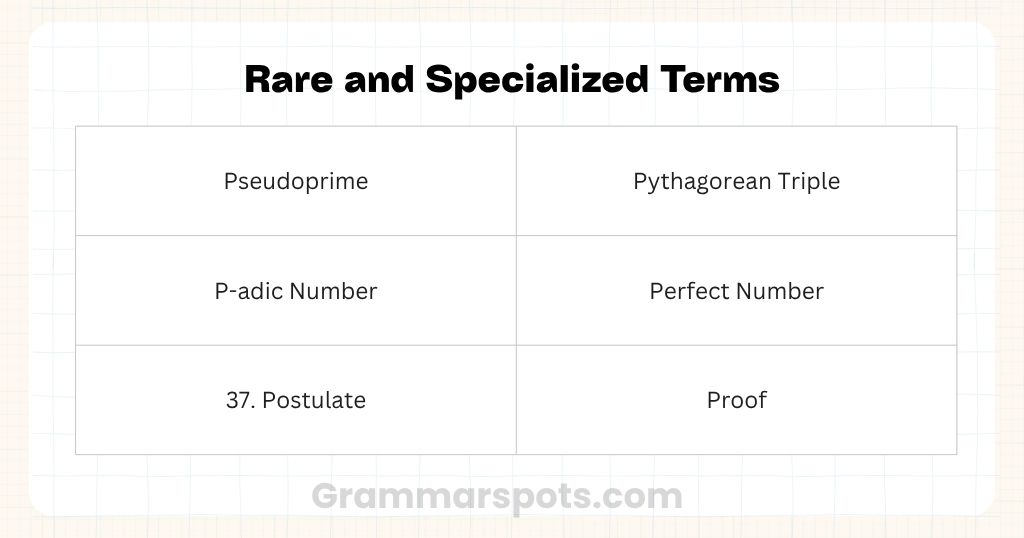
39. Pseudoprime
Meaning: A composite number that passes certain prime-number tests but is not actually prime.
Example: 561 is a Carmichael number a well-known pseudoprime.
Why it matters: Matters in cryptography where primality tests must be reliable.
40. P-adic Number
Meaning: A number system based on a prime p where closeness is defined by divisibility by powers of p.
Example: In the 5-adic system, numbers divisible by large powers of 5 are considered “close” to zero.
Why it matters: Used in advanced number theory; instrumental in proving Fermat’s Last Theorem.
41. Perfect Number
Meaning: A positive integer that equals the sum of all its proper divisors (excluding itself).
Example: 6 = 1 + 2 + 3. Next is 28 = 1 + 2 + 4 + 7 + 14.
Why it matters: A classic topic in number theory with unsolved open questions.
42. Pythagorean Triple
Meaning: A set of three positive integers (a, b, c) satisfying a² + b² = c².
Example: (3, 4, 5) and (5, 12, 13) are Pythagorean triples.
Why it matters: Gives exact integer solutions to right-triangle problems without decimals.
Subject-Specific Categories at a Glance
Geometry: Parallel, Parallelogram, Parabola, Pentagon, Perpendicular, Pi, Plane, Point, Polygon, Polyhedron, Prism, Projection, Pythagorean Theorem
Arithmetic: Percent, Perimeter, Place Value, Placeholder, Positive Integer, Power, Product, Proper Fraction, Proportion, Prime Number, Prime Factorization
Statistics: Parameter, Percentile, Pie Chart, Population, Probability, P-value
Algebra: Parabola, Piecewise Function, Polynomial, Proportion
Advanced / Calculus: Partial Derivative, Polar Coordinates
Logic / Foundations: Postulate, Proof
Number Theory: Perfect Number, Prime Factorization, Prime Number, Pseudoprime, P-adic Number, Pythagorean Triple
Combinatorics: Pascal’s Triangle, Permutation
Real-World Applications
Construction and Architecture:
- Perimeter, parallelogram, perpendicular, and prism calculations are used in design and building.
Finance and Commerce:
- Percent, proportion, and percentile drive interest rates, pricing, and performance ranking.
Science and Engineering:
- Pi, partial derivatives, and polar coordinates appear in physics, fluid dynamics, and antenna design.
Technology and Computing:
- Polynomials power signal processing; pseudoprimes and p-adic numbers matter in cryptography.
Data and Research:
- P-value, parameter, population, and probability are the core language of statistical analysis.
Everyday Life:
- Place value, product, prime numbers, and proper fractions appear in daily calculation and problem-solving.
Tips for Learning Math Words That Start With P
- Group by category — Learn geometry terms together, statistics terms together.
- Draw what you define — Sketch a parabola, parallelogram, or prism next to its definition.
- Write your own example — Don’t copy the textbook sentence; write one from your own life.
- Use flashcards correctly — Put the definition on front, not the word; retrieve the term from meaning.
- Connect to real life — Percent is in every sale; pi is in every circle; probability is in every game.
- Test yourself by category — Cover the definition column and recall each term by field.
Commonly Confused Terms
| Confused Pair | Key Distinction |
| Perimeter vs. Area | Perimeter = distance around; Area = space inside |
| Parallel vs. Perpendicular | Parallel lines never meet; perpendicular lines meet at 90° |
| Product vs. Sum | Product = multiplication result; Sum = addition result |
| Permutation vs. Combination | Permutation = order matters; Combination = order doesn’t matter |
| Parameter vs. Statistic | Parameter = whole population; Statistic = sample measurement |
| Prime vs. Composite | Prime has 2 factors; Composite has more than 2 |
| Proper vs. Improper Fraction | Proper: numerator < denominator; Improper: numerator > denominator |
| Postulate vs. Proof | Postulate is assumed true; Proof is logically established |
FAQs About Math Words That Start With P
What are the most important P math words for elementary students?
Place value, percent, perimeter, product, proper fraction, prime number, and proportion these appear from grades 3 through 6 consistently.
Which P words appear most on standardized tests?
Pythagorean theorem, probability, percent, polygon, prime number, and parabola are among the most frequently tested in middle and high school.
What is the difference between a polygon and a polyhedron?
A polygon is flat (2D) with sides and angles. A polyhedron is a 3D solid with faces, edges, and vertices.
Is pi rational or irrational?
Pi is irrational its decimal never ends or repeats.
What makes a number prime?
It must be a whole number greater than 1 with exactly two divisors: 1 and itself. Note: 1 is neither prime nor composite.
When do students learn polynomials?
Typically in pre-algebra or Algebra I, around grades 7–9.
Is Pascal’s Triangle practically useful?
Yes it directly gives binomial coefficients, combinations, and probability values used in algebra and statistics.
What is a p-value used for?
Researchers use it to decide whether experimental results are statistically significant or likely due to chance.
Conclusion
These 42 math words starting with P span arithmetic, geometry, algebra, statistics, calculus, and number theory. Start with the easy terms relevant to your grade level, then build toward the advanced ones. Learning the precise meaning of each word not just a vague idea is what turns math vocabulary into real mathematical thinking.

I’m Hazel, and I studied BSC English at GCUF. I focus on explaining word meanings in simple, clear language that anyone can understand. My goal is helping readers grasp everyday English, confusing terms, and slang used in real conversations and social media. I believe language learning works best when definitions connect to actual life situations. Through careful research and straightforward explanations, I make vocabulary accessible for students, learners, and anyone curious about how English really works in daily use.