

Math vocabulary starting with Y covers coordinate geometry, transformations, measurement, statistics, and financial mathematics. Whether you’re graphing a line, solving a finance problem, or studying advanced statistics, Y-terms appear across every level of mathematics.
This guide includes 45+ verified math words that start with Y with clear meanings, original examples, and explanations of real use. No filler, no invented terms.
Quick List: 45+ Math Words That Start With Y
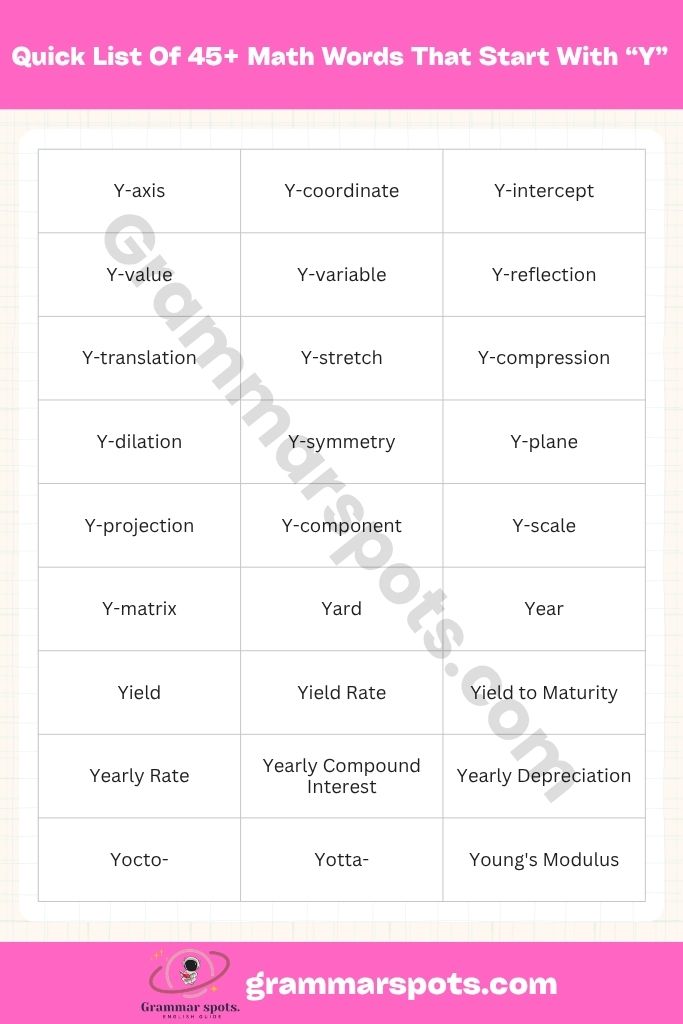
- Y-axis
- Y-coordinate
- Y-intercept
- Y-value
- Y-variable
- Y-reflection
- Y-translation
- Y-stretch
- Y-compression
- Y-dilation
- Y-symmetry
- Y-plane
- Y-projection
- Y-component
- Y-scale
- Y-matrix
- Yard
- Year
- Yield
- Yield Rate
- Yield to Maturity
- Yearly Rate
- Yearly Compound Interest
- Yearly Depreciation
- Yocto-
- Yotta-
- Young’s Modulus
- Yates’ Correction
- Yates’ Chi-Square
- Yule’s Q
- Yule’s Coefficient of Association
- Yule–Walker Equations
- Yule Distribution
- Yule Process
- Y-intercept Form
- Y-shaped Graph
- Y-axis Reflection
- Y-axis Symmetry
- Y-transformation
- Y-dilation Factor
- Yottabyte (data mathematics)
- Yoctometer (measurement theory)
- Yearly Growth Rate
- Yield Curve
- Y-translation Vector
Common Math Words That Start With Y
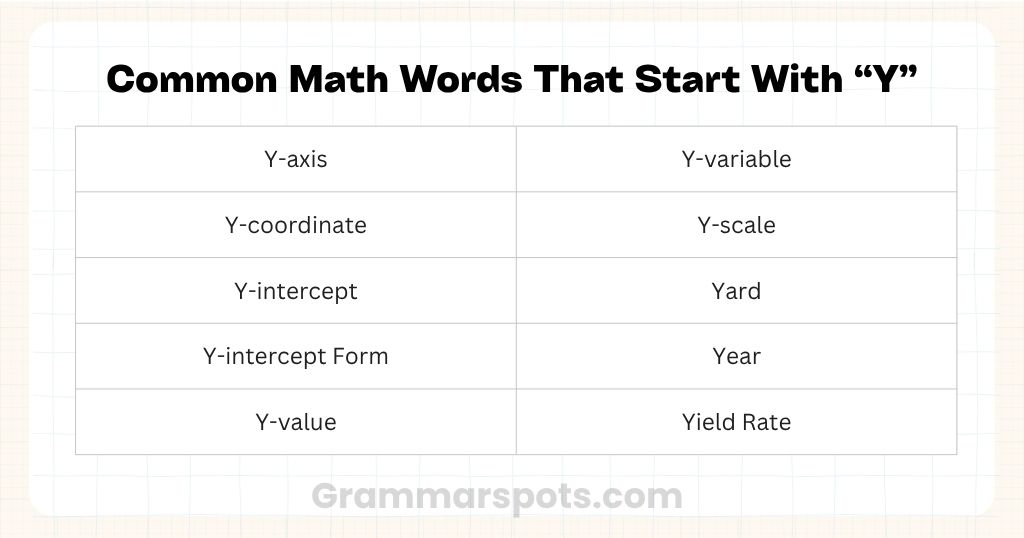
Y-axis
Meaning: The vertical number line on a coordinate plane, passing through the origin (0, 0).
Example: On a temperature graph, the y-axis shows temperature values.
Why It Matters: Every coordinate graph, data chart, and plotted function depends on the y-axis for vertical reference.
Y-coordinate
Meaning: The second number in an ordered pair (x, y), showing vertical position.
Example: In the point (4, 9), the y-coordinate is 9.
Why It Matters: Y-coordinates precisely locate points on a plane essential for graphing, geometry, and data analysis.
Y-intercept
Meaning: The point where a graph crosses the y-axis; the value of y when x = 0.
Example: In y = 3x + 5, the y-intercept is 5, so the graph crosses at (0, 5).
Why It Matters: The y-intercept gives the starting value of any function and is central to the slope-intercept form of a line.
Y-intercept Form
Meaning: Another name for slope-intercept form: y = mx + b, where b is the y-intercept.
Example: y = 2x + 7 is written in y-intercept form; the line starts at (0, 7).
Why It Matters: This is the most commonly used form for writing and reading linear equations.
Y-value
Meaning: The output of a function or equation after substituting a specific x-value.
Example: In f(x) = 2x + 1, when x = 3, the y-value is 7.
Why It Matters: Y-values define what a function produces and help identify patterns, peaks, and intersections on a graph.
Y-variable
Meaning: The dependent variable in an equation its value depends on the input (x).
Example: In y = x² − 4, the y-variable changes every time x changes.
Why It Matters: Distinguishing dependent from independent variables is foundational to algebra and data interpretation.
Y-scale
Meaning: The numerical intervals marked along the y-axis of a graph.
Example: A graph with a y-scale of 10 means each gridline represents 10 units.
Why It Matters: Choosing an appropriate y-scale affects how clearly data trends appear on a graph.
Yard
Meaning: An imperial unit of length equal to 3 feet or 36 inches (≈ 0.914 meters).
Example: A standard swimming pool lane is about 55 yards long.
Why It Matters: Yard conversions appear in measurement units, word problems, and applied geometry.
Year
Meaning: A unit of time equal to 365 days (366 in a leap year), used as the standard period in financial and rate problems.
Example: A loan accrues 6% interest per year.
Why It Matters: Year is the base time unit in compound interest, depreciation, and population growth formulas.
Yield
Meaning: The income or return generated by an investment, expressed as a percentage of its value.
Example: A $1,000 bond paying $50 annually has a 5% yield.
Why It Matters: Yield connects percentage calculations to real investment and banking problems.
Yield Rate
Meaning: The effective rate of return on an investment over a given time period.
Example: An investment growing from $400 to $440 in one year has a yield rate of 10%.
Why It Matters: Yield rate is a direct application of percentage change a core skill in financial and applied mathematics.
Yearly Rate
Meaning: Any rate interest, growth, or depreciation measured over one calendar year.
Example: A car loses value at a yearly rate of 15%.
Why It Matters: Yearly rate standardizes time-based calculations so results from different investments or periods can be fairly compared.
Yearly Compound Interest
Meaning: Interest calculated once per year on both the original principal and any previously accumulated interest.
Example: $1,000 at 5% yearly compound interest becomes $1,050 after year 1, then $1,102.50 after year 2.
Why It Matters: Understanding compounding is essential for personal finance, loan calculations, and applied algebra.
Yearly Depreciation
Meaning: The fixed annual reduction in the value of an asset over its useful life.
Example: A $10,000 machine depreciated over 5 years loses $2,000 in value each year.
Why It Matters: Yearly depreciation applies division, subtraction, and percentage calculations in business and financial math.
Yearly Growth Rate
Meaning: The percentage by which a quantity increases over one year.
Example: A population of 10,000 growing at a yearly rate of 3% becomes 10,300 after one year.
Why It Matters: Yearly growth rate problems appear in algebra, statistics, and science contexts involving exponential models.
Related Post: 50+ Math Words That Start With Z (With Meanings and Examples)
Transformation Geometry Math Words That Start With Y
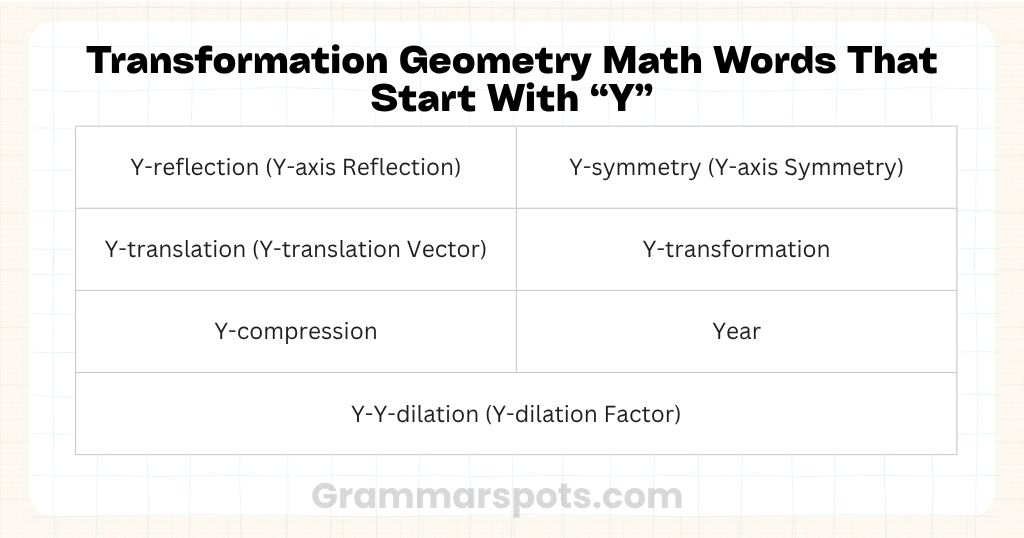
Y-reflection (Y-axis Reflection)
Meaning: A transformation that flips a figure across the y-axis, reversing the sign of each x-coordinate while keeping y-coordinates unchanged.
Example: The point (3, 5) becomes (−3, 5) after a y-axis reflection.
Why It Matters: Reflections are one of the four core geometric transformations studied in middle and high school geometry.
Y-translation (Y-translation Vector)
Meaning: A transformation that moves every point of a figure the same distance up or down, parallel to the y-axis.
Example: Translating triangle ABC by (0, 4) shifts every vertex 4 units upward.
Why It Matters: Translations preserve shape and size a key property in congruence and transformation geometry.
Y-stretch
Meaning: A vertical stretch that multiplies every y-coordinate by a factor greater than 1, making the graph taller.
Example: Replacing f(x) with 3f(x) stretches the graph vertically by a factor of 3.
Why It Matters: Y-stretch is fundamental in function transformations, showing how scaling affects graph shape.
Y-compression
Meaning: A vertical compression that multiplies every y-coordinate by a factor between 0 and 1, making the graph flatter.
Example: Replacing f(x) with 0.5f(x) compresses the graph to half its original height.
Why It Matters: Y-compression is the reverse of y-stretch and is equally important in graphing transformed functions.
Y-dilation (Y-dilation Factor)
Meaning: Any vertical scaling of a figure or graph including both stretches and compressions by a multiplicative factor.
Example: A y-dilation of factor 2 doubles all vertical distances from the x-axis.
Why It Matters: Y-dilation is the umbrella term covering both y-stretch and y-compression in transformation geometry.
Y-symmetry (Y-axis Symmetry)
Meaning: A figure has y-axis symmetry when it is identical on both sides of the y-axis meaning f(x) = f(−x) for every point.
Example: The parabola y = x² is symmetric about the y-axis.
Why It Matters: Symmetry properties simplify graphing and are tested in algebra, geometry, and calculus.
Y-transformation
Meaning: Any transformation applied specifically in the vertical (y) direction including reflections, translations, stretches, and compressions.
Example: Shifting y = x² up by 3 units is a y-transformation producing y = x² + 3.
Why It Matters: Understanding vertical transformations helps students predict and sketch graphs of related functions without recalculating every point.
Vector and 3D Geometry Math Words That Start With Y
Y-component
Meaning: The vertical part of a vector, representing its magnitude in the y-direction.
Example: A vector with coordinates (3, 7) has a y-component of 7.
Why It Matters: Breaking vectors into x and y components is essential in physics-mathematics, engineering, and mechanics.
Y-projection
Meaning: The shadow or footprint a point or vector casts onto the y-axis when projected perpendicularly.
Example: Projecting the point (5, 8) onto the y-axis gives the y-projection 8.
Why It Matters: Projections are core operations in linear algebra, 3D geometry, and computer graphics mathematics.
Y-plane
Meaning: In three-dimensional coordinate systems, the y-plane refers to a plane parallel to or containing the y-axis.
Example: The xy-plane and yz-plane both contain the y-axis and are used to define 3D position.
Why It Matters: Three-dimensional geometry uses y-planes to describe surfaces, solids, and spatial relationships.
Related Post: 55+ Math Words That Start With X (With Meanings and Examples)
Advanced Math Words That Start With Y
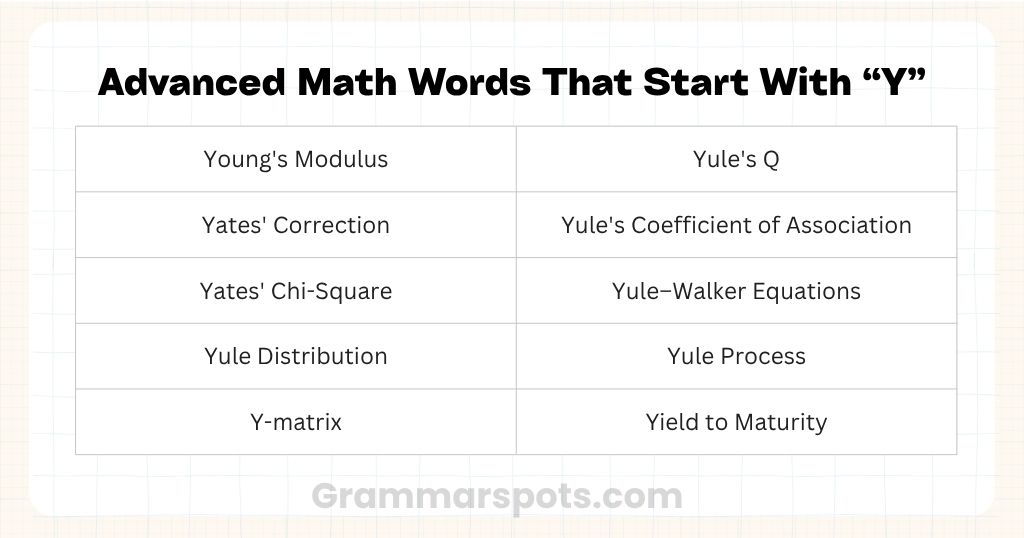
Young’s Modulus
Meaning: A measure of a material’s stiffness, defined as the ratio of stress to strain: E = Stress ÷ Strain.
Example: Steel’s high Young’s Modulus means it barely deforms under large forces a critical engineering calculation.
Math Branch: Applied Mathematics, Engineering Mathematics
Why It Matters: Young’s Modulus requires ratio, proportion, and unit analysis skills central to applied and physics-linked mathematics.
Yates’ Correction
Meaning: An adjustment to the chi-square test formula for 2×2 contingency tables with small sample sizes, subtracting 0.5 from each |Observed − Expected| value before squaring.
Math Branch: Statistics
Why It Matters: Without this correction, small-sample chi-square results overestimate statistical significance, leading to false conclusions.
Yates’ Chi-Square
Meaning: The modified chi-square statistic produced after applying Yates’ Correction.
Example: Researchers testing a small clinical trial use Yates’ Chi-Square to avoid overstating the effectiveness of a treatment.
Math Branch: Statistics
Why It Matters: It is the practically applied result of Yates’ Correction the actual test statistic used in research reports.
Yule’s Q
Meaning: A measure of association between two binary variables, ranging from −1 to +1.
Formula: Q = (ad − bc) ÷ (ad + bc), using the four cells of a 2×2 table.
Example: A Q value of 0.85 between “daily practice” and “exam success” indicates a strong positive association.
Math Branch: Statistics
Why It Matters: Yule’s Q is one of the earliest formal statistical association measures, still used in social science and introductory research methods.
Yule’s Coefficient of Association
Meaning: The formal name for Yule’s Q a symmetric measure that quantifies the strength and direction of association between two categorical variables.
Math Branch: Statistics
Why It Matters: Understanding this term by its formal name is important in academic statistics and research literature.
Yule–Walker Equations
Meaning: A system of linear equations used in time series analysis to estimate parameters of an autoregressive (AR) model from autocorrelation values.
Example: To predict tomorrow’s temperature based on the last several days, the Yule–Walker equations help calculate how much weight to assign to each past day.
Math Branch: Statistics, Time Series Analysis
Why It Matters: These equations underpin time series forecasting in finance, climate science, and signal processing.
Yule Distribution
Meaning: A discrete probability distribution describing situations where existing popularity attracts further popularity known mathematically as preferential attachment.
Example: Word frequency in a language follows a Yule distribution: a few words appear constantly while most appear rarely, in a predictable mathematical ratio.
Math Branch: Probability Theory
Why It Matters: Yule Distribution models networks, species classification, and language mathematics.
Yule Process
Meaning: A continuous-time stochastic process where new events occur at a rate proportional to existing events a probabilistic model of exponential branching growth.
Example: In evolutionary biology, the Yule Process models how a species branches into new species over time.
Math Branch: Probability Theory, Stochastic Processes
Why It Matters: It connects pure probability theory to biological, social, and network phenomena.
Y-matrix
Meaning: A square matrix in linear algebra also called the nodal admittance matrix representing relationships between nodes in a mathematical network.
Example: Engineers apply matrix algebra to a Y-matrix to solve the current flows in a complex electrical network.
Math Branch: Linear Algebra, Applied Mathematics
Why It Matters: The Y-matrix is a real-world application of matrix operations bridging linear algebra with engineering analysis.
Yield to Maturity
Meaning: The total annualized return on a bond if purchased today and held until it matures, accounting for coupon payments and any difference between purchase price and face value.
Example: A bond bought at $950 with a $1,000 face value and 6% coupon has a YTM slightly above 6%.
Math Branch: Financial Mathematics
Why It Matters: YTM calculations involve compound interest, present value, and iterative solving some of the most applied algebra in financial mathematics.
Yield Curve
Meaning: A graph plotting yield to maturity against time to maturity for bonds of equal credit quality.
Example: A normal yield curve slopes upward longer-term bonds offer higher yields than short-term ones.
Math Branch: Financial Mathematics, Applied Statistics
Why It Matters: Reading and interpreting a yield curve requires understanding graphing, slope, and rates of change core mathematical skills applied to real financial data.
Y-shaped Graph
Meaning: A graph whose structure resembles the letter Y, often arising in piecewise functions, branching processes, or network flow diagrams.
Example: A road network splitting from one main route into two branches forms a Y-shaped graph.
Math Branch: Graph Theory, Topology
Why It Matters: Y-shaped graphs appear in discrete mathematics and are used to model branching networks, decision trees, and flow systems.
Related Post: 40+ Math Words That Start With W (With Meanings and Examples)
Rare and Specialized Math Words That Starting With Y
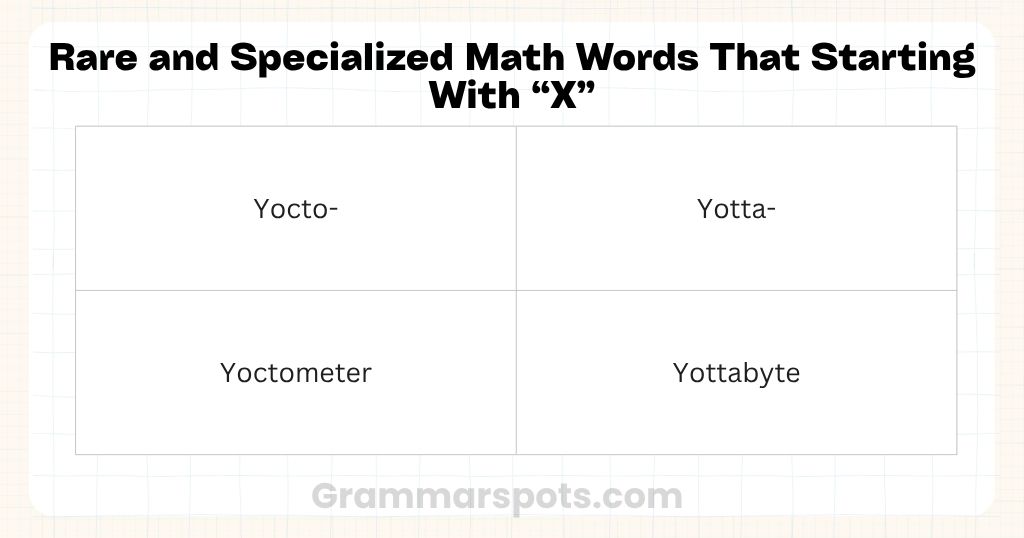
Yocto-
Meaning: A metric prefix representing 10⁻²⁴ one septillionth of a base unit.
Example: A yoctometer (10⁻²⁴ meters) is far smaller than a proton.
Use: Scientific notation, measurement theory, quantum physics mathematics.
Yotta-
Meaning: A metric prefix representing 10²⁴ one septillion of a base unit.
Example: A yottagram equals 10²⁴ grams used in astrophysical mass calculations.
Use: Scientific notation, large-scale measurement, data mathematics.
Yoctometer
Meaning: A unit of length equal to 10⁻²⁴ meters the smallest named metric unit of length.
Example: Theoretical particle physics uses yoctometers when describing sub-subatomic distances.
Use: Measurement theory, scientific notation, extreme-scale mathematics.
Yottabyte
Meaning: A unit of digital data equal to 10²⁴ bytes (or 2⁸⁰ bytes in binary), representing an astronomically large data quantity.
Example: Estimating the total data generated by humanity uses yottabytes in mathematical projections.
Use: Data science mathematics, large-number arithmetic, computer science math.
Coordinate Geometry
- Y-axis, y-coordinate, and y-intercept are used whenever data is plotted from science experiments to sports analytics and business dashboards.
Financial Mathematics
- Yield, yield rate, yield to maturity, and yearly compound interest appear in banking, investment analysis, loan calculations, and personal finance planning.
Engineering
- Young’s Modulus is applied in civil, structural, and mechanical engineering to calculate how materials behave under load.
Statistics and Research
- Yates’ Correction and Yule’s Q ensure accuracy in small-sample studies used in medicine, psychology, and social science.
Data Science
- Yule–Walker Equations drive time series forecasting models used in finance, weather prediction, and signal processing.
Measurement Science
- Yocto- and yotta- prefixes appear in quantum physics and astrophysics calculations at the extreme ends of the measurement scale.
Tips for Remembering Math Words That Start With Y
- Group by topic learn coordinate terms first, then transformations, then financial terms, then statistics
- Draw it sketch a labeled coordinate plane showing the y-axis, y-intercept, and several y-values from sample equations
- Use contrast for prefixes yocto- = unimaginably small; yotta- = unimaginably large; the contrast locks both in memory
- Flashcards for advanced terms write the term on one side, the formula plus one real-world use on the other
- Relate financial terms to real life find the yield rate on a savings account or look up a yield curve in a news article
- Write definitions in your own words restating each term without looking at notes builds deeper recall than re-reading
Commonly Confused Y Terms
Y-intercept vs. Y-coordinate
Every y-intercept has a y-coordinate, but not every y-coordinate is a y-intercept. The y-intercept is only the point where x = 0. A y-coordinate belongs to any point on the plane.
Y-value vs. Y-variable
The y-variable is the symbol (y) used in an equation. A y-value is the specific number y equals after substituting a known x general vs. specific.
Y-stretch vs. Y-compression vs. Y-dilation
- Y-stretch: factor greater than 1 → graph gets taller
- Y-compression: factor between 0 and 1 → graph gets flatter
- Y-dilation: the umbrella term covering both
Yield vs. Yield Rate
Yield is the actual dollar amount earned. Yield rate is that amount expressed as a percentage of the investment’s value.
Yates’ Correction vs. Standard Chi-Square
Standard chi-square is used for large samples. Yates’ Correction is the adjusted version for small samples, specifically 2×2 tables with expected frequencies below 5.
Yule’s Q vs. Yule’s Coefficient of Association
These are the same measure two names for one statistic. Yule’s Q is the shorthand; Yule’s Coefficient of Association is the full formal name.
FAQs
Q1. What are the most common math words starting with Y?
Y-axis, y-coordinate, and y-intercept are the most frequently encountered appearing in algebra and geometry from middle school onward. Yard is the most common measurement term.
Q2. What Y words appear in geometry?
- Y-axis
- Y-coordinate
- Y-plane
- Y-reflection
- Y-translation
- Y-stretch
- Y-compression
- Y-dilation
- Y-symmetry
- Y-shaped Graph
Q3. What does the y-intercept tell you?
It tells you the value of y when x = 0 the point where a graph crosses the y-axis. In real-world graphs, it often represents an initial value, a starting cost, or a baseline measurement.
Q4. What are yocto- and yotta- in math?
They are SI metric prefixes. Yocto- = 10⁻²⁴ (one septillionth). Yotta- = 10²⁴ (one septillion). Both represent extreme-scale magnitudes used in scientific and measurement mathematics.
Q5. What is Yates’ Correction and when is it used?
It is an adjustment to the chi-square test formula applied specifically to 2×2 contingency tables with small expected cell frequencies (below 5). It prevents overestimation of statistical significance.
Q6. How is yield calculated?
Yield (%) = (Annual Income ÷ Investment Value) × 100. A $60 annual return on a $1,000 investment equals a 6% yield.
Q7. What transformation geometry terms start with Y?
Y-reflection, Y-translation, Y-stretch, Y-compression, Y-dilation, Y-symmetry, Y-transformation, and Y-axis Reflection are the main transformation terms starting with Y.
Q8. Is “year” a real math term?
Yes. In applied mathematics and financial math, year is a standard unit of time. Compound interest, depreciation, population growth, and rate problems all use year as the base time unit in their formulas.
Conclusion
Math words starting with Y range from beginner-level essentials to advanced statistical and financial concepts.
Common terms to know:
- Y-axis, y-coordinate, y-intercept core graphing vocabulary
- Yard, year standard measurement and time units
- Yield, yield rate foundational financial math terms
Advanced terms to explore:
- Yates’ Correction, Yule’s Q, Yule–Walker Equations statistical analysis
- Young’s Modulus applied and engineering mathematics
- Yield to Maturity, Yield Curve financial mathematics
Rare but valid:
- Yocto-, Yotta-, Yoctometer, Yottabyte extreme-scale metric terms
Mastering this vocabulary improves mathematical reading, problem-solving, and academic performance across every level of study.

I’m Hazel, and I studied BSC English at GCUF. I focus on explaining word meanings in simple, clear language that anyone can understand. My goal is helping readers grasp everyday English, confusing terms, and slang used in real conversations and social media. I believe language learning works best when definitions connect to actual life situations. Through careful research and straightforward explanations, I make vocabulary accessible for students, learners, and anyone curious about how English really works in daily use.