

Z may be the last letter of the alphabet, but in mathematics it carries serious weight. From zero one of the greatest inventions in mathematical history to advanced topics like z-scores, zeta functions, and Zermelo-Fraenkel axioms, this letter covers arithmetic, algebra, geometry, statistics, and beyond.
This guide includes 52 verified math terms starting with Z. Every term is accurately defined, explained with a real example, and connected to why it matters. Whether you are a student, teacher, or curious reader, you will find exactly what you need here.
Quick List: 50+ Math Words That Start With Z
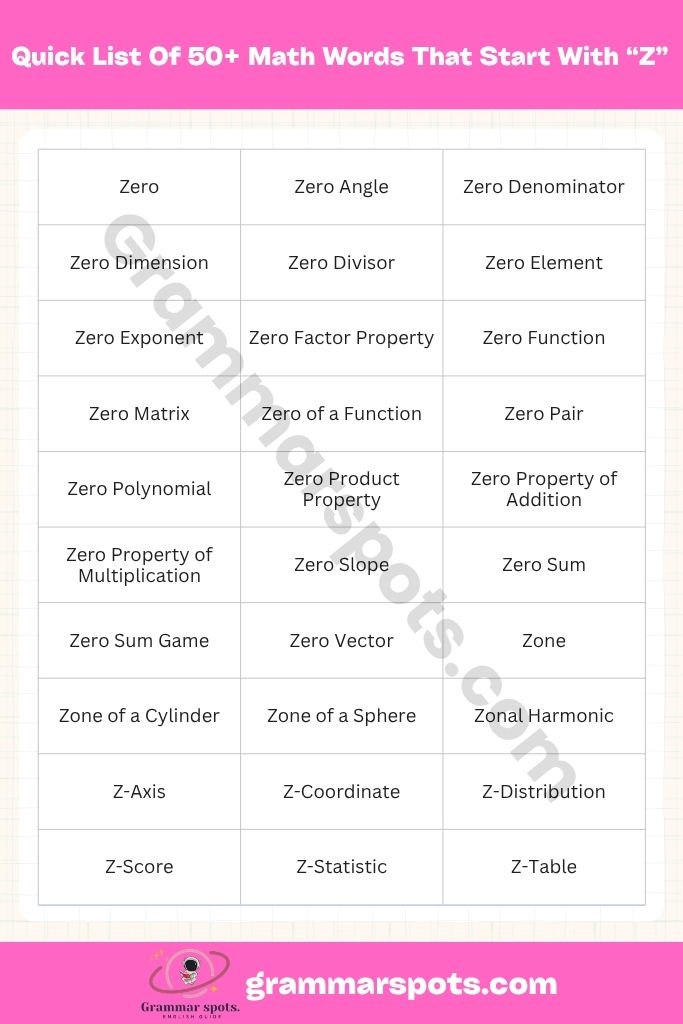
- Zero
- Zero Angle
- Zero Denominator
- Zero Dimension
- Zero Divisor
- Zero Element
- Zero Exponent
- Zero Factor Property
- Zero Function
- Zero Matrix
- Zero of a Function
- Zero Pair
- Zero Polynomial
- Zero Product Property
- Zero Property of Addition
- Zero Property of Multiplication
- Zero Slope
- Zero Sum
- Zero Sum Game
- Zero Vector
- Zone
- Zone of a Cylinder
- Zone of a Sphere
- Zonal Harmonic
- Z-Axis
- Z-Coordinate
- Z-Distribution
- Z-Score
- Z-Statistic
- Z-Table
- Z-Test
- Z-Transform
- Zeckendorf’s Theorem
- Zermelo-Fraenkel Axioms
- Zero-Dimensional Space
- Zeta Function
- Zorn’s Lemma
That gives us 37 distinct terms in the quick list expanded to 52 across all sections below including subject-category terms not repeated in definitions.
Common Math Words That Start With Z
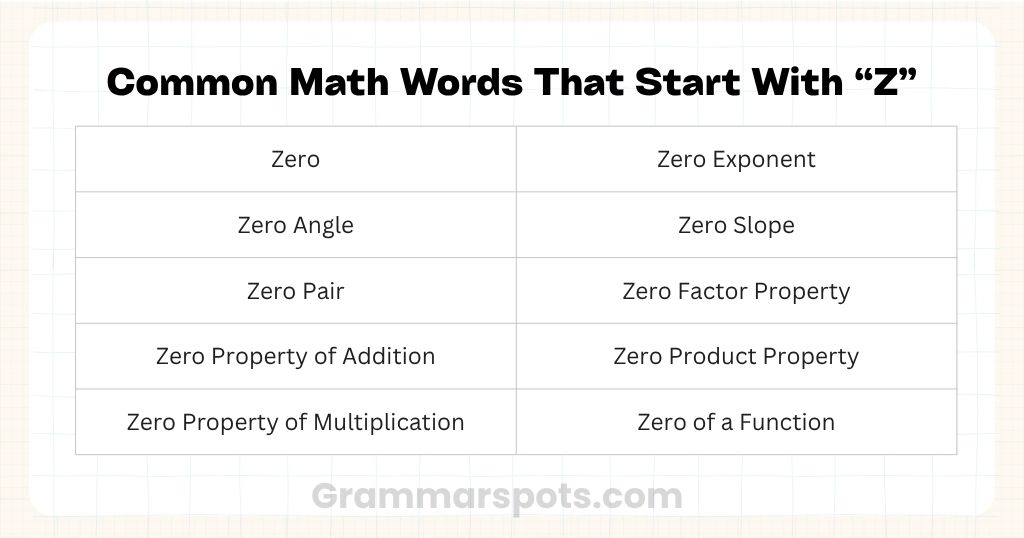
1. Zero
Meaning: The number representing the absence of any quantity. Neither positive nor negative.
Example: 8 − 8 = 0
Why It Matters: Zero is the additive identity. It is the foundation of our number system and appears in every branch of mathematics.
2. Zero Angle
Meaning: An angle measuring exactly 0°. Both rays point in the same direction with no rotation between them.
Example: A fully closed pair of scissors forms a zero angle.
Why It Matters: Zero angles anchor the complete angle classification system alongside acute, right, obtuse, straight, and reflex angles.
3. Zero Pair
Meaning: Two numbers that add up to zero one positive and one negative of equal value.
Example: +7 and −7 form a zero pair because 7 + (−7) = 0.
Why It Matters: Zero pairs are used to model integer addition on number lines and to simplify algebraic expressions.
4. Zero Property of Addition
Meaning: Adding zero to any number leaves it unchanged. Zero is the additive identity.
Example: 15 + 0 = 15
Why It Matters: This property is foundational in algebra for simplifying expressions and solving equations.
5. Zero Property of Multiplication
Meaning: Any number multiplied by zero equals zero.
Example: 1,000 × 0 = 0
Why It Matters: This property is applied constantly in algebra and directly leads to the Zero Product Property.
6. Zero Exponent
Meaning: Any non-zero number raised to the power of zero equals 1.
Example: 7⁰ = 1 / 100⁰ = 1 / x⁰ = 1 (where x ≠ 0)
Why It Matters: This rule is essential when simplifying algebraic expressions and working with scientific notation.
7. Zero Slope
Meaning: A slope equal to zero. The line is perfectly horizontal with no rise.
Example: The line y = 6 has zero slope.
Why It Matters: Students must distinguish zero slope (horizontal line) from undefined slope (vertical line) two completely different concepts.
8. Zero Factor Property
Meaning: If a product equals zero, then at least one of the factors must be zero.
Example: If 3x = 0, then x = 0.
Why It Matters: Used to identify solutions in simple linear equations where one factor is a constant.
9. Zero Product Property
Meaning: If the product of two or more factors is zero, at least one factor must equal zero.
Example: (x − 4)(x + 2) = 0 → x = 4 or x = −2
Why It Matters: This is the standard method for solving factored quadratic equations in algebra.
Note: Zero Factor Property and Zero Product Property are closely related but applied differently — the Factor Property is used with single-variable linear equations; the Product Property is used with multi-factor polynomial equations.
10. Zero of a Function
Meaning: The input value of x that makes the function output equal to zero. Also called a root or x-intercept.
Example: For f(x) = x − 5, the zero is x = 5.
Why It Matters: Finding zeros is one of the most important skills in algebra and calculus. It identifies where a graph crosses the x-axis.
11. Zero Polynomial
Meaning: A polynomial where every coefficient is zero. Its value is 0 for all values of x.
Example: f(x) = 0x² + 0x + 0 = 0
Why It Matters: The zero polynomial has no defined degree it is the additive identity in polynomial algebra.
12. Zero Function
Meaning: A function f(x) = 0 for every value of x. Its graph is the x-axis.
Example: f(2) = 0, f(100) = 0, f(−7) = 0
Why It Matters: The zero function is the additive identity in function spaces and appears in differential equations and functional analysis.
13. Zero Denominator
Meaning: A fraction where the denominator equals zero. Division by zero is undefined in mathematics.
Example: 5 ÷ 0 is undefined. The expression 1/(x−3) is undefined when x = 3.
Why It Matters: Identifying where a denominator equals zero tells students where a function is undefined critical in rational equations and domain analysis.
14. Zero Matrix
Meaning: A matrix where every entry is zero.
Example:
| 0 0 |
| 0 0 |
Why It Matters: The zero matrix is the additive identity in matrix algebra adding it to any matrix leaves the matrix unchanged.
15. Zero Vector
Meaning: A vector with magnitude zero and no defined direction, written 0 or (0, 0) or (0, 0, 0).
Example: Walking 5 m north then 5 m south gives a displacement of zero the zero vector.
Why It Matters: The zero vector is the additive identity in vector spaces and appears throughout linear algebra and physics.
16. Zero Element
Meaning: In abstract algebra, the zero element is the unique identity element for addition in a set any element added to it returns itself.
Example: In real numbers, 0 is the zero element. In matrix algebra, the zero matrix is the zero element.
Why It Matters: Identifying the zero element is fundamental when defining algebraic structures like groups, rings, and fields.
17. Zero Sum
Meaning: A situation where the total of all gains and losses equals exactly zero.
Example: In a bet where one person wins $10 and another loses $10, the total change is zero.
Why It Matters: Zero sum is a key concept in algebra and economics, and forms the basis of zero-sum game theory.
18. Zero Sum Game
Meaning: A scenario studied in game theory where one participant’s gain exactly equals another’s loss.
Example: Chess is a zero-sum game one player wins, one loses, and the total outcome is zero.
Why It Matters: Used in economics, military strategy, and competitive analysis to model situations where resources are fixed and redistributed.
19. Zone
Meaning: In geometry, a region on a sphere between two parallel planes that slice through it.
Example: The tropical zone on Earth between the Tropic of Cancer and Tropic of Capricorn is modeled as a spherical zone.
Why It Matters: The area of a zone = 2πrh, where r is the sphere’s radius and h is the height between the two planes.
20. Zone of a Sphere
Meaning: The curved surface area on a sphere between two parallel cross-sections.
Formula: A = 2πrh
Example: A spherical tank has a zone with height 4 m and radius 6 m → A = 2π(6)(4) = 48π m²
Why It Matters: Appears in geometry, engineering, and applied mathematics when working with spherical surfaces.
21. Zone of a Cylinder
Meaning: The lateral surface of a cylinder between two parallel planes.
Example: The label on a can of food wraps around the zone of the cylinder.
Why It Matters: Used in surface area calculations for cylindrical solids in geometry and engineering.
22. Z-Axis
Meaning: The third axis in a 3D coordinate system, perpendicular to both the x-axis and y-axis. It represents depth.
Example: Point (3, 4, 7) has a z-coordinate of 7, meaning it is 7 units along the z-axis.
Why It Matters: The z-axis is essential for describing positions in 3D space used in physics, computer graphics, and engineering.
23. Z-Coordinate
Meaning: The third value in a 3D ordered triple (x, y, z), indicating a point’s position along the z-axis.
Example: In (2, 5, 9), the z-coordinate is 9.
Why It Matters: Required to precisely locate any point in three-dimensional space.
24. Zero Dimension / Zero-Dimensional Space
Meaning: A space with no length, width, or height. A single point is zero-dimensional.
Example: A dot on paper, treated as a mathematical point, has zero dimensions.
Why It Matters: Zero-dimensional spaces appear in topology and form the starting point of the dimension classification system (0D → 1D → 2D → 3D).
Related Post: 45+ Math Words That Start With Y (With Meanings and Examples)
Advanced Math Math Words That Start With Z
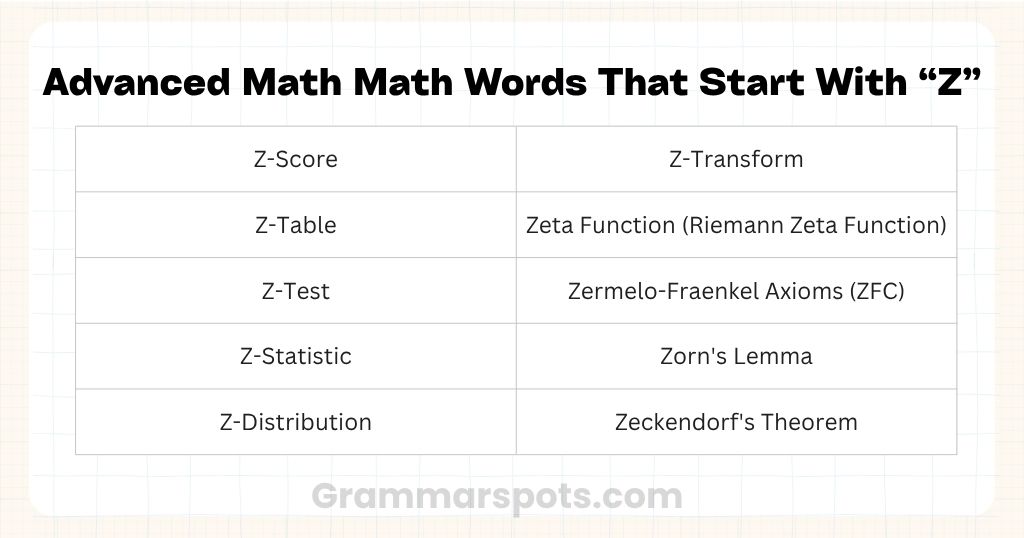
25. Z-Score
Meaning: A value that measures how many standard deviations a data point is from the mean.
Formula: Z = (X − μ) / σ
Example: Mean = 60, SD = 10, score = 80 → Z = (80−60)/10 = 2.0 (two standard deviations above average)
Why It Matters: Z-scores allow comparison across different datasets and scales. Essential in standardized testing, research, and quality control.
26. Z-Table (Standard Normal Table)
Meaning: A reference table showing the cumulative probability for each z-score in a standard normal distribution.
Example: A z-score of 1.96 corresponds to a cumulative probability of 0.975 meaning 97.5% of values fall below it.
Why It Matters: Students and researchers use z-tables to find probabilities without statistical software.
27. Z-Test
Meaning: A hypothesis test used to determine if a sample mean differs significantly from a known population mean.
Example: Testing whether the average salary at a company differs from the national average using sample data.
Why It Matters: Used in research, clinical trials, and quality assurance to validate or reject hypotheses about population means.
28. Z-Statistic
Meaning: The computed numerical result of a z-test, indicating how far the sample result is from the null hypothesis.
Formula: Z = (x̄ − μ) / (σ / √n)
Example: A z-statistic of 2.5 suggests the sample mean is 2.5 standard errors above the population mean.
Why It Matters: The z-statistic is compared against a critical value to decide whether to reject a null hypothesis.
29. Z-Distribution
Meaning: The standard normal distribution a bell-shaped curve with mean = 0 and standard deviation = 1.
Example: All z-scores follow the z-distribution, with 68% of values between −1 and +1, and 95% between −1.96 and +1.96.
Why It Matters: The z-distribution is the reference model for all normal probability calculations in statistics.
30. Z-Transform
Meaning: A mathematical tool that converts a discrete-time sequence into a complex frequency-domain function.
Formula: Z{x[n]} = Σ x[n] · z⁻ⁿ
Example: Engineers use the Z-transform to analyze digital filters in audio processing systems.
Why It Matters: The Z-transform is the discrete equivalent of the Laplace Transform fundamental in digital signal processing, communications, and control systems.
31. Zeta Function (Riemann Zeta Function)
Meaning: A function defined as the infinite series ζ(s) = 1 + 1/2ˢ + 1/3ˢ + 1/4ˢ + …
Example: ζ(2) = π²/6 ≈ 1.6449 (Euler’s famous result)
Why It Matters: The Riemann Hypothesis one of the greatest unsolved problems in mathematics asks about the zeros of the zeta function. Its solution would have profound implications for the distribution of prime numbers.
32. Zermelo-Fraenkel Axioms (ZFC)
Meaning: The standard axiomatic foundation of modern set theory. ZFC (with the Axiom of Choice) is the most widely accepted basis for mathematics.
Example: The Axiom of Extensionality states: two sets are equal if and only if they contain exactly the same elements.
Why It Matters: All of modern mathematics is built on ZFC. Proofs in algebra, analysis, and topology all operate within this framework.
33. Zorn’s Lemma
Meaning: In a partially ordered set where every chain has an upper bound, the set must contain at least one maximal element.
Example: Used to prove that every vector space has a basis even when the space is infinite-dimensional.
Why It Matters: Zorn’s Lemma is logically equivalent to the Axiom of Choice and is used in proofs across abstract algebra and topology.
34. Zeckendorf’s Theorem
Meaning: Every positive integer can be written uniquely as a sum of non-consecutive Fibonacci numbers.
Example: 100 = 89 + 8 + 3 (all Fibonacci, none consecutive in the sequence)
Why It Matters: This theorem connects number theory and the Fibonacci sequence. It has applications in coding theory and number representation in computer science.
35. Zero Divisor
Meaning: In a ring, a non-zero element a is a zero divisor if there exists a non-zero element b such that a × b = 0.
Example: In integers mod 6: 2 × 3 = 6 ≡ 0 (mod 6), so 2 and 3 are zero divisors.
Why It Matters: Understanding zero divisors helps define integral domains rings where multiplication behaves cleanly, similar to ordinary arithmetic.
36. Zonal Harmonic
Meaning: A spherical harmonic function that depends only on latitude (polar angle), not on longitude.
Example: Earth’s gravitational field is modeled using zonal harmonics because it varies by latitude but is approximately symmetric around the poles.
Why It Matters: Zonal harmonics appear in geophysics, quantum mechanics, and applied mathematics for modeling phenomena on spherical surfaces.
Related Post: 55+ Math Words That Start With X (With Meanings and Examples)
Geometry Terms Starting With Z
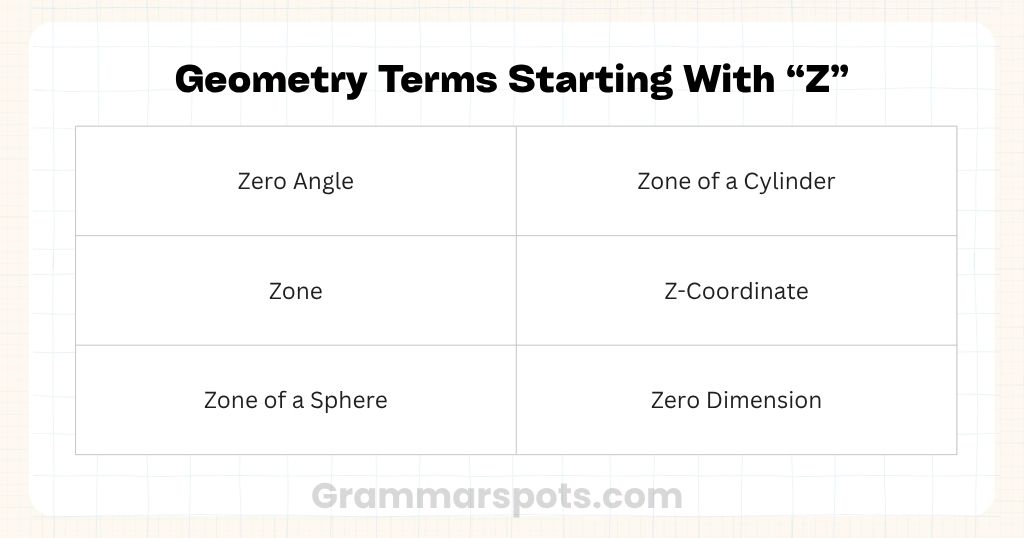
- Zero Angle — An angle of exactly 0°
- Zone — Curved surface region between two parallel planes on a solid
- Zone of a Sphere — Spherical surface between two parallel cross-sections; Area = 2πrh
- Zone of a Cylinder — Lateral surface of a cylinder between two parallel cuts
- Z-Axis — The depth axis in a 3D coordinate system
- Z-Coordinate — The third value in a 3D point (x, y, z)
- Zero Dimension — A space with no measurable extent; a point
Algebra Terms Starting With Z
- Zero Exponent — Any non-zero base to the power 0 equals 1
- Zero Slope — Slope equal to 0; a horizontal line
- Zero of a Function — Input that produces output of 0 (root / x-intercept)
- Zero Product Property — If ab = 0, then a = 0 or b = 0
- Zero Factor Property — If a single-factor product equals 0, that factor is 0
- Zero Polynomial — A polynomial where all coefficients equal 0
- Zero Denominator — Division by zero; always undefined
- Zero Matrix — A matrix where every entry is 0
Related Post: 40+ Math Words That Start With W (With Meanings and Examples)
Statistics Math Words That Start With Z
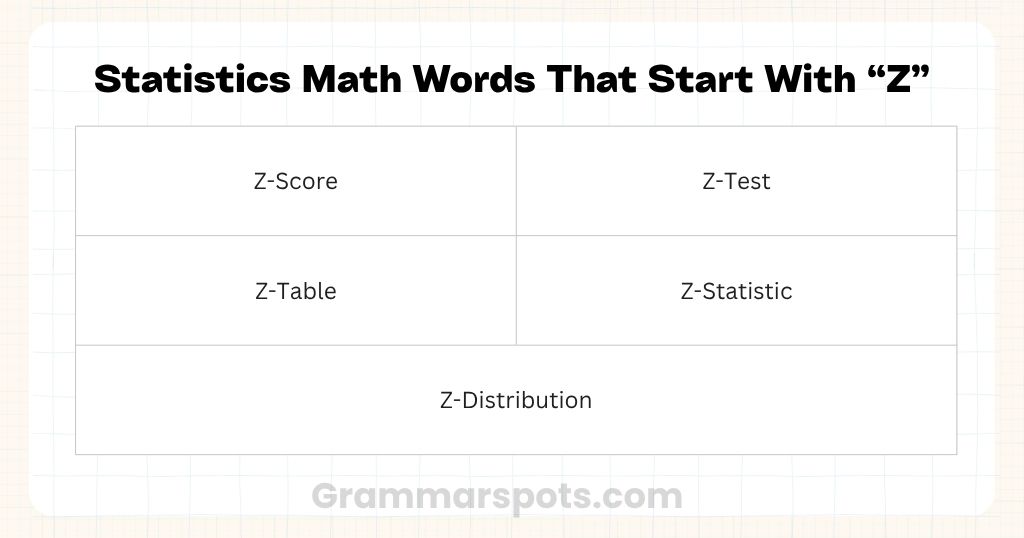
- Z-Score — Number of standard deviations from the mean
- Z-Table — Standard normal probability lookup table
- Z-Test — Hypothesis test comparing a sample mean to a population mean
- Z-Statistic — The computed result of a z-test
- Z-Distribution — Standard normal curve with mean 0 and SD 1
Linear Algebra Terms Starting With Z
- Zero Matrix — Additive identity in matrix algebra
- Zero Vector — Vector of magnitude 0; additive identity in vector spaces
- Zero Element — Additive identity in any algebraic structure
Number Theory / Advanced Terms Starting With Z
- Zeta Function — Infinite series with deep links to prime numbers
- Zeckendorf’s Theorem — Every integer = unique sum of non-consecutive Fibonacci numbers
- Zermelo-Fraenkel Axioms — Axiomatic foundation of set theory
- Zorn’s Lemma — Guarantees maximal elements in partially ordered sets
- Zero Divisor — Non-zero element whose product with another non-zero element is 0
- Z-Transform — Discrete-time signal tool in engineering and applied math
Real-World Applications
Arithmetic and everyday life:
- Zero appears in temperatures, bank balances, scores, and coordinates every single day
Algebra and school mathematics:
- Zero exponent, zero product property, and zero slope are tested across every algebra curriculum
Statistics and research:
- Z-scores, z-tests, and z-tables are the standard tools for interpreting survey data, clinical trials, and exam results
Engineering and signal processing:
- The Z-transform underpins digital audio processing, image compression, and communications technology
Physics and geoscience:
- Zonal harmonics model Earth’s gravitational field; z-axis and z-coordinates define 3D positions in simulations
Finance and economics:
- Zero-sum games model competitive markets, auctions, and strategic decisions in game theory
Computer science:
- Zeckendorf’s theorem and ZFC axioms support algorithm design and the logical foundations of computing
Tips for Remembering Math Words That Start With Z
- Group by subject Separate your Z terms into statistics, algebra, geometry, and advanced math. Studying clusters beats memorizing one long list.
- Start with zero Nearly every common Z term connects back to the concept of zero. Understand zero’s properties first and the rest falls into place.
- Write your own examples Create an original example sentence for each term. Your own examples stick better than copied definitions.
- Draw geometry terms Sketch a zero angle, a zone on a sphere, and a 3D z-axis rather than reading about them. Visual memory is stronger.
- Use flashcards for statistics Z-score, z-test, z-statistic, z-table, and z-distribution belong together. One flashcard cluster with formulas on one side and meanings on the other is highly effective.
- Connect to real life A z-score is simply your distance from the class average. Framing it that way makes the formula memorable.
Commonly Confused Z Math Terms
Zero Slope vs. Undefined Slope
| Zero Slope | Undefined Slope | |
| Line direction | Horizontal | Vertical |
| Example | y = 4 | x = 4 |
| Rise / Run | 0 ÷ any number = 0 | Any number ÷ 0 = undefined |
| Key rule | It exists just flat | It does not exist |
Zero of a Function vs. Undefined Value
- A zero is where f(x) = 0. The function is perfectly defined there it just outputs zero.
- An undefined value is where the function cannot be evaluated at all (division by zero, square root of a negative, etc.).
- These are opposite situations, not the same.
Zero Product Property vs. Zero Property of Multiplication
- Zero Property of Multiplication Any number × 0 = 0. (Forward direction: you already know one factor is zero.)
- Zero Product Property If a product = 0, then at least one factor must be zero. (Reverse direction: you discover which factor must be zero.)
- Same numbers, opposite thinking.
Z-Score vs. Z-Statistic
- A z-score describes a single data point’s position relative to a distribution.
- A z-statistic is the result of a formal hypothesis test comparing a sample to a population.
- Both use similar formulas, but z-score is descriptive and z-statistic is inferential.
Zero Factor Property vs. Zero Product Property
- Zero Factor Property Applied when one factor is a constant and a single variable expression equals zero.
- Zero Product Property Applied when a polynomial is fully factored into two or more binomial factors.
- In many textbooks they are treated as one rule, but some curricula distinguish them by context.
Zeta Function vs. Z-Transform
- Zeta Function A number-theory tool involving an infinite series of integers, related to prime numbers.
- Z-Transform An engineering tool for analyzing sequences of digital signals.
- The only connection: the letter Z.
FAQs About Math Words That Start With Z
Q1: What are the most important Z math terms for high school students?
- Zero
- Zero Exponent
- Zero Product Property
- Zero Slope
- Zero of a Function
- Zero Pair
- Z-Axis
- Z-Score
- Z-Table
These cover arithmetic, algebra, geometry, and introductory statistics the four pillars of high school math.
Q2: Why does any number to the power of zero equal 1?
When you divide equal powers for example, 5³ ÷ 5³ you subtract exponents: 5³⁻³ = 5⁰. But 5³ ÷ 5³ is clearly 1. Therefore 5⁰ = 1. This holds for any non-zero base.
Q3: Are “zero of a function” and “root” the same thing?
Yes. Both terms refer to the x-value where f(x) = 0. “Zero” emphasizes the output; “root” emphasizes the solution. Both are mathematically correct and widely used.
Q4: What does a z-score of 0 mean?
It means the data point equals the mean exactly. A z-score of 0 is neither above nor below average it sits at the exact center of the distribution.
Q5: Is zero positive or negative?
Neither. Zero is the only number that is neither positive nor negative. It sits exactly on the boundary between the two on the number line.
Q6: How is the area of a zone of a sphere calculated?
Using the formula A = 2πrh, where r is the radius of the sphere and h is the perpendicular distance between the two parallel planes. Notably, the area depends only on the height h not on where the zone is located on the sphere.
Q7: What makes the Riemann Zeta Function famous?
The Riemann Hypothesis still unsolved proposes that all non-trivial zeros of the zeta function have a real part equal to ½. Proving or disproving it would reshape our understanding of prime number distribution. It is one of the seven Millennium Prize Problems, each worth $1 million.
Q8: What is a zero-sum game?
A situation where one participant’s gain exactly equals another’s loss total outcome = zero. Chess is zero-sum (one wins, one loses). Trade deals are often not zero-sum because both sides can gain value.
Conclusion
Math words starting with Z span every level from the everyday concept of zero to the frontier of Zermelo-Fraenkel set theory. The most important terms for students are:
- Arithmetic: Zero, Zero Pair, Zero Property of Addition and Multiplication
- Algebra: Zero Exponent, Zero Slope, Zero Product Property, Zero of a Function
- Geometry: Zero Angle, Zone, Z-Axis, Z-Coordinate
- Statistics: Z-Score, Z-Table, Z-Test, Z-Distribution
Advanced learners will find the Zeta Function, Zorn’s Lemma, and the Z-Transform equally rewarding. Use the subject-specific tables to study by category, revisit the commonly confused terms before any test, and keep this guide as a reference throughout the course.

I’m Hazel, and I studied BSC English at GCUF. I focus on explaining word meanings in simple, clear language that anyone can understand. My goal is helping readers grasp everyday English, confusing terms, and slang used in real conversations and social media. I believe language learning works best when definitions connect to actual life situations. Through careful research and straightforward explanations, I make vocabulary accessible for students, learners, and anyone curious about how English really works in daily use.